- The paper introduces a multiscale generative framework that decomposes the Boltzmann measure, reducing critical slowing down.
- It employs conditional Gaussian mixtures and normalizing flows, achieving nearly constant autocorrelation times even at large lattice sizes.
- The approach integrates MLMC variance reduction via exact coarse-to-fine restrictions, outperforming HMC in efficiency and precision.
Scalable Multiscale Generative Sampling for Critical Lattice Field Theories
Introduction and Motivation
Sampling lattice field configurations near criticality is a central problem in computational physics, underlying the first-principles estimation of physical observables in quantum field theories and statistical mechanics. Traditional Markov Chain Monte Carlo (MCMC) methods such as Hybrid Monte Carlo (HMC) exhibit severe inefficiency in the critical regime. The autocorrelation time increases polynomially with the correlation length ξ (with dynamical exponent z∼2 for HMC in scalar theory), yielding sharply increased computational cost as system size and criticality are approached.
Recent progress in machine learning–driven generative modeling, especially via normalizing flows (NFs), has provided alternatives that bypass Markov chain correlations and enable efficient parallelized proposals. However, these models struggle to scale at criticality—their representational and computational demands scale poorly with increasing system size, particularly for single-scale architectures that must capture all correlations at once. This work introduces a multiscale generative framework explicitly designed to decompose and model the hierarchical structure of critical lattice systems, achieving improved scalability, efficiency, and statistical accuracy.
Multilevel Coarse-to-Fine Generative Modeling
Theoretical Framework
The method is inspired by renormalization-group (RG) concepts: long-wavelength (infrared) modes are encoded at successively coarser representations, while short-wavelength fluctuations are introduced via finer-scale refinements. The proposed generative decomposition expresses the Boltzmann measure as a product of conditional distributions across levels, forming a coarse-to-fine sampling hierarchy. At each upsampling step, the newly introduced degrees of freedom are generated conditionally on the previously sampled (coarser) field:
q(ϕ)=q0(ϕ(0))ℓ=1∏ℓmaxqℓ(ϕ(ℓ)∣ϕ(≤ℓ−1))
where ϕ(0) is the coarsest lattice, and each qℓ models the conditional distribution for new sites at scale ℓ given all previously sampled sites. This factorization enables strictly local or short-range conditional dependencies at each scale, bypassing the need for large receptive fields in the generative network even at large system sizes.
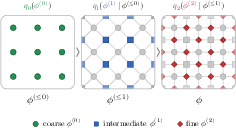
Figure 1: Kadanoff-inspired multilevel partition of a periodic lattice into coarse, intermediate, and fine sites, visually delineating the generative coarse-to-fine decomposition.
Generative Components
- Conditional Gaussian Mixture Models (GMMs): For each refinement, a local conditional GMM rapidly approximates the leading structure of the distribution for new variables given their coarse neighbors; this factorizes for efficiency and tractability.
- Conditional Normalizing Flows (CNFs): To overcome limitations of GMM expressivity, the samples are further refined by conditional CNFs parameterized by neural ODEs, enhancing their fit to the true conditional Boltzmann weights while preserving analytic tractability for importance sampling.
This hierarchical design ensures that coarse fields are preserved exactly during each refinement step, enabling an exact restriction from fine to coarse representations at no extra cost—a crucial property for downstream variance reduction via multilevel control variates.
Numerical Results: 2D ϕ4 Theory at Criticality
The methodology is evaluated on two-dimensional scalar ϕ4 theory at its critical coupling. The critical slowing down of HMC is severe in this regime, with autocorrelation time scaling as ∼L1.99 in system size. The study benchmarks the proposed scheme against baselines including HMC, dense-CNF, Hutch CNF, and the Super Resolving (SR-NF) hierarchical flow.
Numerical highlights:
- The integrated autocorrelation time for magnetization, τint(∣m∣), remains nearly flat (z∼20) up to z∼21 for the new multiscale method, while HMC rises to z∼22 and SR-NF surges at large z∼23.
- At z∼24, the method still beats HMC by a factor of z∼25 in autocorrelation time and z∼26 in wall-clock time to reach HMC statistical precision for physical observables.
- The effective sample size per generated configuration remains robust for the new model, even as rivals like SR-NF collapse at high z∼27 due to shallow or non-hierarchical generative policies.
Statistical Consistency
A critical test is whether the generative model, combined with importance weights, yields unbiased results for physical observables relative to HMC. The method's self-normalized IS estimates for the connected susceptibility z∼28 are in agreement with direct HMC values within z∼29–q(ϕ)=q0(ϕ(0))ℓ=1∏ℓmaxqℓ(ϕ(ℓ)∣ϕ(≤ℓ−1))0 across all q(ϕ)=q0(ϕ(0))ℓ=1∏ℓmaxqℓ(ϕ(ℓ)∣ϕ(≤ℓ−1))1, while baseline methods deteriorate at large lattice size.

Figure 2: Relative deviation of the connected susceptibility from HMC, q(ϕ)=q0(ϕ(0))ℓ=1∏ℓmaxqℓ(ϕ(ℓ)∣ϕ(≤ℓ−1))2, as a function of system size q(ϕ)=q0(ϕ(0))ℓ=1∏ℓmaxqℓ(ϕ(ℓ)∣ϕ(≤ℓ−1))3 for various models.
Multilevel Monte Carlo (MLMC) Variance Reduction
A further advantage of the hierarchical approach is its compatibility with the MLMC estimator framework. The exact restriction property means that multiple levels of the hierarchy can serve as correlated control variates, systematically reducing estimator variance at fixed computational budget. The variance reduction observed for observables such as magnetization corresponds, for example, to a q(ϕ)=q0(ϕ(0))ℓ=1∏ℓmaxqℓ(ϕ(ℓ)∣ϕ(≤ℓ−1))4 wall-time saving at q(ϕ)=q0(ϕ(0))ℓ=1∏ℓmaxqℓ(ϕ(ℓ)∣ϕ(≤ℓ−1))5 compared to plain importance sampling.
Implications, Limitations, and Future Directions
This work demonstrates that explicit multiscale decompositions, rooted in RG structure and implemented with hybrid probabilistic deep learning, provide a robust pathway for scalable, statistically sound generative modeling of critical lattice distributions. The significant reduction in autocorrelation and computational expense at large scales represents a tangible step forward for both statistical physics and quantum field theory computations.
Key implications:
- Computational efficiency: Applicable to system sizes and regimes where baseline generative models and HMC are ineffective, enabling precision studies of larger and more complex field theories.
- Generalizability: The modular design—separating coarse modeling, fine-graining, and flow-based refinement—suggests adaptability for gauge theories, higher dimensions, or even quantum many-body applications.
- Control variate integration: The exact restriction property is unmatched by full-lattice CNF upsampling (noisier or incurably expensive backtracking), further incentivizing the use of masked, locality-preserving designs in probabilistic modeling for critical phenomena.
Limitations and prospects:
- The decrease in importance-sampling efficiency at very large q(ϕ)=q0(ϕ(0))ℓ=1∏ℓmaxqℓ(ϕ(ℓ)∣ϕ(≤ℓ−1))6 signals the need for larger or better-trained fine-level models.
- Future work should address capacious modeling for group-valued variables (e.g., gauge field configurations), and further exploit the synergy between machine learning and classical multiscale statistical mechanics.
Conclusion
The multilevel generative sampling framework presented in "Scalable Generative Sampling and Multilevel Estimation for Lattice Field Theories Near Criticality" (2604.10209) resolves key bottlenecks for lattice simulation near criticality. By aligning generative modeling with renormalization principles and exploiting hierarchical conditional dependencies, the approach achieves orders-of-magnitude improvement in sampling efficiency and estimator precision. Its design principles are broadly relevant for domains requiring scalable, unbiased inference from high-dimensional, correlated distributions, and are poised for further impact as generative modeling techniques merge with multiscale physical theory.

