- The paper introduces a deep learning framework that fuses latent fatigue signatures to synthesize realistic, subject-specific motion degradations.
- It employs a modular approach combining temporal normalization, CVAE-FusionAE fusion, and non-linear fatigue intensity modeling to capture biomechanical nuances.
- Quantitative evaluations reveal high correlation (up to 0.90) and low error (MAE ≤ 2.16), underscoring its practical value in simulation and rehabilitation.
FatigueFusion: Latent Space Fusion for Fatigue-Driven Motion Synthesis
Introduction and Motivation
Fatigue impacts human motor function across physiological, biomechanical, and perceptual axes, yet its direct integration into generative motion frameworks is minimally explored. Current motion synthesis systems optimize for physical plausibility and variability but typically disregard how fatigue degrades movement over time and between individuals. "FatigueFusion: Latent Space Fusion for Fatigue-Driven Motion Synthesis" (2604.10199) proposes an end-to-end deep learning architecture capable of fusing fatigue signatures in latent space, enabling not only the emulation of fatigue accumulation but the transfer and fusion of subject-specific fatigue features between arbitrary movements. This marks a substantive departure from prior works, which predominantly model fatigue accumulation deterministically or via RL-driven policy adaptation, without explicit control over individualized fatigue semantics.
Architecture and Methodological Framework
FatigueFusion comprises three principal modules that operate synergistically along temporal, spatial, and intensity dimensions:
- Fatigue Tempo Module: Employs interpolation in temporal space to normalize stance-phase durations, capturing subject-specific irregularities introduced by fatigue, such as gait de-synchronization or stumbling.
- Fatigue Features Module: Leverages a conditional variational autoencoder (CVAE) paired with a Fusion Autoencoder (FusionAE). The CVAE learns mappings from joint torque time series to latent fatigue profiles conditioned on subject embeddings, enabling stochastic sampling of individualized fatigue characteristics. The FusionAE further improves latent space coverage, supporting vector arithmetic to blend or interpolate fatigue effects from multiple sources, overcoming limitations of scarce fatigue-annotated datasets.
- Fatigue Intensity Module: Utilizes an extended 3CC-λ PINN-based state machine to model progressive torque degradation via non-linear residual capacity decay, reflecting realistic, joint-specific fatigue accumulation informed by muscle compartment dynamics.
An overview of the modular pipeline and the explicit segregation between tempo, feature, and intensity is captured below.
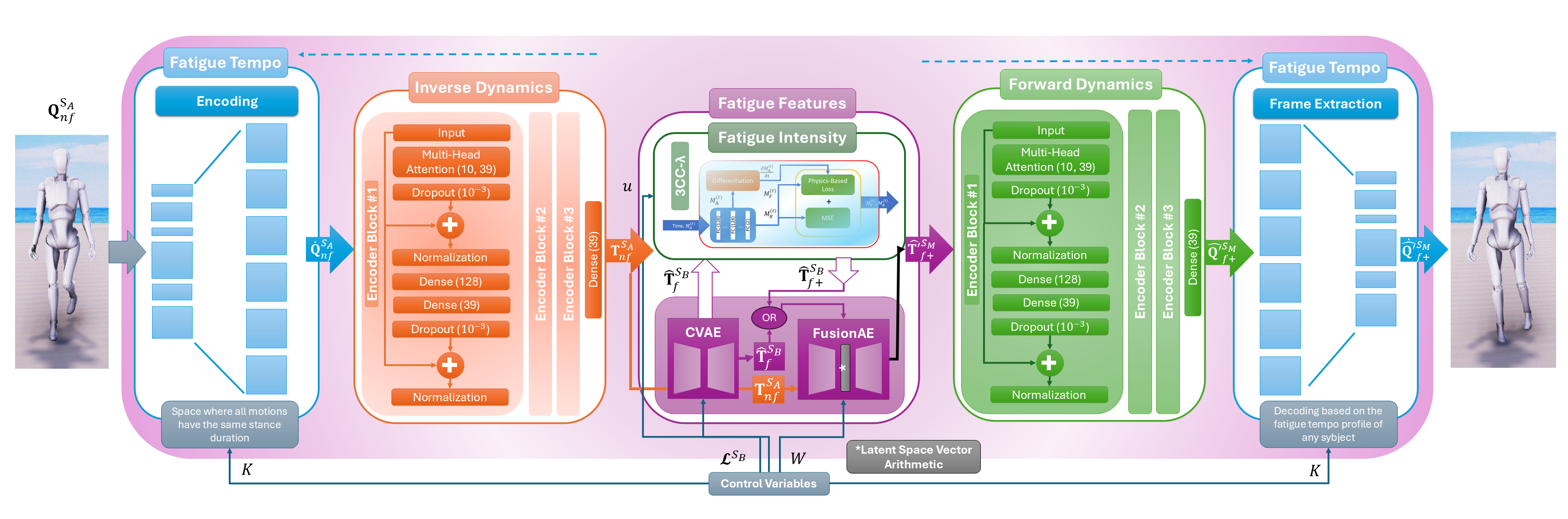
Figure 1: The FatigueFusion architecture, integrating Fatigue Tempo, Fatigue Features (CVAE + FusionAE), and Fatigue Intensity modules for compositional fatigue-driven motion synthesis.
The Fatigue Features module is depicted in detail, illustrating the encoding, fusion, and reconstruction of fatigue profiles.
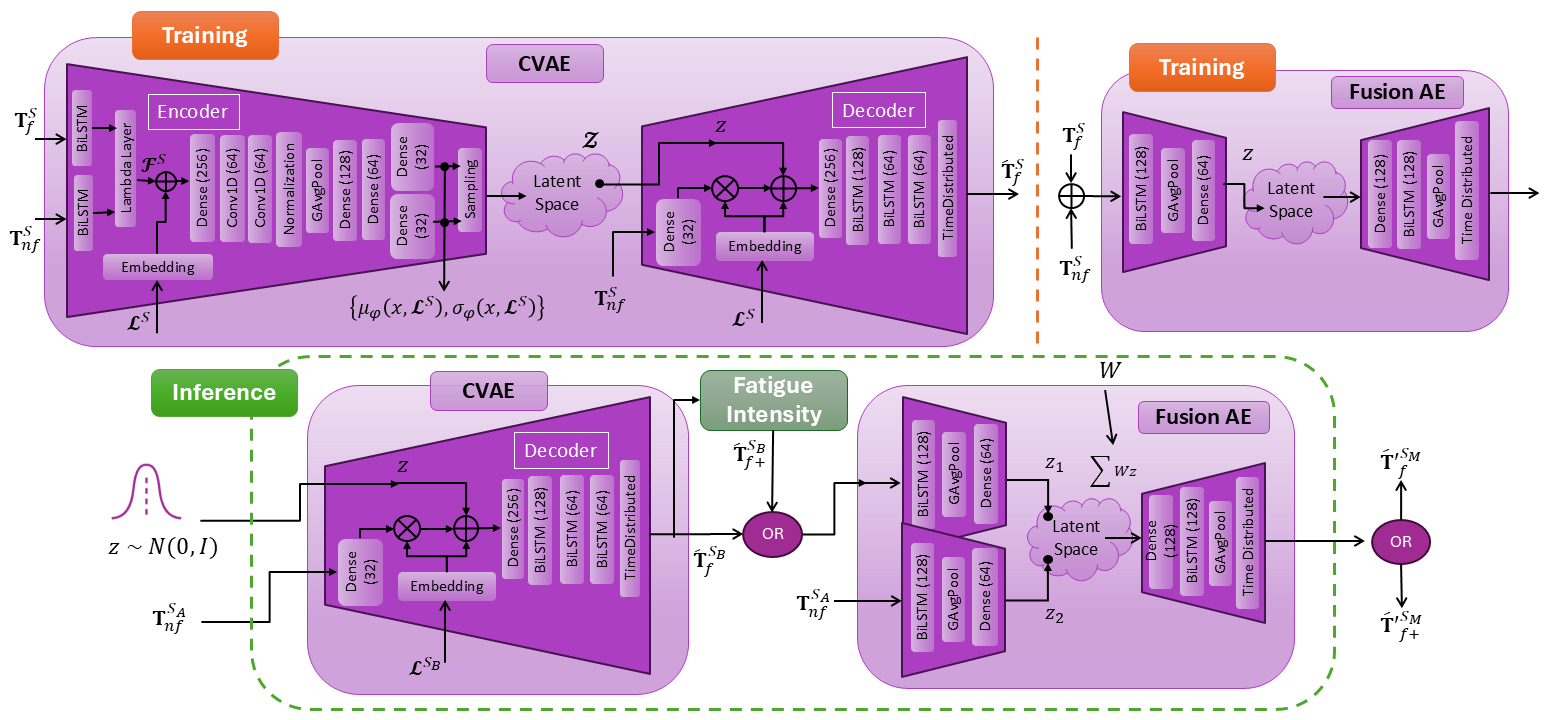
Figure 2: Structure of the Fatigue Features module, showing CVAE and FusionAE pathways for latent fatigue profile encoding and blending.
Experimental Setup and Evaluation
Training and evaluation are performed on the DUO-Gait dataset, containing synchronized multi-IMU gait data from healthy adults under fatigued and non-fatigued walking conditions. Preprocessing involves quaternion-to-Euler transformations for joint angle estimation, followed by OpenSim-based inverse and forward dynamics translation to torque space. Subject-annotated fatigue profiles are embedded using learned subject label embeddings.
The model supports three primary synthesis tasks:
- Fatigue Profile Transfer: Mapping fatigue features from one subject/movement to another's non-fatigued motion.
- Fatigue Profile Fusion: Blending multiple fatigue profiles in the latent space to create novel compound fatigue states.
- Progressive Fatigue Generation: Dynamic modulation of fatigue intensity to generate temporally evolving, increasingly fatigued motions.
Representative output sequences for profile transfer and fusion are exemplified below.
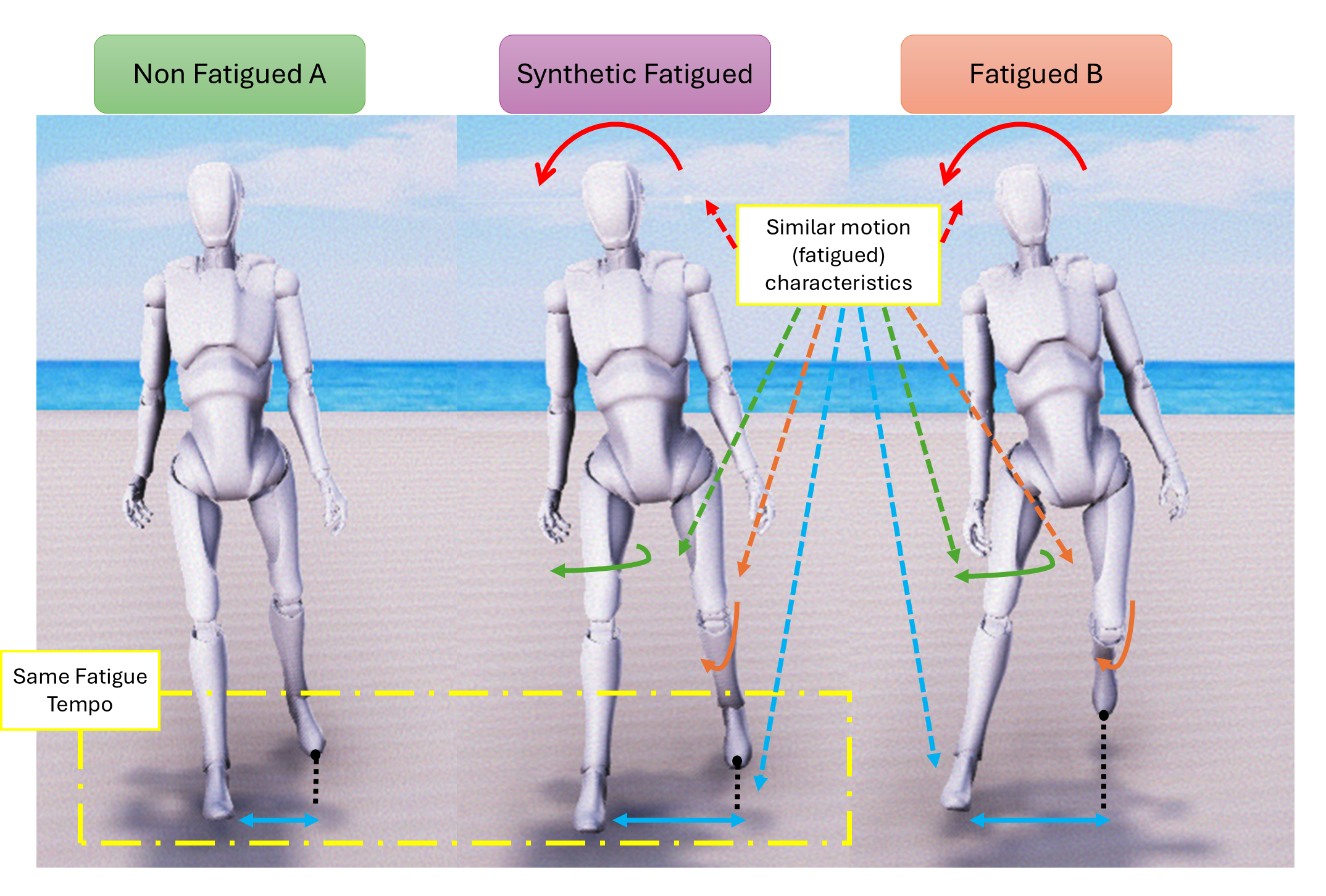
Figure 3: Fatigue profile transfer from subject B to subject A's gait, with clear annotation of lumbar, hip, knee, and step width effects in the synthesized fatigued motion.
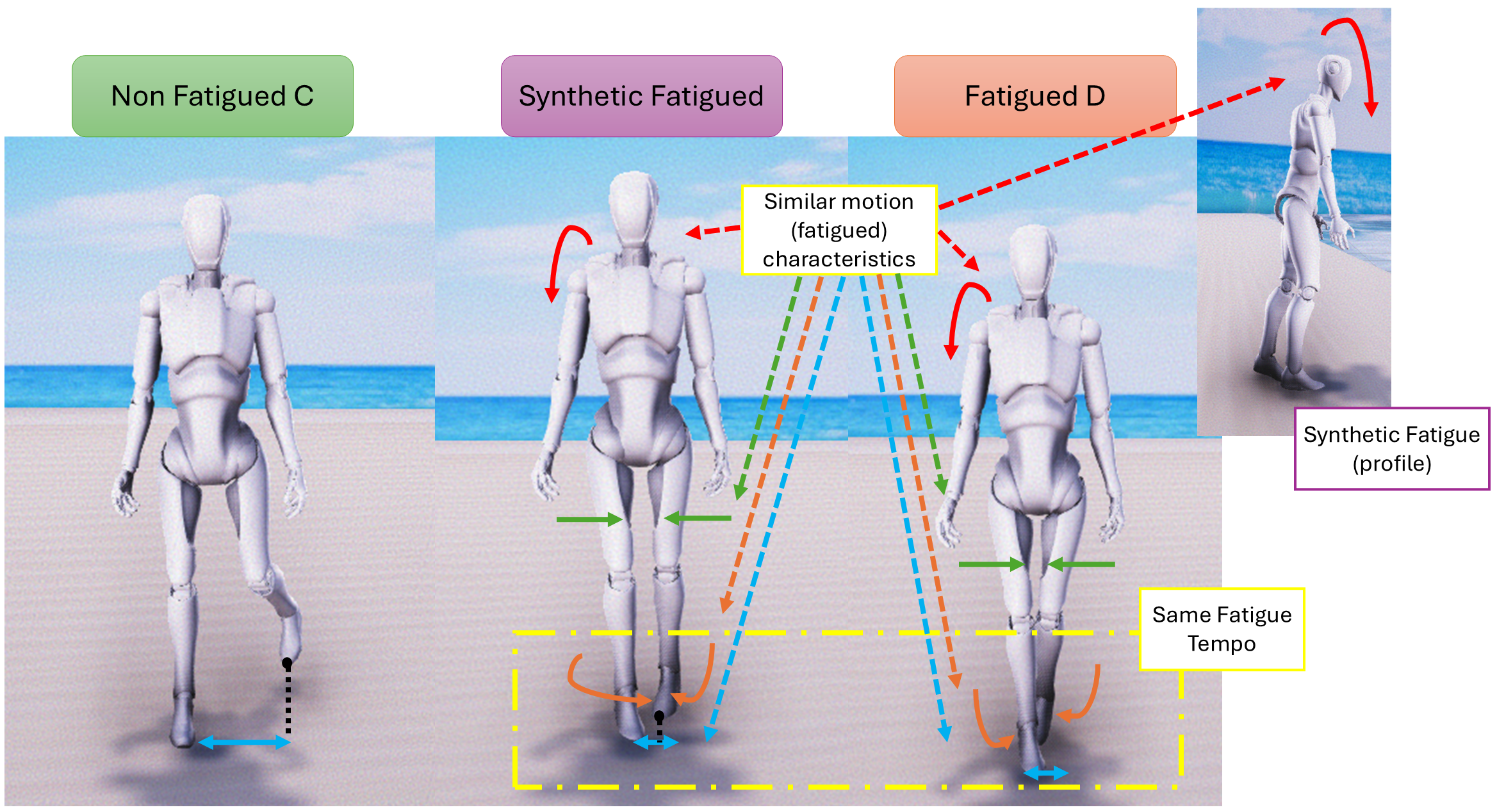
Figure 4: Fatigue feature fusion, demonstrating composite gait synthesis with lumbar, hip, subtalar, and step width markers transferring subject D's fatigue into subject C's baseline gait.
Quantitative and Qualitative Results
Strong alignment between generated and ground-truth fatigued motions is substantiated through Mean Absolute Error (MAE), Pearson R2, and Frechet Inception Distance (FID) metrics. Synthesized outputs with matching spatial/temporal fatigue profiles yield:
- MAE≤2.16 for joint angles,
- R2 correlation up to $0.90$ with ground-truth fatigue motions,
- FID as low as $0.045$, approximating the ground-truth distribution (see ablation results).
Comparative experiments versus prior deterministic PINN-based approaches (Fatigue-PINN) highlight the inability of purely physics-informed models to capture diverse, subject-specific fatigue characteristics, which FatigueFusion successfully reproduces.
Profile fusion and stochastic sampling via FusionAE convincingly increase diversity of generated fatigued motions without sacrificing realism. The model’s capacity for gradual fatigue modulation and latent interpolation enables generation of continuous fatigue trajectories, as visualized in the following temporal progression plots.
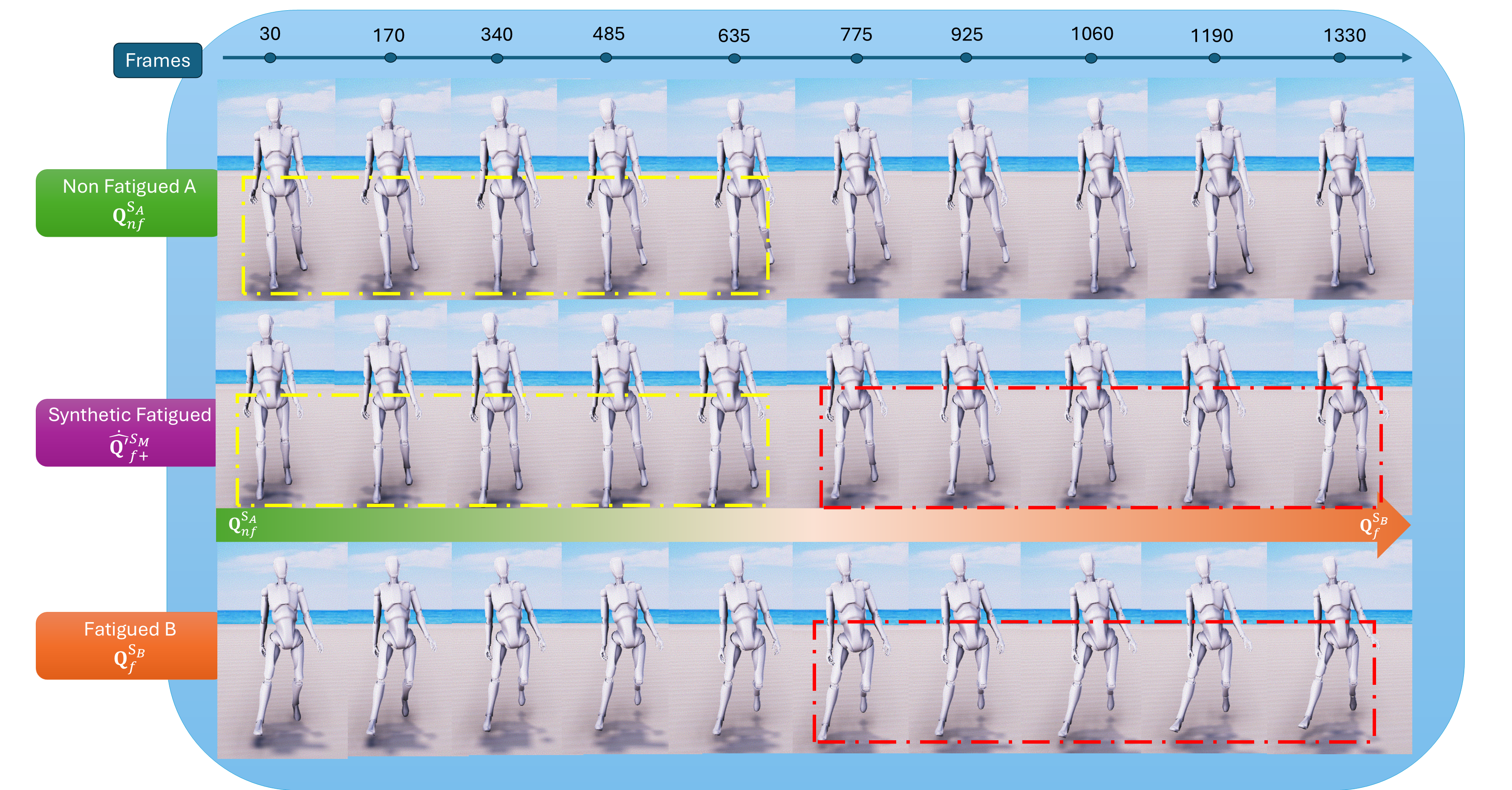
Figure 5: Temporal transition from non-fatigued to fatigued gait, showing the sequence's evolving resemblance to target subject B's fatigued motion.
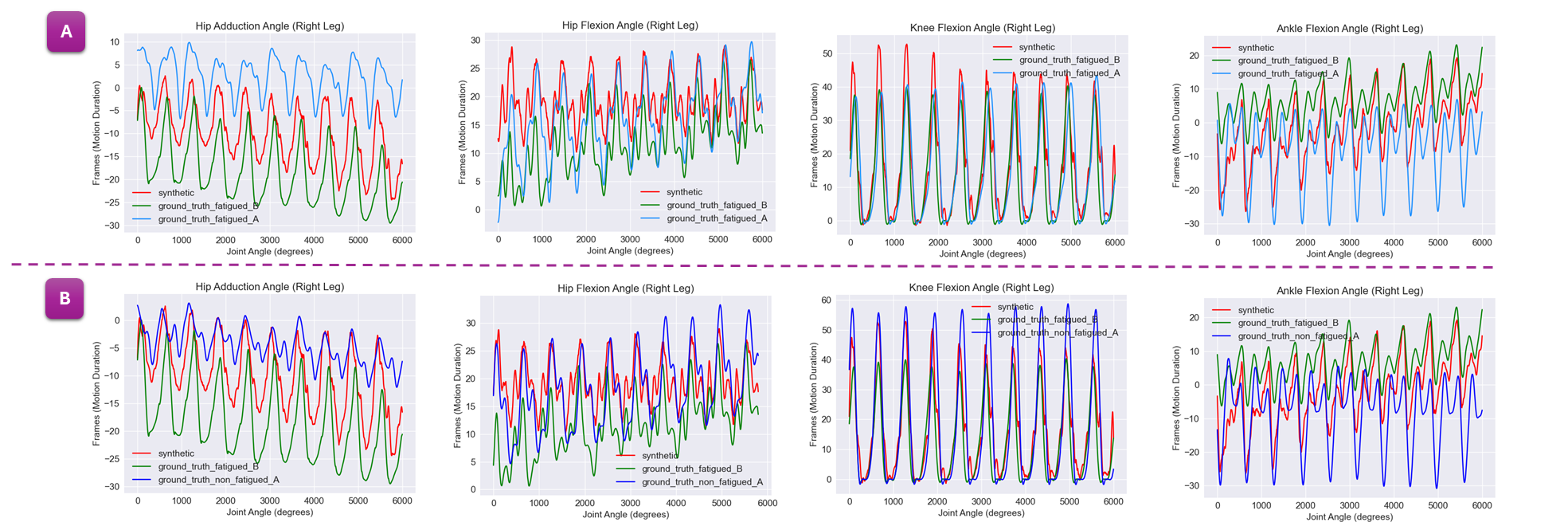
Figure 6: Quantitative angle trajectories—hip adduction, flexion, knee, and ankle—comparing synthesized, non-fatigued, and different subjects' fatigued ground truths.

Figure 7: Fatigue-PINN vs. FatigueFusion output. Only FatigueFusion captures authentic fatigued joint angle trajectories aligning with empirical recordings.
Ablation indicates that the inclusion of the FusionAE is critical for diversity and fidelity, and that the modular addition of Tempo and Intensity modules further closes the gap to human-level fatigue variations.
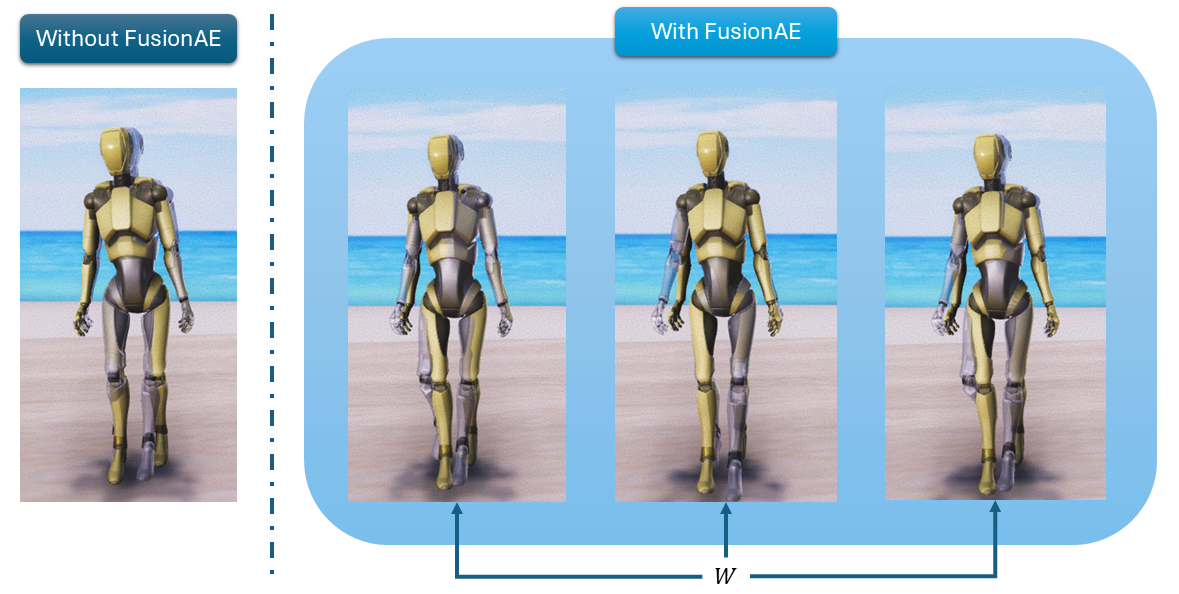
Figure 8: Qualitative impact of FusionAE inclusion; with FusionAE, synthetic motions express a broader range of fatigue-affected variability aligning more closely with ground truth.
Theoretical and Practical Implications
FatigueFusion’s ability to synthesize valid, biomechanically-plausible, and controllably variable fatigued motions directly addresses important deficits in both animation and biomedical simulation. Practically, it enables:
- Subject-specific ergonomic and rehabilitation scenario simulation,
- Realistic avatar sequencing for animation and human-robot interaction,
- Assessment and optimization of fatigue-mitigation strategies,
- Data augmentation for rare or hazardous fatigue states.
Theoretically, the work demonstrates the utility of latent space manipulation for generalized multi-attribute motion synthesis, the value of combining PINN-based biomechanical priors with deep generative latent models, and the potential of vector arithmetic in motion feature spaces for controllable motion editing.
Future Directions
Immediate research avenues include:
- Integrating more detailed physics models (e.g., musculoskeletal parameter estimation, muscle force tracking) throughout all modules,
- Expanding action classes beyond gait,
- Leveraging larger, more varied fatigue motion datasets to expand the continuity and coverage of the learned latent space,
- Exploring conditional text or multimodal control for fatigue-guided animation,
- Investigating robustness to sensor/measurement noise and domain adaptation for varied real-world deployment.
Conclusion
FatigueFusion introduces a modular, latent space-centric approach that enables transfer, fusion, and progression of subject-specific fatigue characteristics in generative motion synthesis. By holistically addressing temporal, spatial, and intensity axes of fatigue in a unified architecture, and leveraging adversarial, probabilistic, and physics-informed modeling paradigms, the framework expands the scope of controllable, realistic human motion generation well beyond prior imitators of generic fatigue accumulation (2604.10199). Its demonstrated capabilities invite significant advances in animation, simulation, and personalized biomechanical modeling.

