- The paper develops updated He I Stark profile models that incorporate advanced Doppler treatments, line dissolution, and normalization for improved spectral analysis.
- It quantitatively compares semi-analytical B25 profiles with simulation-based approaches, demonstrating better effective temperature and log g determinations, especially below 15,000 K.
- Findings indicate that despite these methodological advances, unresolved atmospheric physics still contribute to spectroscopic mass discrepancies in DB white dwarfs.
Theoretical Advances in He I Line Profile Modeling for DB White Dwarf Spectroscopy
Introduction
The accurate determination of atmospheric parameters in DB (helium-dominated atmosphere) white dwarfs (WDs) hinges critically on the quality of neutral helium (He I) line broadening theory. Stark broadening in particular governs spectral line profiles across most of the DB cooling sequence, and the interplay with Doppler and van der Waals broadening becomes essential at lower effective temperatures (Teff). The paper "A Theoretical Investigation of He I Line Profiles for the Spectroscopic Analysis of DB White Dwarfs" (2604.10195) presents an exhaustive revision of both the semi-analytical and simulation-based He I Stark profiles, focusing on their implications for precise spectroscopic measurements and resolving persistent discrepancies between photometric and spectroscopic mass distributions in the Sloan Digital Sky Survey (SDSS) DR17 DB sample.
Methodological Synopsis
Spectral analysis of DB WDs is traditionally executed via two pipelines: the spectroscopic method, fitting normalized observed spectra with synthetic profiles to infer Teff, logg, and H/He abundances; and the photometric method, using broadband magnitudes, flux calibrations, and trigonometric parallaxes. The paper applies both approaches to 738 SDSS DR17 DB WDs, ensuring high S/N and excluding magnetically peculiar objects. Model atmospheres are updated with revised line broadening physics—incorporating new Stark broadened profiles, line dissolution, and improved treatments of neutral collision broadening.
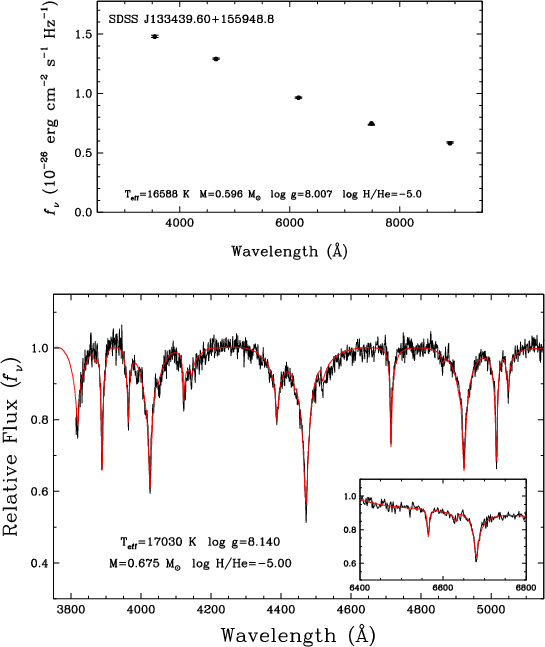
Figure 1: Best photometric (top panel) and spectroscopic (bottom panel) fits to a DB white dwarf in the sample, highlighting agreement and differences between methodologies.
Semi-Analytical vs. Simulation-Based Stark Profiles
Comprehensive Revision of Semi-Analytical Stark Profiles
Building on the canonical Beauchamp et al. (B97) Stark profiles, several critical corrections were incorporated:
- Modernization and precision improvements in atomic constants and numerics.
- Proper convolution with Doppler profiles, addressing previous undersampling artifacts especially significant for narrow and forbidden lines at low densities.
- Systematic application of normalization across the transition from impact to one-electron regimes, reducing high-density discrepancies.
- Explicit management of line dissolution effects, restricting the ionic microfield integration to its critical field.
These refinements—designated as the B25 profile set—are directly confronted with simulation-based Stark profiles developed using an advanced molecular dynamics/statistical simulation platform unifying electron and ion dynamics and employing a power-spectrum approach for explicit spectral synthesis.
Quantitative Assessment
Comparison of the revised B25 profiles against the B97 originals demonstrates negligible shifts in inferred Teff and logg, validating the robustness of previous mass distributions above Teff∼17,000 K Figure 2. However, significant improvements are observed at the cool end (Teff<15,000 K), where proper Doppler treatment mitigates artificial high-mass tails.
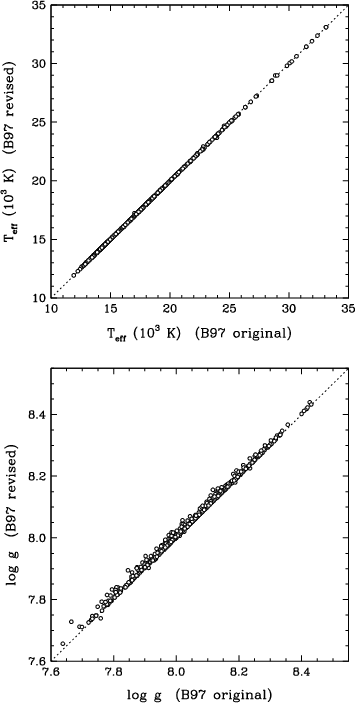
Figure 2: Effective temperature and logg comparison for DBs derived from original and revised Stark profile calculations.
Similarly, normalization of semi-analytical profiles reduces logg by ∼0.03 dex at high Teff0, a non-negligible adjustment considering current mass measurement precision Figure 3.
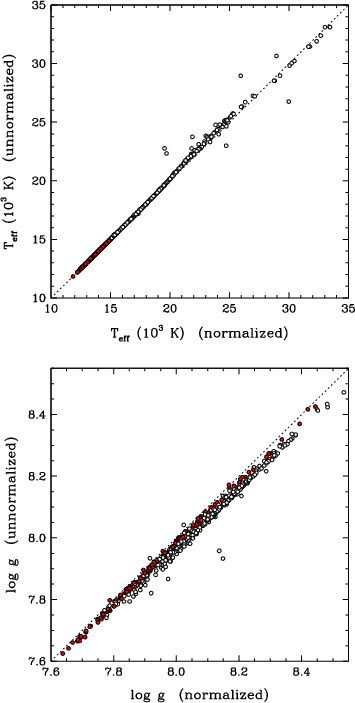
Figure 4: ΔTeff1 and ΔTeff2 between normalized and unnormalized semi-analytical He I line profiles.
Simulation-based approaches yield nearly identical Teff3 and marginally larger Teff4 (by 0.03 dex) relative to B25, underscoring both the convergence of improved theory and detecting sub-percent residual flux differences attributable chiefly to ion-dynamical corrections Figure 5. These differences cluster near the limits of current observational uncertainty.
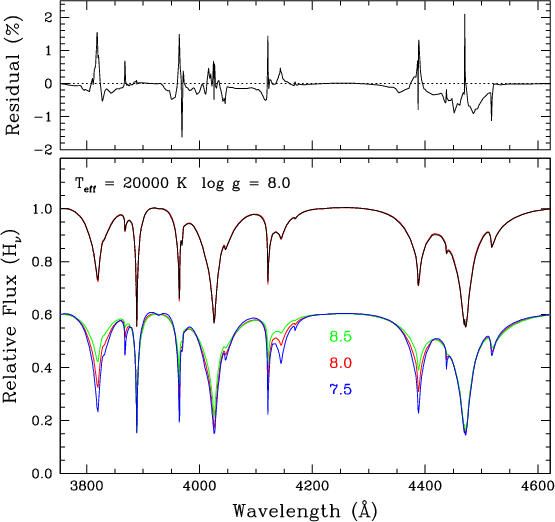
Figure 6: Synthetic spectra at Teff5 K for Teff6 using both B25 Stark profiles and simulation-based profiles, with residuals demonstrating their proximity.
Systematic Uncertainties and Mass Distribution Discrepancies
Decades of spectroscopic DB analyses report a systematic divergence between photometrically and spectroscopically-inferred masses, particularly in the Teff7 regime. Neither the B25 nor the simulation-based Stark profiles resolve this tension. Inclusion of updated treatments for Doppler broadening, line dissolution, and 3D hydrodynamical corrections (COTeff8BOLD models) reduce discrepancies at the cool end and high-mass tails for Teff9 K (Figures 3, 5, 12), but a high-mass inference persists at intermediate logg0.
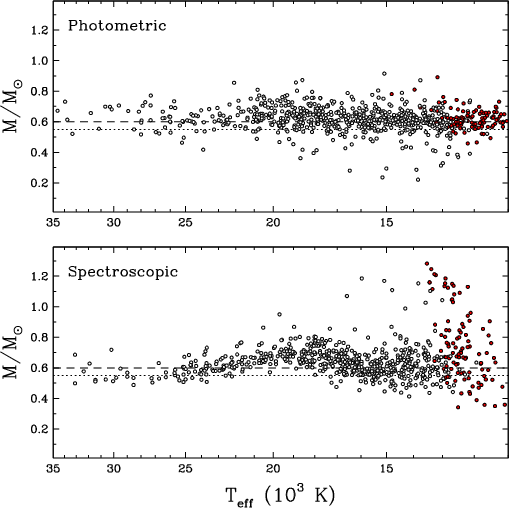
Figure 7: Photometric and spectroscopic mass distributions as a function of logg1 for the DB sample, exposing regions of systematic disagreement.
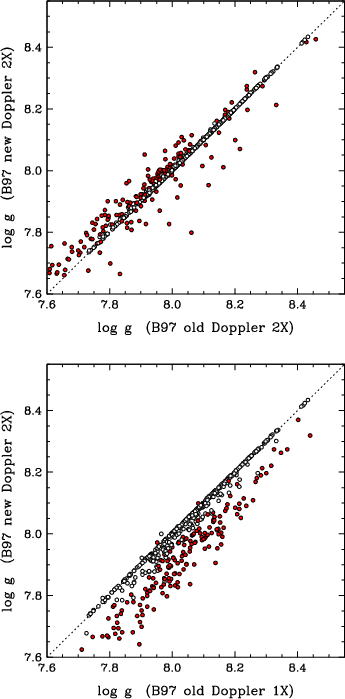
Figure 8: Surface gravity comparison between old and new Doppler/convolution treatments for semi-analytical He I profiles, showing largest impact at low logg2.
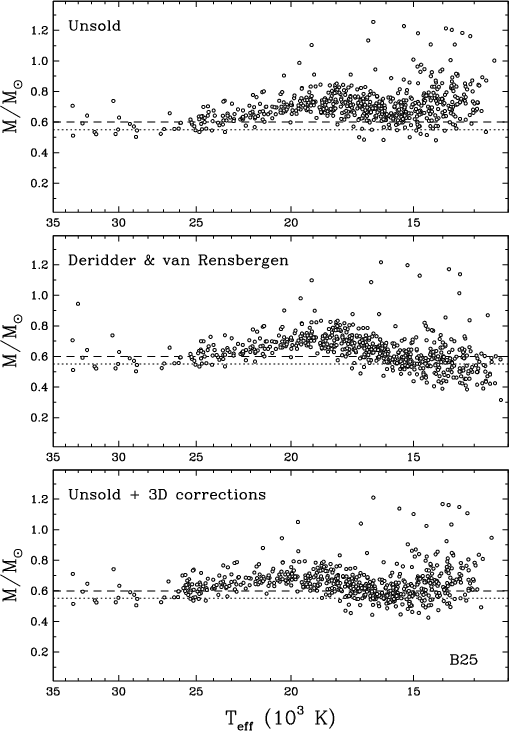
Figure 3: Effects of van der Waals broadening theory and 3D hydrodynamical corrections on spectroscopic mass distribution; 3D corrections bring photometric and spectroscopic determinations closer, but significant discrepancy remains in logg3 region.
Accounting for broadening by neutral perturbers (van der Waals, resonance) remains a limiting source of theoretical uncertainty at low logg4. Empirical choices between Unsöld and Deridder–van Rensbergen formalisms move the derived mass distributions but do not explain the mid-range discrepancy. The implementation of 3D corrections (Cukanovaite et al. 2021) narrows the gap only at logg5 K.
Theoretical and Practical Implications
The principal theoretical advance is the consolidation of improved microphysical line-broadening theory for He I, marrying the computational tractability of the semi-analytical B25 approach (with line dissolution) to the physically complete simulation-based models. The persistent spectroscopic mass logg6 excess in the mid-temperature DBs—immune to changes in line broadening theory, neutral broadening, and 3D corrections—strongly suggests missing physics either in the atmospheric structure modeling or opacity sources (e.g., UV resonance lines, pseudo-continuum opacity from dissolved levels).
For practitioners, the developed B25 Stark profiles, including proper Doppler and dissolution treatments, are recommended for standard DB analysis. The negligible residuals between B25 and simulation line profiles ensure physical fidelity without excessive computational penalties, provided dissolution is included for the high-logg7 regime.
These results confirm that further progress in DB white dwarf mass determinations likely requires improved radiative transfer calculations (opacity completeness), revised equation-of-state microphysics, or enhanced UV line blending treatments rather than further refinements in line-broadening alone.
Conclusion
Despite substantial microphysical and computational advancements—including revised B25 Stark profiles, frequency sampling, Doppler treatments, and the deployment of advanced simulation-based line profile calculations—the spectroscopic mass discrepancy in DB white dwarfs from SDSS persists, particularly for logg8. While the corrected theory eliminates some cool-end pathologies, these results point toward unmodeled/non-local physics or opacity deficits. The newly available Stark profile grids represent the most physically robust basis yet for DB parameter inferences, but resolving the systematic mass offset demands further exploration in fundamental WD atmosphere modeling and possibly new opacity source identification.
(2604.10195)