- The paper introduces a novel dataset with 15,999 annotated LoL messages, achieving high inter-annotator agreement (Fleiss’ κ = 0.62).
- The paper fine-tunes a BERT model (IGC-BERT) that attains an F1-score of 0.76, outperforming general-purpose toxicity detectors.
- The paper demonstrates practical applications through a browser extension for on-device toxicity detection and cross-domain validation on YouTube captions.
NLP-based Toxicity Detection in Video Games: Dataset, Model Development, and System Integration
Introduction and Motivation
This paper addresses the substantial gap in automated toxicity detection in the context of competitive online video games, with a primary focus on League of Legends (LoL). Despite extensive analysis on the prevalence and consequences of toxic and harassing behavior in such environments, there has been a notable deficiency in the availability of high-quality, fine-grained annotated datasets and corresponding NLP/ML-based detection mechanisms tailored to in-game chat. The authors systematically review over 1,000 prior works and find that less than 2% propose ML/NLP solutions, with existing datasets being either non-public, insufficiently granular, or non-specific to live gameplay. This systematic analysis forms the rationale for both constructing a new annotated dataset and developing specialized detection strategies.
Construction of a Granular and Domain-Specific Dataset
Building upon the widely-referenced Tribunal dataset—which contains over one million annotated LoL chat logs but only match-level toxicity labels—the authors introduce a novel message-level annotation via extensive expert involvement.
Eight veteran LoL players, varying in experience and competitive rank, participated in a rigorous multi-stage annotation procedure. Each message was labeled as toxic, non-toxic, or non-English using explicit domain-specific guidelines, accounting for the nuances of gaming-specific jargon, sarcasm, and abbreviated insults. Consensus thresholds were applied to reduce subjectivity and ensure high inter-annotator agreement (Fleiss’ κ = 0.62). The resulting dataset comprises 15,999 messages from approximately 100 matches, with 1,398 toxic and 13,773 non-toxic entries—a clear advancement over previously available resources in terms of both scale and granularity.

Figure 1: Overview of the creation process of the annotated League of Legends chat dataset, leveraging expert annotation for message-level toxicity labels.
Fine-Tuning LLMs for In-Game Toxicity Detection
Using the newly curated dataset, the authors fine-tune a BERT-based model (dubbed IGC-BERT) to adapt to the highly specialized linguistic characteristics of in-game abuse. The model's architecture features a binary classification head optimized for computational efficiency and inference latency, essential for real-time gaming scenarios.
Empirical evaluation demonstrates statistically significant improvements when fine-tuning on the proposed dataset. On a held-out test set, IGC-BERT achieves an F1-score of 0.76, outperforming state-of-the-art general-purpose models such as Toxic-BERT, Roberta-based classifiers, and even commercial API-driven LLMs like GPT-4o and Llama 3.2. Notably, competing general-purpose models exhibit poor precision on LoL data, misclassifying context-specific sarcasm and slang as toxic—a limitation absent from the fine-tuned IGC-BERT.
The performance of IGC-BERT is further amplified by aggregating consecutive messages by the same player or entire match-level logs. Grouped-message and match-level evaluations yield even higher precision and recall, suggesting strong utility for in-game player moderation and post-match analysis pipelines.
Broadening Practical Utility: From YouTube Captions to In-browser Detection
To illustrate the domain transferability and deployment potential of their approach, the authors systematically apply IGC-BERT in out-of-domain contexts and real-world deployment scenarios.
Applying the model to YouTube captions on LoL-related videos confirms its efficacy in identifying toxicity embedded in content designed for humor or critique. The model accurately flags toxic utterances in captions derived from automatic speech-to-text pipelines, validating the generalizability of the annotation principles.
Furthermore, the integration of IGC-BERT into a custom-developed web browser extension demonstrates on-device, privacy-preserving toxicity detection. The extension functions purely client-side, leveraging a quantized ONNX artifact for BERT inference in-browser to avoid data leakage and protect user privacy.
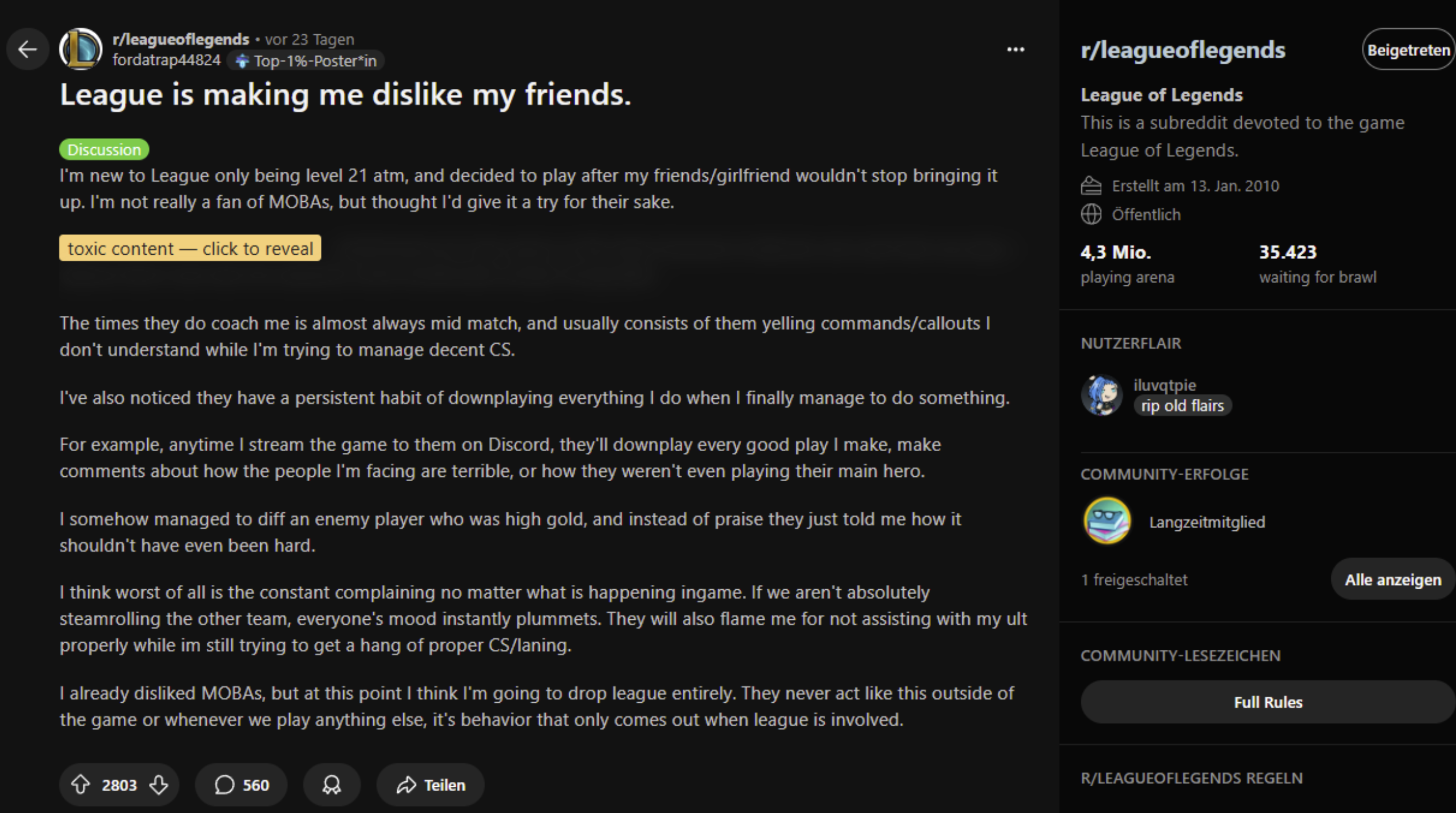
Figure 2: Exemplary application of the browser extension, highlighting flagged toxic content on a League of Legends subreddit.
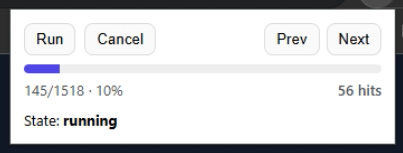
Figure 3: Graphical interface of the browser extension with user controls to pause or resume the live analysis of web page content.
Extensive profiling during prototype development shows that efficient quantization and batch-inference strategies are necessary for acceptable user experience. While technical constraints currently limit scalability to dynamic content-heavy web applications, the approach is viable for static or semi-static chat and forum interfaces.
Theoretical and Practical Implications
By open-sourcing both dataset and models, this work establishes a reproducible benchmark for toxic language detection in the online gaming domain, enabling both fine-tuned model research and practical application development. The demonstration that general-purpose toxicity classifiers significantly underperform compared to domain-specific models underscores the necessity for domain adaptation in NLP, especially for environments with evolving slang, sarcasm, and context-dependent abuse.
The cross-domain applicability to platforms like YouTube hints at a direction for future research in multi-modal and multi-source toxicity detection in gaming-related social media ecosystems. Importantly, the limitations of the model in other contexts—such as application to children's cartoons, where colloquialisms are misclassified as toxic in a gaming frame—demonstrate the risks of domain overfitting and emphasize the need for context-aware and multi-domain discriminator ensembles.
Conclusions
This paper provides a comprehensive foundation for the deployment of NLP-based toxicity detectors in online video games by introducing a large, granular, expert-annotated dataset and empirically demonstrating the necessity and performance gains of domain-specific fine-tuning. The open-source release of resources and demonstration of browser-based, on-device toxicity detection represents an important contribution toward practical, privacy-preserving moderation tools for both gaming platforms and their related online communities.
Future directions identified include expansion of annotated datasets to cover additional games and languages, the integration of chat-based toxicity signals with behavioral and gameplay-based features, and model optimization for broader deployment in live environments.

