- The paper demonstrates that active forces reorganize the internal fluctuation spectrum in a mode-specific, non-uniform manner.
- It uses explicit ABP and implicit OU noise models to derive analytical expressions and validate predictions with simulations.
- The study highlights the breakdown of effective temperature descriptions and proposes refined coarse-grained theories for active matter.
Spectral Organization of Active Fluctuations in Semiflexible Polymers
Introduction
The study "Spectral Signatures of Active Fluctuations in Semiflexible Polymers" (2604.10168) presents a comprehensive framework for understanding how active forces from a non-equilibrium bath reorganize the internal fluctuation spectrum of a semiflexible polymer. The work leverages both simulation and theory to delineate the detailed, mode-resolved impact of active environments, critically examining the limits of effective temperature descriptions and colored-noise modeling in active matter, particularly for extended objects such as semiflexible polymers.
Theoretical Framework and Modeling Approach
The authors model the polymer as a bead–spring chain with harmonic bonds and bending rigidity, simulated in two dimensions under two different active environments: an explicit bath of active Brownian particles (ABPs) and an implicit bath represented by temporally correlated (Ornstein–Uhlenbeck, OU) noise. The explicit ABP bath entails direct interactions between polymer beads and active particles, capturing force transduction through collisions and persistent pushes. In contrast, the implicit model introduces colored noise directly onto the beads, generating persistence without explicit particle mediation.
A key theoretical contribution is the derivation of an effective mode-space forcing kernel from the microscopic dynamics and interaction statistics of the ABP bath. This kernel is translated into a mode-resolved description of the polymer, with critical parameters encoding the temporal persistence, spatial correlation, and strength of active forcing. The analysis yields closed-form expressions for the steady-state variance of polymer normal modes, facilitating direct comparison with simulation data. The conceptual advance is the demonstration that activity acts as a spectral, filtration-like driving force, with its effects strongly dependent on both polymer relaxation timescales and the persistence characteristics of the bath.
Results: Mode-Resolved Spectral Reorganization
The principal finding is that active forcing reorganizes the fluctuation spectrum of the polymer in a highly non-uniform, mode-dependent fashion. At constant persistence time, increasing the magnitude of the active force fa predominantly amplifies the lowest (longest-wavelength) modes, while high-frequency modes remain weakly affected. Conversely, at fixed fa, increasing the persistence time τ shifts the enhancement to yet longer wavelength modes, leading to a pronounced spectral crossover. Thus, the polymer does not experience a uniform elevation in fluctuation amplitude; rather, it acts as a multiscale probe redistributing energy in a mode-dependent manner.
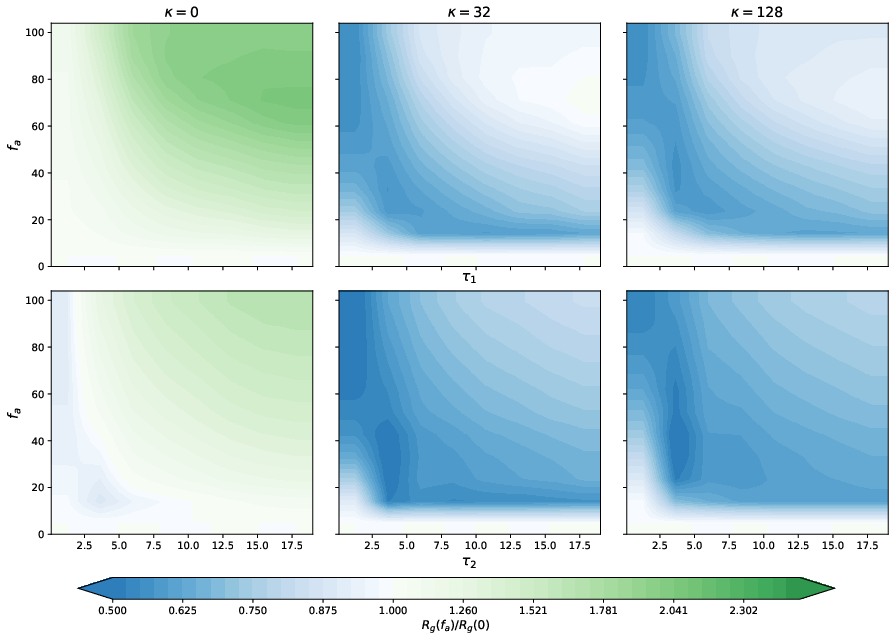
Figure 2: Heatmaps of normalized radius of gyration Rg(fa)/Rg(0) in the (fa, τ) plane for explicit (top) and implicit (bottom) active baths, across different bending rigidities. Both models display closely similar swelling phenomenology.
A salient aspect of these findings is the inadequacy of a scalar effective temperature to characterize the nonequilibrium response: the effective temperature becomes fundamentally mode-dependent, with each internal degree of freedom (mode) reporting a distinct value based on its relaxation timescale relative to the bath's persistence. This contradicts naive generalizations of equilibrium thermodynamics to active systems and underscores the breakdown of the fluctuation–dissipation theorem in active matter settings.
Comparison of Explicit and Implicit Active Baths
Both explicit (ABP) and implicit (OU-noise) models were investigated. The study reveals that while a colored-noise (OU) model can capture broad, qualitative trends—especially the large-scale swelling behavior of the polymer—there remain systematic differences due to microscopic details not encoded in the minimal noise description. Notably, excluded-volume interactions, crowding effects, and activity-induced extensibility—manifested as measurable bond stretching—are absent from the colored-noise model. Despite this, the primary spectral trends and the major features of conformational swelling are remarkably robust across both explicit and implicit models, justifying the use of colored-noise as a reduced, phenomenological description over wide parameter regimes.
Bond Stretching, Extensibility, and the Limitations of the Minimal Theory
A critical, numerically substantiated observation is that global size measures such as the radius of gyration Rg are consistently underestimated by the weak-bending fixed-contour theoretical framework, especially at high activity and/or persistence. This underestimation is directly linked to activity-induced bond stretching, which increases the effective contour length of the chain—an effect not captured by the current theory. The discrepancy becomes more prominent under conditions of strong driving, indicating the emergence of effective extensibility and mode cross-correlations.
The study introduces a finite-N reconstruction of Rg from the full simulation-generated bond mode covariance matrix, demonstrating that when all geometric and modal information is retained, the mode description remains exact at the discrete level. Thus, the limitations of the spectral colored-noise theory are traced to geometric approximations—not to deficiencies in the spectral analysis itself.
Implications and Future Directions
The results have significant implications for the theoretical understanding and experimental probing of active matter. First, they establish that semiflexible polymers are sensitive, spectroscopic probes for detecting and resolving the temporal and spatial structure of nonequilibrium forces, emphasizing the need for mode-resolved analysis in active systems. The findings challenge the adequacy of single-parameter thermodynamic descriptors, compelling a shift toward mode-dependent and multiscale observables in both modeling and experiment.
Practically, these insights motivate improved coarse-grained theories incorporating activity-induced extensibility, for example via contour-length renormalization based on the observed bond stretching. The revealed correspondence and limitations between explicit and implicit baths suggest a promising avenue for the development of reduced models that remain accurate across extended parameter spaces, yet call for careful consideration of the underlying microscopic interactions.
Experimentally, the study resonates with recent work on chromatin and cytoskeletal filament dynamics, where nonequilibrium fluctuations have spectrum-specific signatures linked to local structural and mechanical properties.
Conclusion
This work rigorously demonstrates that the response of semiflexible polymers to active baths is inherently spectral, with selective amplification dependent on both polymer relaxation modes and the persistence of active forcing. While colored-noise models suffice to capture core spectral trends, explicit simulations reveal additional conformational and extensibility phenomena under strong activity. The theoretical framework delineated here advances the field's understanding of active matter probing and filtration, offering concrete directions for both modeling refinements and experimental design.