A sign-blocking method for mitigating the fermion sign problem
Published 11 Apr 2026 in physics.comp-ph | (2604.10156v1)
Abstract: The fermion sign problem remains the primary obstacle in simulating the thermodynamic properties of various fermionic systems. In this work, we present a sign-blocking method to mitigate the numerical instability inherent in the sign problem. In the sign-blocking method, the Monte Carlo importance sampling remains identical to traditional methods; instead, the sign-blocking method is applied during the post-processing of signed samples. Given the significant progress in simulating the 2D Fermi-Hubbard model over the past decade, a wealth of energy benchmarks is available for comparison. Consequently, we use the 2D Fermi-Hubbard model as a benchmark to validate the sign-blocking method. Surprisingly, our results align exceptionally well with existing state-of-the-art benchmarks, even in regimes previously considered challenging. The physical mechanism of the sign-blocking method lies in uncovering the correlation between energy and sign factors through data blocking, thereby successfully inferring the fermionic system's energy. Our findings suggest that the sign-blocking method holds promise for complex quantum systems, particularly when combined with appropriate simulation techniques such as auxiliary-field formalisms that trace out the fermionic degrees of freedom.
The paper presents a novel sign-blocking method that partitions QMC samples to extract vital energy-sign correlations.
It leverages block-wise estimators and optimal block size calibration to achieve energy predictions comparable to exact results and advanced benchmarks.
The approach offers a computationally efficient post-processing framework that can be generalized to various fermionic systems and simulation protocols.
Sign-Blocking: A Post-Processing Framework for the Fermion Sign Problem
Introduction and Background
The fermion sign problem fundamentally limits the feasibility of quantum Monte Carlo (QMC) simulations in fermionic many-body systems, particularly at large system sizes or low temperatures. This challenge stems from the alternating signs of configuration weights imposed by exchange antisymmetry, rendering stochastic sampling estimators—based on reweighting—exponentially inefficient. Over the past decade, advances including constrained-path auxiliary-field QMC (CP-AFQMC), the fictitious particle method, and block/permutation-based approaches have alleviated the sign problem, albeit with constraints such as trial wavefunction bias or reliance on extrapolation from bosonic statistics.
This paper introduces the sign-blocking method as a fundamentally distinct post-processing approach, operated independently of the importance sampling measure. Instead of altering the Monte Carlo sampling protocol or extrapolating via auxiliary parameters, the sign-blocking method partitions signed samples into blocks and constructs block-wise estimators that more effectively capture correlations between observables (e.g., energy) and their sign factors. This exploits the residual statistical interference between positive and negative weight sectors, which is crucial for any physical observable in fermionic systems.
Methodology: Block-Wise Correlation Extraction
Traditional reweighting computes an observable ⟨O⟩ as the ratio of signed averages, but suffers from exponentially decaying signal-to-noise as the mean sign vanishes. In contrast, naive sign-ignoring yields biased estimators, missing interference information (Eq. 4). The sign-blocking method interpolates between these extremes:
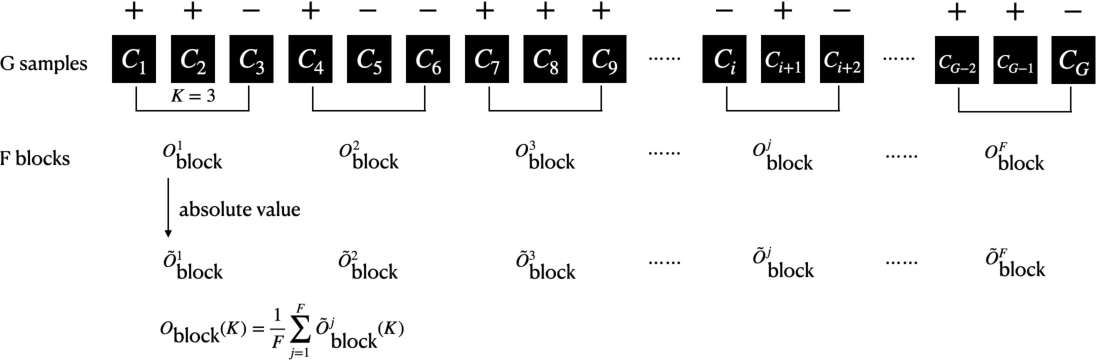
The Monte Carlo trajectory is partitioned into F blocks, each of size K.
Within block j, the standard reweighting average is computed, and its absolute value is taken:
O~blockj(K)=∑i∈jSi∑i∈jOiSi
The final estimator is the mean over blocks:
Oblock(K)=F1j=1∑FO~blockj(K)
For homogeneous systems, a scaling ansatz f(N)=αN+1 determines the optimal block size for correction, with α calibrated on small systems using exact diagonalization or high-accuracy benchmarks.
This procedure preserves computational efficiency by decoupling the sign-blocking post-processing from the underlying sampling mechanism.
Figure 1: Schematic of partitioning signed samples into blocks for construction of block-wise sign-sensitive estimators.
Benchmarking: 2D Fermi-Hubbard Model
The method is benchmarked on the paradigmatic 2D Fermi-Hubbard model, whose Hilbert space complexity and strongly correlated regimes exemplify the severity of the sign problem. Simulations are performed using determinant QMC (DQMC) within the AFQMC formalism.
Calibration and Small Lattice Results
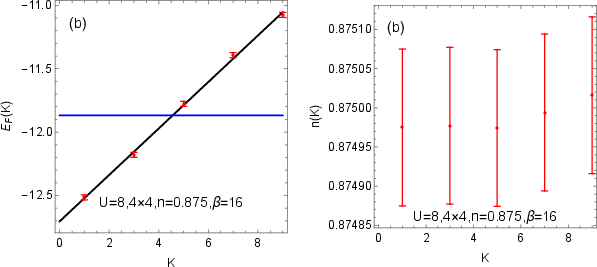
For U=8, n=0.875 (F0 hole-doped), and F1 on F2 lattices, block-wise energies are compared to exact diagonalization (ED):
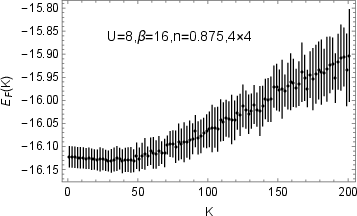
Figure 2: Block-size dependence of energy and site occupancy for F3, F4, F5; energies approach ED result as block size is optimized.
A linear relationship is observed between block size and energy; calibration yields F6 for F7 in this geometry.
Large-Scale Simulations and Comparison with State-of-the-Art
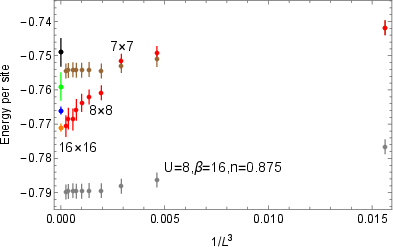
On larger F8 lattices, sign-blocking (red points) produces energy per site estimates in close agreement with high-precision DMET and CP-AFQMC benchmarks, outperforming sign-ignoring and fixed-node (FN) methods.
Figure 3: Energy per site versus system size for F9, K0; sign-blocking (red) captures correct thermodynamic and correlation-driven trends, matching or surpassing advanced benchmarks.
Importantly, the sign-blocking method captures nontrivial finite-size and correlation effects, such as a sharp energy drop at K1 associated with the onset of stripe correlations—without presupposing the nature of emergent order. This robustness extends across rectangular lattices as well.
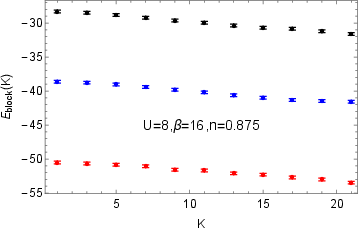
Figure 4: Block-size dependence of energy for increasing K2 lattices, showing consistent monotonic behavior.
(Figure 5), (Figure 6)
Figure 5: Rectangular (K3) lattice benchmarks, where sign-blocking aligns with DMRG and CP-AFQMC outcomes.
Figure 6: Rectangular (K4) lattice results; sign-blocking matches the plausible stripe period and outperforms certain VMC variants.
Applicability Across Monte Carlo Frameworks
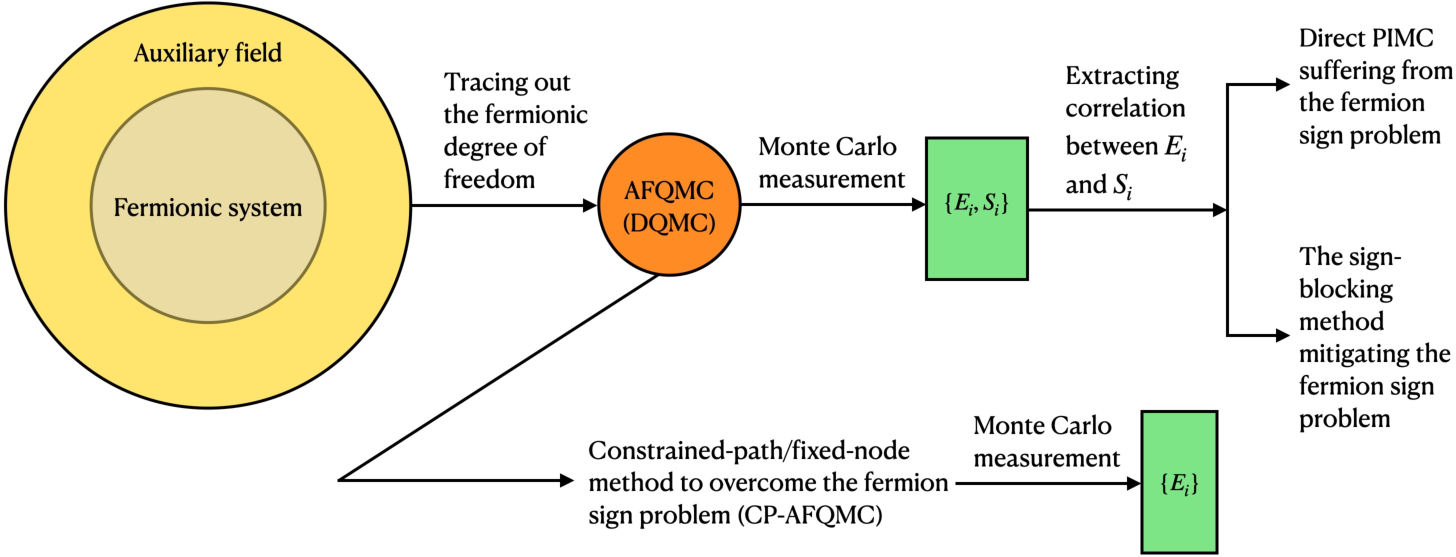
The efficacy of sign-blocking strongly depends on the sample generation protocol. While DQMC (AFQMC) sampling, which traces out fermionic degrees of freedom via auxiliary fields, allows robust extraction of energy-sign correlations, direct fermionic propagator PIMC methods (without HS transformation) are far less amenable:
Figure 7: Sign-blocking applied to PIMC/propagator samples for K5 lattice; absence of effective trend toward exact energy.
In such cases, increasing block size does not recover the correct physical result, and statistical errors dominate. Therefore, AFQMC-based engines should be preferred for sign-blocking applications to retain the critical sign-energy correlation.
Figure 8: Conceptual comparison of direct PIMC, CP-AFQMC, and the sign-blocking pipeline, highlighting where sign-problem suppression originates for each method.
The sign-blocking method can be conceptualized as a classical data post-processing technique that recovers quantum statistical correlations obscured in noisy observables. By partitioning and averaging over block compositions, the procedure reveals hidden structure between sample energies and their sign factors, analogous (in philosophy) to extracting K6 correlation from quantum noise in cold-atom measurements. The approach explicitly leverages interference information neglected when considering energy or sign marginal distributions in isolation.
Exposing energy-sign correlations is essential for accurate observable estimation in the presence of the sign problem. While the technique is demonstrated for the Fermi-Hubbard model, its concept generalizes to broader contexts—potentially including uniform electron gas, frustrated lattices, and 3He.
Implications and Future Directions
The sign-blocking method establishes a framework that is computationally efficient (sampling is unchanged; only post-processing is altered), parameterizable (with block size scaling calibrated on small benchmarks), and physically meaningful (energy-sign correlation is targeted). Numerical results demonstrate energy predictions commensurate with or superior to constrained-path, DMRG, and DMET methods, especially in regimes where established techniques diverge.
Practically, the method is most powerful when:
The system supports AFQMC/DQMC sampling;
Strong correlations and complex ordering challenge traditional benchmarks;
Sign-calibrated block scaling can be reliably extrapolated from small to large systems.
Theoretically, sign-blocking provides a new lens to study the quantum-to-classical interface in statistical mechanics, suggesting new families of post-processing estimators that exploit block structure, correlation, or even higher-order statistics.
It remains an open direction to devise optimized block partitioning strategies, test performance on canonical DQMC ensembles, and generalize beyond homogeneous models, as well as to study its synergy with recent progress in sign-problem-free simulation frameworks.
Conclusion
The sign-blocking method expands the toolkit for addressing the fermion sign problem by reframing it as a correlation extraction challenge, amenable to robust and scalable post-processing. Its formal simplicity, compatibility with existing QMC pipelines, and competitive accuracy in difficult regimes suggest broad utility for both fundamental studies and benchmarking of quantum many-fermion systems. Its future integration with advanced QMC and AI-driven statistical analysis may open new avenues for the study of strongly correlated electronic and quantum matter.