- The paper demonstrates that spectral analysis of QED scattering amplitudes can fully characterize entanglement evolution, leading to maximally entangled states in fermion-fermion interactions.
- It employs a quantum map formalism based on POVM measurements to iteratively calculate concurrence and reveal asymptotic behavior in scattering processes.
- By contrasting fermion-fermion with fermion-photon scattering, the study exposes how underlying QED symmetries govern the conservation and dynamics of entanglement.
Entanglement Dynamics in QED Scattering: Spectral Approaches and Asymptotic Structure
Introduction
The study "Characterizing entanglement dynamics in QED scattering processes" (2604.10136) presents a comprehensive analysis of helicity entanglement evolution in quantum electrodynamics (QED) scattering, leveraging a formalism based on quantum maps derived from POVM-based measurements. The work demonstrates that the spectral properties of matrices constructed from QED scattering amplitudes fully determine the resulting entanglement dynamics, with particular focus on fermion-only and fermion-photon processes. Iterative application of these quantum maps elucidates both the conservation and generation of maximally entangled asymptotic states, underpinning a robust connection between QED symmetries and quantum informational properties.
The approach models QED scattering at fixed outgoing momenta as a generalized measurement, effectively describing the process by a non-linear quantum map. The post-measurement state ρ~f is constructed as
ρ~f=Tr[MρinMT]MρinMT,
with the real matrix M composed from tree-level QED amplitudes Mij;kl, encoding helicity dynamics. Entanglement is quantified by concurrence, and iterated application of these maps defines a discrete time, non-linear dynamical process within the two-qubit (helicity) Hilbert space.
Fermion-Fermion Scattering: Conservation and Saturation of Maximal Entanglement
A central result is the exact conservation of maximal entanglement in all fermion-fermion elastic QED scattering events, regardless of the kinematical parameters. Analysis of the spectral properties of M reveals that its eigenvectors are maximally entangled Bell states or specific real linear combinations thereof. Iteration of the map for arbitrary (even separable or mixed) initial states leads to asymptotic convergence toward maximally entangled pure states, except in a measure-zero region of parameter space.
This dynamical evolution is illustrated in the context of Bhabha scattering (electron-positron), with the concurrence saturating over iterations for pure and mixed initial states:
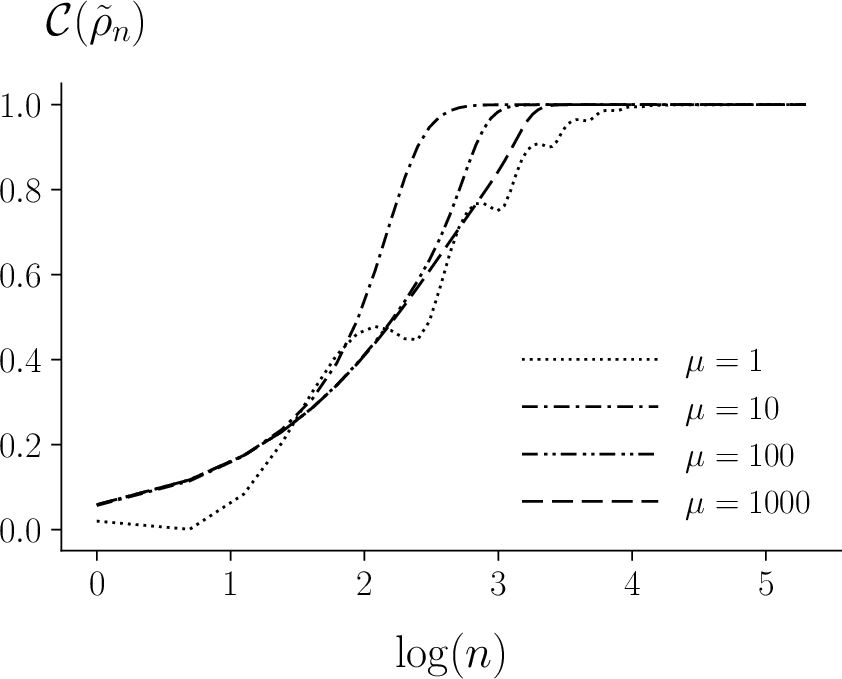
Figure 1: Concurrence C of the post-measurement state ρ~n versus iteration number n under Bhabha scattering for initial state ∣RL⟩ and θ=π/4.
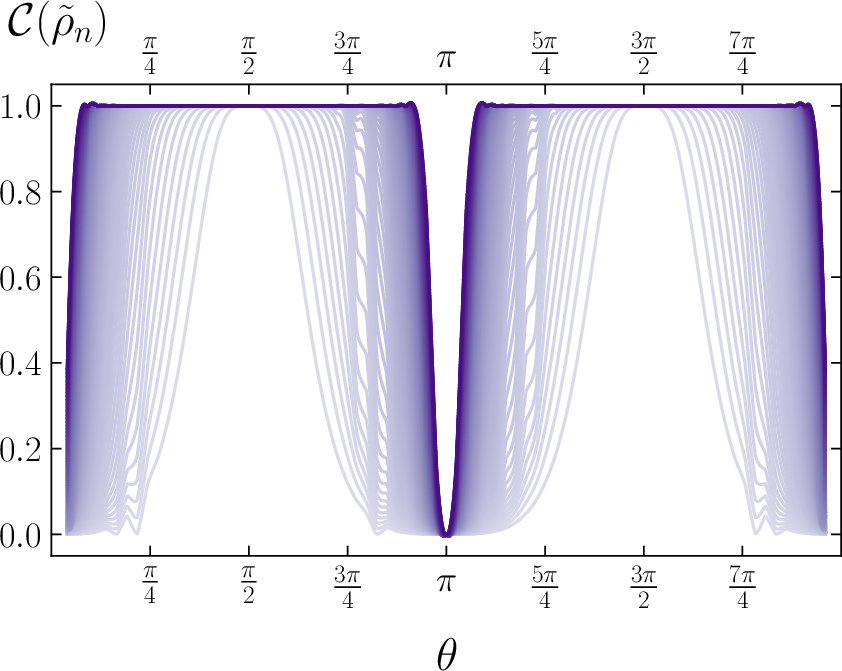
Figure 2: Concurrence ρ~f=Tr[MρinMT]MρinMT,0 for iterated Bhabha scattering with mixed initial states, demonstrating saturation at maximally entangled asymptotic states for ρ~f=Tr[MρinMT]MρinMT,1 and ρ~f=Tr[MρinMT]MρinMT,2.
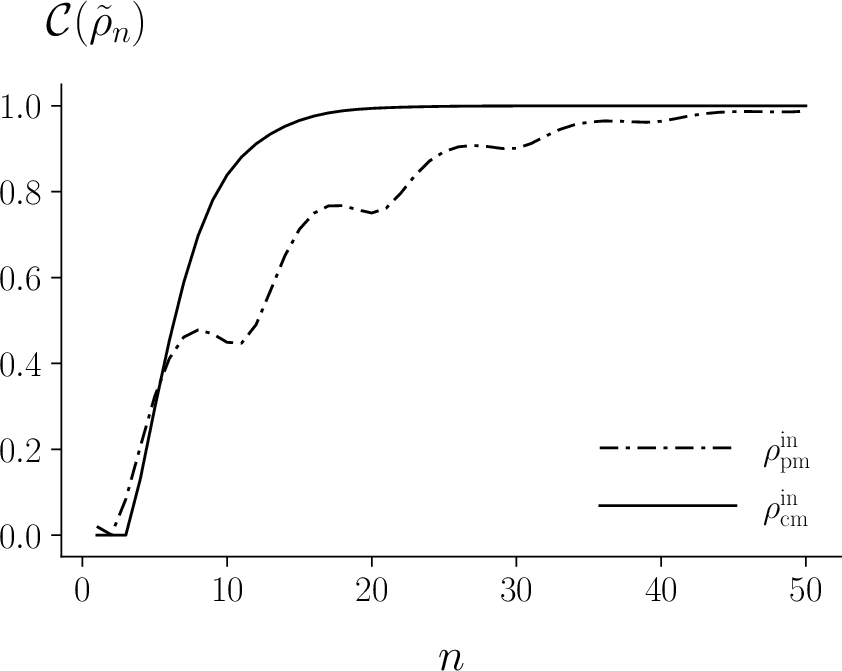
Figure 3: Concurrence ρ~f=Tr[MρinMT]MρinMT,3 over all scattering angles after ρ~f=Tr[MρinMT]MρinMT,4 iterations in Bhabha scattering (ρ~f=Tr[MρinMT]MρinMT,5), illustrating global entanglement saturation.
The explicit spectral analysis shows that, except for highly fine-tuned initial conditions or pathological regions of ρ~f=Tr[MρinMT]MρinMT,6, all states converge to a Bell state, with the rate controlled by the spectral gap of ρ~f=Tr[MρinMT]MρinMT,7, functioning analogously to a Lyapunov exponent.
Spectral Characterization and Invariant Structure
The work provides a detailed decomposition of the entanglement map’s spectral structure. For Bhabha and Møller scattering, the evolution operator ρ~f=Tr[MρinMT]MρinMT,8 is block-structured such that:
- Its eigenvectors span the maximally entangled subspace.
- The dominant eigenvalue (by modulus) dictates the asymptotic (fixed point) state.
- The rate of approach is exponential, governed by logarithmic differences of eigenvalue moduli.
In the ultrarelativistic limit, only the two-dimensional subspace containing ρ~f=Tr[MρinMT]MρinMT,9 and M0 (opposite helicity states) exhibits non-trivial dynamics, and in this regime, entanglement saturation is universal unless the initial state is orthogonal to the relevant eigenvector. In the non-relativistic regime, the entire Bell basis is accessible but with similar asymptotic structure, aside from an extremely narrow set of initial conditions.
Fermion-Photon Scattering: Distinct Dynamics and Partial Conservation
Contrasting with fermion-fermion cases, fermion-photon scattering (e.g., Compton process) is characterized by distinct spectral properties of the corresponding M1 matrices. Specifically, iterations of the quantum map do not converge to maximally entangled asymptotic states. Instead, in the ultrarelativistic domain, the initial state is preserved under map iteration, while in the non-relativistic regime, concurrence exhibits persistent oscillations rather than monotonic saturation:
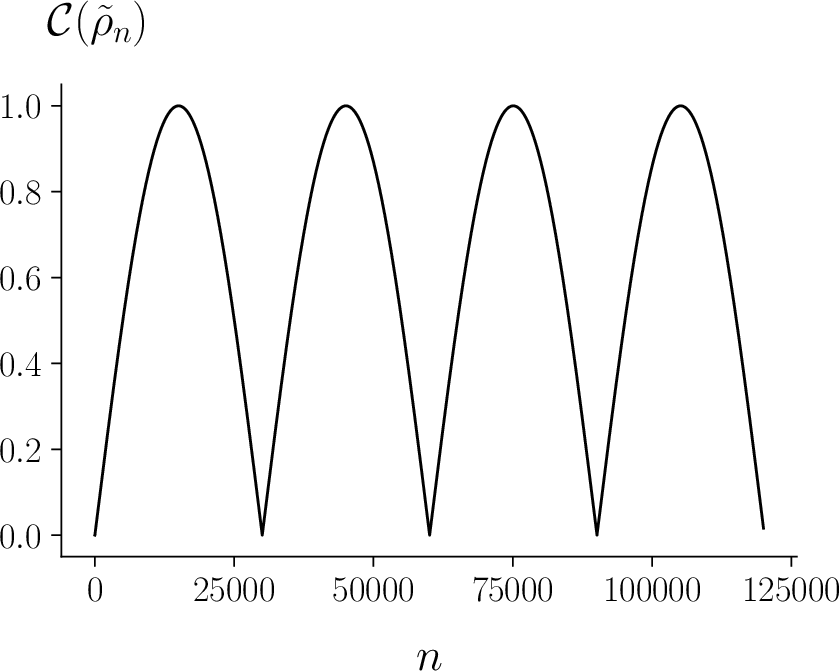
Figure 4: Concurrence M2 for the iterated Compton process with initial M3 state, illustrating non-convergent, oscillatory entanglement dynamics in the mixed fermion-photon scenario.
This qualitative difference arises due to altered symmetry properties in the QED interaction when photons (bosonic degrees of freedom) are involved, affecting the structural and spectral content of the generated quantum maps.
Implications and Theoretical Significance
The analysis robustly connects invariance under discrete symmetries—particularly parity (M4)—to the emergent conservation of maximal entanglement in fermionic QED scattering. Consequently, the described quantum map formalism can serve as a sensitive diagnostic for underlying symmetry content, and potential new physics, within quantum field processes. The formalism is well-positioned for extension to other gauge theories and possibly to the inclusion of higher-order (e.g., one-loop) corrections, as well as applications in the quantum tomography of scattering events.
On the quantum informational frontier, these results demonstrate that QED scattering can act as a generator of maximally entangled states from arbitrary (including mixed and separable) initial conditions, provided the system remains within the fermionic sector. This has prospective utility in high-energy scenarios where stable entanglement resources are needed.
Conclusion
By recasting QED scattering processes into a spectral analysis of quantum maps, this study achieves a complete analytic and numerical characterization of entanglement dynamics for a wide class of elastic processes. Maximal entanglement conservation is shown to be a generic outcome for fermion-fermion scattering, while fermion-photon processes entail richer, non-convergent dynamical regimes. The findings reinforce profound connections between symmetry, scattering, and entanglement, motivating future studies on the interplay of quantum information and quantum field theory—both for deeper theoretical insights and potential experimental applications.

