- The paper shows that DRIS-induced active channel aging converges to an i.i.d. complex Gaussian distribution, with variance scaling by DRIS size and cascaded path loss.
- It formulates an ISAC waveform co-design as a Pareto optimization to balance multi-user interference suppression for communications and covariance shaping for sensing.
- The analysis reveals anisotropic sensing impacts: AoD estimation degrades while AoA accuracy improves, exposing vulnerabilities in future ISAC systems.
Bistatic ISAC under Disco RIS: Analytical Characterization of Disruption and Sensing Anisotropy
System and Threat Model
The paper introduces a bistatic integrated sensing and communication (ISAC) architecture incorporating a disco reconfigurable intelligent surface (DRIS), which operates as a randomized, rapidly time-varying reflector, akin to a "disco ball." This DRIS is configured independently of the ISAC system and rotates its phase and amplitude coefficients stochastically, inducing unpredictable channel variation well within the conventional channel coherence time.
The system comprises a multi-antenna ISAC base station (BS), several single-antenna communication users, a sensing receiver with its own array, and a DRIS with a massive number of discrete-state reflecting elements. The bistatic radar scenario enables simultaneous communications with end users and radar-based sensing (target detection), prototypical of 6G ISAC visions.
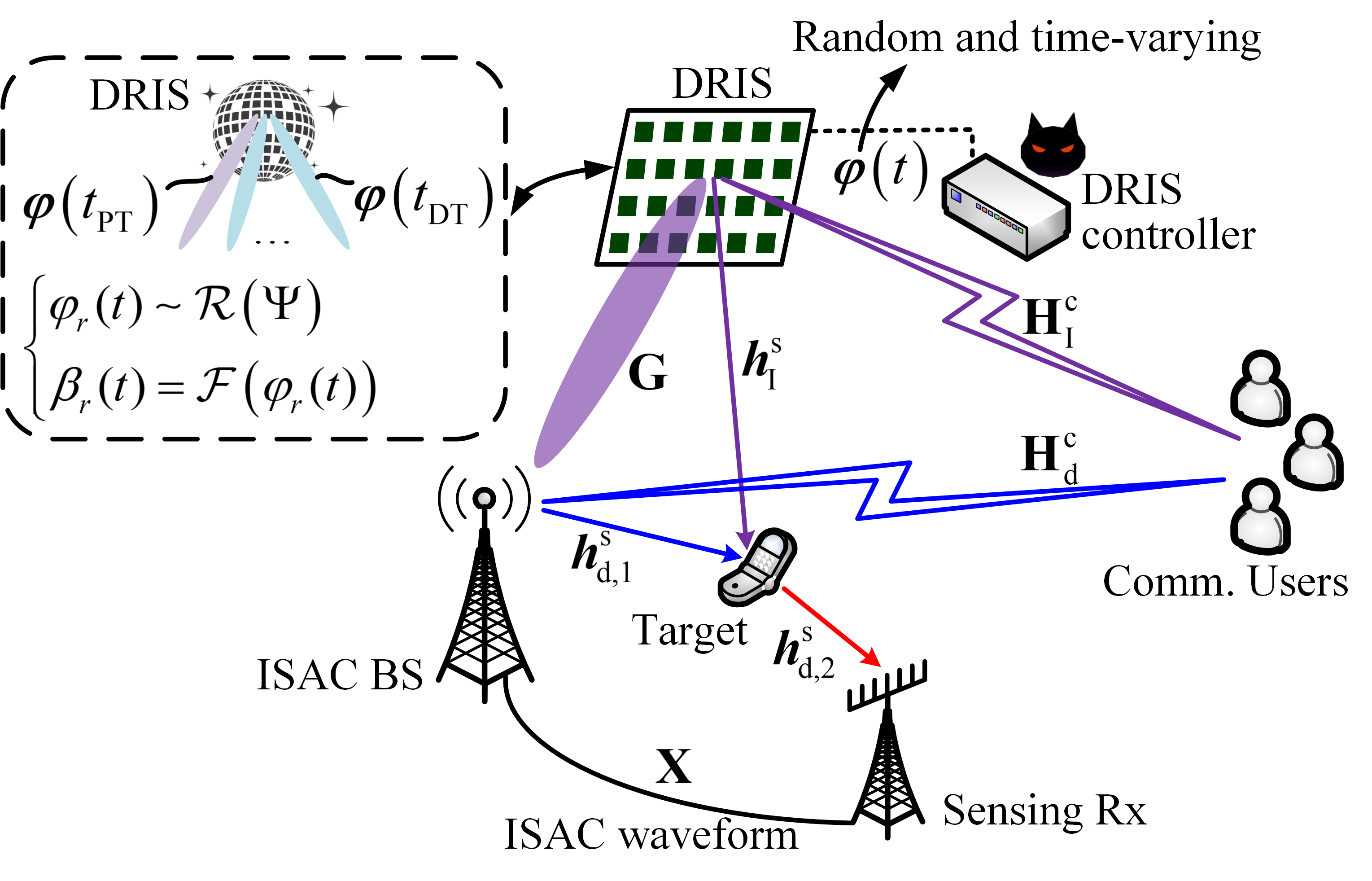
Figure 1: A bistatic ISAC topology illustrating the location of the DRIS and its randomized element-wise reflections, introducing active channel aging (ACA) effects.
DRIS-Induced Channel Aging: Statistical Characterization
Classical ISAC and RIS-assisted systems rely on quasi-static channel models, with CSI acquisition in a pilot phase, exploited throughout subsequent data transmission. The DRIS, with its randomized, rapid phase variation, nullifies this assumption, creating actively aged channels even during a single coherence interval. The paper models both the direct and DRIS-reflected links, leveraging near-field and far-field models appropriately, and explicitly formulates the statistical characteristics of the DRIS-induced active channel aging (ACA) effect.
Key analytical results include:
- The ACA channels—differences in channel states seen in pilot versus data phases—are shown to converge to i.i.d. complex Gaussian distributions as the number of DRIS elements increases, with variance scaling proportionally to both DRIS size and the cascaded path loss.
- DRIS-induced ACA interference is fundamentally different from that due to passive RIS or propagation-induced channel aging—it cannot be mitigated by increased transmit power and is uncorrelated with system choices.
The paper poses ISAC waveform optimization as a Pareto problem, balancing multi-user interference suppression for communications and covariance shaping for radar sensing. The formulation introduces a tunable trade-off factor, κ, dictating performance focus.
- The optimal waveform for sensing strictly enforces a transmit covariance constraint matching that of a desired radar codebook, at the expense of strong multi-user interference.
- The ISAC Pareto design interpolates between communications and sensing optima, and achieves this via an SDP that is shown to admit globally optimal, rank-one solutions.
SINR Degradation: Analytical Lower Bound
The main communication metric is the sum-rate over all users, with SINR at each user analyzed in closed-form. Under DRIS-induced ACA, the expected SINR lower bound at user k is
γk≥E[∣MU interferers∣2]+P0Lcas,kNDμ+σ2E[∣sk,l∣2]
where the ACA penalty term P0Lcas,kNDμ reflects both transmit power and DRIS element count, demonstrating that increased system power exacerbates, rather than mitigates, DRIS impact.
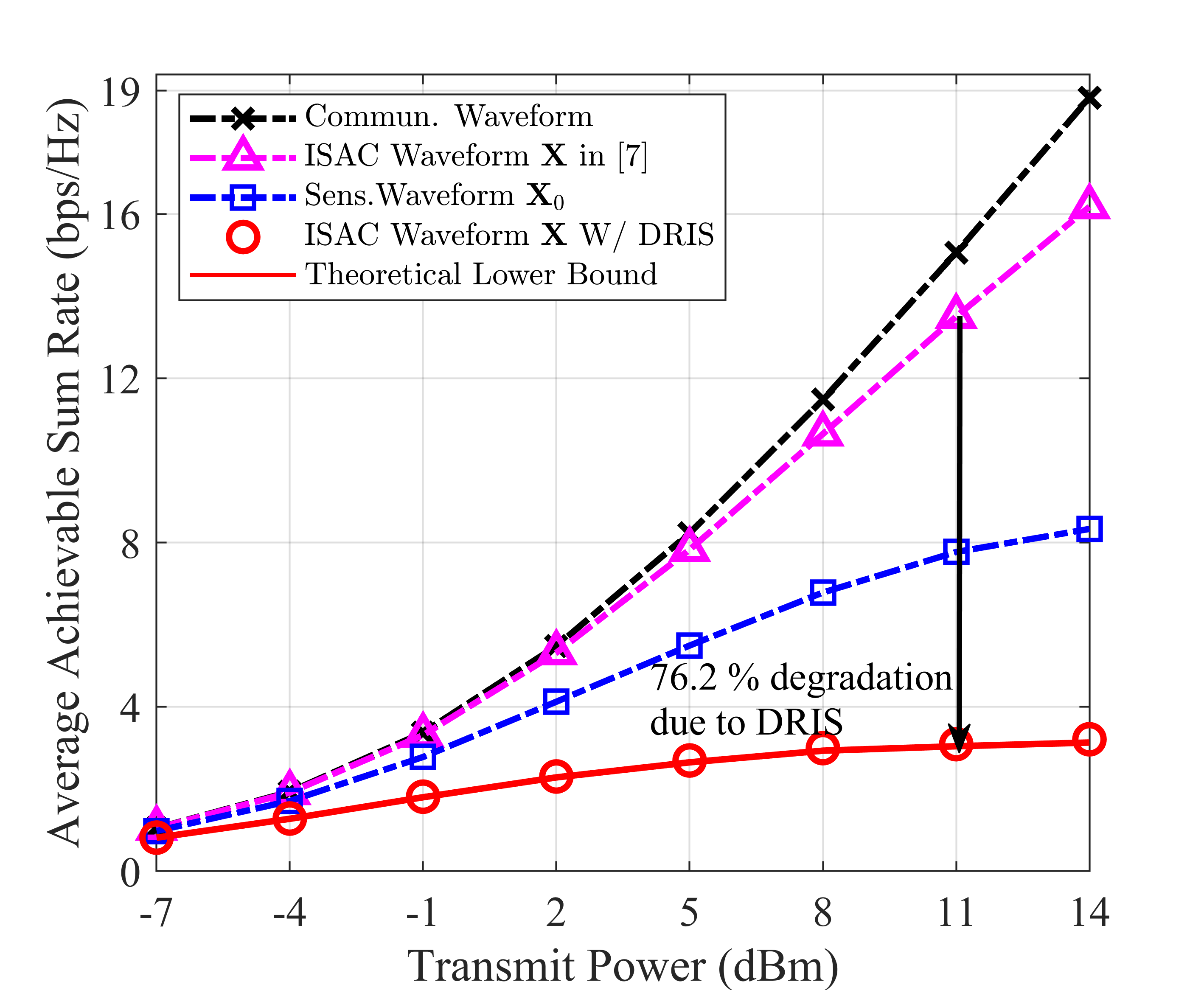
Figure 2: Sum-rate vs. transmit power; the presence of DRIS leads to significant degradation, and the analytical lower bound closely matches simulation.
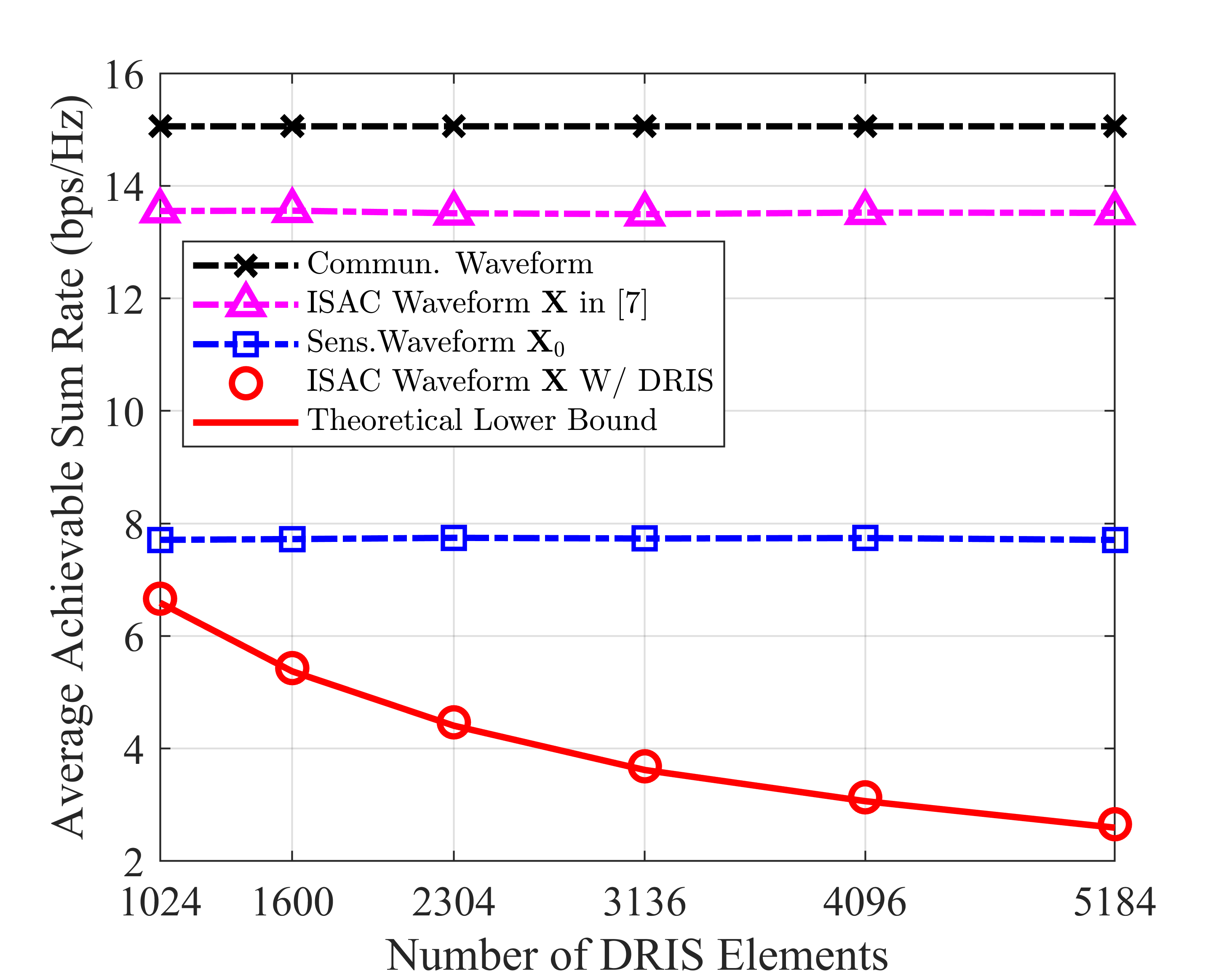
Figure 3: Sum-rate degradation increases with the number of DRIS elements, in agreement with the scaling predicted by the lower bound.
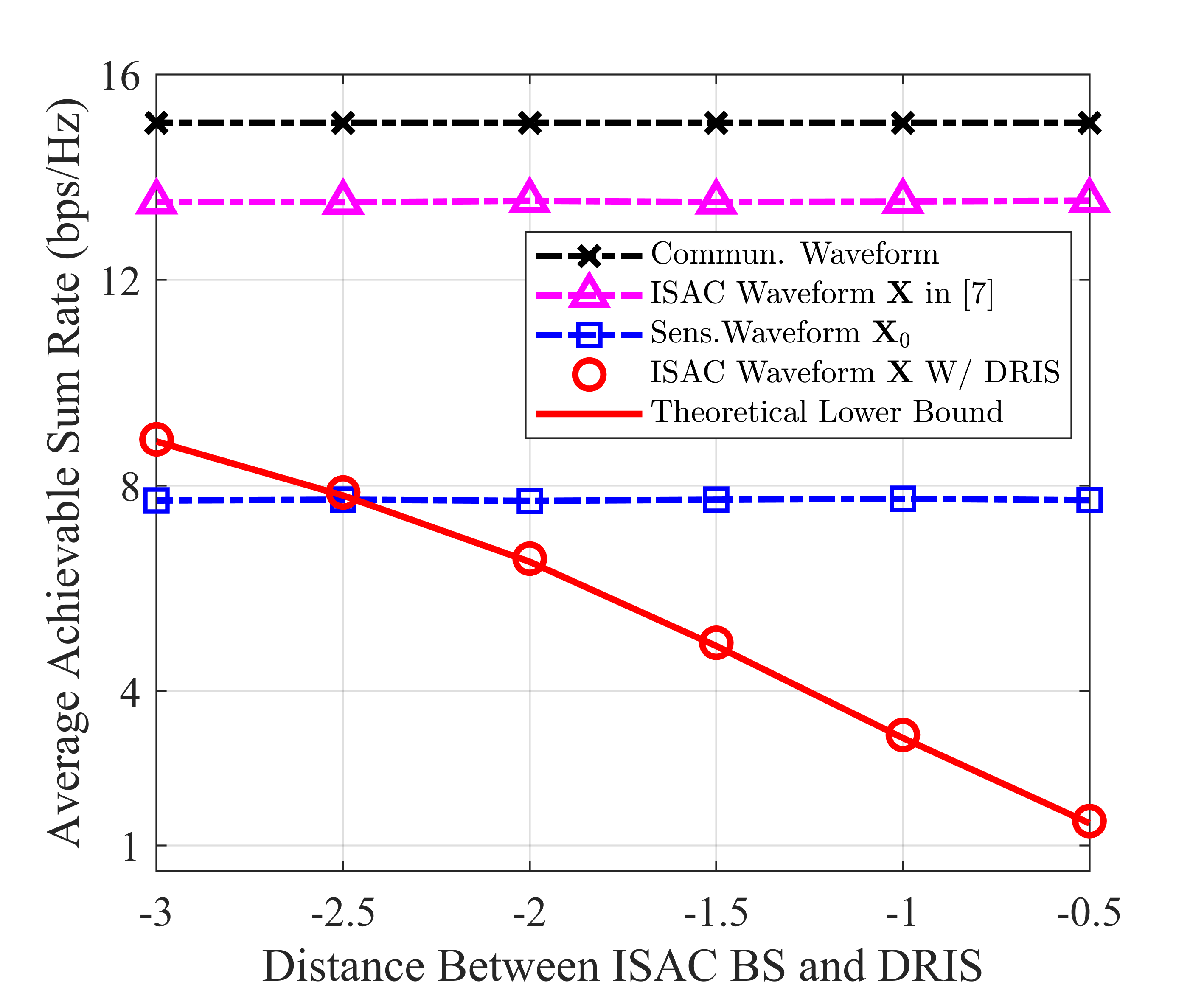
Figure 4: Communication degradation diminishes as the DRIS is placed farther from the ISAC BS, showing the path loss dependence of the ACA effect.
Anisotropic Sensing Impact: CRLB Analysis for AoD and AoA
For sensing performance, the paper derives closed-form Cramér-Rao lower bounds (CRLB) for angle-of-departure (AoD, θ1) and angle-of-arrival (AoA, θ2) estimation. Notably, the DRIS exerts a direction-dependent effect:
- AoD Estimation Degradation: The CRLB for AoD increases significantly, with the error floor rising as either the number of DRIS elements grows or the DRIS approaches the transmitter.
- AoA Estimation Enhancement: Contrarily, the CRLB for AoA estimation decreases with larger/more proximal DRIS, improving angular resolution at the sensing receiver.
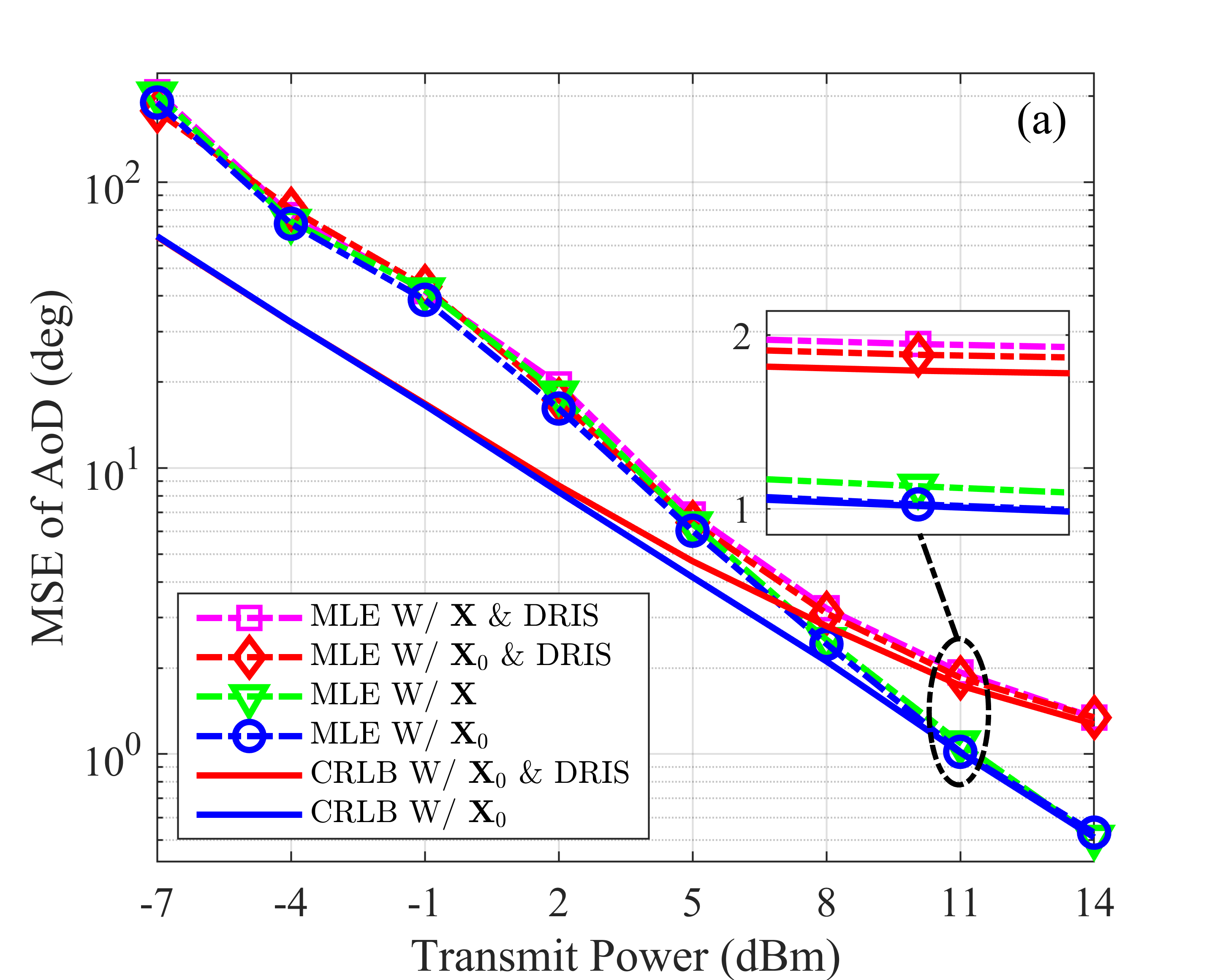
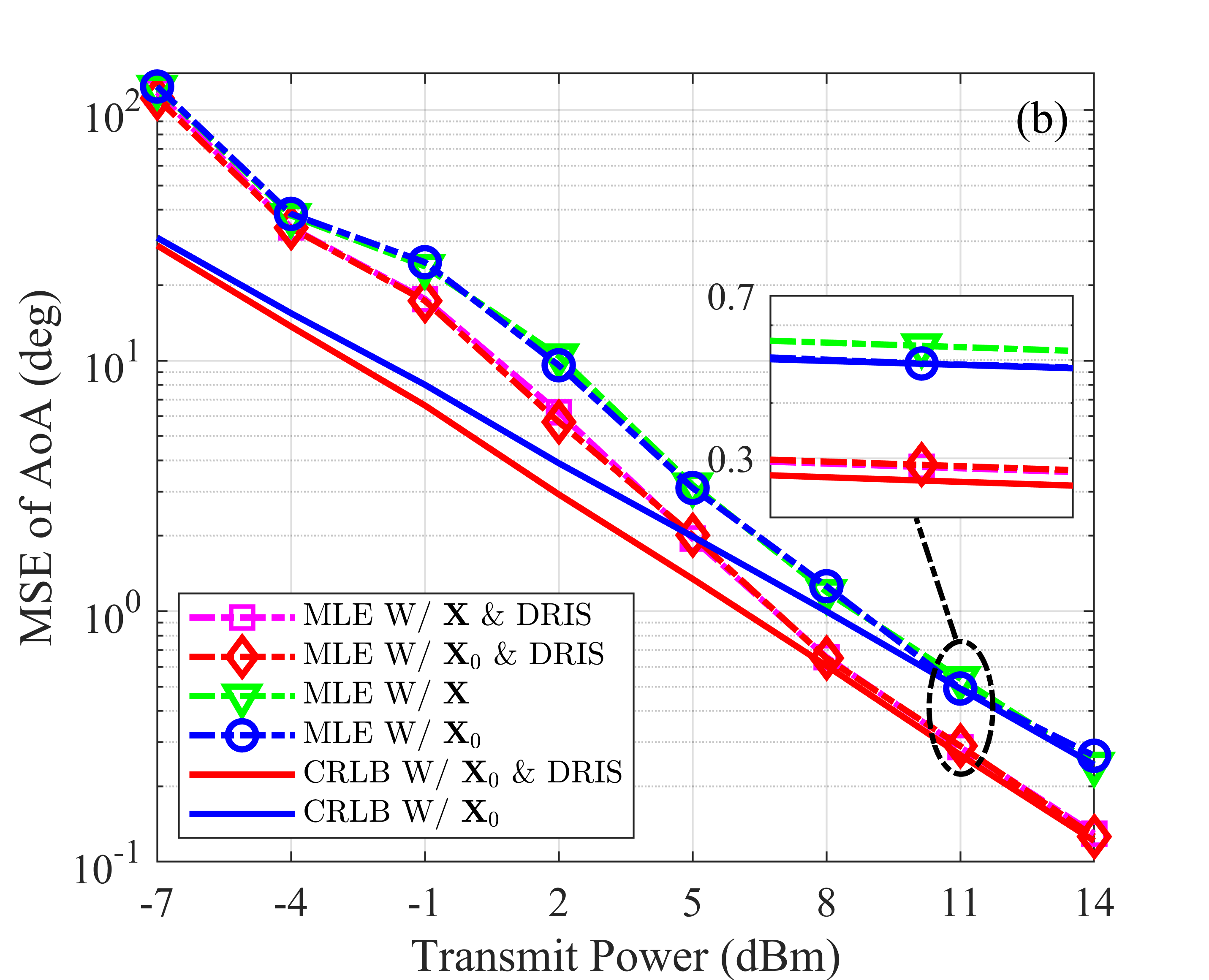
Figure 5: (a) MSE of AoD estimation increases, (b) MSE of AoA estimation decreases, with higher power, showing the opposite trends induced by DRIS presence.
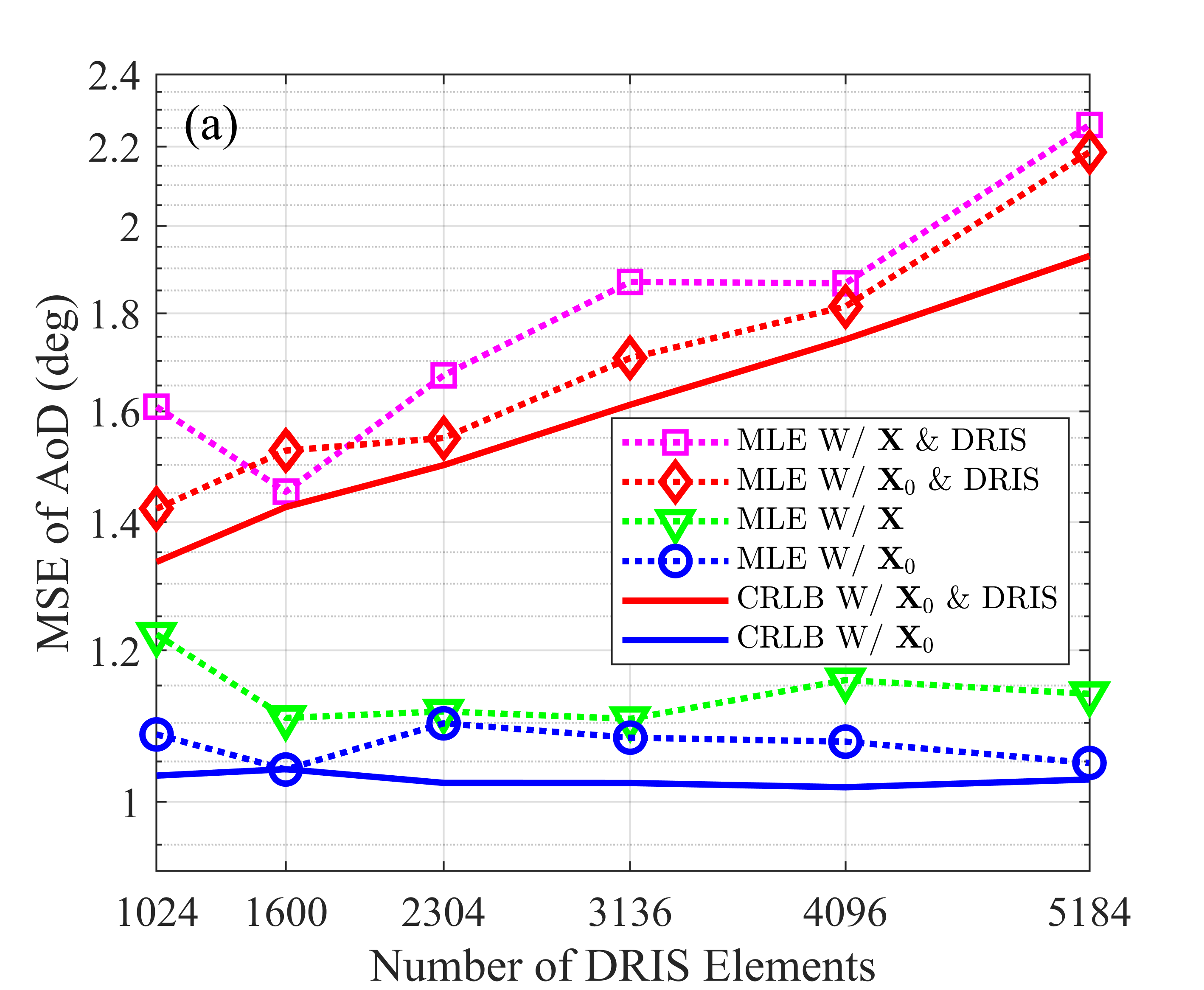
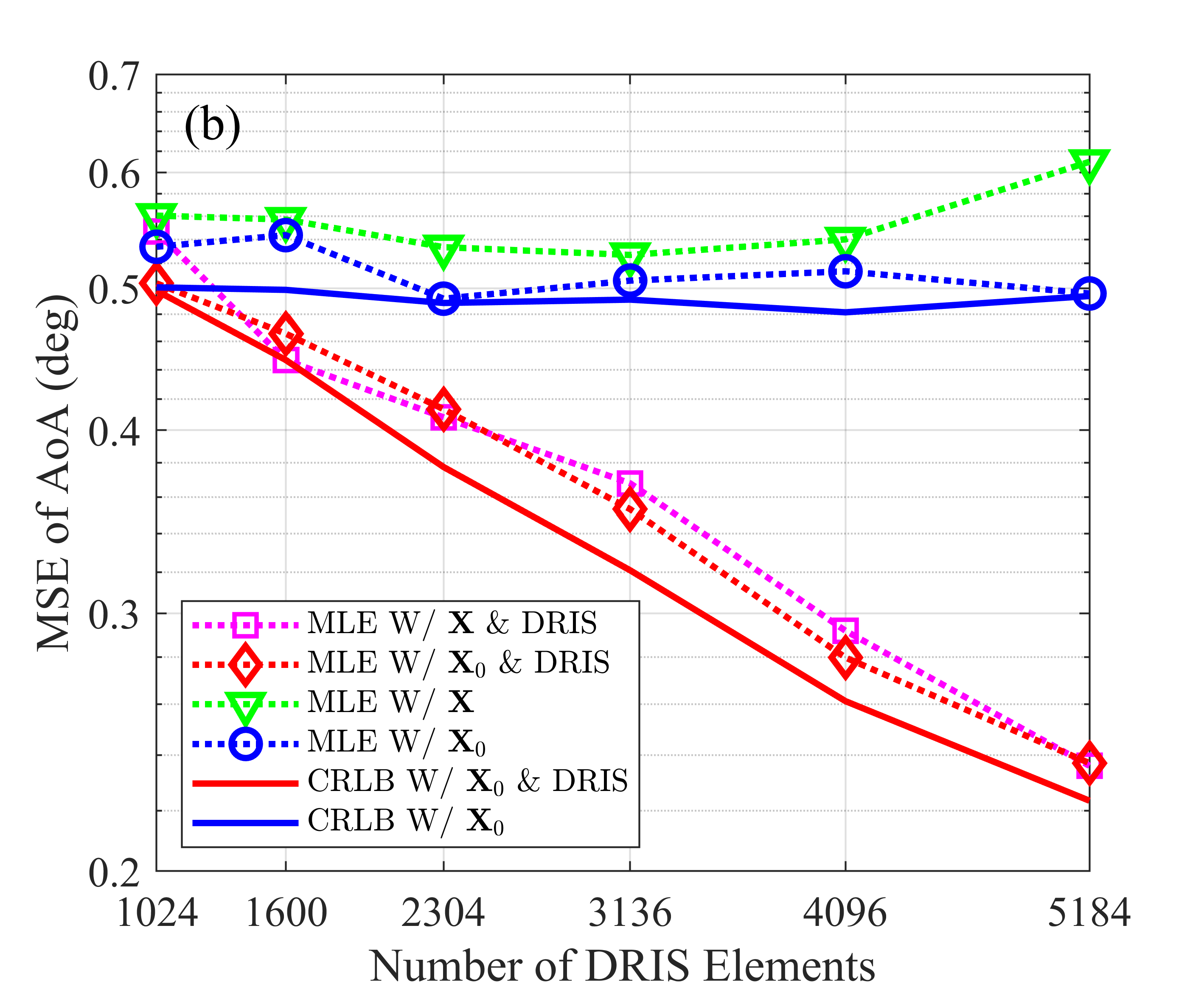
Figure 6: AoD estimation error monotonically worsens and AoA error monotonically improves as DRIS size increases.
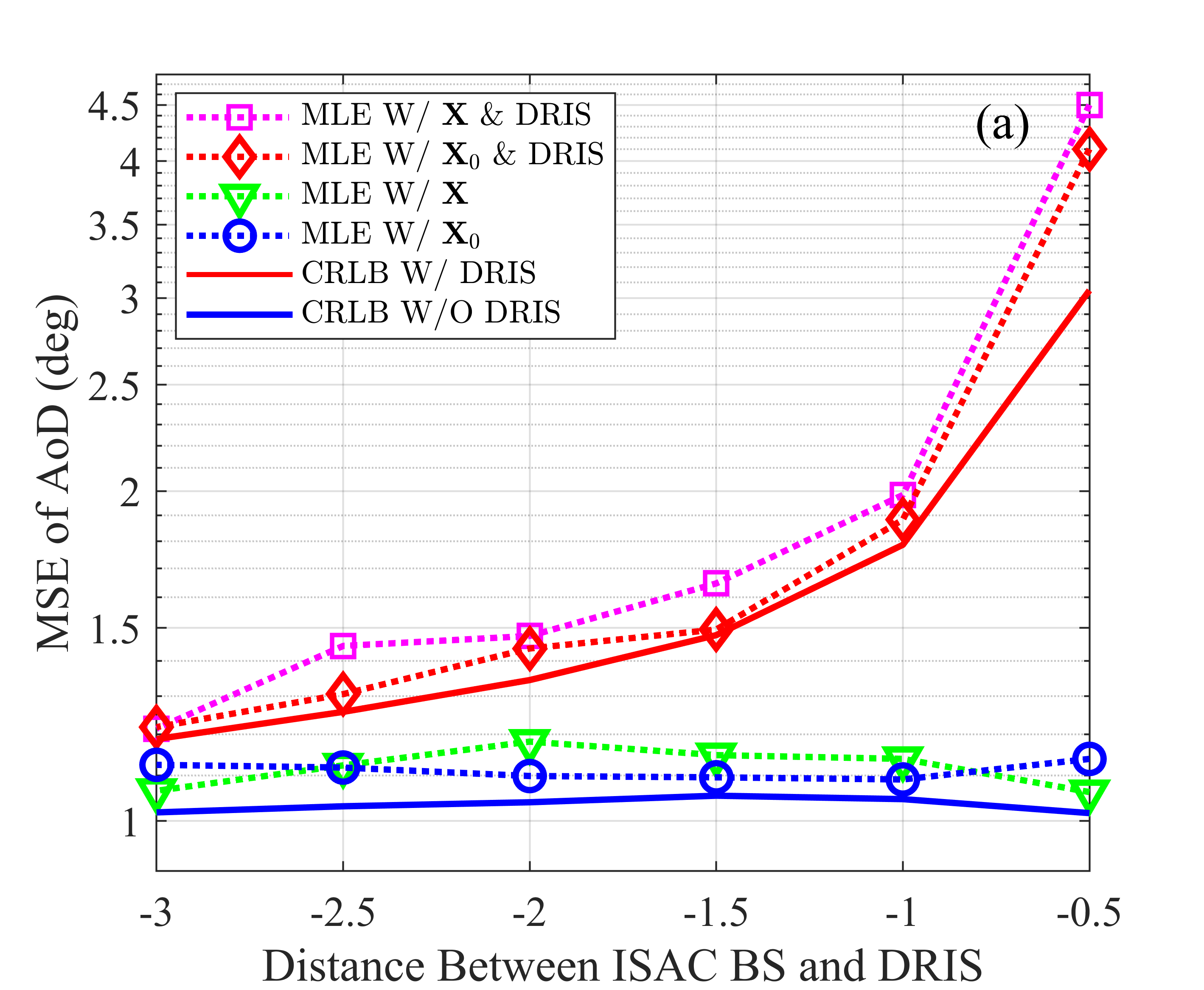
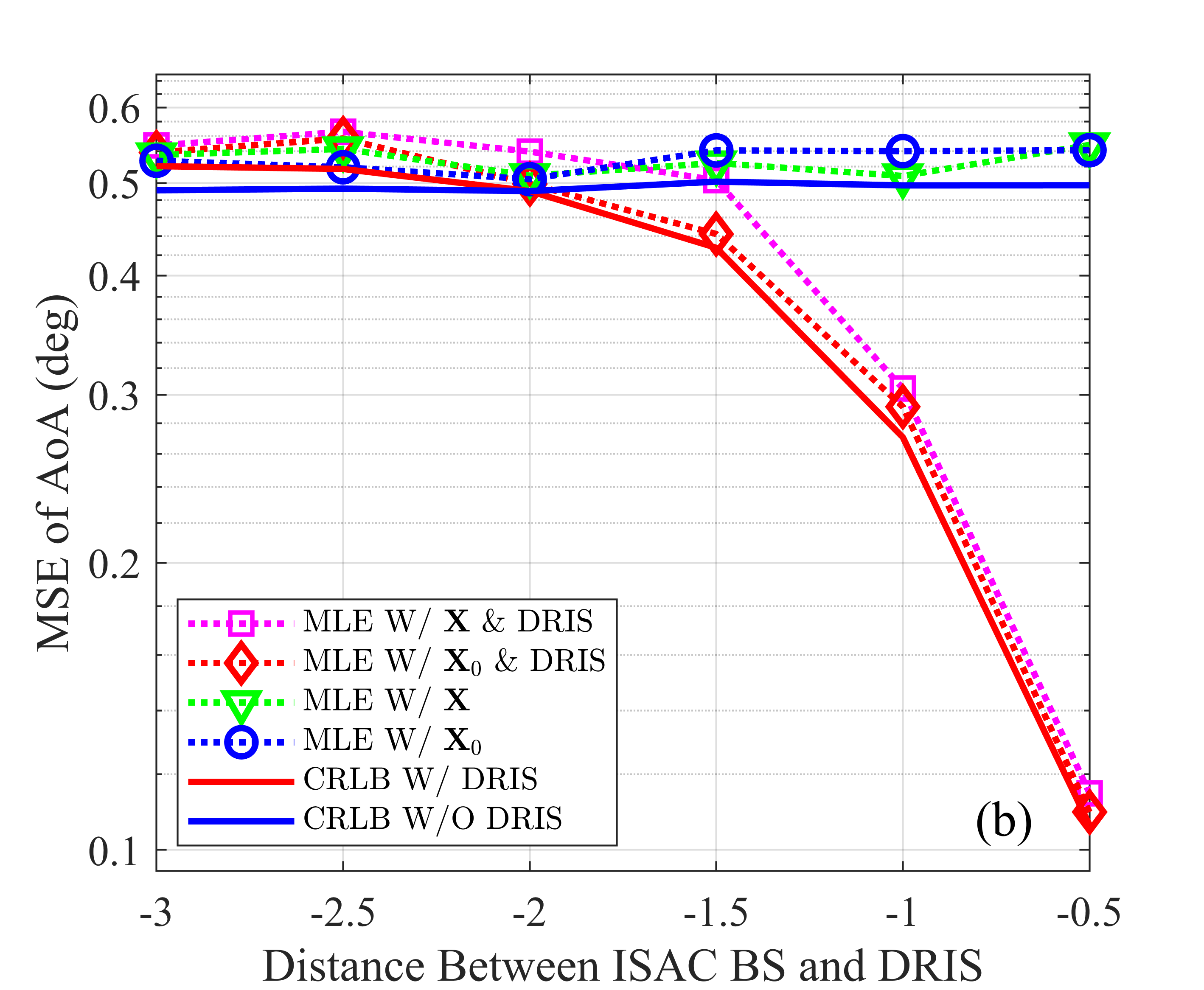
Figure 7: AoD error climbs and AoA error diminishes as DRIS is positioned closer to the ISAC BS, quantifying the anisotropic sensing consequence.
Practical and Theoretical Implications
Communication Security and Robustness
The results imply that passive, energy-free adversarial DRIS structures can fundamentally challenge ISAC networks, rendering standard countermeasures (e.g., power control) ineffective. DRIS-induced ACA interference is independent of ISAC system parameters or user locations.
The anisotropic property—the selective degradation of AoD but not AoA estimation—has both attack and system design implications. An adversary can mask transmitter location/fingerprint while leaving receiver-based localization intact. This rather counterintuitive property could be leveraged for privacy protection or exploited for directionally selective jamming.
Scalability and Infrastructure Attacks
The linear scaling of disruption with DRIS element count predicts severe vulnerability in dense or large-area deployments. Because the DRIS can be camouflaged and requires no energy input or knowledge of system operation, physical-layer security must devote increased attention to such “environmental” jamming modes.
Prospects and Future Directions
This analytical framework calls for rethinking ISAC waveform and resource allocation strategies under severe, environment-induced channel aging. Potential research threads include:
- Joint DRIS detection and mitigation techniques leveraging environment mapping and non-stationarity detection.
- DRIS-resilient ISAC waveform designs decoupling communication and sensing tasks or leveraging diversity orthogonal to DRIS effects.
- Active monitoring for environmental anomalies in the electromagnetic landscape as part of ISAC security.
Conclusion
The paper delivers quantitative, closed-form analysis of the impact of a randomly modulated DRIS on bistatic ISAC performance. It is rigorously shown that DRIS-induced channel aging severely degrades communication reliability, scales with DRIS size and proximity, and cannot be overcome by increased transmission power. In sensing, the DRIS selectively impairs AoD estimation but enhances AoA accuracy, producing a strongly anisotropic disruption and enhancement profile. These results expose substantial new vulnerabilities and system design trade-offs for future ISAC architectures in adversarial environments.