- The paper introduces a coupled astrocyte–neural field model demonstrating that spatial diffusion of metabolic resources stabilizes persistent bump activity in working memory.
- It employs piecewise-smooth linear stability and Evans function analysis to derive explicit thresholds and conditions for stable bump solutions amid synaptic depletion.
- Numerical validations confirm that increased astrocytic diffusion and faster resource replenishment extend the stability regime, counteracting destabilization effects.
Introduction and Context
The study titled "Astrocytic resource diffusion stabilizes persistent activity in neural fields" (2604.10036) addresses a critical gap in theoretical neuroscience regarding the maintenance of persistent activity underlying working memory. Persistent population activity—modeled as stationary "bumps" in neural field frameworks—has been a canonical construct for working memory representations. Traditional neural field models typically incorporate short-term synaptic depression but neglect the spatially extended, diffusive dynamics of metabolic and neurotransmitter resources mediated by astrocyte networks. This paper introduces and rigorously analyzes a coupled astrocyte–neural field model that incorporates resource cycling and spatial diffusion, providing new insights into the stabilization of persistent activity by astrocytic processes.
Coupled Astrocyte–Neural Field Model
The model augments a standard one-dimensional neural field with explicit variables for synaptic (q(x,t)) and astrocytic (a(x,t)) resources, coupled by depletion/replenishment dynamics and nonlocal astrocytic diffusion. The neural activity u(x,t) is modulated by the product of synaptic resource and a Heaviside firing-rate nonlinearity, integrated over cosine-kernel lateral connectivity on a ring.
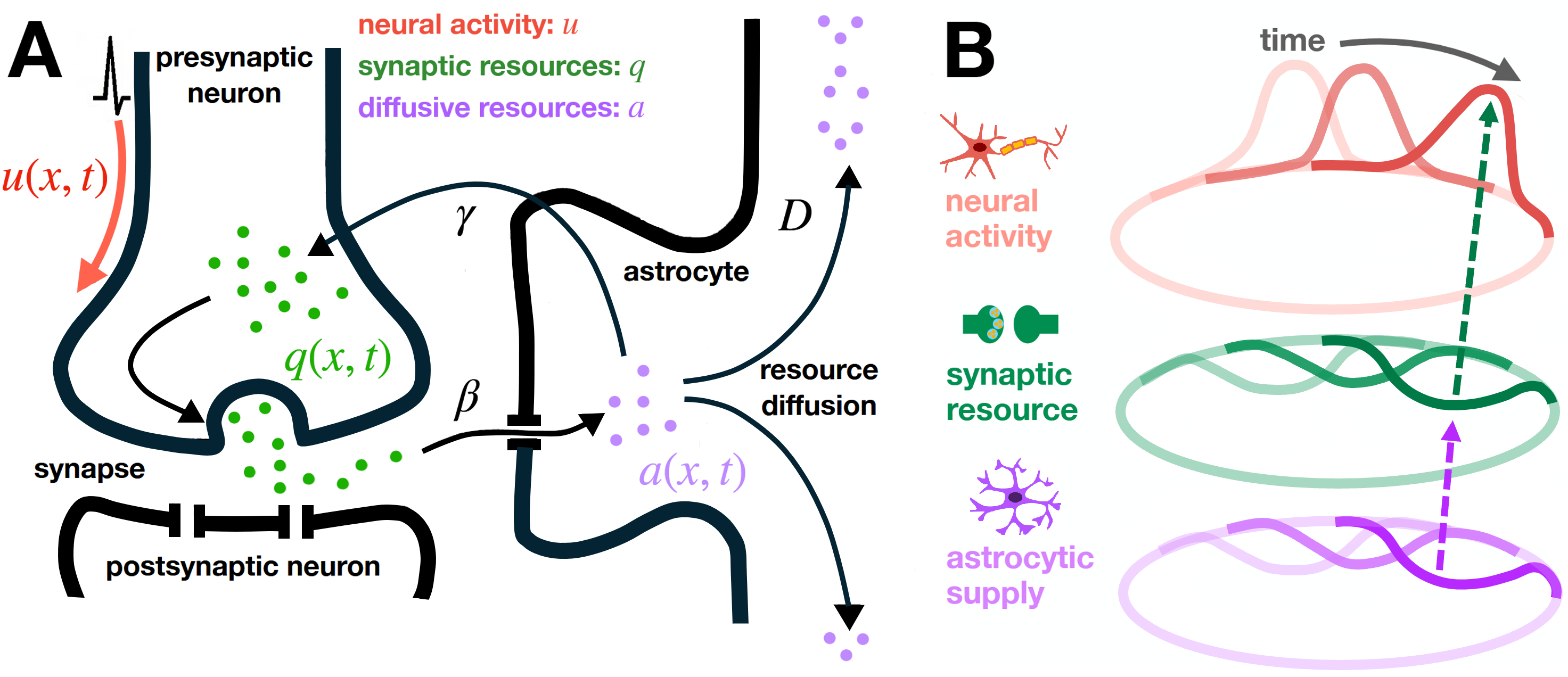
Figure 1: Schematic of local and spatial resource flows in the astrocyte–neural field model, highlighting depletion, replenishment, and astrocytic diffusion.
Critically, the resource pool is globally conserved; astrocytic resources are both replenished by depletion from synaptic use and diffused spatially via a diffusion coefficient D. This construction enables explicit analysis of resource sharing and transport in a spatially extended neural structure.
Existence and Construction of Stationary Bump Solutions
Analytical construction of stationary bump solutions is facilitated by the Heaviside nonlinearity and symmetric cosine connectivity. Stationary solutions are characterized by their half-width Δ and amplitudes, with explicit expressions derivable for the activity and resource profiles under the imposed conservation law. The mid-point equations yield a self-consistency relationship for bump width as a function of synaptic depletion strength β, resource replenishment rate γ, and astrocytic diffusion D.
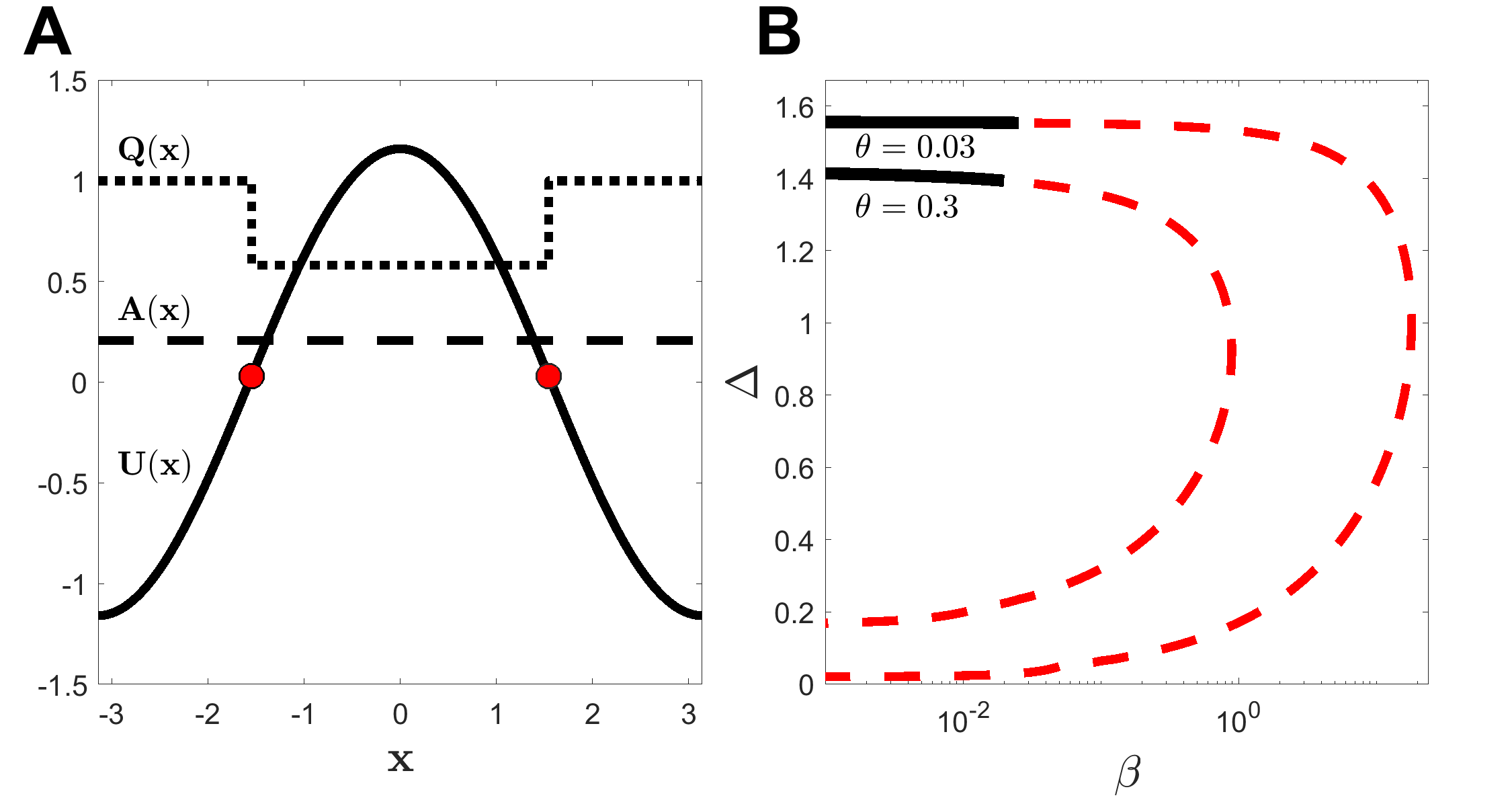
Figure 2: Example of stationary bump solutions and width dependence on synaptic depletion for varying threshold values.
The model predicts the existence of two distinct stationary bump solutions for certain parameter sets, with explicit thresholds for existence emerging from the nonlinear self-consistency condition.
Piecewise-Smooth Linear Stability Analysis and Evans Function Framework
The stability of stationary bumps is analyzed by linearizing the system around these solutions, carefully constructing a piecewise-smooth spectral problem due to the nonsmooth (Heaviside) firing rate. Perturbations at the bump edges generate four cases (expansions/contractions or left/right shifts), each corresponding to a distinct linearized eigenproblem.
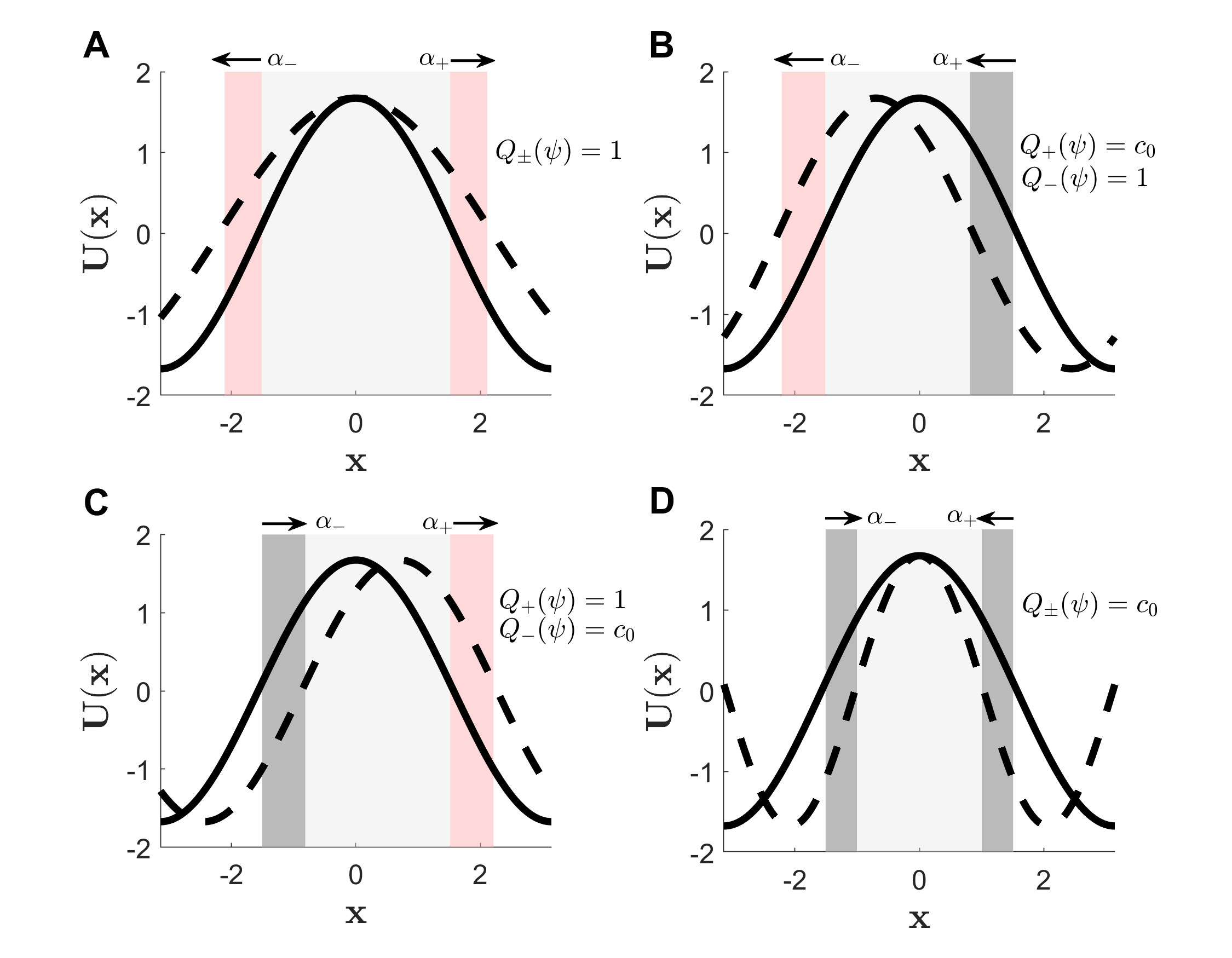
Figure 3: Schematic depiction of four perturbation cases: expansions, contractions, and asymmetric shifts at the bump boundary.
By projecting onto the low-dimensional Fourier basis, the stability problem reduces to a system whose eigenvalues are determined by the roots of a parameter-dependent Evans function. This construction captures the indirect coupling of bump boundary perturbations to spatially extended astrocytic resource redistribution.
Limiting Cases: Zero and Infinite Diffusion
Comprehensive analysis is provided in two limits:
- Zero diffusion (D=0): Resource balance collapses to a local constraint; bump stability is determined directly by the replenishment rate (γ>1/2 demarcates stability), independent of depletion strength a(x,t)0.
- Infinite diffusion (a(x,t)1): Resource asymmetries are instantaneously homogenized, and bump stability is controlled jointly by replenishment and kernel parameters.
Analytic expressions for the Evans function in these limits are compared to full numerical solutions of the PDE system, demonstrating close agreement.
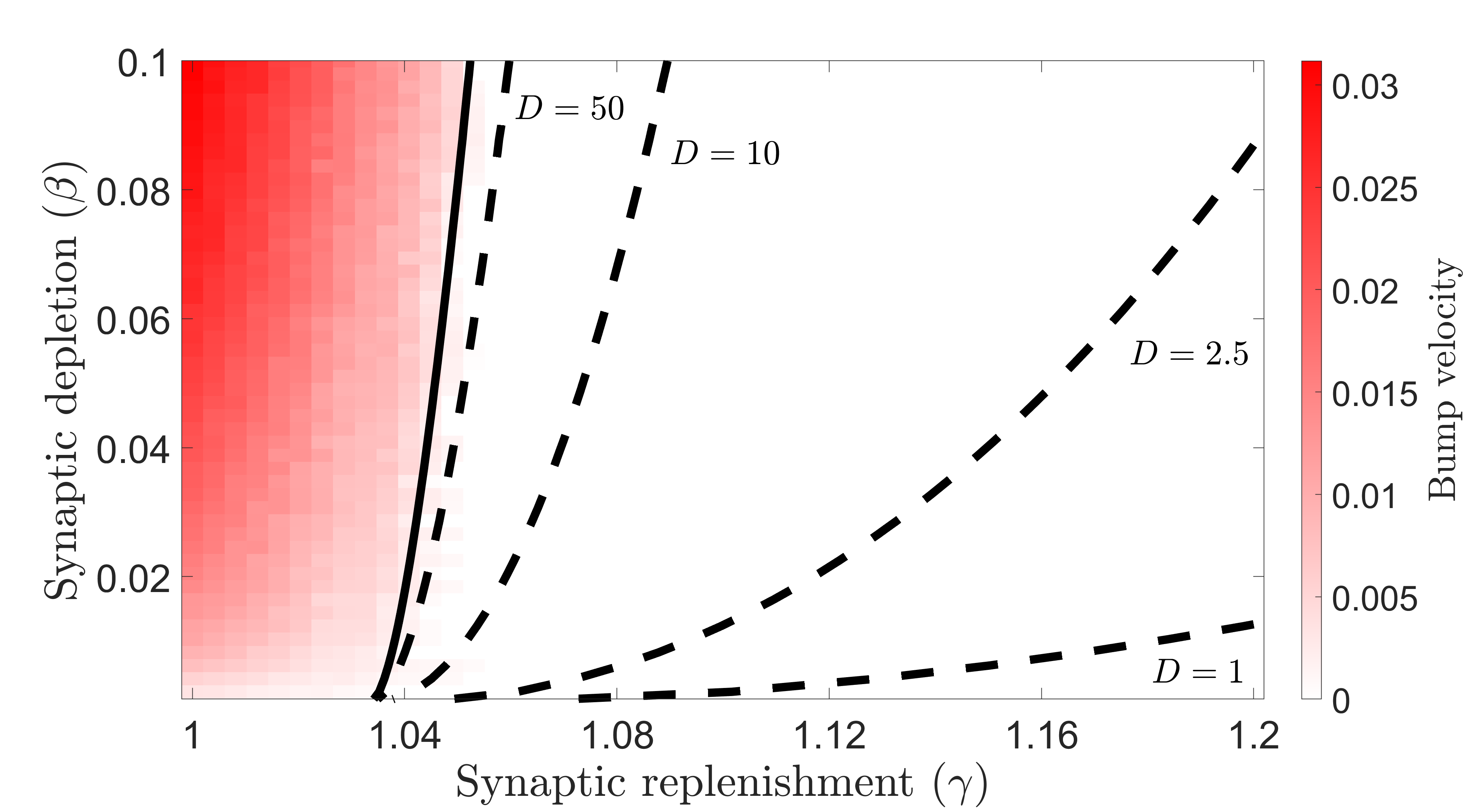
Figure 4: Bump velocity diagrams in the large astrocytic diffusion limit, aligning numerical and analytic stability boundaries.
Numerical Validation and Phase Diagrams
Direct simulations of the coupled system subjected to boundary shift perturbations validate the predicted stability regime and dynamical behaviors. Numerical phase diagrams in a(x,t)2 and a(x,t)3 space quantitatively confirm that astrocytic diffusion monotonically expands the parameter region supporting stationary, drift-stable bumps, partially offsetting the destabilizing effects of increased synaptic depletion.
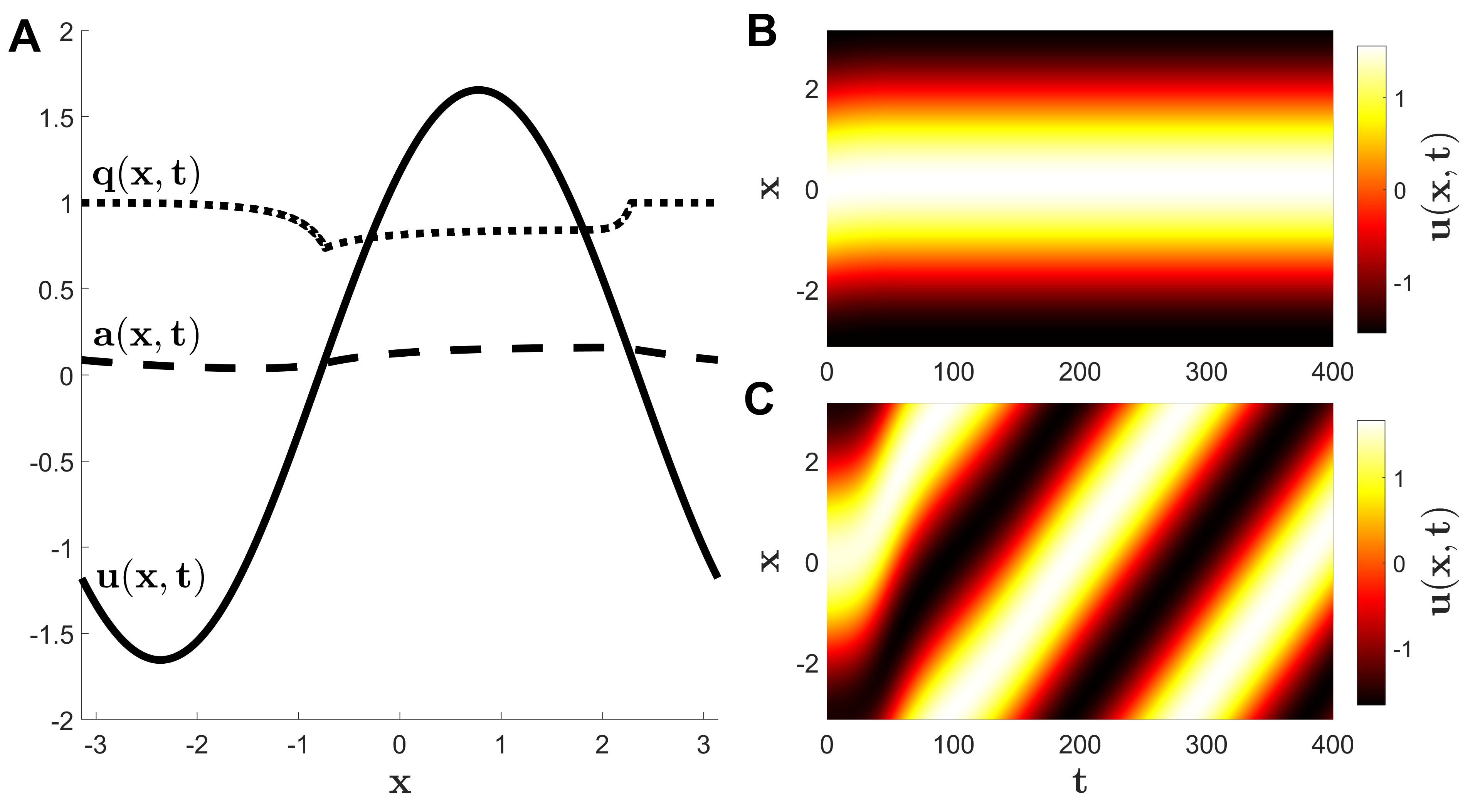
Figure 5: Response of bump activity to shift perturbations, showing stabilization with increased astrocytic diffusion.
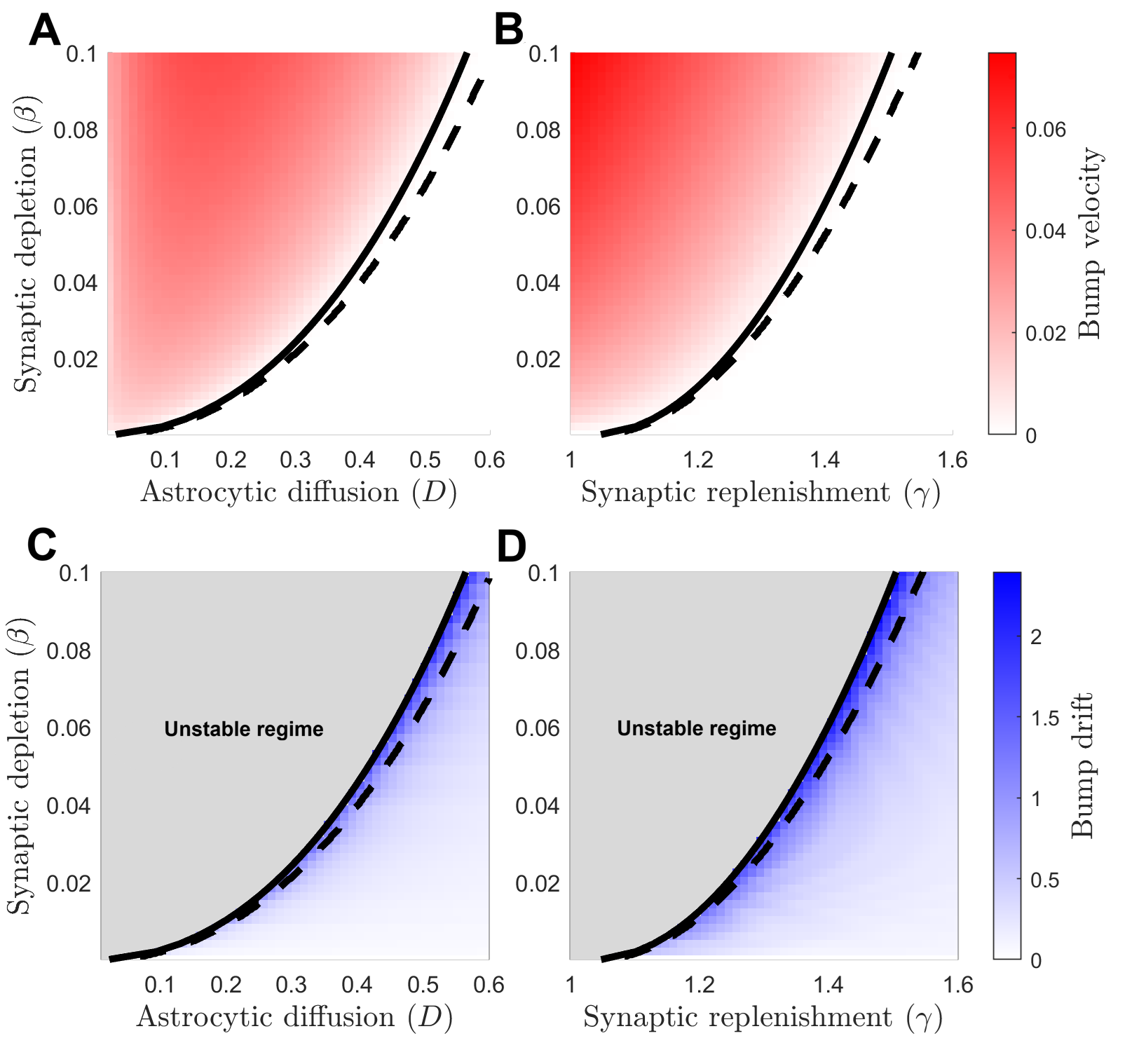
Figure 6: Phase diagrams for bump velocity and drift as a function of key system parameters; solid line denotes the analytic Evans function stability boundary.
Fourier truncation methods provide a computationally efficient approximation of the true stability region, though the Evans function analysis captures the boundary with greater precision.
Mechanistic Analysis: Two-Stage Stabilization Process
The study identifies and mechanistically details a two-stage stabilization process:
- Resource smoothing: Astrocytic diffusion homogenizes resource asymmetries created by bump displacements, generating a countergradient in astrocytic resource a(x,t)4 that opposes drift.
- Replenishment feedback: Sufficiently fast replenishment from the astrocytic to synaptic pool (a(x,t)5 large) is necessary for this smoothing to effectively suppress drift and restore symmetric stationary bumps.
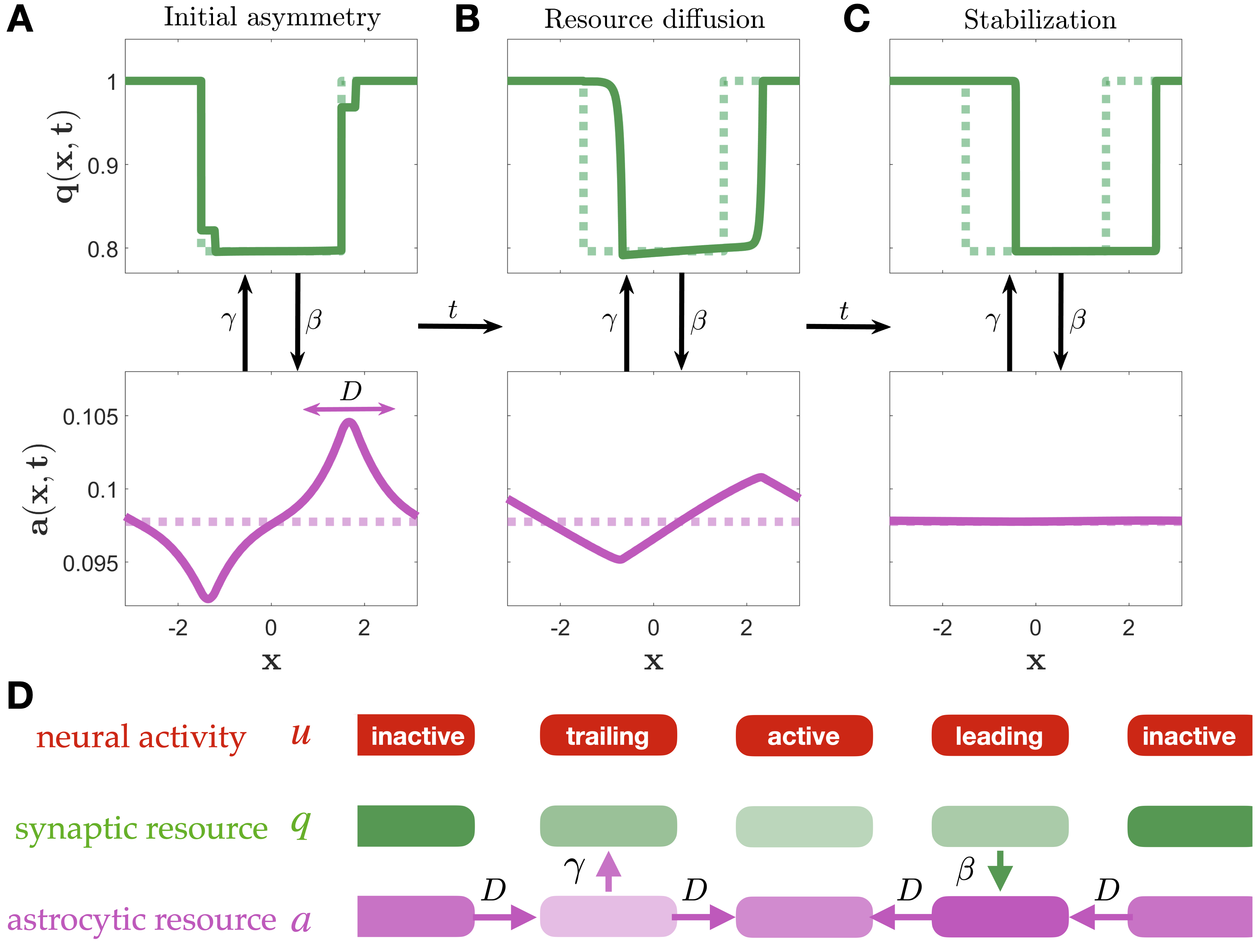
Figure 7: Mechanistic summary: astrocytic diffusion and replenishment cooperate to restore symmetry after shift-induced asymmetries in resource pools.
Notably, the claim that both high diffusion a(x,t)6 and high recovery rate a(x,t)7 are jointly necessary for robust stabilization directly contradicts earlier assumptions in local depression-only models where stability depended primarily on local parameters.
Broader Implications and Future Directions
The introduction of spatially extended resource trafficking fundamentally alters the stability and robustness landscape of working memory bump attractors. From a biological perspective, this modeling underscores the dynamical role of astrocyte networks in regulating persistent activity, with testable predictions for how modifications in astrocyte coupling (e.g., via gap junctional communication) and recycling rates affect memory robustness.
Theoretically, the model generalizes to a broad class of nonlocal-local coupled systems with conserved auxiliary fields, relevant in population dynamics and epidemiological contexts. Methodologically, the piecewise-smooth Evans function construction provides a framework for analyzing coherent structure stability in such multiscale systems.
Looking forward, the paper motivates several extensions:
- Introducing spatial heterogeneity in astrocytic coupling coefficients to investigate attractor position selectivity.
- Analyzing traveling wave, front, or breathing solutions in the presence of diffusive resource redistribution.
- Incorporating stochastic fluctuations to link astrocytic diffusion with noise-induced drift and errors in working memory.
- Extending the framework to models incorporating both depression and facilitation, as well as biophysically derived resource transport equations.
Conclusion
This study rigorously demonstrates that astrocytic resource diffusion, in tandem with rapid replenishment, is essential for stabilizing persistent spatial activity patterns in neural fields subject to synaptic depletion. Analytical and numerical results collectively show that spatial coupling of resource reservoirs enlarges the parameter regime supporting stable working memory representations and alters the dynamical response to perturbations. These findings have direct implications for our understanding of glial-neural interactions in working memory and suggest new theoretical and experimental directions for dissecting the biophysical substrate of robust cognitive function.