- The paper introduces new probabilistic softmax-based algorithms to construct metaphorical mappings via category theory.
- The paper leverages coslice categories and natural transformations to encode and explore associative semantic structures.
- The method achieves enhanced systematicity, novelty, and alignment with human interpretive data compared to deterministic models.
Introduction
The paper “Computational Implementation of a Model of Category-Theoretic Metaphor Comprehension” (2604.10035) presents new computational algorithms grounded in the Theory of Indeterminate Natural Transformation (TINT), a category-theoretic formalism for metaphor comprehension. TINT aims to capture the intuitive, systematic, and flexible mechanisms underlying human metaphor understanding with a mathematical and operational framework. The proposed algorithms make metaphor comprehension tractable as a stochastic search over semantic structures crafted as coslice categories, applying and extending fundamental concepts of category theory—categories, functors, and natural transformations—towards cognition-inspired computational models. Evaluation of these algorithms demonstrates superior data fit to human interpretive judgments, increased systematicity, and enhanced novelty relative to prior art.
TINT models semantic structures of lexical items (referred to as “images”) as categories, specifically using coslice categories that encode local associative relationships. The process of metaphor comprehension is formalized as a dynamic construction of new functors and natural transformations between the coslice categories of source and target images. Upon encountering a metaphorical statement (e.g., “Butterflies are dancers”), the model updates the semantic network by instantiating an association from the target to the source, which induces a canonical “base-of-metaphor” functor (BMF) and initiates a search for a more interpretable and meaningful mapping via natural transformations.
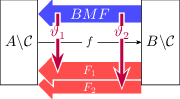
Figure 1: Schematic workflow of natural transformation search in TINT, illustrating the progression from canonical BMF to the discovery of new interpretive mappings.
This formalism leverages the inherent representational flexibility of category theory, avoiding restrictive predicate-based or tree-like structures of traditional analogy systems such as Gentner’s structure-mapping engine. Instead, TINT operates directly over associative networks, accommodating the loose and context-sensitive associations native to human conceptualization.
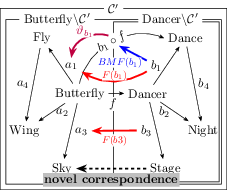
Figure 2: Stepwise exploration in TINT exemplified by the metaphor "A butterfly is like a dancer," showing associative propagation and emerging correspondences.
Algorithmic Advances
Object-Based and Relation-Based Algorithms
Two principal algorithmic paradigms are operationalized in TINT:
- Object-based algorithms construct natural transformations based solely on direct associations (arrows) between initial images in the coslice categories of source and target. Correspondence is grounded in maximizing associative weights.
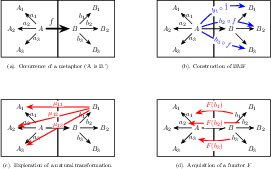
Figure 3: Object-based construction of natural transformations, mapping associations between source and target images.
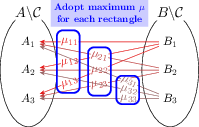
Figure 4: Example of object-based correspondence between images in coslice categories.
- Relation-based algorithms extend the search to commutative triangle structures (triplets of arrows), evaluating and aligning more complex local subgraphs for relational isomorphism. Correspondences are scored using the element-wise distance between triangle substructures.
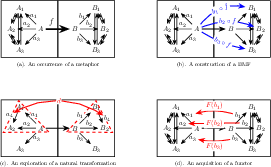
Figure 5: Schematic of the triangle method in relation-based algorithms for matching relational patterns.
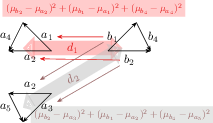
Figure 6: Quantification of the structural distance between triangle configurations.
Both paradigms formerly utilized deterministic hardmax selection, corresponding to purely greedy correspondence construction.
Stochastic Softmax-Based Correspondence
This work introduces a significant modification: the deterministic selection in both exploration strategies is replaced with a probabilistic, softmax-based sampling procedure. In the object-based case, candidate correspondences are sampled according to the softmax-transformed associative weights. For the relation-based variant, triangle matches are chosen via a softmax over the negative squared distances among substructures, parameterized by an inverse temperature β. This change empirically increases flexibility and aligns simulated results with the inherent variability and indeterminacy observed in human metaphor comprehension.
Empirical Evaluation
The model is parameterized using empirical associative strengths between images, derived from human subject data. Metaphor comprehension is evaluated along three axes:
- Data Fit: Rank correlation between model-predicted correspondences and human-provided metaphor interpretation data.
- Systematicity: The mean “width” of functors (i.e., the number of targets mapped), reflecting the extent of structural preservation and mapping, analogous to Gentnerian systematicity.
- Novelty: The inverse cosine similarity (derived from word embeddings) of mapped image pairs, serving as a measure of the interpretive novelty generated by the model.
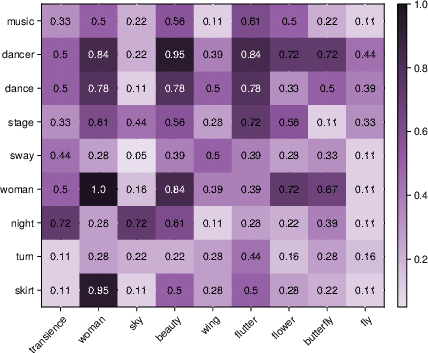
Figure 7: Visualization of associative weights from source to target initial images in the latent semantic network.
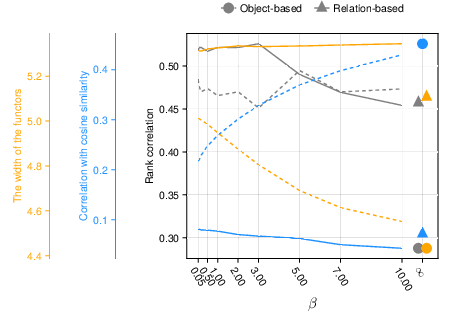
Figure 8: Model performance across data fit (gray), systematicity (orange), and novelty (blue) as a function of softmax inverse temperature β; comparisons include both deterministic and stochastic variants.
Key results include:
- The relation-based softmax algorithm consistently achieves higher rank correlation to human data compared to deterministic and object-based variants.
- Systematicity is superior in the relation-based methods, reflecting a broader and more relationally coherent mapping space.
- Novelty is maximized for the probabilistic relation-based algorithms, showing markedly lower embedding similarity and thus more creative, non-stereotypical correspondences.
Discussion and Implications
The transition from deterministic to probabilistic correspondence construction is pivotal for modeling the indeterminacy of human metaphor comprehension and yields empirically superior outcomes across all measures. Relation-based methods significantly outperform object-based techniques, supporting the theoretical centrality of relational pattern mapping in metaphor processing, in line with structure-mapping theory [Gentner, 1983; 1997]. The probabilistic approach also allows the model to flexibly account for multistable, distributed outputs analogous to human interpretive behavior and avoids trivial, high-association matches.
Practically, this category-theoretic formulation provides a rigorous and extensible computational architecture for analogy, metaphor, and potentially other semantic phenomena requiring structural flexibility. Theoretically, the findings motivate further investigation of stochastic approaches to structure-mapping, integration with richer semantic resources (beyond word associations), and potential applications to transfer learning and low-shot generalization in artificial intelligence.
Conclusion
This work demonstrates that TINT, realized as a category-theoretic and probabilistically-driven model, achieves a more faithful and systematic computational account of metaphor comprehension than previous deterministic algorithms or attribute-focused analogical models. The incorporation of stochastic correspondence and structural (relation-based) mapping advances both the descriptive validity and creative potential of computational metaphor models. These results provide a robust foundation for future research into category-theoretic approaches to semantics, analogical reasoning, and creative cognition in artificial intelligence.