- The paper establishes that the BP₃ monolayer exhibits robust strong electron-phonon coupling and two-gap superconductivity with a critical temperature of 9.7 K.
- It employs DFT, AIMD, and anisotropic Migdal–Eliashberg formalism to confirm structural stability and reveal distinct superconducting gap anisotropy.
- The study highlights how built-in polarity and mixed ionic-covalent bonding, along with dominant low-frequency phonon modes, drive the multiband superconductivity.
Strong Electron-Phonon Coupling and Multiband Superconductivity in Hexagonal BP₃ Monolayer
Structural Stability and Crystal Architecture
The hexagonal BP₃ monolayer exhibits a buckled atomic structure, as revealed by DFT-based relaxations. The side and top views highlight a periodically buckled P–B network, with symmetry-driven arrangements of two inequivalent boron atoms and six phosphorus atoms per unit cell. The lattice constant is a=6.51 A˚, and the vertical buckling amplitude yields an effective thickness of 1.60 A˚, while interlayer interactions are suppressed by a 15 A˚ vacuum Figure 1.
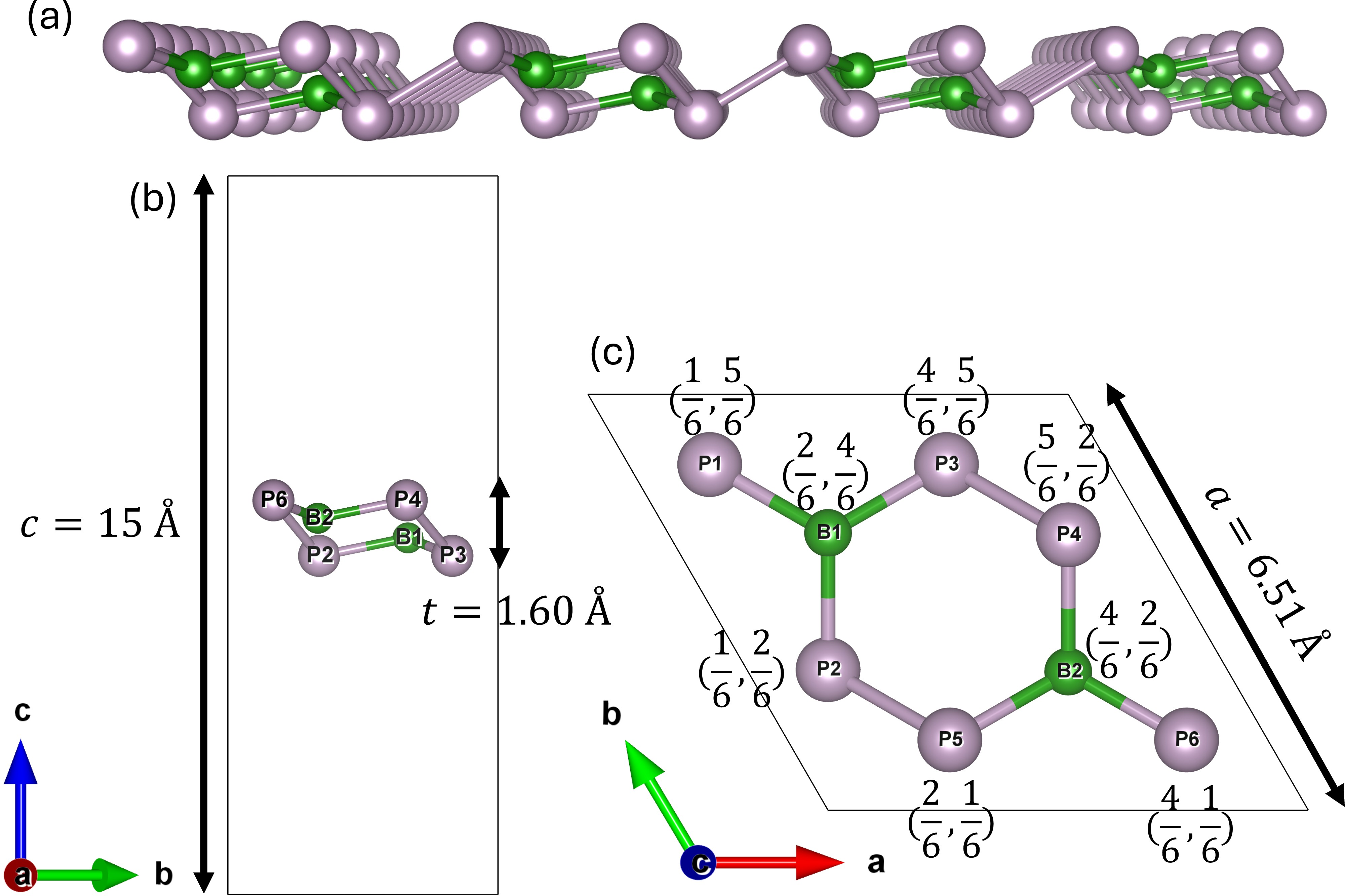
Figure 1: Structural configuration of hexagonal BP₃ monolayer: buckling in the side view, layer isolation in the simulation cell, and atomic site labeling in the primitive cell—lattice parameter a=6.51 A˚.
Thermal and dynamical stability were assessed via AIMD simulations. The atomic configuration remains intact over a 10 ps trajectory, without reconstruction or bond dissociation. The energy and temperature profiles display minor fluctuations around their equilibrium values, confirming robustness at finite temperature Figure 2. The elastic constants (C11=115.98 N/m, C12=21.46 N/m, C66=47.26 N/m) fulfill 2D mechanical stability criteria, supporting the feasibility of experimental synthesis.
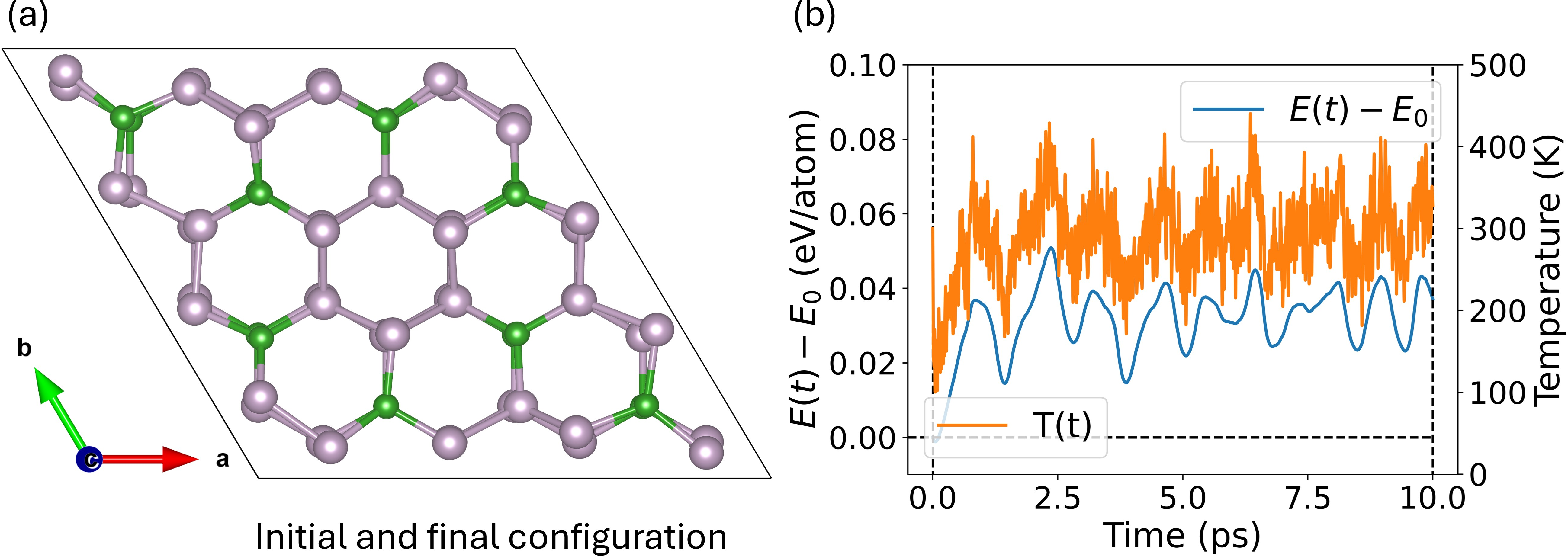
Figure 2: AIMD simulations verify thermal robustness, with structural integrity retained over 10 ps and minimal energy/temperature fluctuations.
Electronic Structure and Bonding Analysis
Plane-averaged potential and internal electric field calculations evidence built-in polarity due to the asymmetric charge distribution across the layer. Bader analysis and ELF mapping uncover a mixed ionic-covalent bonding character: charge transfer results in positively charged B and negatively charged P atoms, while ELF attractors along B–P bonds and around P atoms indicate π-type covalent bonding—an electromechanical hybridization motif critical for both transport and pairing mechanisms Figure 3.
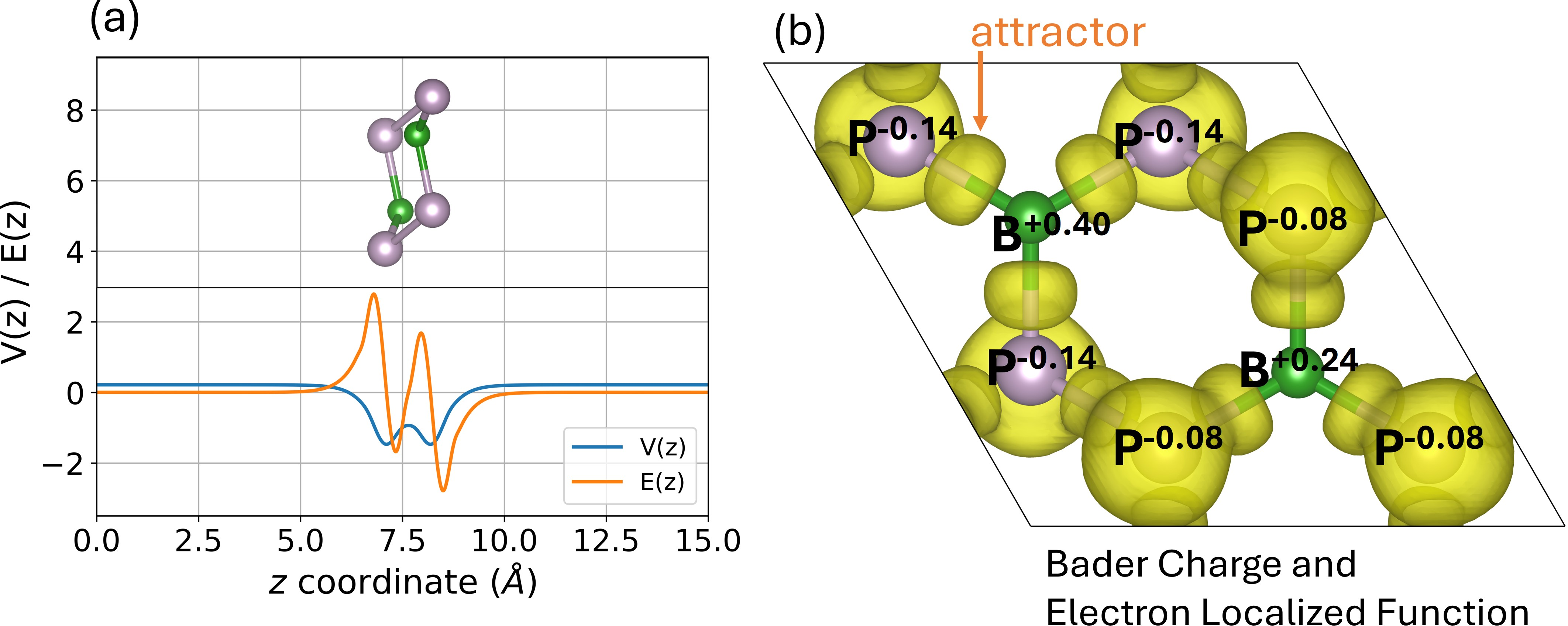
Figure 3: Out-of-plane electrostatic potential, internal electric field, and ELF isosurfaces; charge transfer from B to P yields partial ionic character and strong directional bonding.
Electronic band structure calculations along Γ–K–M–Γ confirm metallicity, with multiple bands crossing the Fermi level. The PDOS demonstrates that both B and P 1.60 A˚0 orbitals dominate the states near 1.60 A˚1, and strong hybridization is evident. The Fermi surface comprises two distinct sheets—inner and outer—associated separately with B and P 1.60 A˚2 states, underlining a pronounced multiband character. The LDOS visualizes spatial electron accumulation along B–P bonds, with lobes characteristic of 1.60 A˚3-dominated bands Figure 4.
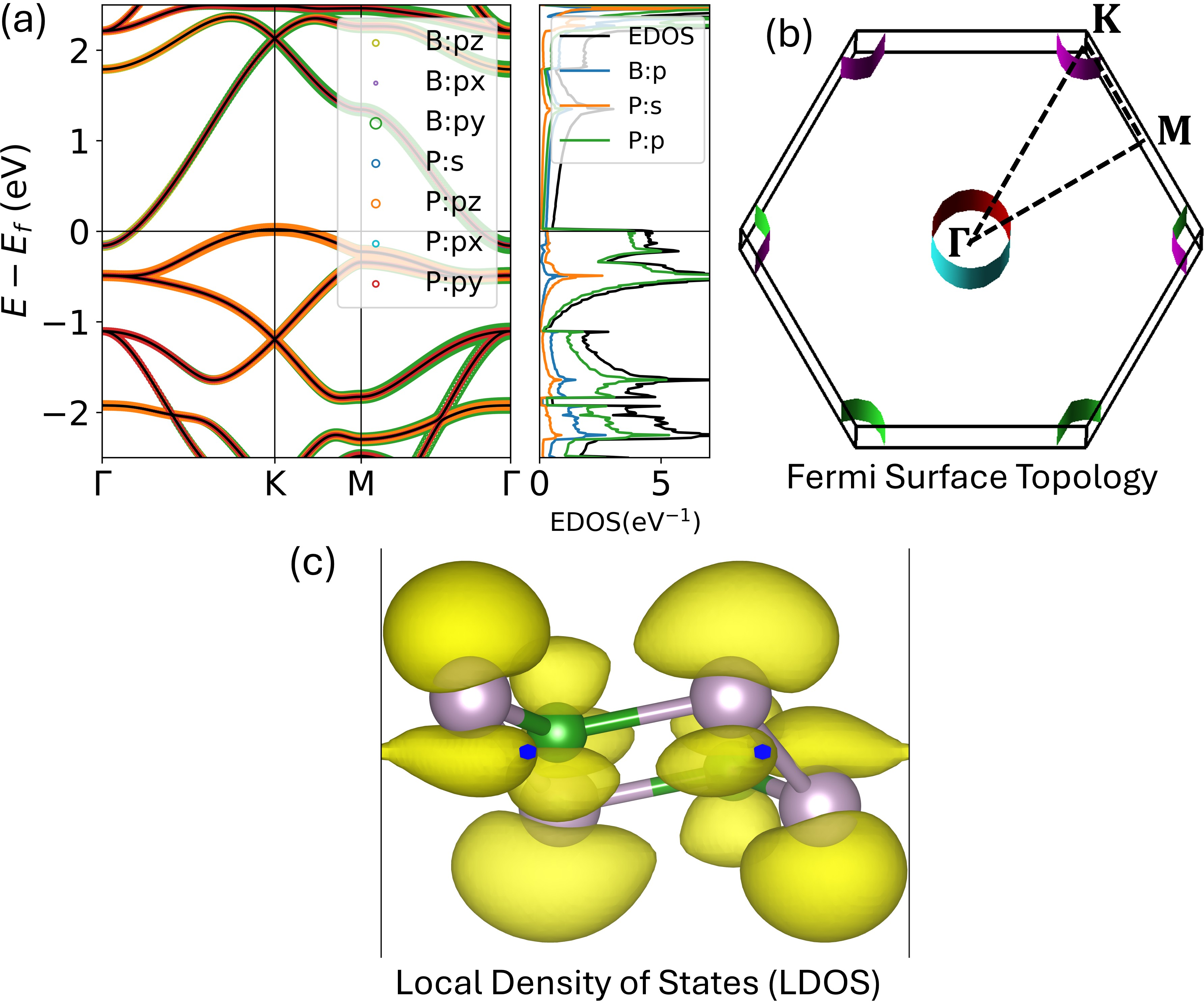
Figure 4: Band structure and PDOS clarify 1.60 A˚4 orbital hybridization at 1.60 A˚5; the Fermi surface sheets, and LDOS distribution, substantiate the multiband nature and significant 1.60 A˚6-bonding contributions.
Phonon Spectrum and Electron-Phonon Coupling
Phonon dispersions show no unstable (imaginary) modes, indicating dynamical stability. The EPC-weighted dispersion reveals that coupling is concentrated in specific low- and intermediate-frequency modes around high-symmetry K and M points. The PhDOS demonstrates broad vibrational participation, with low-frequency modes associated with P and high-frequency modes with B atom motion, indicative of selective EPC channeling.
Analysis of the Eliashberg spectral function 1.60 A˚7 and cumulative 1.60 A˚8 yields an unusually high EPC constant 1.60 A˚9, placing BP₃ in the strong coupling regime. Low-frequency phonons dominate the EPC (contributing 15 A˚0), while high-frequency B modes provide a secondary channel Figure 5.
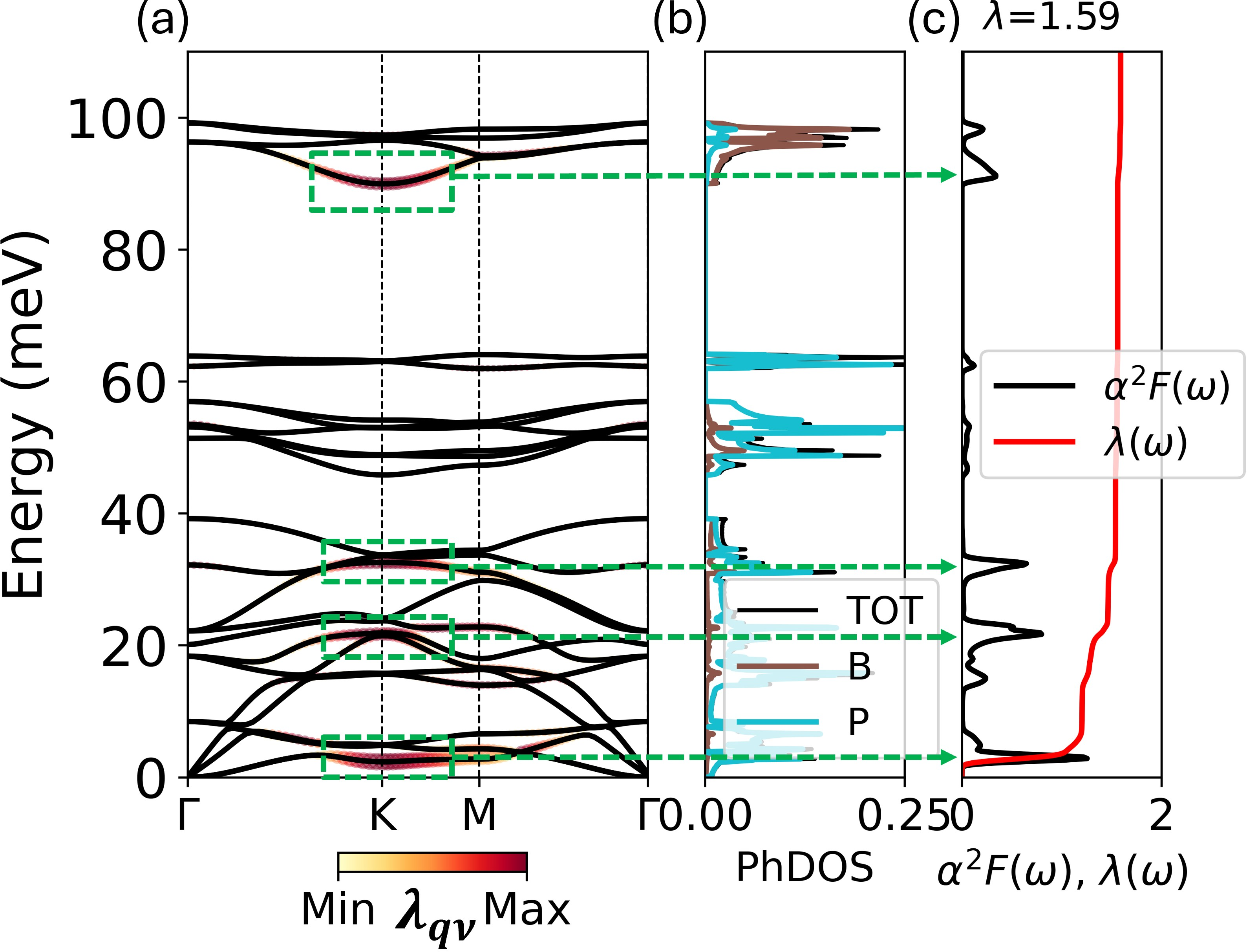
Figure 5: EPC-weighted phonon dispersion and spectral function reveal dominant coupling from low- and intermediate-frequency modes; 15 A˚1 reflects strong-coupling behavior.
Superconducting Gap Structure: Anisotropy and Multiband Effects
Superconductivity was evaluated through anisotropic Migdal–Eliashberg formalism. The temperature-dependent gap function 15 A˚2 adheres well to BCS-like behavior, but gap ratios far exceed the BCS weak-coupling limit: the larger gap (15 A˚3meV) and smaller gap (15 A˚4meV) yield 15 A˚5 and 15 A˚6, respectively, at 15 A˚7 K. The computed transition temperature is 15 A˚8 K.
The Fermi surface analysis shows fully nodeless gaps distributed anisotropically over the two Fermi sheets, originating from their differentiated orbital (B 15 A˚9 vs. P a=6.51 A˚0) and EPC characters. These results unambiguously establish BP₃ as a two-gap, strongly coupled 2D superconductor; this places it among a limited class of low-dimensional multiband superconductors Figure 6.
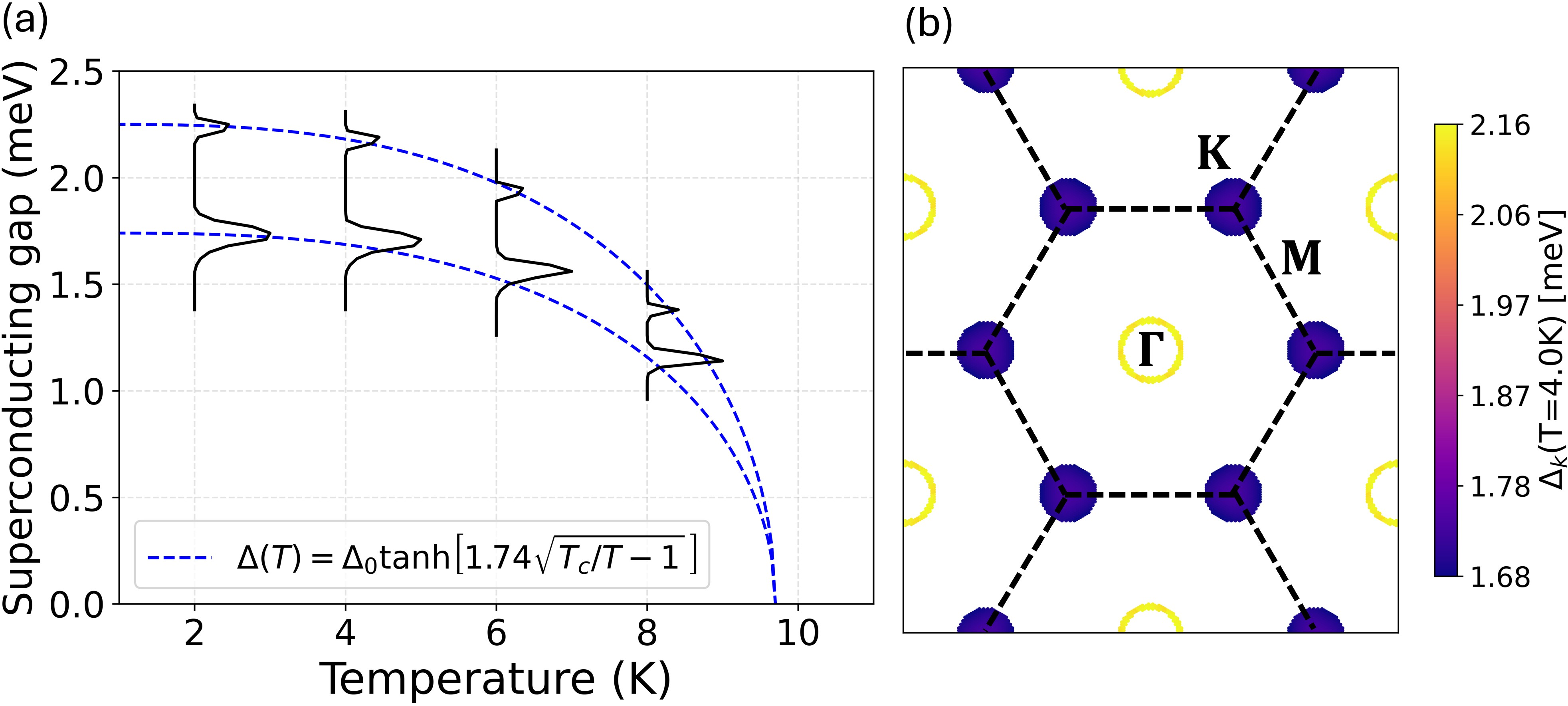
Figure 6: Two-gap superconducting structure as a function of temperature, with gap anisotropy mapped to distinct Fermi sheets—a hallmark of multiband, strong-coupling superconductivity.
Theoretical and Practical Implications
The identification of BP₃ as a mechanically stable, strongly coupled, multiband superconductor with a=6.51 A˚1 K expands the landscape of 2D superconducting motifs beyond commonly explored metal borides and dichalcogenides. The combination of built-in polarity, mixed ionic-covalent bonding, and a=6.51 A˚2-hybridization facilitates robust EPC channels and supports nodeless two-gap superconductivity. These findings could inform the targeted design of novel low-dimensional superconductors where interband coupling and internal electric fields are engineered for tunable responses. Practically, BP₃ and structurally related compounds may be promising for electrochemical devices, quantum phase engineering, and fundamental studies of pairing in systems with intertwined orbital, lattice, and polarization effects.
Further exploration of external field tuning, interface effects, and controlled doping is warranted to investigate the potential for a=6.51 A˚3 enhancement and new superconducting ground states. Theoretical advances in first-principles modeling of complex EPC landscapes and interband scattering will also play a central role in guiding experimental implementation.
Conclusion
This study demonstrates that the hexagonal BP₃ monolayer is a robust, dynamically stable 2D material characterized by strong EPC and distinct two-gap superconductivity derived from multiband metallicity and hybrid a=6.51 A˚4 orbital participation. The calculated critical temperature of a=6.51 A˚5 K, combined with empirical gap ratios indicative of strong-coupling superconductivity, positions BP₃ as a prototypical material for exploring unconventional pairing in low-dimensional systems. The underlying mechanisms elucidated here highlight the role of orbital and lattice engineering in tailoring superconducting phenomena, with implications for both fundamental condensed matter physics and the development of nanoscale quantum devices.