- The paper introduces a Markov process-based MDR framework that incorporates multiple covariates to adjust for non-random recruitment in RDS.
- It generalizes existing prevalence estimators by replacing degree-based weights with MDR-adjusted ones, effectively reducing bias and variance.
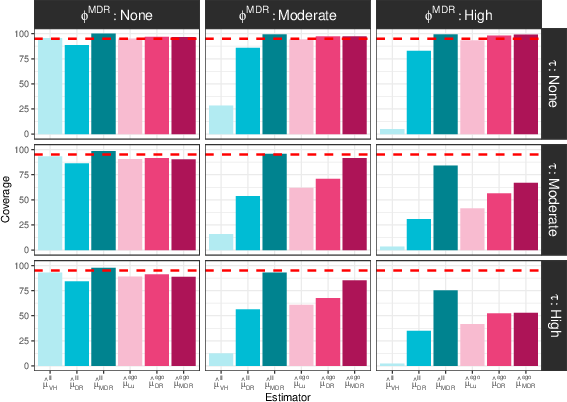
- Simulation and empirical studies demonstrate that MDR-corrected estimators achieve improved confidence interval coverage and lower estimation error under strong recruitment biases.
Multivariate Differential Recruitment Inference in Respondent-Driven Sampling
Introduction and Motivation
Respondent-Driven Sampling (RDS) is the prevailing methodology for estimating population characteristics in hidden or hard-to-reach populations, relying on a peer recruitment process over an underlying social network. Traditional inference in RDS assumes random peer recruitment, but empirical evidence consistently demonstrates systematic recruitment preferences—described as differential recruitment (DR)—where participants favor certain groups or alter attributes. Existing statistical remedies to DR are almost exclusively univariate, typically limited to modeling recruitment preferences for a single categorical variable. However, in real-world applications, recruitment is often simultaneously influenced by multiple continuous and categorical covariates.
The paper "Inference from multivariate differential recruitment in respondent-driven sampling data" (2604.10018) advances RDS methodology by formalizing Multivariate Differential Recruitment (MDR), providing new model-based estimators that directly incorporate multiple, arbitrary covariates driving non-random recruitment. This addresses a key source of non-sampling error in RDS estimation, with significant implications for prevalence estimation, variance quantification, and study design in epidemiology and network-based surveys.
MDR Framework: Markov Process and Stationary Distribution
The central contribution is a Markov process-based generalization of the RDS recruitment process. Let xij denote a vector of recruitment-related covariates (both node and dyad-specific, continuous or categorical). Recruitment by participant i among neighbors j is modeled as a discrete Markov chain with transition probabilities:
PijMDR=∑lyilexp(xilTβ)yijexp(xijTβ)
where yij encodes network connectivity and β is a vector of regression weights quantifying recruitment preferences.
The stationary distribution of this chain exists and is unique under mild connectivity assumptions, with probabilities proportional to:
πiMDR∝j∑yijexp(xijTβ+riTα)
where ri/ α summarize node-level effects. Sampling probabilities—crucial for unbiased prevalence estimation and valid weighting in HT/Hájek-type estimators—are derived from πiMDR, with i0 estimated by likelihood maximization over observed recruitment data.
Extended MDR Estimators and Uncertainty Quantification
The MDR formalism is integrated into standard RDS estimators, notably the Volz-Heckathorn (VH) and Lu ego-network (Lu-ego) prevalence estimators. The MDR-adjusted estimators replace degree-based or univariate DR-based weights with those derived from the MDR stationary distribution, leading to:
i1
where i2 is sample inclusion, i3 is outcome, and i4 is the estimated sampling probability.
Analogous generalization occurs for ego-type estimators, updating all predominant RDS prevalence estimators for MDR.
Bootstrap-based variance estimation is also adapted, via a modified neighborhood bootstrap (NB) algorithm, ensuring that replicates mirror complex dependencies in recruiter-recruitee ties and maintaining fixed sample size.
Simulation Study: Bias, Variance, and Coverage
A comprehensive simulation study evaluates the MDR estimators against classical (VH, Lu) and univariate DR-corrected variants. Networks with varying degree of homophily on age, and multiple recruitment covariates influencing recruitment (age, infection status, age-difference, interaction), are generated.
Estimation error, RMSE, and 95% coverage across nine combinations of homophily and MDR strength are systematically assessed.
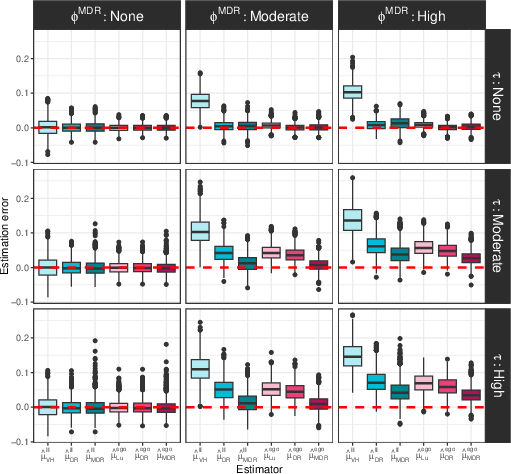
Figure 1: Estimation error for each estimator under different configurations of homophily and MDR. MDR-adjusted estimators demonstrate minimal bias regardless of scenario, while classical estimators show marked bias as MDR strength increases.
Key findings:
Empirical Application: RDS Among Venezuelan Immigrants
The methodology is applied to a real RDS dataset: Venezuelan nationals aged 18+ in Santiago, Chile. The prevalence of male gender is estimated, with high-dimensional MDR modeled via age, gender, and age difference.
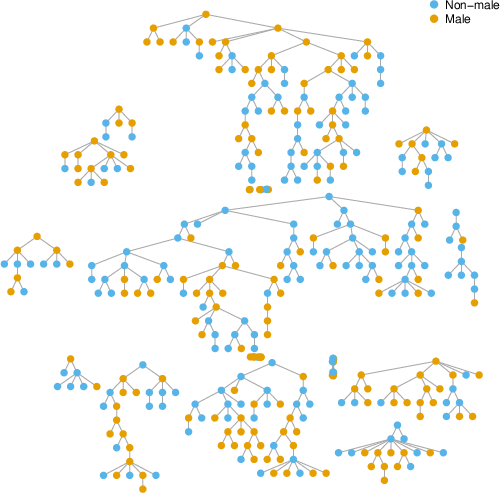
Figure 3: Recruitment tree visualization of the empirical RDS sample, with recruiter and gender status encoded by node color.
In both original and covariate-perturbed datasets (the latter imposing stronger artificial MDR), classical estimators deviate considerably, while MDR-corrected estimators not only display reduced bias, but also substantially lower standard errors, particularly for ego-type variants. This demonstrates the practical consequences of ignoring MDR and the value added by collecting recruiter-alter covariate information.
Implications and Theoretical Contributions
The MDR framework represents a substantive generalization of network sampling inference. It relaxes the restrictive assumption that DR can be adequately modeled by a single attribute, accommodates arbitrary covariate effects—including network tie-level predictors—and provides a statistically rigorous mechanism to adjust for and quantify the influence of complex recruitment preferences. The MDR formalism directly addresses the primary mode of non-sampling error in RDS analyses.
From a practical perspective, this framework recommends systematic collection of alter-level covariate data in RDS implementations and motivates development of tools for imputation or reconstruction in partially observed settings. Moreover, it lays the foundation for principled analysis of additional sources of RDS error (e.g., non-response or misreporting) within a unified network-based inferential framework.
Future research directions include robust estimation when alter covariate information is partially observed or missing, extension to longitudinal or multiplex network settings, and adaptation to nonparametric models of recruitment preference.
Conclusion
The MDR Markov process formalism and corresponding prevalence estimators presented in this work constitute a significant extension to RDS inference, improving estimator robustness to realistic, simultaneous recruitment biases. Simulation and empirical applications demonstrate superiority in bias, variance, and interval coverage relative to standard practice. The practical utility of this approach depends on collecting or reconstructing alter-level data, the careful modeling of recruitment mechanics, and ongoing methodological extension to accommodate partially observed or dynamically evolving network structures.