- The paper demonstrates that decreasing DM particle mass results in DM-dominated halos that embed a stable ~2–2.5 M⊙ neutron star core.
- It employs a two-fluid TOV framework using RMF for neutron matter and a Fermi gas EOS for DM to capture both strong and weak interaction regimes.
- A derived m_D⁻² scaling law accurately predicts maximum DM mass and connects DANS configurations to supermassive black hole analogs like Sgr A*.
Supermassive Dark Objects with Neutron Star Cores: Structure and Implications of Light Fermionic Dark Matter Admixture
This work addresses the equilibrium structure of dark matter admixed neutron stars (DANSs) in the regime of light fermionic dark matter (DM), extending the analysis to mD∈[10−10,1] GeV. The system is modeled as a two-fluid configuration, where neutron matter (NM) and DM interact solely via gravity, each governed by coupled Tolman-Oppenheimer-Volkoff (TOV) equations. The DM is treated as a non-annihilating, self-interacting Fermi gas, with the equation of state (EOS) parameterized by DM mass mD and an interaction parameter y distinguishing strong (SI) and weak (WI) interaction scenarios. For NM, a density-dependent relativistic mean-field (RMF) treatment with the DDME2 parameter set is employed.
The DM EOS exhibits a crossover from degeneracy-dominated (p∼ε/3) to interaction-dominated (p∼ε) regimes, with the causal limit determined jointly by mD and the interaction scale mI.
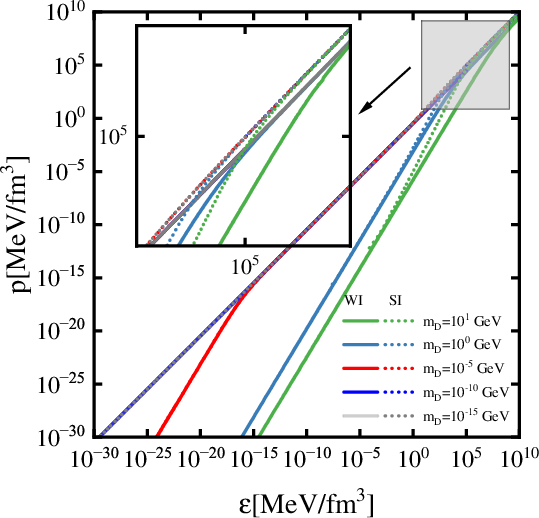
Figure 1: DM EOSs for SI (solid) and WI (dotted) cases, pressure vs. energy density, for various mD.
Structural Properties of DANSs with Light DM
A central result is the emergence of DM-dominated stellar configurations as mD decreases below 10−1 GeV. For such values, a traditional mD02--2.5mD1 neutron star core becomes embedded within a vast DM halo, which can attain supermassive spatial and mass scales. The mD2-mD3 and mD4-mD5 profiles for both DM and NM, resolved for SI/WI forms and spanning six orders of magnitude in mD6, reveal threshold behavior. At high mD7, DM accumulation remains subdominant; at low mD8, DM halo masses reach up to mD9 with radii y0 km, while the NM core is unaffected.
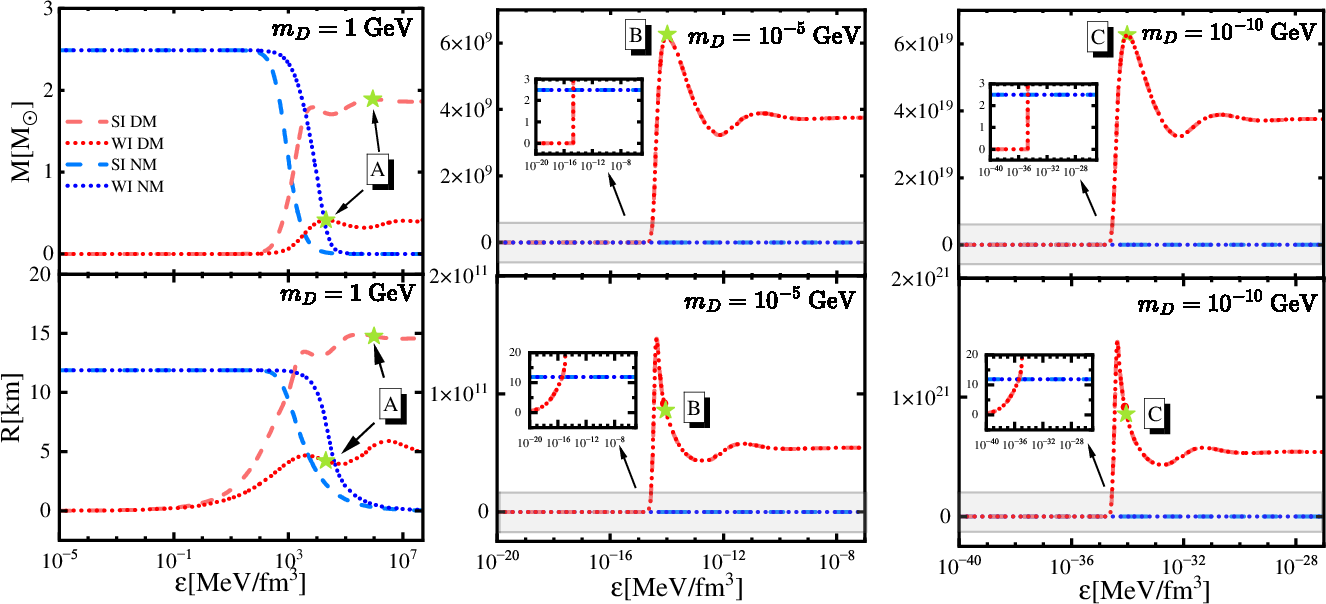
Figure 2: NM/DM mass and radius as a function of DM central energy density at various y1; the neutron star core remains nearly constant while the DM halo grows with decreasing y2.
The analysis of energy and mass distributions as a function of radial coordinate for specific extremal configurations highlights a supermassive DM object embedding an unchanged neutron star core. Cases (B) and (C) in the study explicitly demonstrate DM halos whose physical properties—mass and radius—map closely to that of galactic supermassive black holes (SMBHs).
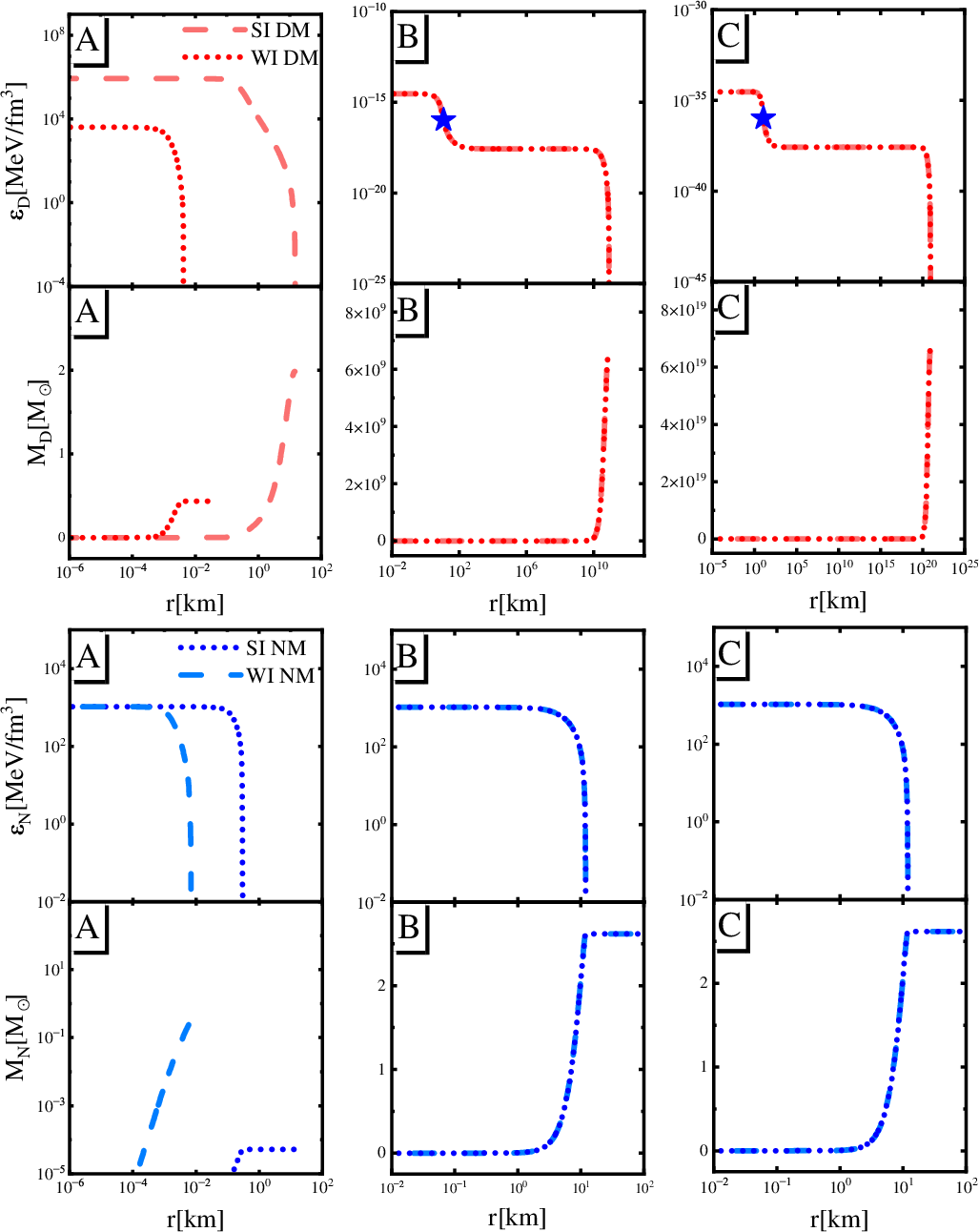
Figure 3: Radial profiles of energy density and cumulative mass for DM and NM in three DANS cases; abrupt DM density transition demarcates the neutron star core boundary.
Maximum Mass Scaling and Empirical Law
A key numerical result is the explicit scaling law for the maximal stable DM mass in these admixtures:
y3
This y4 scaling, analytically derived (from the Fermi gas TOV solution), is observed to persist from y5 GeV to y6 GeV, regardless of interaction strength (SI/WI distinction suppressed at light y7). Stronger interactions become relevant only for heavier DM.
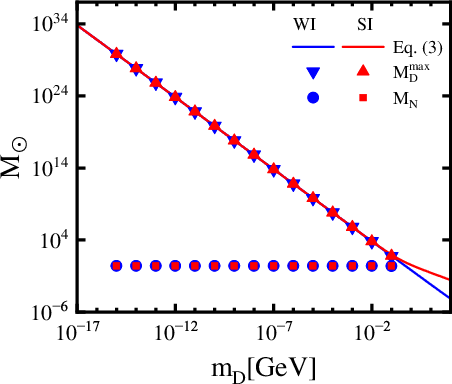
Figure 4: Maximum DM and NM mass as a function of DM mass y8; blue/red points (SI/WI) closely track the empirical y9 curves.
As p∼ε/30 decreases, the DANS structure transitions unequivocally to DM-dominated halos, with NM core mass and radius essentially decoupled from the DM configuration.
Sgr A* as a DANS Analog and Astrophysical Implications
The study draws a direct connection between DANSs with p∼ε/31 GeV and known SMBHs such as Sgr A*. The mass and Schwarzschild radius of the DM halo in such DANSs reproduce the global parameters of Sgr A*, provided the DM particle mass sits in the sub-MeV keV--MeV range.
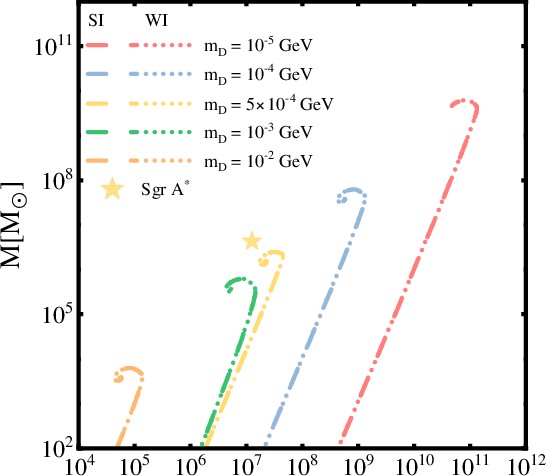
Figure 5: Mass-radius relation for supermassive DM objects at various p∼ε/32; the observed values for Sgr A
coincide with
p∼ε/33 near 500 keV, as marked by the gold star.*
The presence of a neutron star core at the center of these supermassive DM halos is a central distinction from prior pure-DM compact object models (e.g., the Ruffini-Argüelles-Rueda, RAR, scenario). The suggestion is that neutron stars could function as "gravitational seeds" for DM accretion and assembly of such supermassive objects, a scenario with nontrivial consequences for the internal structure and observable characteristics (e.g., potential deviations in gravitational lensing, photon ring profiles, or accretion signatures).
From a theoretical perspective, the study establishes that self-gravitating DM objects with embedded neutron star cores span the parameter space necessary to mimic observed SMBHs in mass and size. However, the dynamic feasibility—whether such DM halos can form via astrophysical accretion onto neutron stars over cosmic timescales—remains an open question. Future progress will require improved modeling of DM capture and continued cross-correlation with astronomical observations and direct DM searches.
Conclusion
By systematically modeling DANSs with light, self-interacting, non-annihilating fermionic DM, the paper demonstrates that maximum mass configurations exhibit an inverse-square p∼ε/34 dependence, permitting supermassive DM halos embedding a constant neutron star core at sufficiently low p∼ε/35. This scenario generates configurations that closely parallel observed galactic SMBHs if p∼ε/36 GeV. The results suggest a potential unification of neutron star and SMBH phenomenology within the context of light DM admixtures, contingent on unresolved astrophysical formation mechanisms and subject to forthcoming observational constraints.