- The paper presents a novel GPU-accelerated continuous-time successive convexification framework that unifies high-fidelity contact dynamics with scalable real-time performance.
- The paper employs integral cross-complementarity and time dilation with C¹ control parameterization to accurately enforce contact mode transitions using coarse discretization.
- The paper demonstrates significant computational speedups and improved gait performance on monoped and biped models, highlighting potential for hardware deployment.
Introduction and Motivation
This paper presents a novel framework for contact-implicit trajectory optimization (CITO) applied to legged locomotion, targeting the intersection of trajectory accuracy, computational efficiency, and physical realism. Traditional CITO methods depend heavily on fine time discretization to accurately capture contact events, resulting in high-dimensional optimization problems and increased computational burdens. The authors address these limitations by deploying a continuous-time version of sequential convex programming (SCP), named 0.7, augmented with innovations in constraint enforcement and GPU-based acceleration. The key technical aim is to unify high-fidelity contact dynamics modeling with scalable, real-time computational performance.
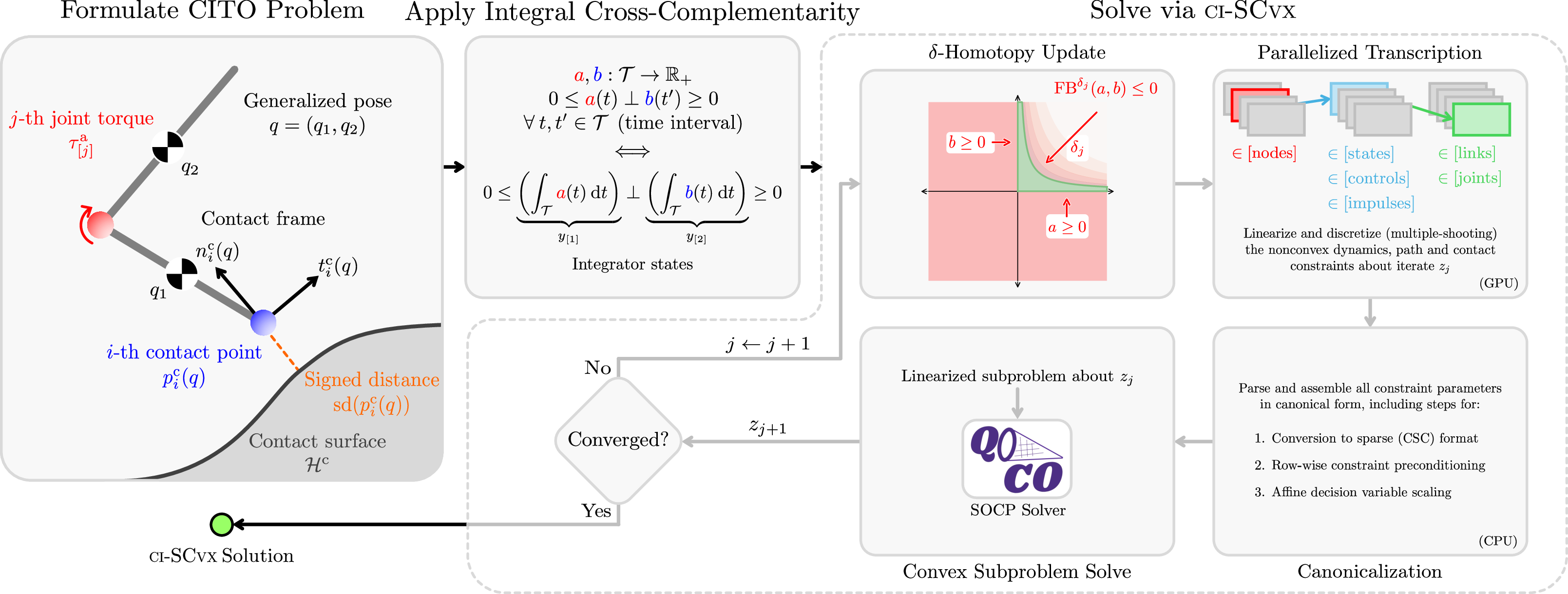
Figure 1: Overview of the proposed framework, including problem formulation, integral cross-complementarity, and the 0.7 algorithm.
Technical Framework
The method employs a maximal-coordinate formulation for multibody robot dynamics, including stick-slip friction and partially elastic impacts. Contact points are tracked using smooth approximations, and the contact force model adheres to the maximum dissipation principle with complementarity constraints enforced for both normal and tangential directions.
Key to the approach is formulating and solving these dynamics in continuous time, rather than relying on grid-locked discrete-time approximations. The resultant state and control dimensions are increased, but the formulation’s inherent sparsity is leveraged for highly parallelizable computation on GPUs.
Integral Cross-Complementarity
A primary methodological advancement is the introduction of integral cross-complementarity constraints, which guarantee that contact mode switches (i.e., transitions between stick, slip, and no-contact) only occur at predefined grid nodes. This is achieved by replacing pointwise-in-time constraints with integral equivalents and encoding them within auxiliary dynamical systems. This ensures that transitions are not missed between grid intervals, even with coarse time discretization, a problem that plagues previous contact-implicit methods.
Time Dilation and Control Parameterization
To retain flexibility in the contact sequence and mitigate discretization artifacts, the framework employs time-dilation. This allows adaptive stretching or shrinking of time intervals, so the temporal grid does not unduly constrain feasible gaits. The control inputs are parameterized using basis functions that support C1 continuity within intervals, which facilitates robust enforcement of friction and kinematic constraints.
Optimization and Numerical Solution
The resulting CITO problem is highly nonconvex due to the presence of complementarity and hybrid dynamics. Successive convexification (SCP) is employed, using a prox-linear model and exact penalization of nonconvexities. To ensure convergence with complementarity relaxations, a backtracking homotopy scheme is embedded within SCP. Here, the Fisher-Burmeister function is used to smoothly relax the complementarity conditions; the tightness of relaxation is adaptively and progressively decreased, with temporary backtracking when lack of progress is detected.
To achieve real-time viability, the authors implement transcription, linearization, and constraint assembly on the GPU using JAX, exploiting the sparsity and interval-based parallelizability of the problem. A custom parser directly generates canonical-form SOCPs, bypassing CVXPY, further accelerating the solve phase. All sparsity structures are preserved for fast solver input preparation.
Experimental Validation
Monoped Locomotion
The framework is first demonstrated on monoped locomotion across a flat surface. The optimized gait (see below) is energy-minimizing, exhibiting predominantly impulsive contacts except where persistent ground engagement is required for maneuvering. The optimization resolves high-dimensional contact events using only a coarse discretization (N=15), highlighting the efficacy of integral cross-complementarity.
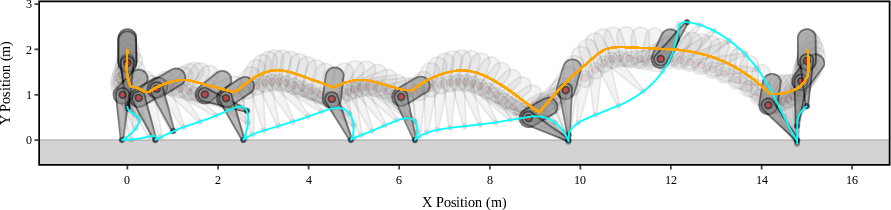
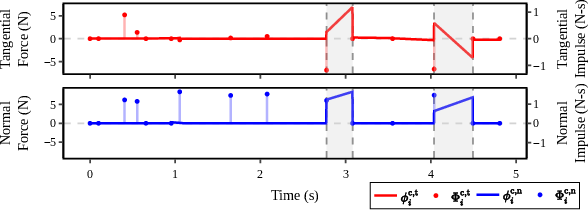
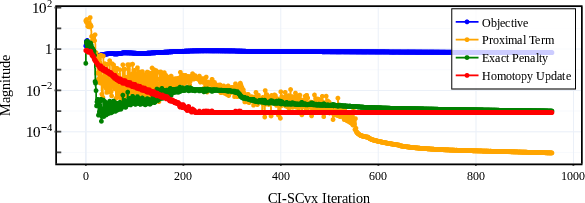
Figure 2: Gait produced by a monoped locomotion solution. The path of the center of mass (CoM) of the upper leg is shown by the orange trace.
Convergence behaviors illustrate the reliable progression of the tightness parameter under backtracking homotopy, and typical trajectories are obtained in roughly 40 seconds over approximately 800 SCP iterations.
Biped on Uneven Terrain
A more complex biped traverses a sinusoidal surface, showcasing the automatic selection of stick and slip contact regimes along uneven terrain. The approach flexibly determines contact mode sequences, with tangential velocities and Lagrange multipliers reflecting both sticking and slipping phases without requiring extensive contact event tuning.
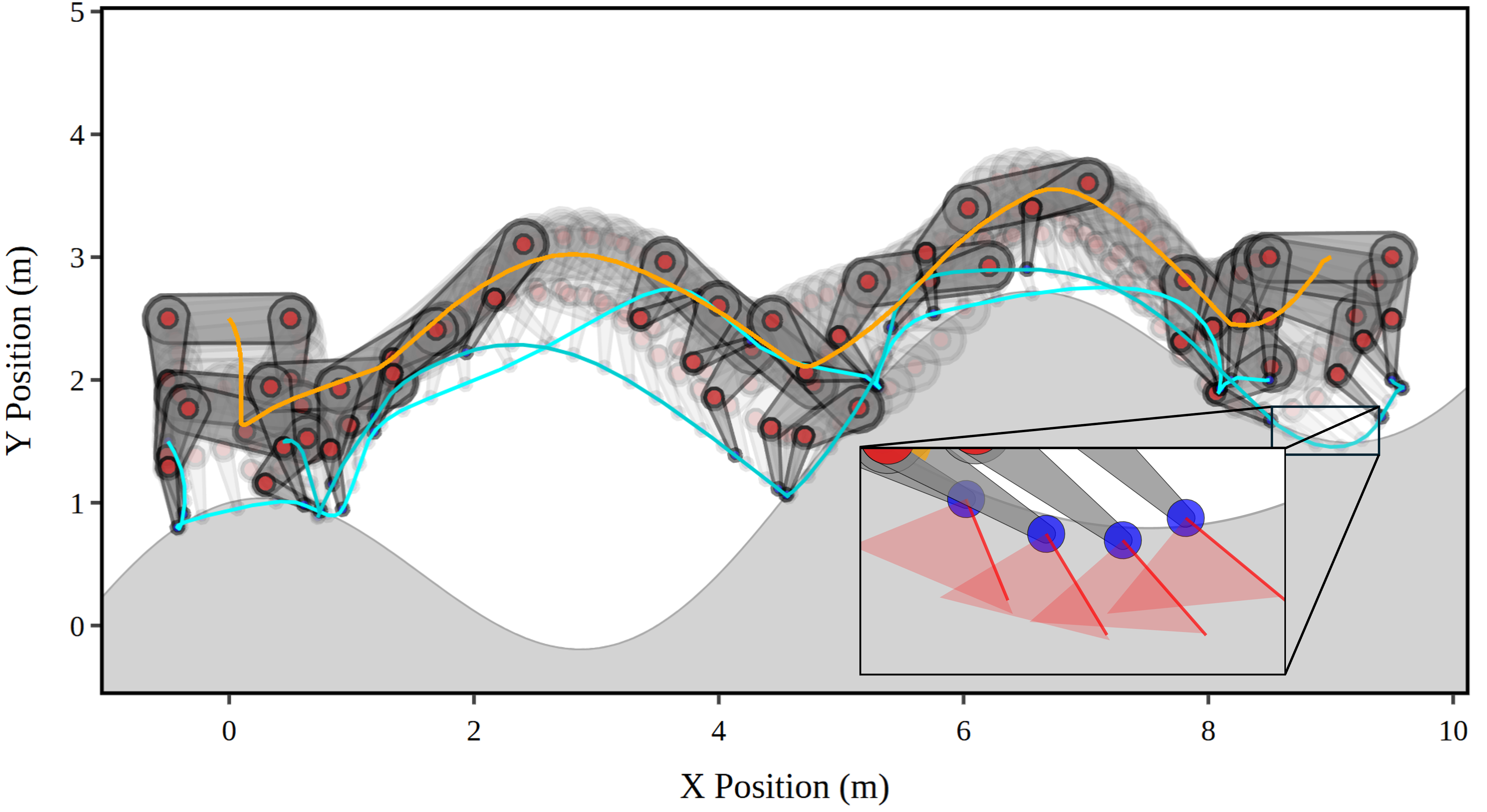
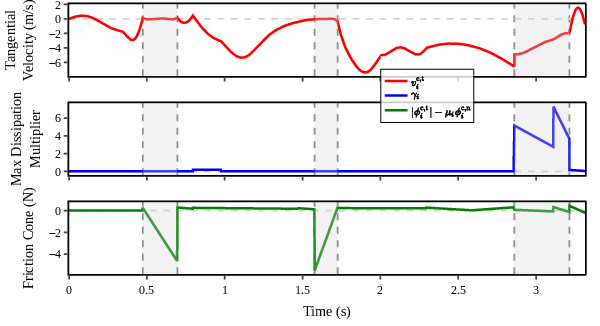
Figure 3: Gait produced by a biped locomotion solution. The path of the torso CoM is shown by the orange trace.
MuJoCo Demonstration and Comparative Analysis
Deployment in the Gymnasium HalfCheetah MuJoCo environment facilitates a comparison with the MuJoCo MPC (MJPC) baseline. The 0.7-optimized trajectories serve as feasible inputs to closed-loop model predictive control, yielding gaits with improved energy efficiency (10.52% reduction in cumulative torque) and a 6.64% improvement in standard environment reward—without additional reward shaping.

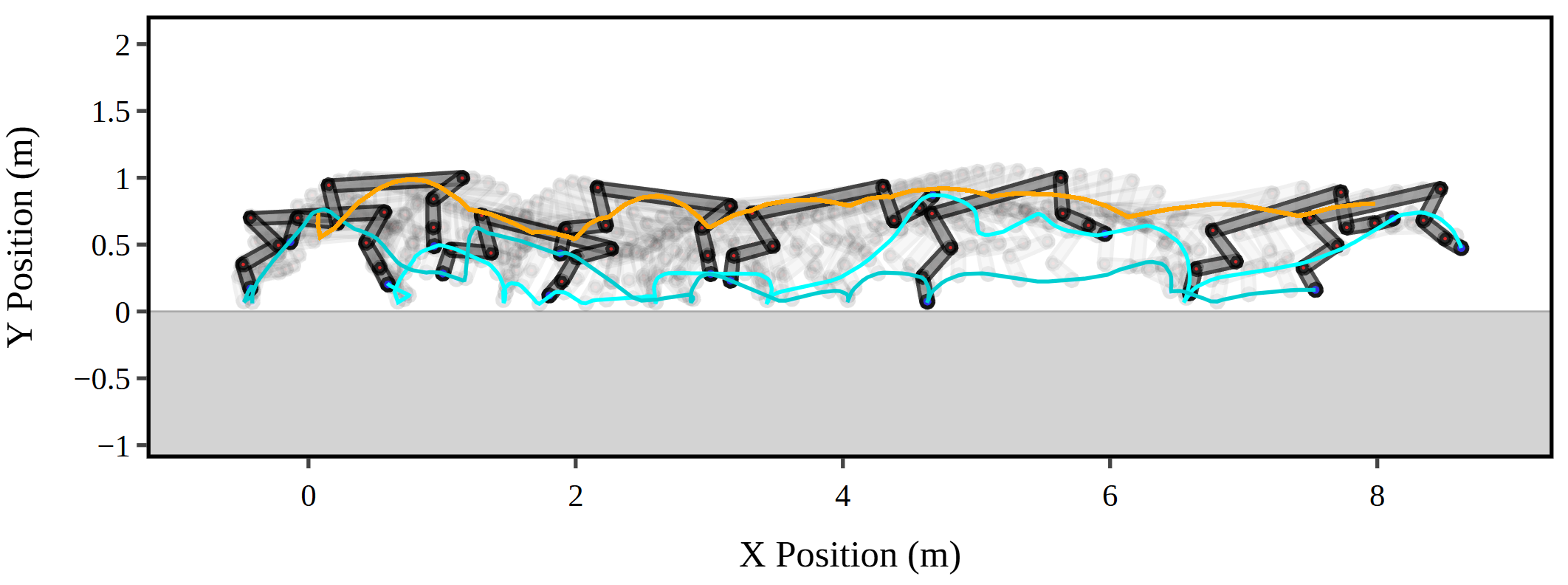
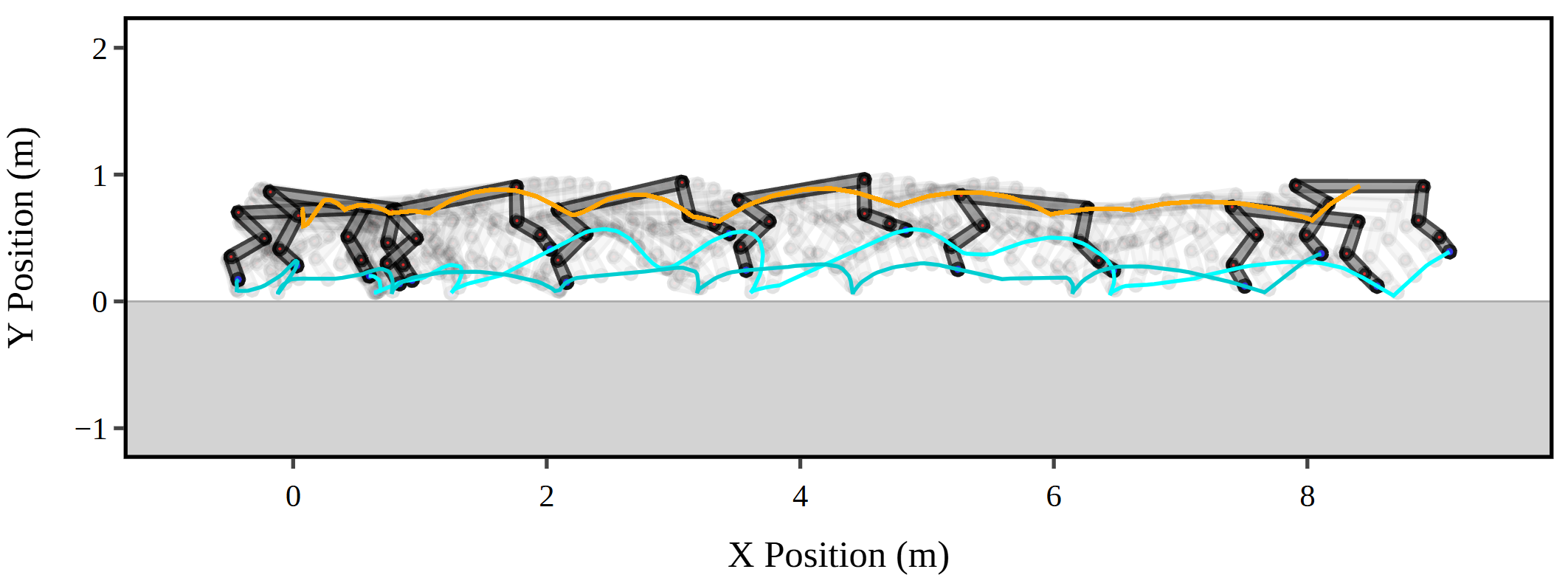
Figure 4: Snapshots of the MJPC-tracked 0.7 solution visualized with Gymnasium.
Timing and Scalability
A direct comparison to OpenSCvx, a state-of-the-art SCP toolbox, demonstrates substantial computational gains: the new framework achieves speedups of approximately 6× (monoped) and 19× (biped). Notably, the baseline fails to handle further model complexity due to CVXPY’s parsing overhead, while the proposed approach retains scalability.
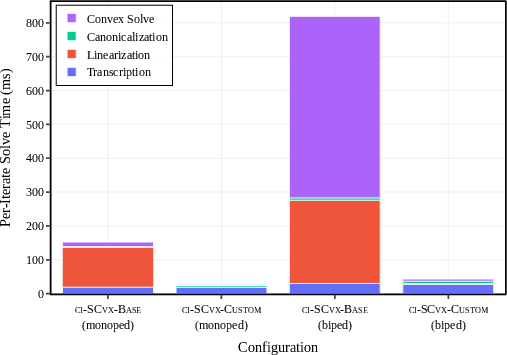
Figure 5: Timing results comparing the proposed 0.7 implementation against the baseline 0.7.
Implications and Future Directions
The synthesis of continuous-time integral cross-complementarity and GPU-accelerated SCP addresses longstanding issues in CITO for legged locomotion—namely, the need for fine discretization to avoid missed contacts, and the computational intractability of high-fidelity models. By demonstrating high-accuracy, real-time-feasible trajectory optimization with physically consistent contact behaviors, the framework enables application in both simulation and potential hardware deployment, especially in scenarios requiring rapid replanning or adaptation to complex contact sequences.
The paper’s methodological advancements are likely to influence further extension to 3D legged models, manipulation, and broader classes of hybrid dynamical systems. The approach's reliance on maximal coordinates and parallelization suggests that even more complex multi-contact scenarios remain within the reach of real-time optimization, provided advances in GPU capabilities continue. Open issues include further reducing runtime through improved homotopy adaptation strategies, integrating learning-based warm starts, and expanding benchmarking against advanced direct and indirect optimal control solvers.
Conclusion
This work establishes a new benchmark for contact-implicit trajectory optimization by unifying continuous-time constraint enforcement, real-time GPU-based computation, and robust optimization of physically valid legged gaits under sparse time discretization. The experimental results corroborate the theoretical advantages regarding both trajectory quality and solution speed. The framework is well-positioned for scaling to more complex robot morphologies and richer contact environments, supporting both practical robotics applications and future theoretical developments in hybrid optimal control.