- The paper proposes a diff-based scale loss ensuring strictly monotonic gradients, promoting stable and accurate target scale prediction.
- It integrates a Gaussian-shaped spatial attention with a rotated pinwheel mask to capture IR target intensity patterns and directional features.
- Experiments on standard IRSTD benchmarks demonstrate significant improvements in mIoU, detection probability, and false alarm rates compared to previous methods.
Revisiting Scale Loss and Gaussian-Shaped Convolution for Infrared Small Target Detection
Introduction and Motivation
Infrared small target detection (IRSTD) remains a technically challenging computer vision problem, particularly relevant for applications in surveillance, autonomous navigation, and defense. The unique constraints—tiny target scale (typically spanning a few pixels), low SNR, and lack of discriminative features—render generic object detection and segmentation frameworks inadequate for IR data. The paper "Revisiting the Scale Loss Function and Gaussian-Shape Convolution for Infrared Small Target Detection" (2604.09991) identifies two persistent limitations in recent IRSTD methods: (1) conventional scale losses induce unstable training due to their non-monotonic penalty landscape, and (2) standard convolutional spatial attention disregards the physical intensity and morphology priors particular to IR small targets.
Monotonic Diff-Based Scale Loss
A principal contribution is the introduction of a diff-based scale loss that re-weights the soft IoU with a strictly monotonic area-discrepancy factor. Unlike previous variance-based scale penalties, which induce local optima and oscillatory gradients, the proposed loss ensures smooth, directed convergence toward optimal scale alignment between prediction and ground truth.
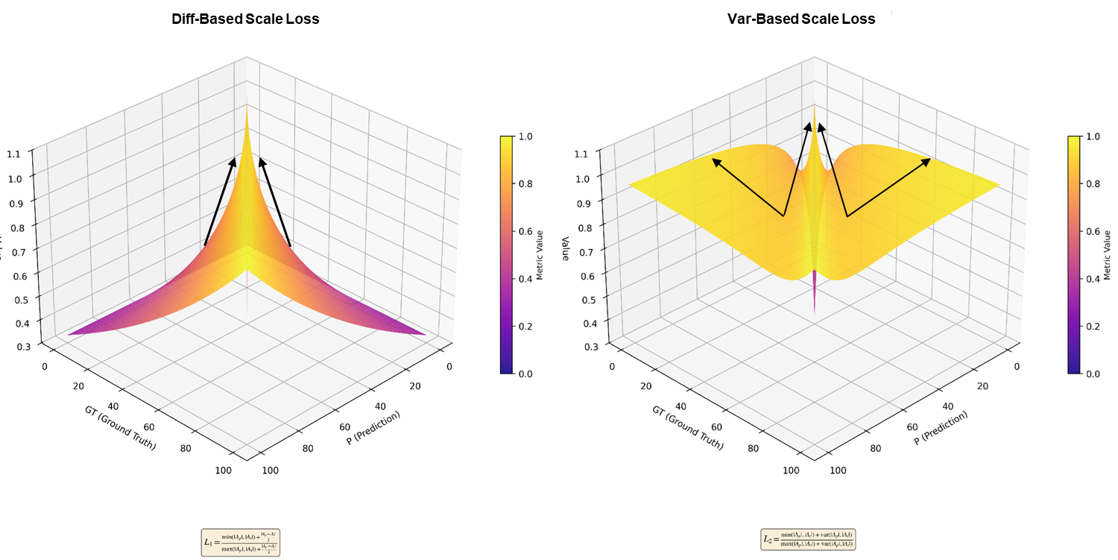
Figure 1: The diff-based scale loss yields strictly monotonic, stable gradients across the prediction-target area discrepancy, promoting convergence to correct target scale.
The authors formalize the diff-based scale weight as
α=max(Ap,At)+∣Ap−At∣/2min(Ap,At)+∣Ap−At∣/2
where Ap and At denote the predicted and ground-truth mask areas, respectively. The overall loss becomes 1−α⋅IoU+Lloc, where Lloc provides a centroid-based location penalty. Systematic ablation confirms strict monotonicity is critical for eliminating gradient oscillations and spurious optima prevalent in the non-monotonic (variance-based) alternatives, directly translating into improved stability and accuracy during training.
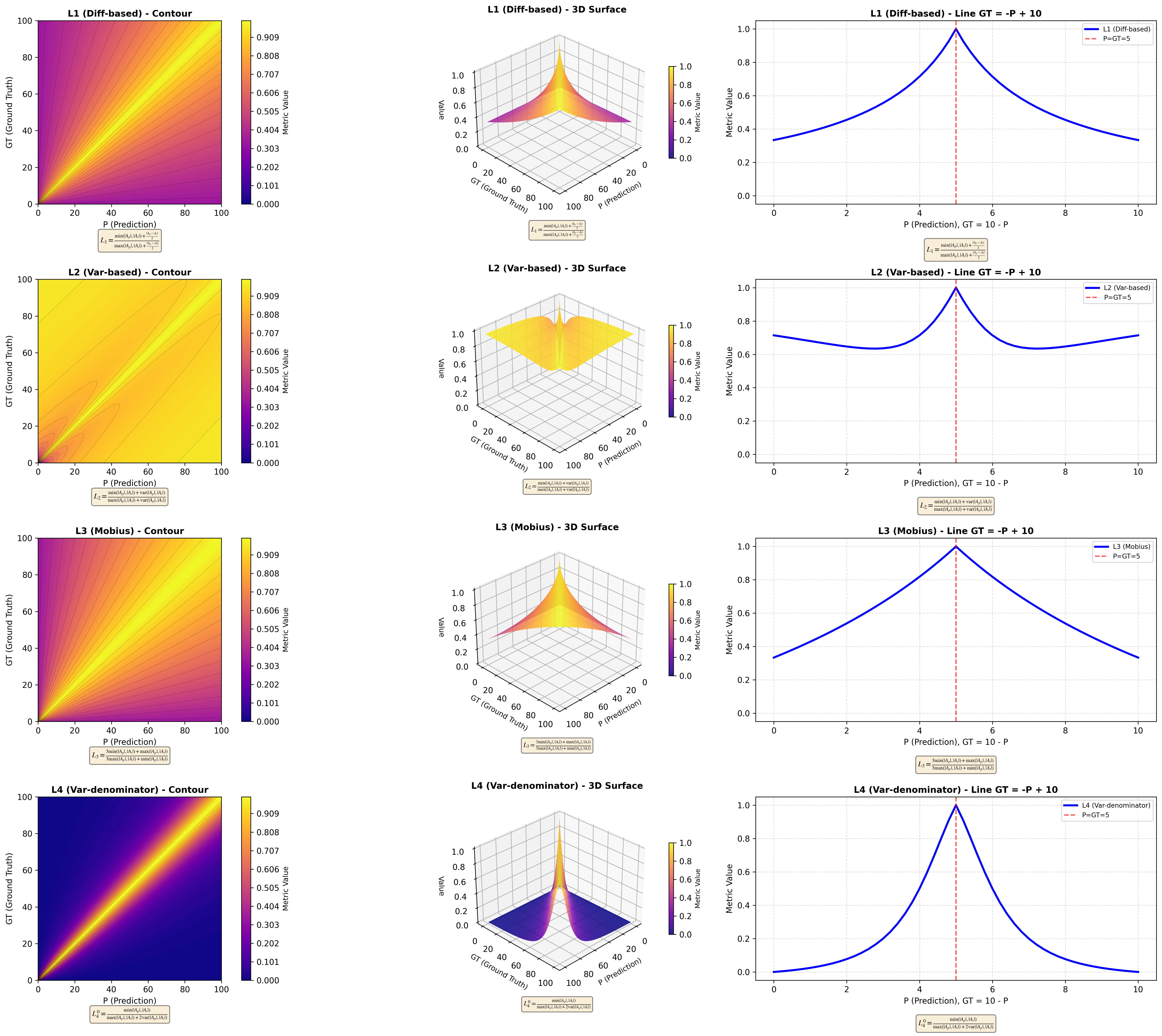
Figure 3: Visual comparison of four weighting functions; only the diff-based loss produces a smooth, monotonic surface, guaranteeing robust optimization behavior.
Gaussian-Shaped Spatial Attention and Pinwheel Mask Design
Another key technical advancement is the adoption of a Gaussian-shaped spatial attention kernel, parameterized by a learnable scale σ and modulated by a rotated pinwheel mask. This approach is motivated by empirical observations that IR small targets exhibit a center-bright and radially decaying intensity pattern, well-approximated by a Gaussian profile.
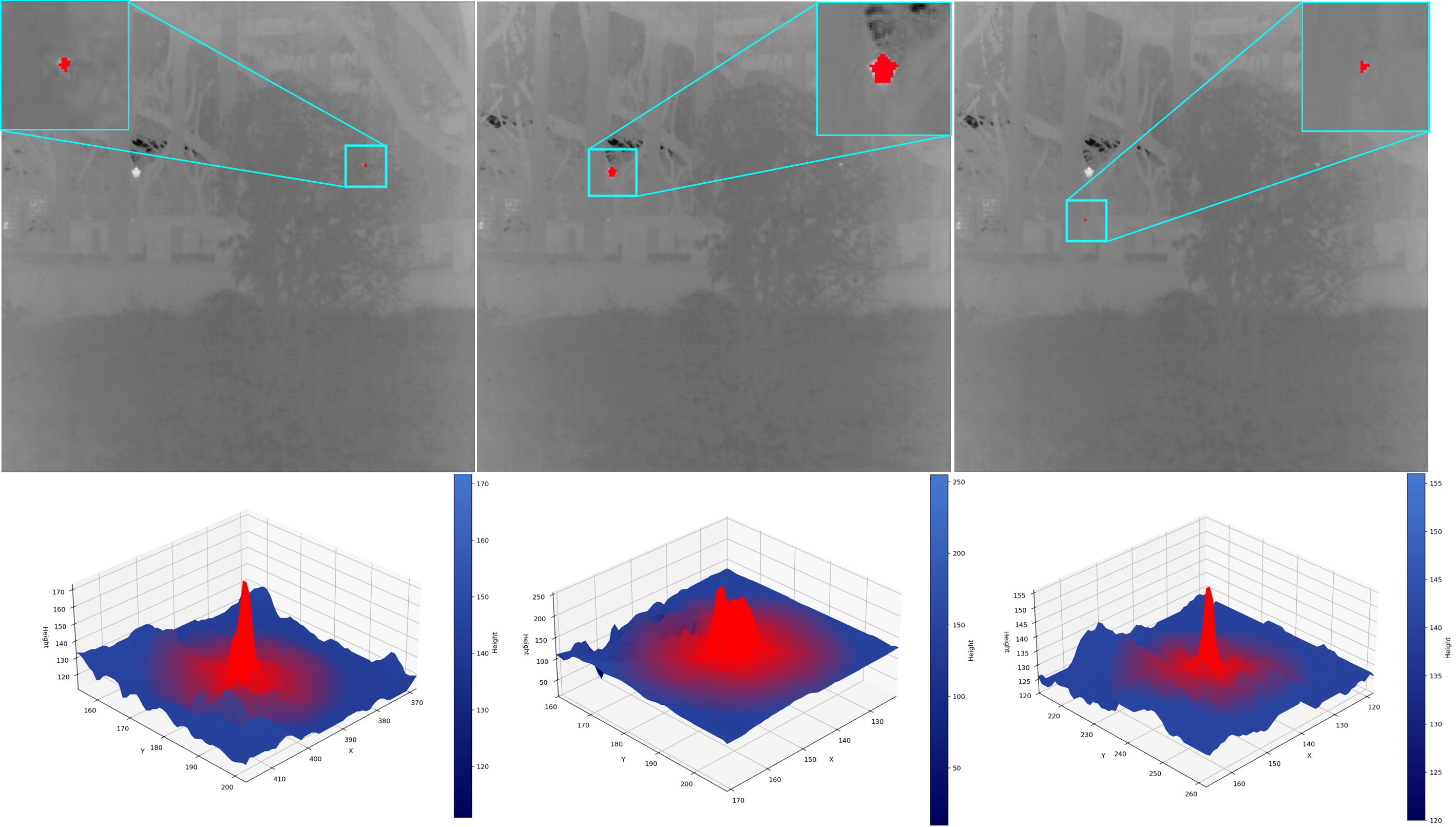
Figure 4: Infrared small targets characteristically display a Gaussian-like, center-concentrated intensity, justifying a spatial attention mechanism with a Gaussian prior.
However, many targets also manifest directional elongation (e.g., due to motion blur, sensor characteristics, or actual object shape). The pinwheel mask is designed as a binary directional strip—implemented via a differentiable straight-through estimator—allowing the kernel's dominant orientation to be optimized end-to-end during training.
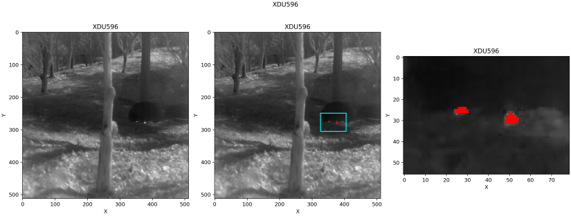
Figure 5: The rotated pinwheel mask enables anisotropic, directionally adaptive spatial attention, aligning the kernel with target morphology.
The final 7×7 kernel is the product of the Gaussian prior and the binary/differentiable pinwheel mask, effectively encoding both the generic intensity prior and the locally dominant direction of the observed IR target.
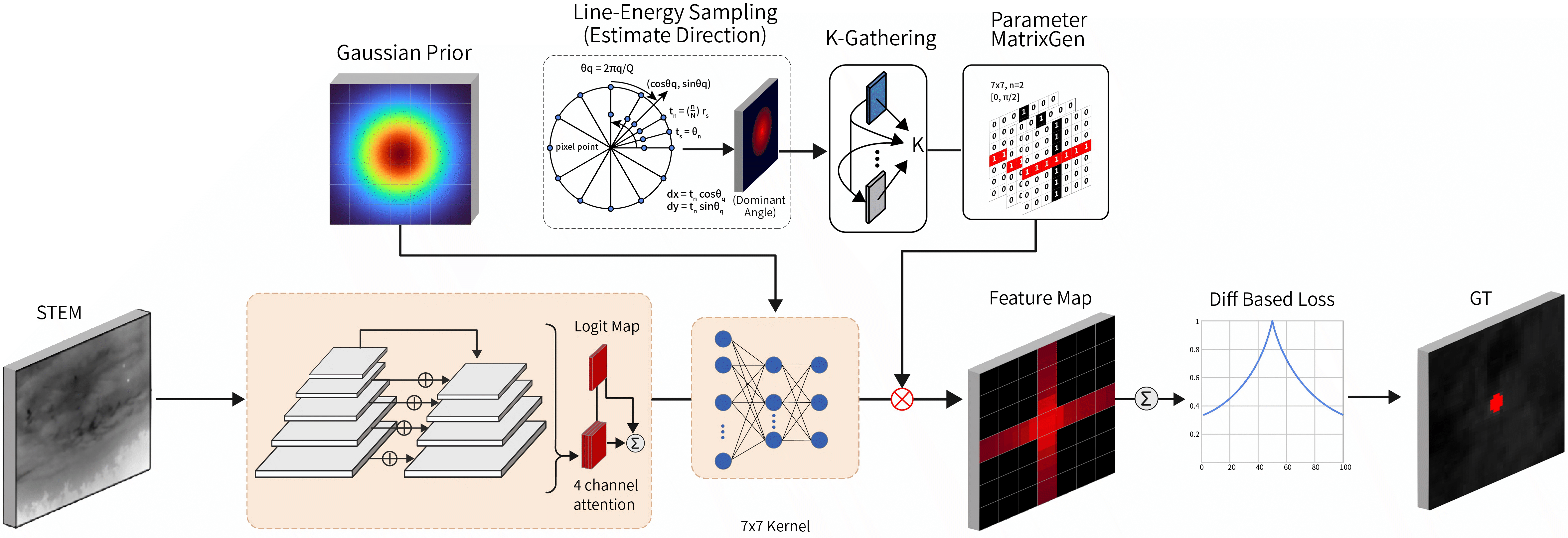
Figure 2: Overall framework architecture, integrating U-Net backbone, channel attention, and the proposed Gaussian + pinwheel spatial attention. Final mask prediction is optimized using the diff-based scale loss.
Experimental Results and Ablations
Evaluations across three standard IRSTD benchmarks (IRSTD-1k, NUDT-SIRST, SIRST-UAVB) demonstrate that the combination of monotonic diff-based scale loss and Gaussian-shaped attention yields consistent improvements over strong recent baselines across mIoU, probability of detection (Pd), and false alarm rate (Fa). For example, on IRSTD-1k, the best configuration achieves 69.19% mIoU, 94.22% Pd, and Ap0 Ap1, outperforming prior state-of-the-art methods.
Qualitative results highlight that L1-GP-Rotated (i.e., diff-based loss plus Gaussian + rotated pinwheel attention) produces segmentations that are compact, with clean boundaries, minimal false positives, and reduced missed detections, particularly in noisy backgrounds and for elongated targets.
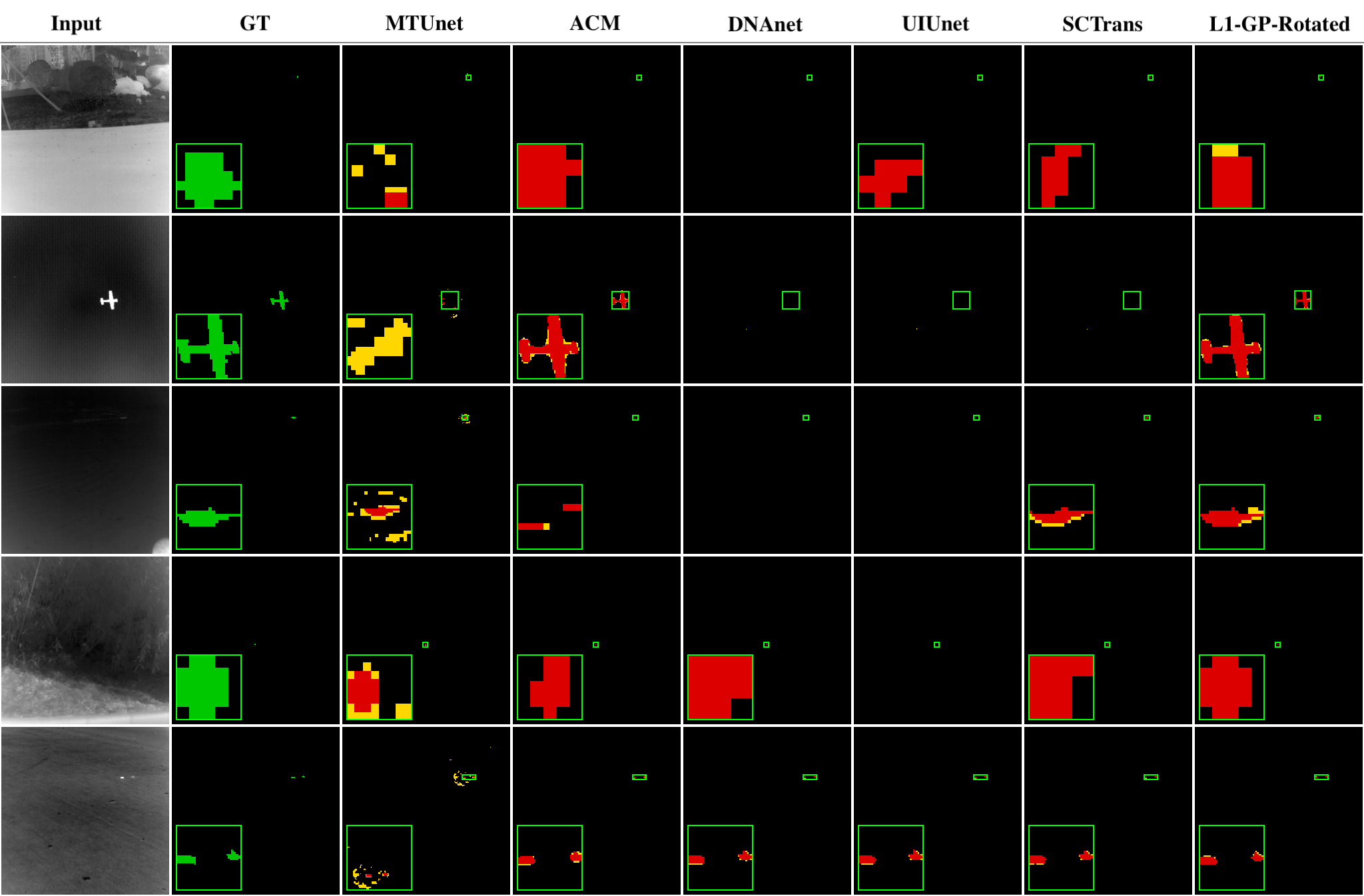
Figure 6: The proposed method achieves cleaner segmentation outputs and superior suppression of false alarms compared to baselines.
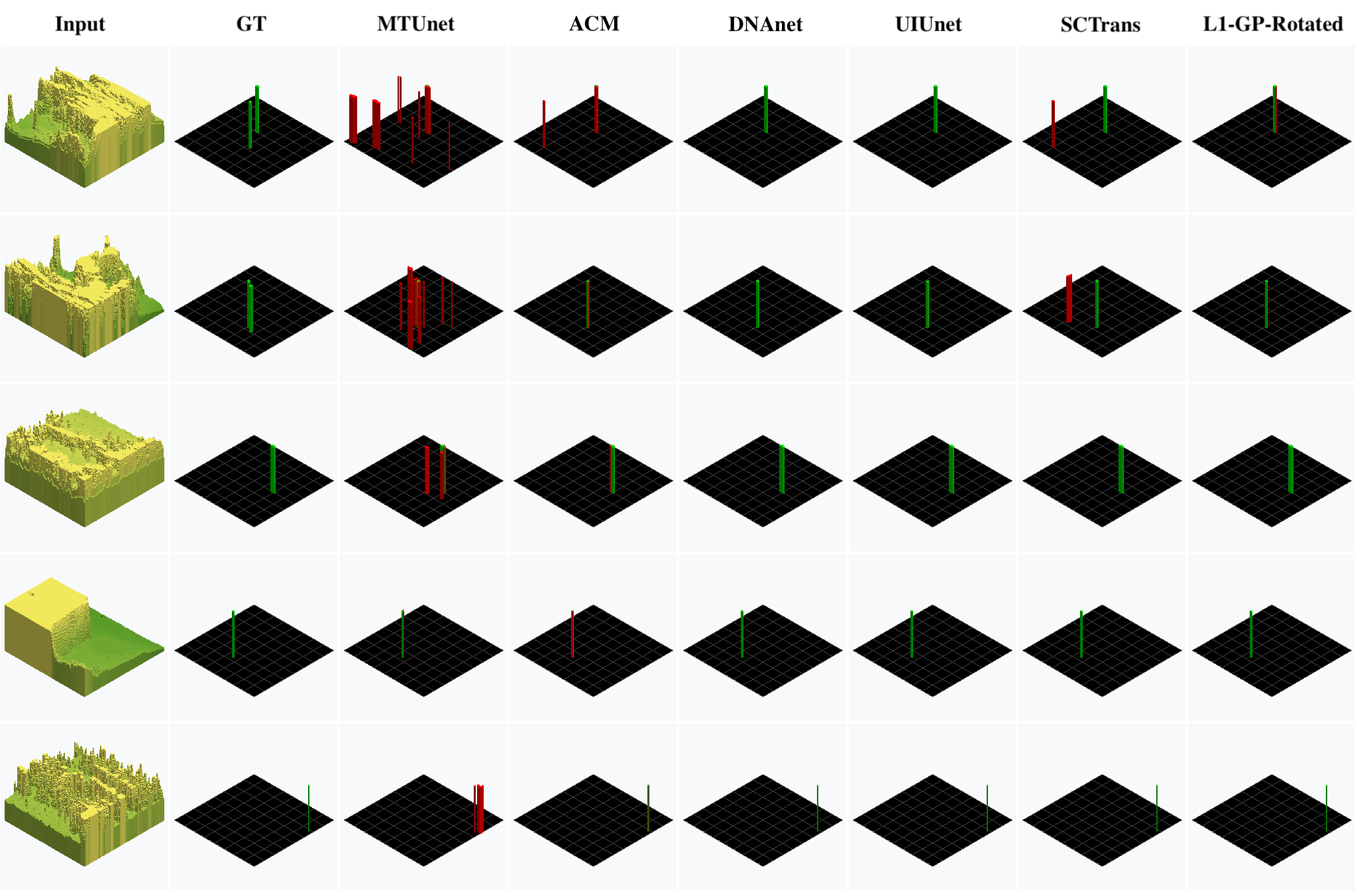
Figure 7: 3D heatmap comparison emphasizes the concentration of detection response at the true target location and suppression of spurious activations.
Systematic ablation further confirms:
- Strict monotonicity of the diff-based loss is necessary for stable, reliable convergence.
- Plug-and-play evaluations show immediate benefit when the Gaussian-shaped convolution replaces standard convs even in strong detection backbones (YOLOv8n, RetinaNet) without increased parameter count.
- Location regularization does not systematically increase false alarms, as shown by comparative experiments.
Implications and Future Directions
The results underscore the importance of loss design tailored to the peculiarities of IR small target morphology and the necessity of physically motivated inductive biases in spatial modeling. The proposed primitives—monotonic diff-based scale loss, Gaussian-shaped convolution, and directional pinwheel attention—are lightweight, interpretable, and broadly compatible with various backbone architectures.
Practically, the diff-based scale loss can be extended or further analyzed in other modalities that involve small, sparse detection regimes (e.g., medical imaging, remote sensing). The Gaussian + pinwheel kernel may inspire new attention mechanisms in contexts where spatial priors are strong but morphological diversity is constrained.
Future work may consider:
- Extending the approach to video-based IRSTD, leveraging temporal consistency,
- Exploring more flexible orientation parameterizations or multi-directional pinwheel masks,
- Unifying Gaussian and transformer-based self-attention for hybrid receptive fields,
- Adapting these losses and kernels to unsupervised or semi-supervised small target detection.
Conclusion
The paper provides a rigorous analysis of scale-sensitive loss landscape properties and proposes a loss formulation that yields strictly monotonic, stable training for IRSTD. Combined with physically inspired, Gaussian-shaped and directionally adaptive spatial attention, the approach achieves consistently superior detection performance and strong generalization across benchmarks and detection backbones. These contributions offer principled, effective tools for advancing IR small target detection and related sparse object discovery problems in computer vision.