- The paper presents a distributed optimization approach using convex surrogates and graph transformer networks for effective AP–UE association and beamforming design.
- It leverages a multi-agent reinforcement learning strategy with centralized training and decentralized execution to achieve near-optimal performance and significant runtime speedups.
- Evaluation reveals substantial gains in sensing accuracy and energy efficiency in dense THz CF-ISAC systems compared to conventional setups.
The paper presents a rigorous framework for distributed optimization and learning in terahertz (THz) cell-free integrated sensing and communication (CF-ISAC) systems (2604.09981). The system addresses the challenge of efficient AP coordination for joint communication and sensing in dense networks with strong geometric and topological dynamics caused by near-/far-field effects, blockage, and rapid user mobility.
The core optimization problem is a non-convex mixed-integer program that jointly determines AP–UE associations and beamforming vectors under constraints derived from SINR and Cramér–Rao Bound (CRB) requirements, LoS-driven visibility, and per-AP power limits. This intricate coupling arises due to the intertwined nature of THz propagation phenomena—combining severe molecular absorption, highly directional channels, and blockaged-induced dynamic connectivity.
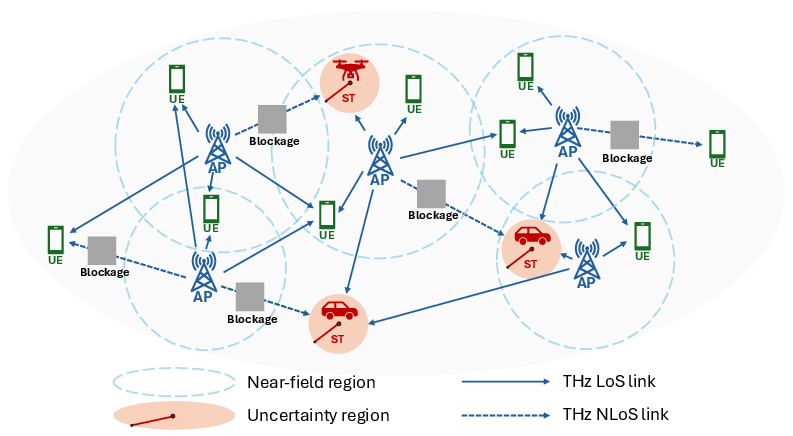
Figure 1: Illustration of the THz CF-ISAC system with cross-field propagation that underpins joint communication and sensing tasks.
The authors design a block coordinate descent–based benchmark (termed BCD-SCA-SDR or "B2S") that relaxes the original MINLP structure via convex surrogates and semidefinite relaxations. This approach alternately updates lifted beamforming covariances and relaxed association variables, efficiently handling the nonconvexities and combinatorial aspect of AP–UE association. The per-UE SINR constraints and per-AP power limits are transformed into convex forms, while the CRB constraints for sensing accuracy are tractably surrogated.
A novel contribution is the redesign of a Graph Transformer Network (GTN) as an optimization-aware, permutation-equivariant representation module. The GTN encodes heterogeneous system interactions, encompassing cross-field wavefront geometry, LoS/blockage masks, and per-link sensing relevance, producing richly structured node and edge features for AP–UE pairs. This encoding offers two primary interfaces to the optimizer: (1) warm-started, physics-consistent beamformer initializations and (2) adaptive feasibility weighting for constraint management.
Distributed Optimization-Learning (DOLG): Amortized MARL Policy
To overcome the scalability constraints of iterative optimizers, the framework advances to a multi-agent reinforcement learning (MARL) paradigm, distributed across APs, with centralized training and decentralized execution (CTDE). The GTN-conditioned DOLG framework amortizes the B2S optimization process: each AP observes its GTN embedding and local state, then yields relaxed association coefficients and beamformers, which are projected for feasibility.
Rewards in MARL are carefully aligned with the original constrained optimization objective, incorporating both communication (sum rate) and sensing (CRB) metrics, and are further supplemented by constraint violation margins (i.e., actual slack on SINR/CRB inequalities).
Numerical Results: System-Level and Algorithmic Evaluation
A comprehensive simulation campaign evaluates DOLG from both system-architectural and algorithmic perspectives.
System-Design Results:
- Sensing Accuracy: The joint CF-ISAC architecture with both AP association and beamforming optimization significantly lowers average CRB compared to multicell and non-joint schemes, demonstrating the necessity of joint optimization for high-resolution sensing.
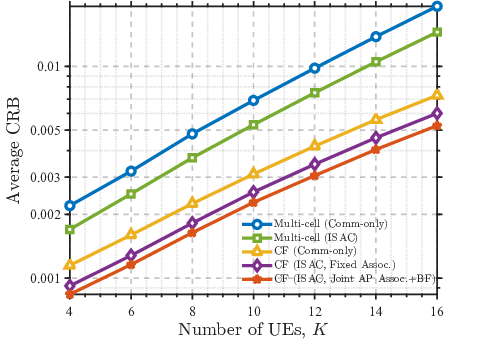
Figure 2: Average CRB degradation as user density increases, with the joint CF-ISAC solution achieving the lowest CRB among alternatives.
- Energy Efficiency: Energy efficiency monotonically decreases with user density, but the proposed method maintains consistently higher efficiency, reflecting resource pooling and coordinated transmission benefits.
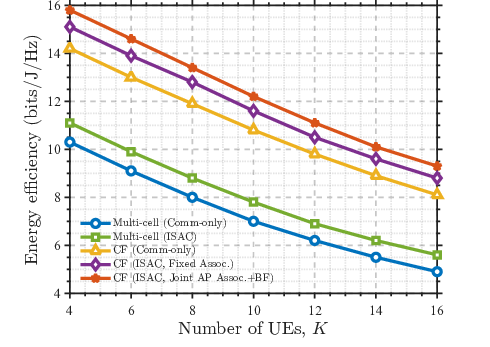
Figure 3: Energy efficiency comparison, highlighting the superiority of joint CF-ISAC design at scale.
Algorithmic Benchmarks:
- DOLG closely approaches the B2S optimization performance in terms of CRB, outperforming both heuristic and MARL-without-GTN variants.
- In terms of runtime and complexity, DOLG achieves near-linear scalability with system size, offering several orders of magnitude speedup over B2S as AP count increases.
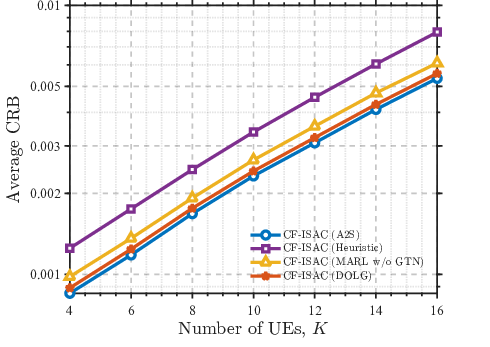
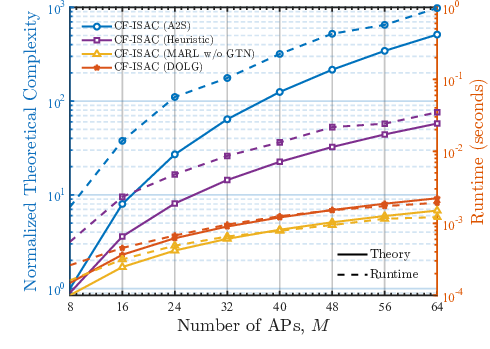
Figure 4: Algorithmic comparison of CRB (accuracy) and complexity/runtimes across different methods for CF-ISAC design.
Learning Dynamics of Proposed DOLG
Training curves reveal rapid convergence and robust learning stability of DOLG:
- The optimization-aligned objective stabilizes after initial epochs.
- The coordination between sum-rate and CRB demonstrates that DOLG balances the fundamental tradeoffs in ISAC design.
- Constraint violations decrease sharply and remain negligible after convergence.
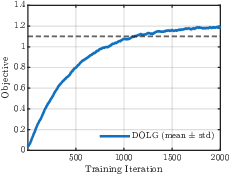
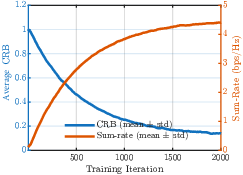
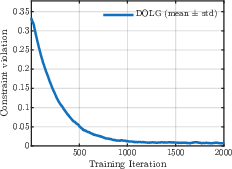
Figure 5: Training behavior of the proposed DOLG framework, showing convergence in objective, sum-rate/CRB, and constraint violations.
Implications and Future Development
The study establishes that structured graph representations coupled with optimization-consistent MARL yield scalable, high-performance solutions for large-scale THz CF-ISAC deployments. The GTN-based DOLG provides a principled path to amortize computationally expensive optimization into fast, decentralized online policies, robust to highly non-convex, dynamic, and physics-driven environments.
Key implications:
- Substantial efficiency and accuracy gains can be harvested by aligning MARL policies to optimization geometry and constraint structure, rather than through generic policy architectures.
- The GTN’s ability to encode heterogeneous, permutation-equivariant interactions is crucial in wireless domains with spatial, spectral, and topological variabilities.
- The DOLG framework is extensible to broader multi-agent, non-stationary, and cross-layer ISAC settings, and supports integration with online or lifelong learning paradigms for adaptive THz networks.
Conclusion
This work provides a unified architecture for distributed, scalable joint communication–sensing resource allocation in THz CF-ISAC systems, leveraging optimization-aware graph transformer representations and distributed MARL. DOLG achieves near-optimality relative to intractable optimization baselines while maintaining practical, low online complexity. The methodological synergies between structured optimization and graph-conditioned learning highlight a promising direction for the deployment of intelligent, adaptive, and large-scale ISAC networks in future 6G and beyond wireless infrastructures.