- The paper demonstrates that minimal geometric deformation via harmonic perturbations successfully models strange stars consistent with millisecond pulsar observations.
- The methodology splits the Einstein field equations into a seed GR fluid and an auxiliary sector, applying the MIT bag model EOS and a sinusoidal perturbation ansatz.
- The work predicts up to a 15% mass increase and accurate radii ranges while ensuring stability, causality, and compatibility with high-mass pulsar data.
Geometrically Perturbed Strange Stars with Minimal Decoupling: Analysis via Millisecond Pulsar Timing
Introduction and Motivation
This work addresses the structure and stability of strange stars (SSs) by deploying a perturbatively extended framework in general relativity: the Minimal Geometric Deformation (MGD) approach. The central aim is to reconcile analytically tractable models of self-bound quark compact objects with the stringent empirical constraints provided by massive millisecond pulsar timing (notably, the radii of high-mass pulsars such as PSR J0740+6620, PSR J1810+1744, PSR J1959+2048, and PSR J2215+5135). Recognizing the difficulty of direct integration within nonlinear Einstein field equations for realistic equations of state (EOS), the paper adopts a gravitational decoupling scheme—splitting the system into a "seed" GR fluid and an auxiliary source sector, parametrized by a geometric deformation β and a radial perturbation frequency Ψ.
Theoretical Framework and Methodology
The stellar matter is modeled by the MIT bag model EOS under the massless, non-interacting quark assumption:
Pr=31(ρ−4Bg),
where Bg is the bag constant.
A non-singular, monotonically decreasing energy density profile is imposed:
ρ(r)=ρ0[1−(1−ρ0ρs)rs2r2],
with ρ0 and ρs as the central and surface densities.
MGD is implemented by deforming only the radial metric component through an additive function βg(r). Specifically, the perturbation ansatz:
g(r)=sin(Ψr2)
models small-amplitude, spatially oscillatory deformations representing minimal external disturbances (e.g., weak accretion events or transient gravitational waves). The choice of this harmonic form, regular at the center, is justified on grounds of analytic tractability and physical relevance for quadrupolar even-parity perturbations.
Separation of the Einstein field equations is performed into a seed sector (solved exactly for the MIT bag EOS profile) and a secondary sector sourced by the extra energy-momentum tensor θij. The star–exterior matching (at Ψ0) uses Israel–Darmois conditions.
Matter Structure: Energy Density and Pressure Profiles
The resulting model ensures physically reasonable stellar structure: non-singular, positive-definite central energy density and pressures, monotonically decreasing toward the surface, and vanishing radial pressure at the boundary (see below).
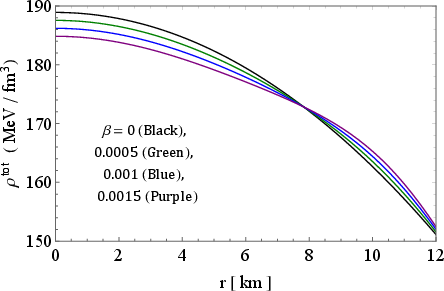
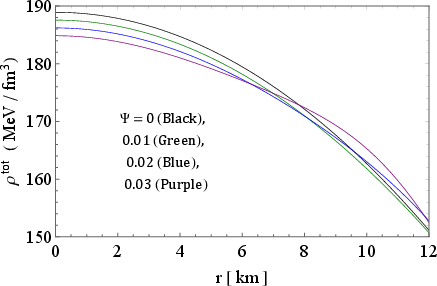
Figure 1: Energy density Ψ1 as a function of radius for various Ψ2 (left) and Ψ3 (right); showing monotonic decrease from the center outward consistent across parameter choices.
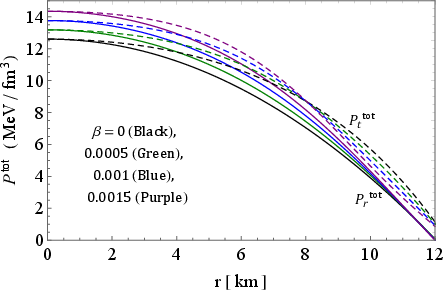
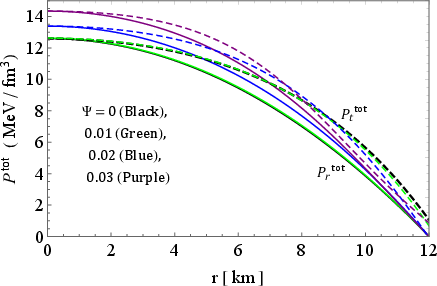
Figure 2: Radial and transverse pressures for varying Ψ4 (left) and Ψ5 (right); both components decrease radially, upholding hydrostatic equilibrium and the MIT bag EOS's predictions.
Decoupling introduces anisotropic stresses—quantified by Ψ6—with clear consequences for stability and maximum mass.
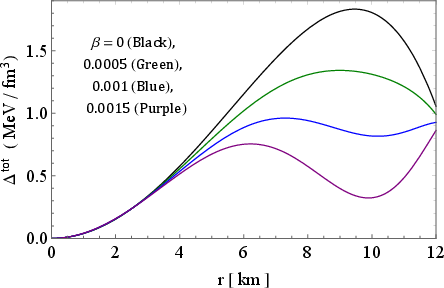
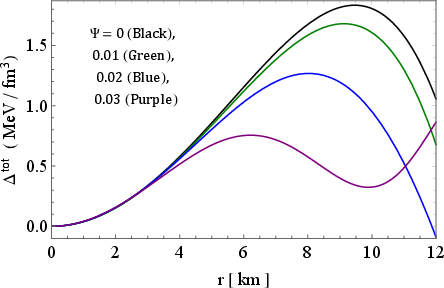
Figure 3: Pressure anisotropy profiles showing that increased Ψ7 or Ψ8 enhance the outward-directed stress, supporting higher compactness and mass.
The anisotropy vanishes at the center and grows smoothly outward, reaching Ψ9 near the surface for parameters matching observed massive pulsars.
Mass-Radius Relations and Astrophysical Constraints
The Pr=31(ρ−4Bg),0-Pr=31(ρ−4Bg),1 relation, computed for a range of deformation/perturbation parameters, robustly accommodates all considered high-mass millisecond pulsars. Notably, Pr=31(ρ−4Bg),2 provides a Pr=31(ρ−4Bg),3 increase of maximum mass over the unperturbed case, directly counteracting constraints from the so-called "mass gap" between the most massive neutron stars and low-mass black holes.
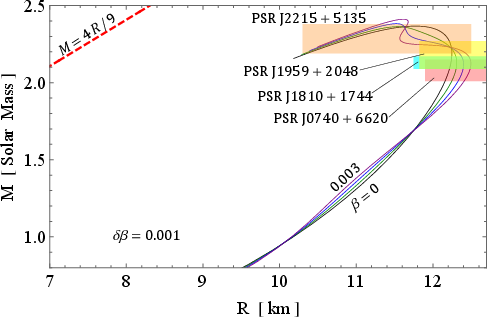
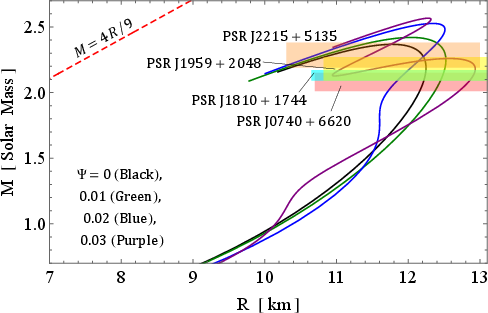
Figure 4: Mass–radius trajectories for increasing Pr=31(ρ−4Bg),4 (left) and Pr=31(ρ−4Bg),5 (right); higher Pr=31(ρ−4Bg),6 broadens the allowed mass range up to Pr=31(ρ−4Bg),7 while Pr=31(ρ−4Bg),8 controls fine oscillatory structure and stability.
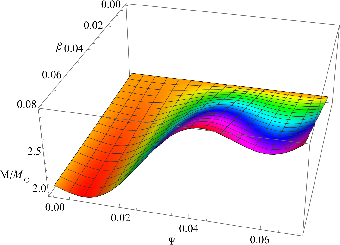
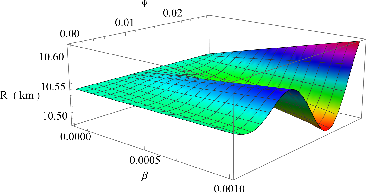
Figure 5: Explicit dependence of Pr=31(ρ−4Bg),9 and Bg0 on Bg1 and Bg2, confirming that deformation increases both mass and radius up to observational thresholds before damping sets in.
Radii for the highest-mass stars are predicted in the Bg3–Bg4 km range, agreeing with NICER and X-ray modeling within systematic uncertainties.
Stability Criteria and Dynamical Response
Adiabatic Index and Hydrostatic Stability
The adiabatic index Bg5,
Bg6
emerges as a central indicator of dynamical (radial) stability. Values remain in the Bg7–Bg8 interval; near the core, Bg9 approaches the relativistic limit (ρ(r)=ρ0[1−(1−ρ0ρs)rs2r2],0), but remains globally above threshold, ensuring stability against radial oscillations.
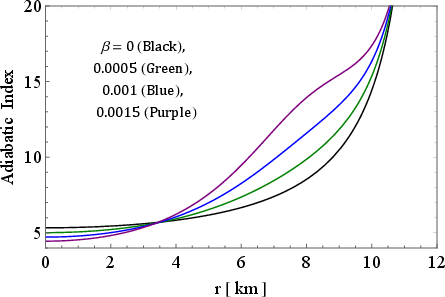
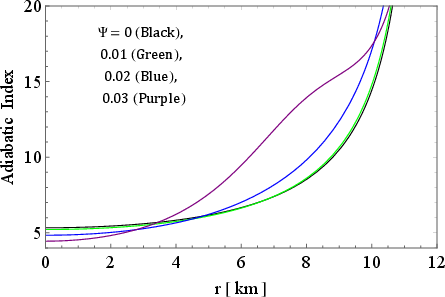
Figure 6: Radial profiles of the adiabatic index for different ρ(r)=ρ0[1−(1−ρ0ρs)rs2r2],1 and ρ(r)=ρ0[1−(1−ρ0ρs)rs2r2],2. Perturbations soften the core slightly but do not induce instability within tested ranges.
Causal Sound Speeds
Radial and tangential sound speeds,
ρ(r)=ρ0[1−(1−ρ0ρs)rs2r2],3
remain subluminal (ρ(r)=ρ0[1−(1−ρ0ρs)rs2r2],4, ρ(r)=ρ0[1−(1−ρ0ρs)rs2r2],5), even at maximal deformation (before violation of causality and breakdown of the perturbative regime).
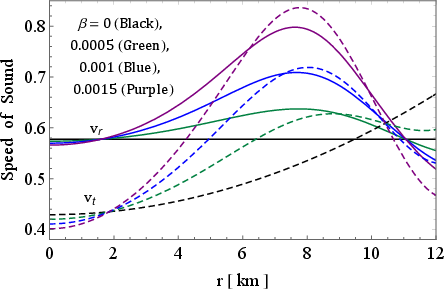
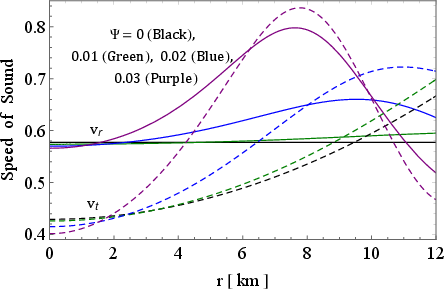
Figure 7: Sound speeds as functions of radius; ρ(r)=ρ0[1−(1−ρ0ρs)rs2r2],6 and ρ(r)=ρ0[1−(1−ρ0ρs)rs2r2],7 are always below the unit line, and thus respect causality for physically reasonable ρ(r)=ρ0[1−(1−ρ0ρs)rs2r2],8.
Harrison–Zel'dovich–Novikov Stability
The mass–central density relation ρ(r)=ρ0[1−(1−ρ0ρs)rs2r2],9 is maintained across the parameter space (mass increases monotonically with central density), confirming dynamical stability for all relevant configurations.
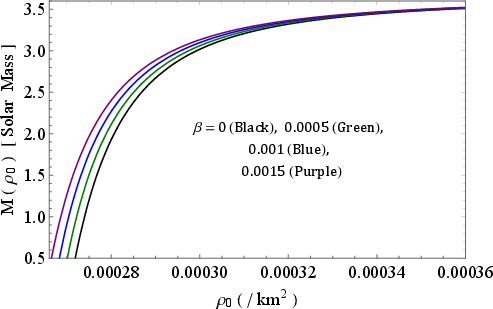
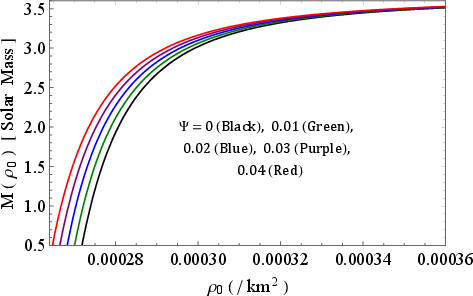
Figure 8: ρ00 versus ρ01 for varying ρ02 and ρ03; derivative positive throughout, no sign of dynamical instability.
Implications and Prospects
This model provides a parameter-dependent tuning of the maximum mass, compactness, and tidal response of strange stars under minimal geometric deformation—yielding analytic predictions compatible with current and future high-precision ρ04-ρ05 pulsar measurements. The formalism successfully reproduces observed masses and radii of the heaviest known neutron stars without exotic stiffening of the EOS or ad hoc assumptions about quark matter interactions.
The presence of spatially oscillatory perturbations, as controlled by ρ06, opens avenues for incorporating tidal deformability constraints from gravitational-wave events and provides a tractable method for analytic studies of tidal Love numbers in the ultra-relativistic regime.
Conclusion
The integration of minimal geometric deformation into compact star modeling, coupled with an explicit harmonic perturbation ansatz, yields a robust analytic platform for explaining the observed properties of massive neutron stars under the hypothesis of self-bound quark matter. The model remains physically viable—respecting causality, stability, and empirical ρ07-ρ08 constraints—and offers clear predictions for how small geometric or topological perturbations can influence compact object structure and stability. This approach is poised for extension to dynamical scenarios, nonradial modes, and multimessenger tests as observational data continue to advance.

