- The paper rigorously proves the existence of slow-moving planar interfaces in a two-dimensional Swift–Hohenberg model using advanced spatial dynamics and center manifold reduction.
- It applies detailed spectral analysis and degenerate normal form transformations to overcome challenges posed by resonant modes and anisotropic regularity.
- Numerical simulations confirm analytic predictions, linking front speeds and interface structures with Turing instability and marginal stability theory.
Slow-Moving Pattern Interfaces in General Directions for a Two-Dimensional Swift–Hohenberg-Type Equation
Introduction and Motivation
The study addresses the rigorous construction and analysis of planar pattern interfaces—specifically invasion fronts—emerging in two-dimensional rotationally invariant systems near a Turing instability, focusing on a semilinear Swift–Hohenberg-type PDE as a canonical model. Such systems are fundamental in the theory of pattern formation, modeling emergent spatially periodic structures across physics, chemistry, and biology. The manuscript formalizes the existence of slow-moving interfaces by generalizing the front direction, overcoming technical difficulties posed by spectral degeneracies and resonance phenomena intrinsic to higher-dimensional pattern-forming PDEs.
The authors consider the Swift–Hohenberg equation with generic (rotation- and reflection-invariant) nonlinearity: ∂tu=−(1+Δ)2u+μu+N(u,Du,D2u,D3u;ϑ)
for u:R2→R, parameter μ near criticality, and nonlinearity N of general polynomial form. The central regime of interest is near μ=0, where a classical Turing bifurcation gives rise to stripe and hexagonal patterns concentrated at a critical wavenumber kc=1.
Planar pattern interfaces are considered in arbitrary rational directions: $\d = (\cos \theta, \sin \theta) \quad \text{with} \quad \cot(\theta) \in \sqrt{3} \mathbb{Q}$
encompassing the full sector of physically admissible invasion phenomena. The interface is described by a solution U depending on the co-moving coordinate normal to the invasion direction, periodic in the transversal coordinate: $u(t,\x) = U(\d \cdot \x - \varepsilon c_0 t, \x)$
Main Analytical Approach and Technical Innovations
1. Spatial Dynamics and Spectral Theory
The elliptic PDE is recast as a spatial-dynamical system with respect to the invasion coordinate. The key spectral analysis centers on the study of a non-self-adjoint operator with discrete spectrum, influenced by the O(2) symmetry and the discrete hexagonal (or generalized) Fourier lattice. Resonant interactions—manifesting as quadratic terms generating modes at critical wavenumber—imply that low-frequency spectral gaps can close nonuniformly (Figure 1, Figure 2, Figure 3).
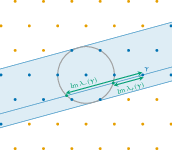
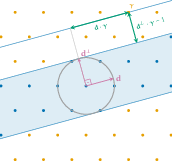
Figure 1: Geometric characterisation of the spectrum of u:R2→R0 reveals central and less-central eigenvalues associated with lattice symmetries and resonances.
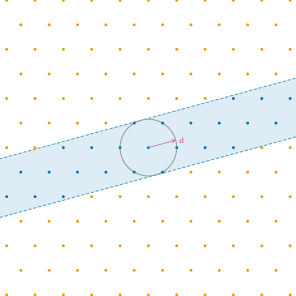
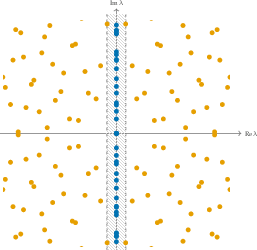
Figure 2: Spectrum of u:R2→R1 for critical front directions, displaying the alignment and detachment of central eigenvalues from the imaginary axis.
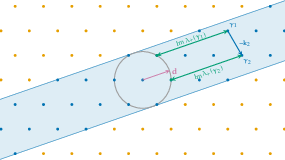
Figure 3: Visualisation of resonant interaction between Fourier modes responsible for the emergence of less-central eigenvalues.
The classification of eigenvalues guides the construction of finite-dimensional center manifolds. Spectral gap conditions—guaranteed for a rational set of directions—enable a rigorous separation of central/less-central and hyperbolic dynamics.
2. Center Manifold Reduction in High Dimensions
A singular perturbation expansion and the application of a non-standard (degenerate) normal form transformation (necessitated by hexagonal quadratic resonances and anisotropic regularity gain) enable reduction of the infinite-dimensional spatial system to a finite-dimensional, slow manifold, wherein the dynamics are approximately described by coupled Ginzburg–Landau amplitude equations: u:R2→R2
for u:R2→R3 and u:R2→R4 cyclic.
The principal technical difficulty is the non-uniform spectral gap on the imaginary axis (Figure 4), which precludes direct application of classic invariant manifold theory. The authors circumvent this via Sobolev spaces of mixed-dominating smoothness, exploiting the localization structure of the Fourier representation in the nonlinearity.
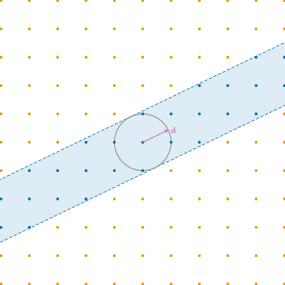
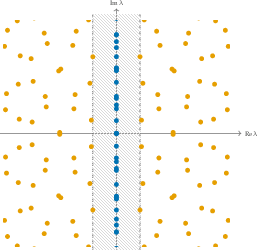
Figure 4: Spectrum geometry highlighting central and less-central eigenvalues requiring mixed-regularity functional analytic methods.
3. Existence and Classification of Heteroclinic Orbits
The amplitude ODEs admit equilibria corresponding to roll waves, hexagons, and mixed modes (see Figure 5), with full characterization of their stability via a precise mapping between temporal and spatial stability (the relation between Landau equation linearization and its spatial analog). The presence of a Lyapunov function for the truncated (cubic) amplitude system ensures the existence of heteroclinic connections—from down-hexagons and roll waves to the trivial state—interpreted as planar interfaces in the PDE (Figure 6).
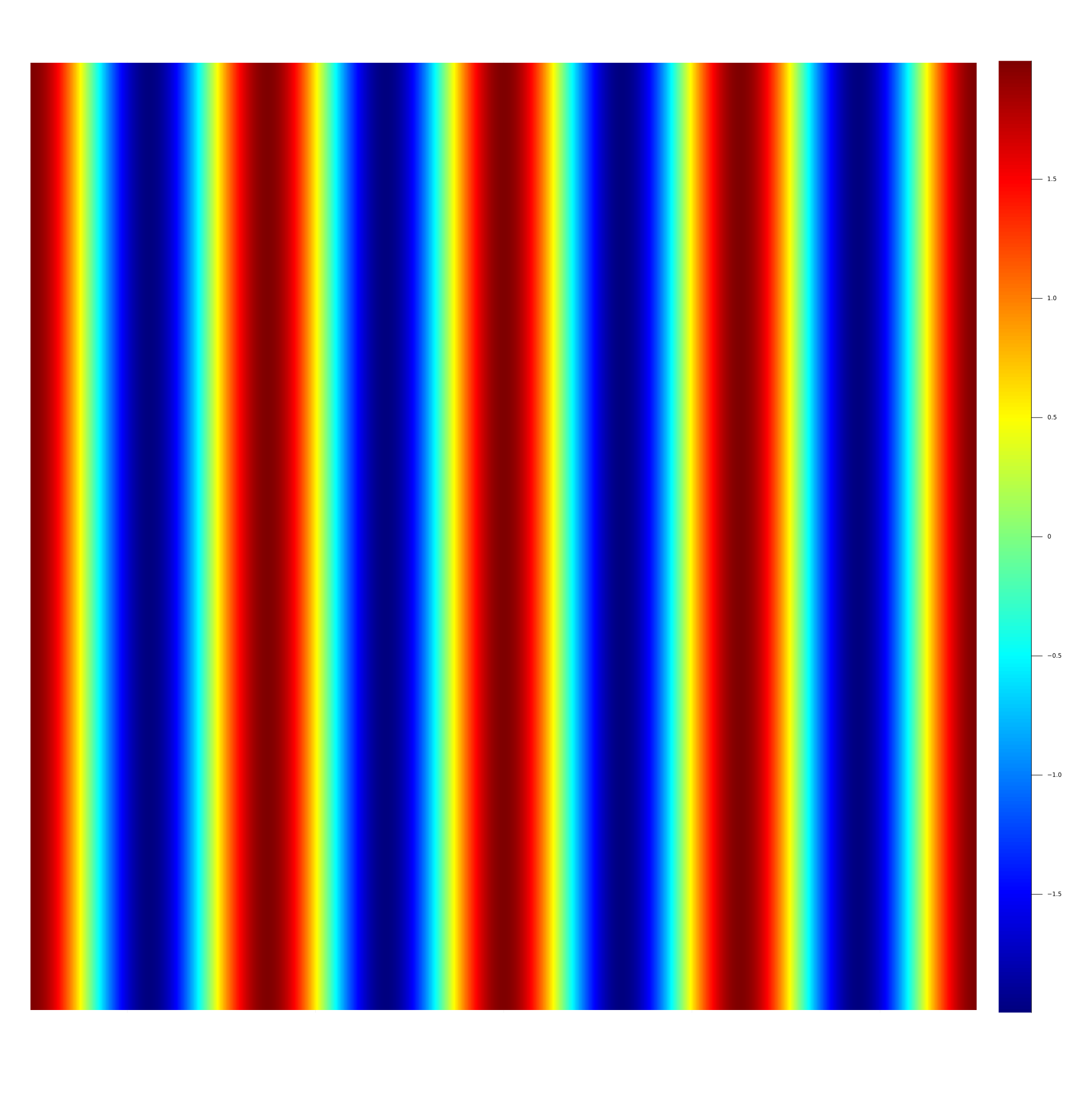
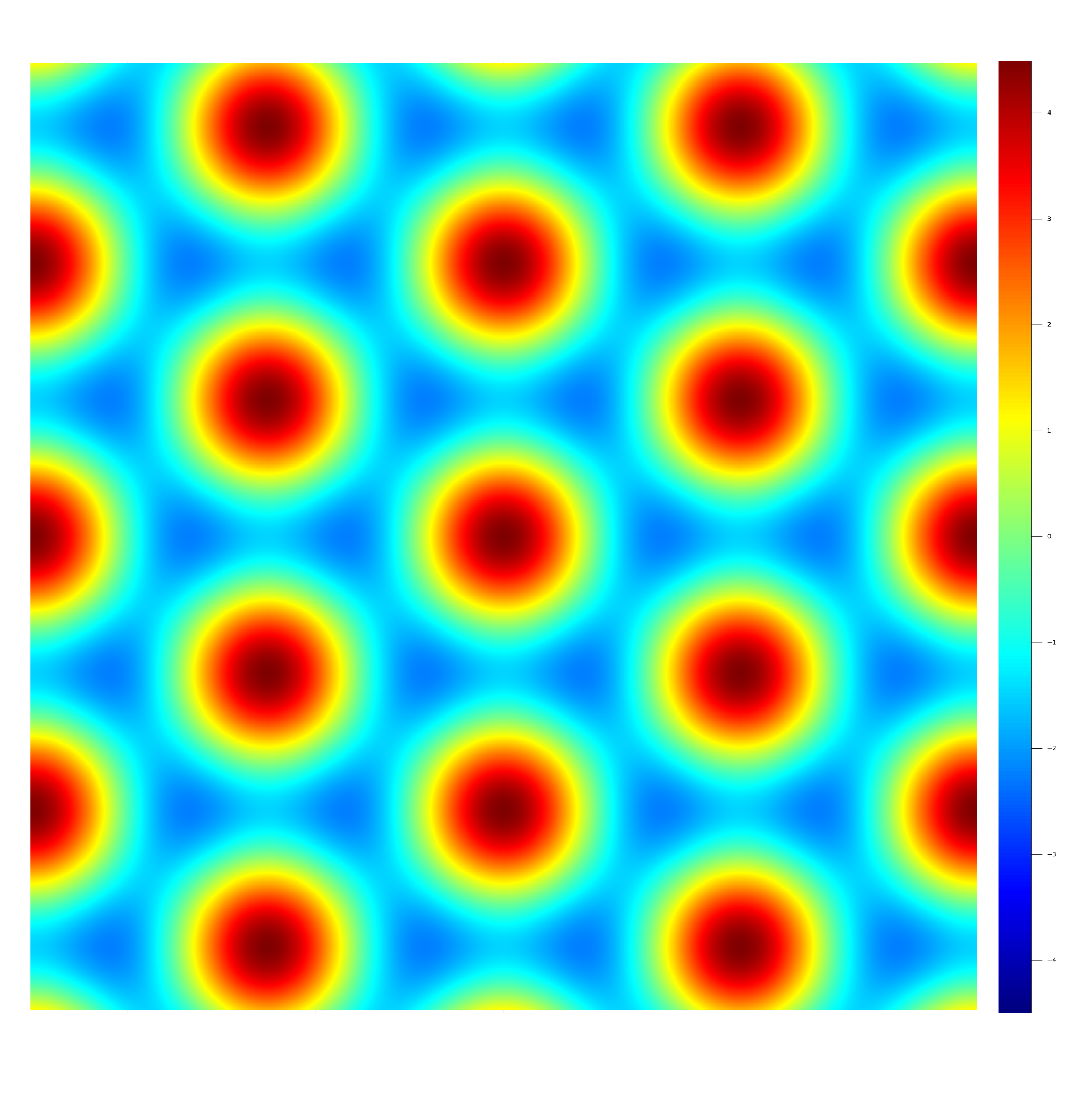
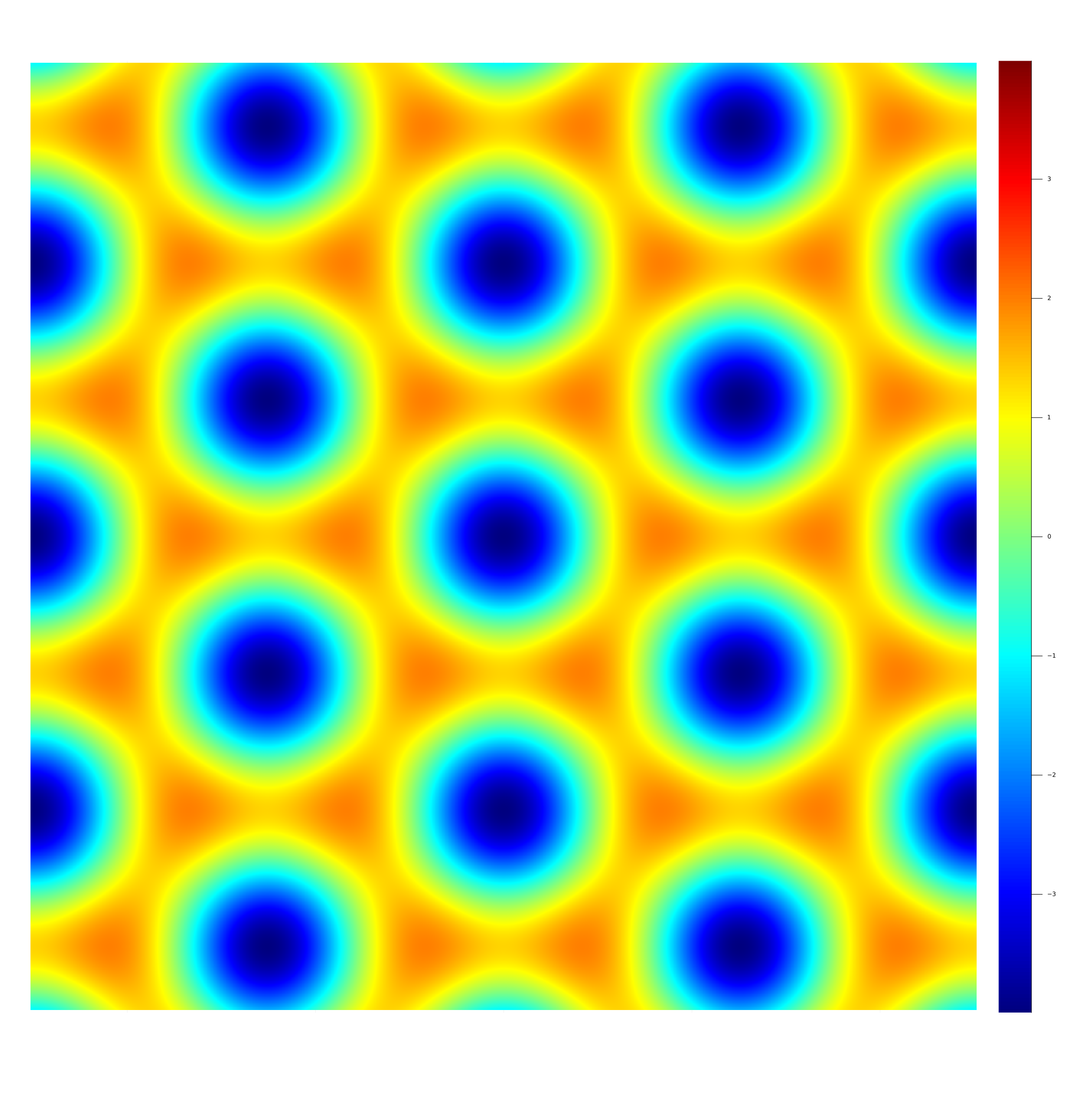
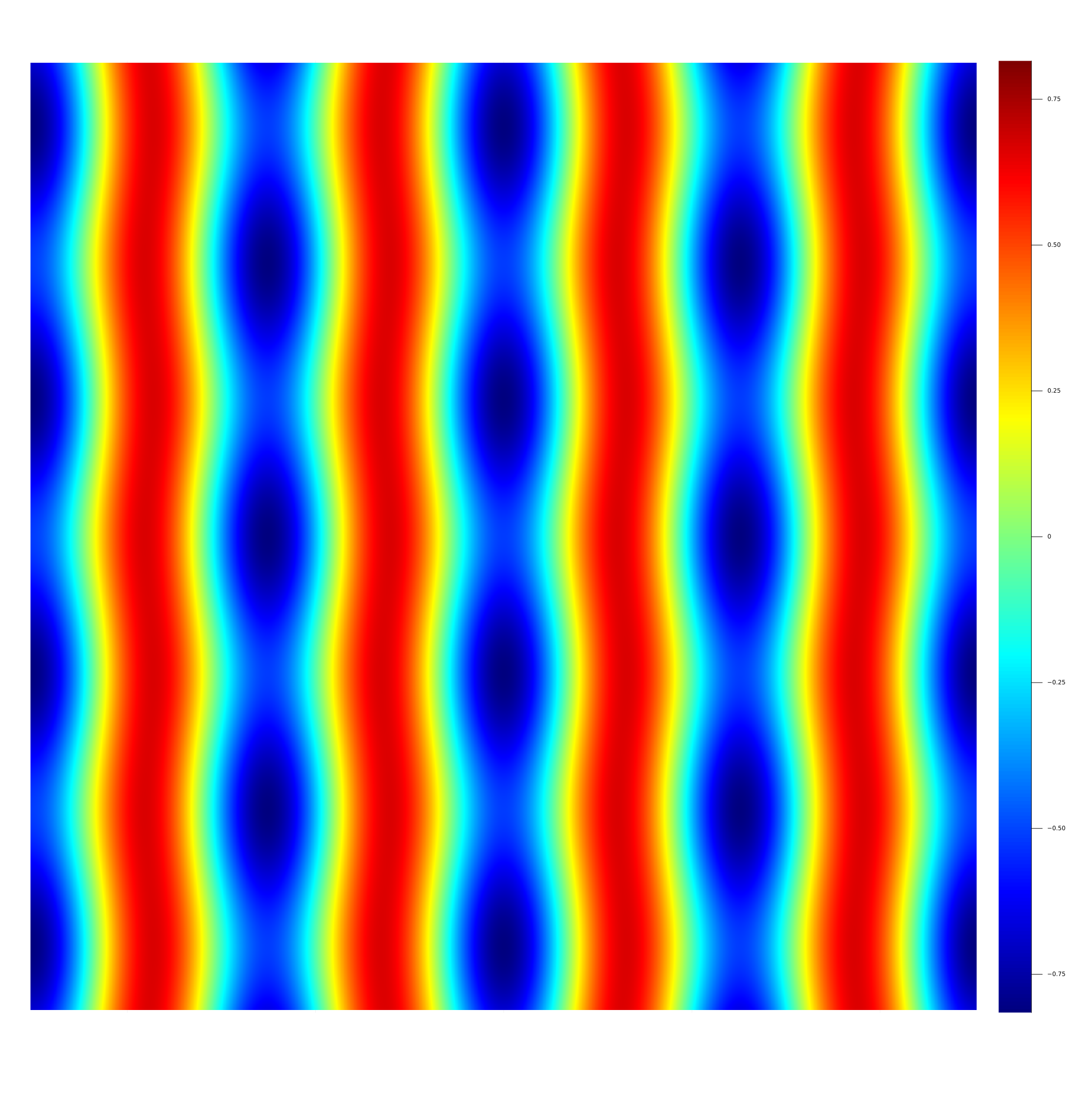
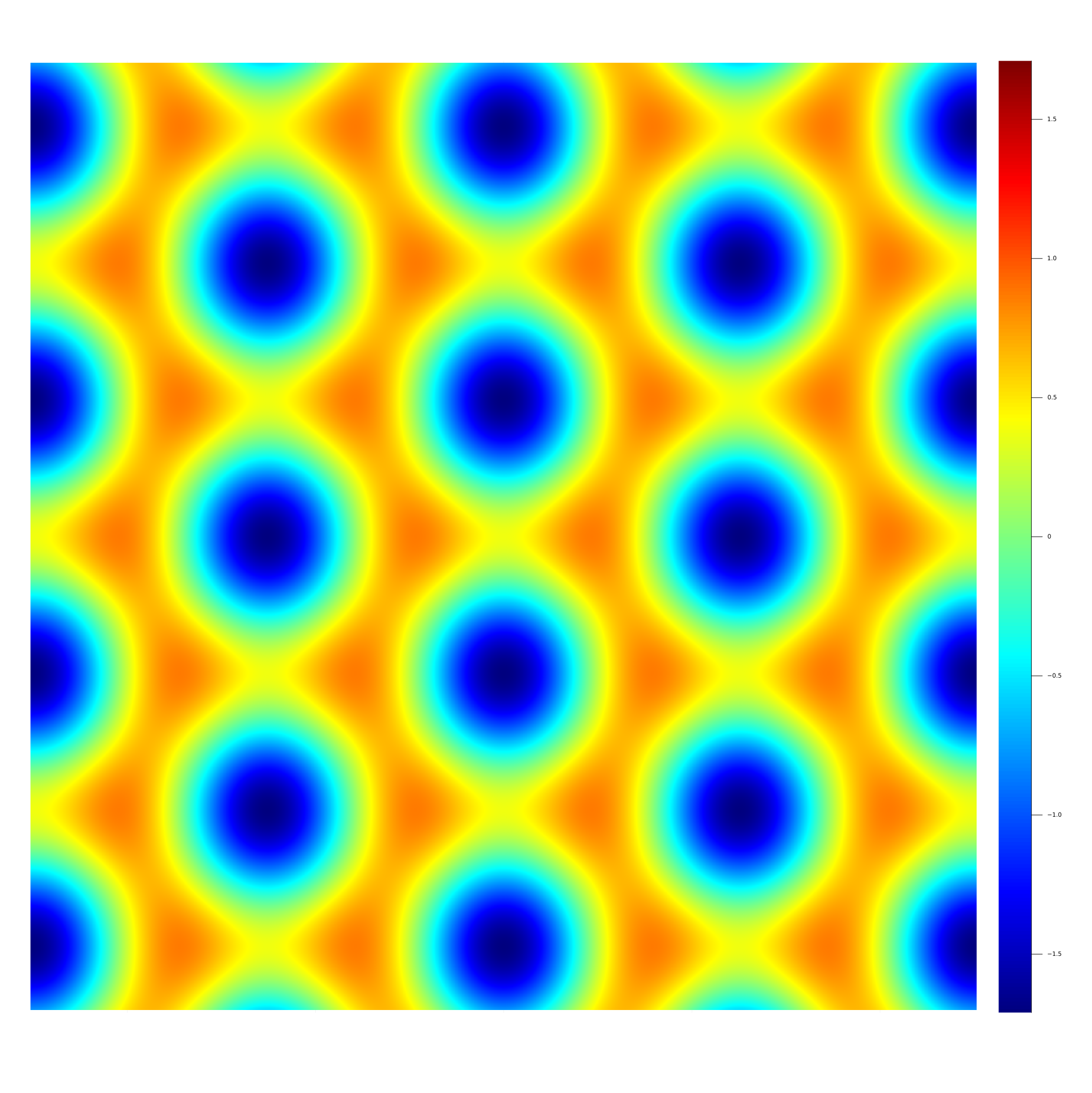
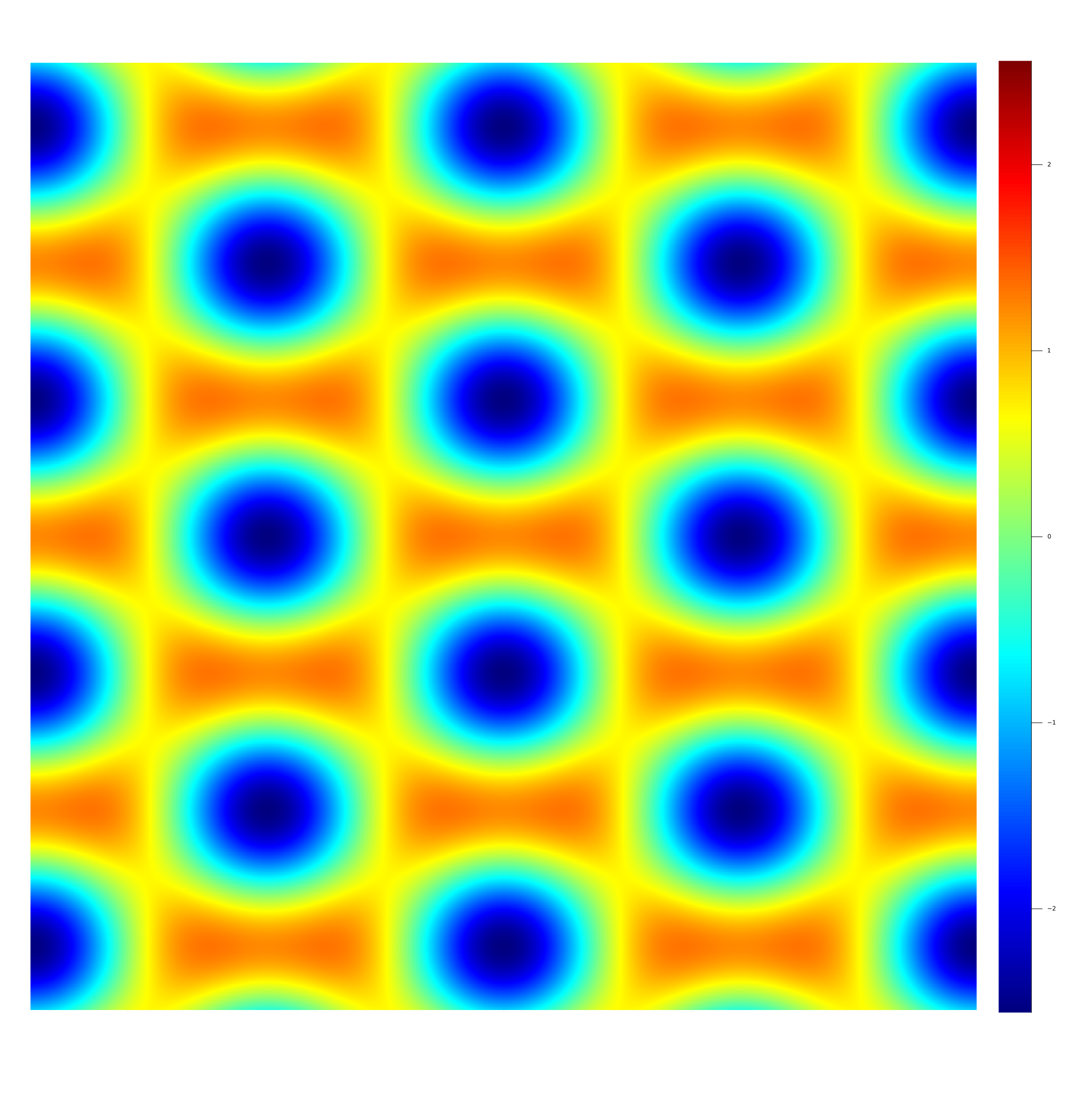
Figure 5: Enumeration of stationary patterns—rolls, hexagons, and mixed modes—corresponding to equilibria in the reduced amplitude equations.
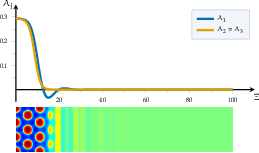
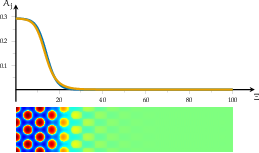
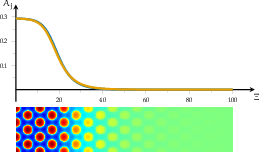
Figure 6: Representative numerically computed heteroclinic orbits in the amplitude system, connecting periodic patterns to the homogeneous state.
The existence of such orbits is proven for generic settings (with u:R2→R5, u:R2→R6, u:R2→R7), and their persistence as solutions in the full PDE is established through controlled application of geometric singular perturbation theory and invariant manifold theorems.
Numerical Confirmation and Front Selection Theory
Numerical simulations corroborate the analytically determined front speeds and structural features (Figure 7, Figure 8, Figure 9), including the stripe-like structure of the front edge as predicted by marginal stability theory and observed experimentally.
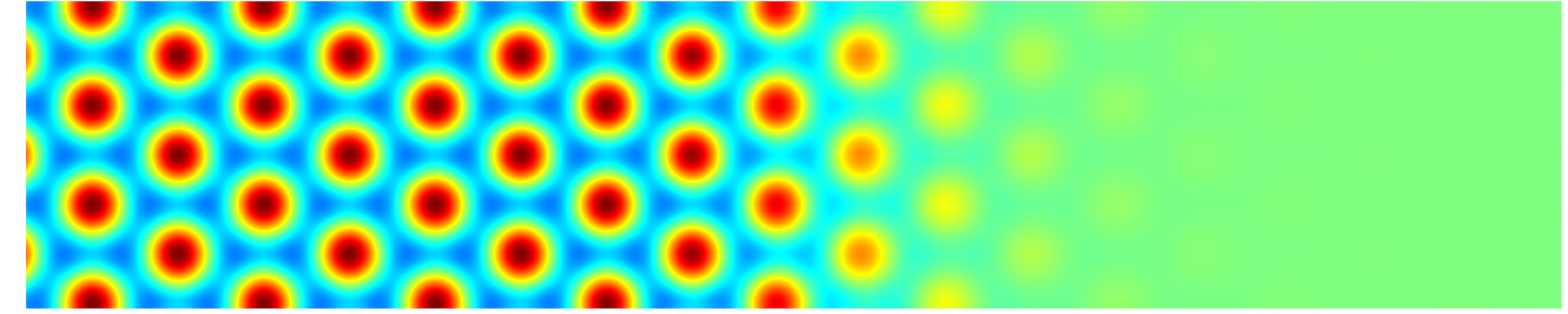
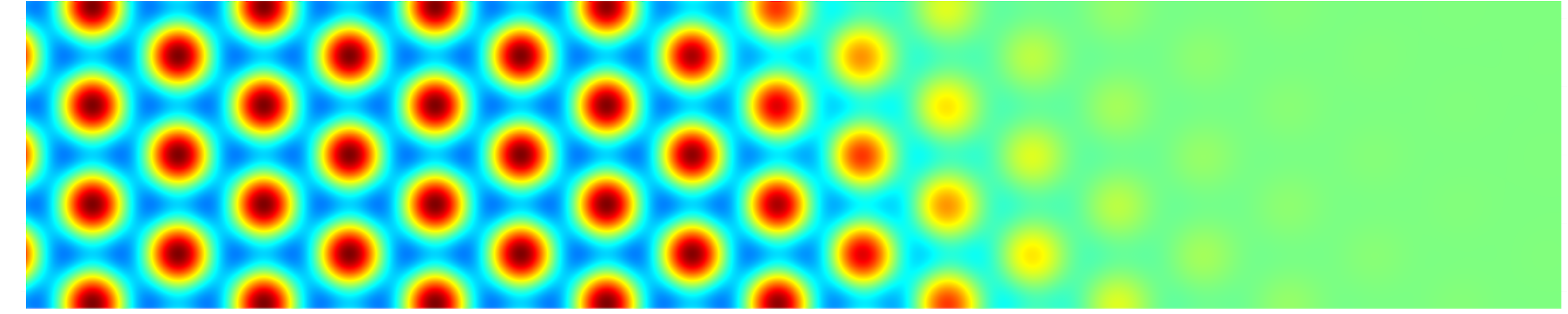
Figure 7: Two-dimensional planar pattern interfaces demonstrating invasion of hexagonal patterns into the homogeneous state along selected directions.



Figure 8: Snapshots of solution u:R2→R8 showing evolution and propagation of the invasion front.



Figure 9: Interface propagation in non-aligned directions, showcasing anisotropic speed selection and transverse structure.
The authors link the analyzed front selection to the marginal stability conjecture, providing explicit asymptotics for the selected speed near the Turing threshold and verifying the prediction with PDE simulations.
Implications, Generalizations, and Open Problems
From a practical perspective, the results ensure that generic, physically relevant two-dimensional pattern-forming media exhibit slow-moving, direction-dependent pattern invasion, and predict the detailed interface structure in experimentally realistic settings.
Theoretically, the paper generalizes classic one-dimensional front results to higher-dimensional, symmetric systems, and provides a template for further analysis in quasilinear, multi-mode, and anisotropic problems. The normal form and spectral analysis developed here is broadly applicable to systems near codimension-one pattern-forming instabilities.
Significant open directions include:
- Extending the construction beyond rational angles, i.e., to dense (Diophantine) directions;
- Full characterization of two-stage and multi-type invasion processes (notably, the up-hexagon to roll wave to homogeneous cascades);
- Rigorous front selection and stability under non-quadratic nonlinearities and in non-semininear or fully nonlinear PDEs;
- Application to experimental and multi-physics systems, e.g., in Marangoni or Bénard-Marangoni convection models featuring conserved quantities and multiple pattern-forming modes.
Conclusion
This work rigorously establishes the existence and structure of slow-moving, directionally general pattern interfaces in two-dimensional Swift–Hohenberg-type equations near a Turing bifurcation. Through a careful blend of spatial dynamics, spectral theory, and center manifold reduction, the analysis enables explicit connection between abstract bifurcation theory, amplitude equations, and observable pattern selection phenomena. The results provide both technical tools for further analytical investigation and concrete predictions for physically relevant pattern-forming systems.