- The paper presents a unified ADE model that links impactor statistics with regolith mixing to predict isotope depth profiles.
- The methodology accurately reproduces observed 60Fe distributions from Apollo missions, isolating pulse-driven supernova signals.
- Results suggest that deep regolith coring (≥1 m) is crucial for distinguishing transient astrophysical events from continuous cosmic backgrounds.
Advection-Diffusion Transport and the Preservation of Astrophysical Isotope Signatures in the Lunar Regolith
Introduction
The lunar regolith functions as an archive of Solar System history, capturing signals from the solar wind, cosmic rays, and episodic extraterrestrial events, including supernova and kilonova ejecta. However, this historical stratigraphy is dynamically reworked by continuous impact-driven mixing, a process known as "gardening." Accurate interpretation of isotopic signatures—especially live radioisotopes such as 60Fe and actinides linked to nucleosynthesis—requires a robust physical framework for regolith mixing and isotope transport. This study presents a unified, stochastic, mass-conserving advection-diffusion equation (ADE) model, linking the impactor size-frequency distribution to macroscopic regolith transport and enabling forward modeling of isotope depth profiles under arbitrary, time-dependent surface fluxes.
The model constructs regolith transport as a competition between impact-driven downward advection (burial, compaction) and upward exhumation, parameterized in terms of the impactor flux and the geometry of crater formation. The model defines explicit expressions for the cumulative mixing depth Dz(t), advection velocity vz(t), and diffusion coefficient κ(t) as analytic functions of time and the impact size-frequency slope b. For the secondary cratering regime that dominates lunar regolith reworking at meter and sub-meter scales, the model yields net downward advection with spatially homogeneous, time-dependent transport coefficients.
The resulting transport is encoded in a one-dimensional ADE:
∂t∂C=∂z∂(κ(t)∂z∂C)−vz(t)∂z∂C−λdecayC+S(z,t)
where C(z,t) is the species concentration, λdecay is the radioactive decay constant, and S(z,t) the source term (e.g., surface pulses of supernova debris, in-situ cosmogenic production).
The model was validated against surface maturity indices in Apollo regolith cores over >108 yr timescales, yielding excellent agreement (see below), and an empirically calibrated uncertainty envelope quantifies stochastic deviations from the mean-field model.
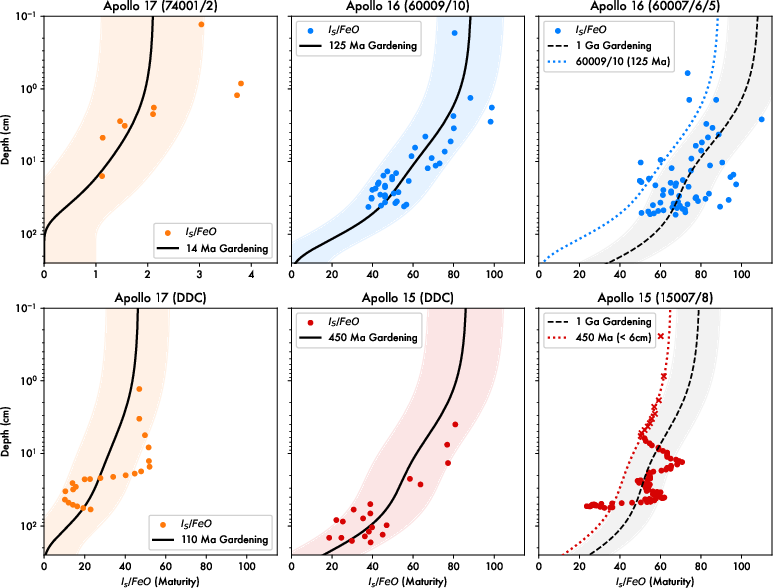
Figure 1: Surface maturity profiles for Apollo 15, 16, and 17 samples closely matched by the unified advection-diffusion gardening model across a wide range of regolith ages.
Modeling of Supernova Dz(t)0Fe in Lunar Regolith
The model reproduces observed vertical distributions of Dz(t)1Fe in Apollo 11, 12, 15, and 16 regolith samples following two supernova pulses at 2.3 and 7.3 Myr BP, as inferred from deep-ocean and lunar isotopic archives. The time-resolved source function is parameterized as a sum of two Gaussian flux pulses at the regolith surface, with the instantaneous deposition convolved with subsequent advection-diffusion and decay. The model incorporates site-dependent FeO normalization to remove compositional biases.
The simulated depth profiles indicate that post-depositional regolith mixing is consistent with the observed Dz(t)2Fe centroid and profile sharpness when properly accounting for the advection-diffusion dynamics, confirming that the pulse-like nature of the deposition is preserved through the gardening process. Notably, the lateral uniformity in Dz(t)3Fe across disparate Apollo sites (despite differences in native Fe content) is in accord with the isotropic delivery model, and the measured uppermost (>cm) fine fractions are found to be anomalously enriched, likely reflecting enhanced external deposition and space-weathering effects.
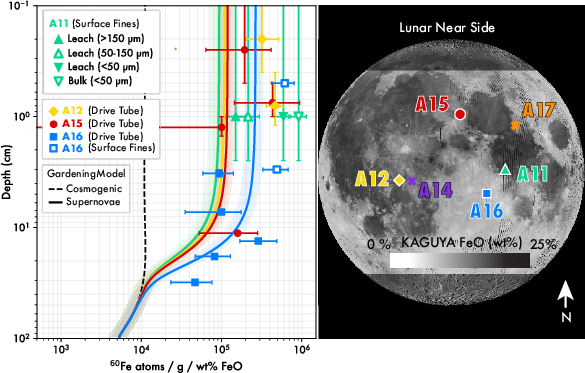
Figure 2: Depth profiles of supernova-derived Dz(t)4Fe at Apollo landing sites, showing strong agreement between the advection-diffusion model and lunar measurements.
The model also quantifies the sensitivity of derived Dz(t)5Fe profiles to the width of the input pulse, demonstrating robust separability of astrophysical events versus steady-state cosmogenic backgrounds (see Supplemental Figure 3).
Application to r-Process Isotopes: Dz(t)6Pu, Dz(t)7I, Dz(t)8Hf, Dz(t)9Cm
Expanding the model to actinides and other vz(t)0-process species (e.g., vz(t)1Pu, vz(t)2I, vz(t)3Hf, vz(t)4Cm), the work presents forward-evolved, depth-resolved concentration profiles for three distinct astrophysical source scenarios: (H1) deposition tied to the two identified recent supernova pulses, (H2) continuous flux over the last 10 Myr, and (H3) persistent deposition over 80 Myr. Despite the order-of-magnitude difference in isotope half-lives, the regolith stratigraphic response (width, centroid) is strongly diagnostic of the history and duration of the influx.
Depth profiles for vz(t)5Pu generated under each hypothesis demonstrate that pulse-driven or recent-capture models yield shallow, steeply peaked signals (vz(t)6 cm), while long-term, continuous influx scenarios generate tails extending to vz(t)7 cm. The relative ratios of co-produced vz(t)8-process isotopes (e.g., vz(t)9I/κ(t)0Pu, κ(t)1Hf/κ(t)2Pu) as a function of depth allow discrimination of coeval versus temporally distinct production and deposition events.
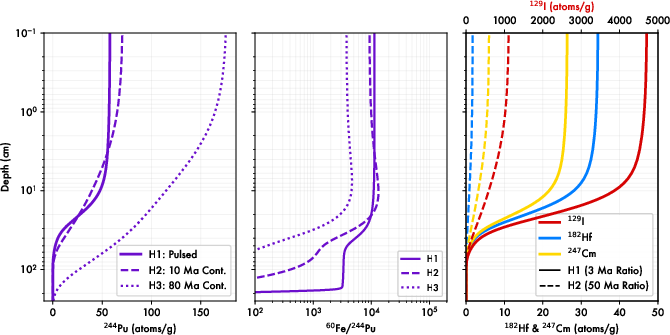
Figure 4: Forward-modeled depth profiles for κ(t)3Pu and κ(t)4-process isotopes under diverse delivery histories, illustrating the discriminating power of deep core measurements for astrophysical event timing and origin.
Implications for Artemis and Future Lunar Core Analyses
The ADE model's predictions motivate high-priority isotopic analysis of forthcoming Artemis mission regolith cores, particularly at the South Pole, which will enable latitude-dependent studies of deposition uniformity, source directivity, and the potential retention of arrival vector information for supernova-derived isotopic carriers. The capacity to distinguish between isotopic signals deposited through multiple, time-separated events versus steady-state galactic backgrounds will yield constraints on the astrophysical frequency and nature of events contributing to Solar System composition.
The model demonstrates that deep regolith coring (target depths κ(t)5 m) is necessary to resolve long-lived κ(t)6-process deposition events and establish background secular equilibrium. Simultaneous quantitation of multiple nuclides will offer cross-validation and discrimination between candidate events and nucleosynthetic environments.
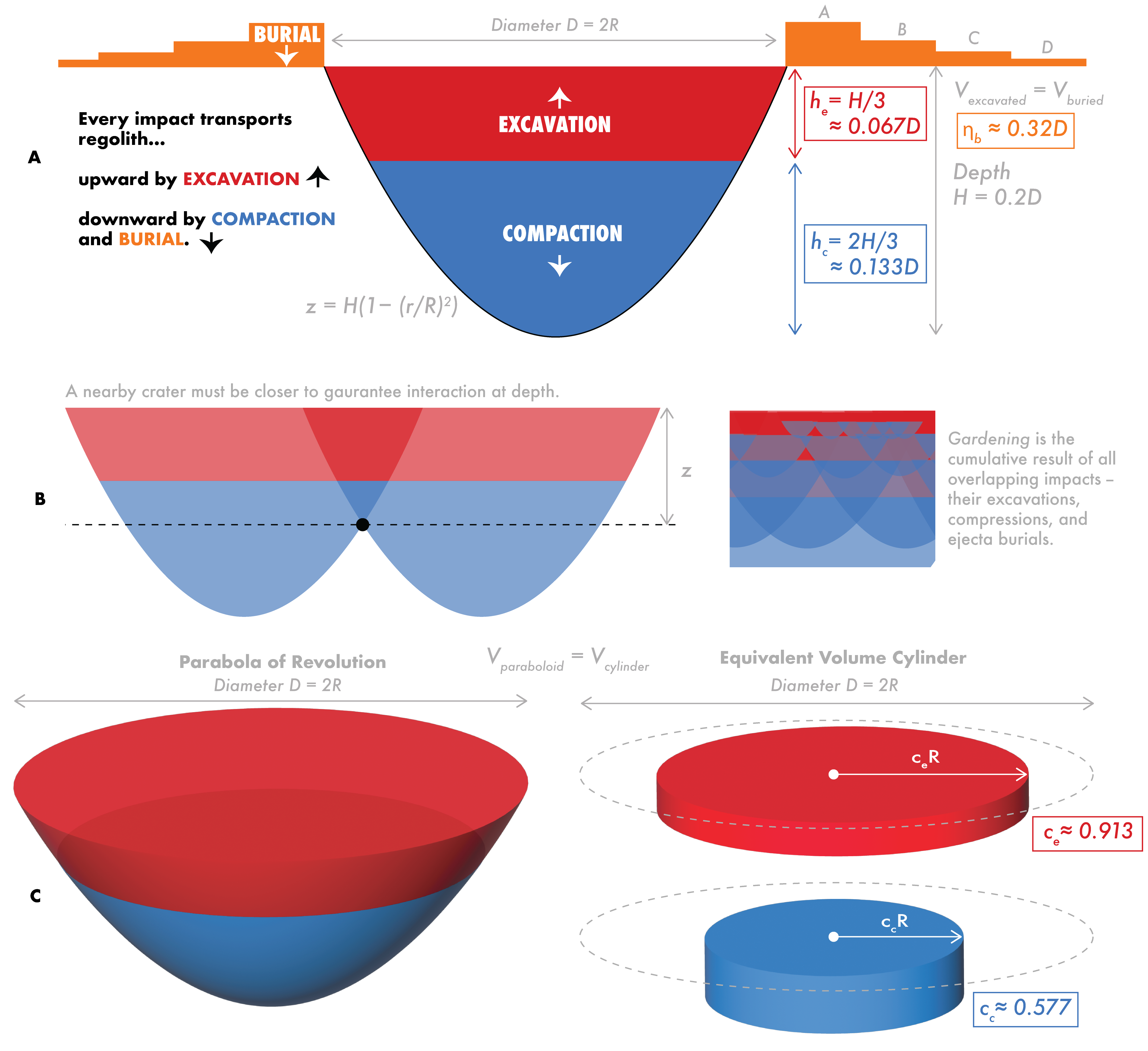
Figure 5: Schematic illustration of crater geometry and regolith domains relevant to the ADE transport model.
Theoretical and Practical Implications
This unified ADE formalism offers a rigorous, scalable framework for quantitatively connecting impact statistics, regolith stratigraphy, and episodic as well as continuous isotope delivery. By resolving the effects of stochastic impact mixing, the model supersedes previous pure-diffusion treatments and accurately predicts both the shape and centroids of isotope profiles.
The results bolster confidence in the interpretation of lunar radioisotope profiles as direct records of Solar System passage through transient, event-driven environments (e.g., supernova shells, nucleosynthesis outflows) and provide a validated roadmap for the design of future regolith core retrieval and analysis strategies. Practically, the framework affords predictive power for regolith volatile and isotope reservoirs beyond the astrophysical context, with direct applications for chronological reconstructions and planetary surface process models.
Conclusion
The study establishes a robust, analytic and stochastic advection-diffusion model that successfully describes the vertical transport and preservation of live astrophysical isotopes in the lunar regolith, reconciles Apollo observations with astrophysical event histories, and enables diagnostic forward modeling for future lunar sample missions. By coupling detailed impactor statistics to isotope stratigraphy, the framework enables precise characterization of short- and long-lived nuclide responses to astrophysical transients and long-term galactic environments, with substantial implications for planetary science, nuclear astrophysics, and regolith chronology.
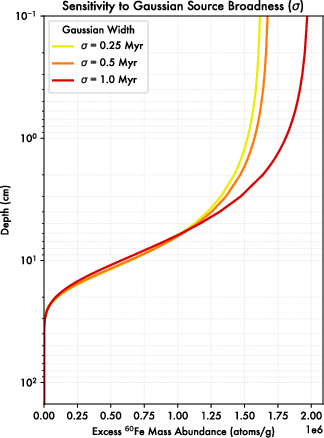
Figure 3: Sensitivity of the calculated κ(t)7Fe profile to the input pulse width; impact gardening preserves astrophysical event structure in the vertical record.

