- The paper introduces a framework for quantifying multi-agent intent-preserving communication by deriving capacity-induced semantic spaces.
- It employs quotient POMDPs to define effective alphabets and identifies a critical rate below which perfect alignment is impossible.
- The work applies Wyner-Ziv coding principles to design near-optimal protocols, with empirical results validating sharp phase transitions in diverse domains.
Semantic Rate-Distortion for Bounded Multi-Agent Communication
Introduction and Motivation
The paper "Semantic Rate-Distortion for Bounded Multi-Agent Communication: Capacity-Derived Semantic Spaces and the Communication Cost of Alignment" (2604.09521) addresses an essential problem in multi-agent systems: determining how agents with mismatched computational capacities can achieve intent-preserving communication. The framework departs from traditional rate-distortion (R-D) and Wyner-Ziv (WZ) coding by deriving the effective alphabets—"semantic spaces"—for each agent directly from their bounded interaction with the environment, formalized as quotient POMDPs determined by each agent's finite-state controller (FSC) capacity.
This perspective is inspired by the observation that agents with different computational resources do not merely compress a common set of semantic symbols differently; in fact, the set of distinctions they can maintain within the environment itself diverges according to their bounded capacities. Communication is thus situated not only over a noisy channel but subject to semantic bottlenecks induced by the agents' respective quotient structures, creating an explicit information-theoretic cost for "alignment" or intent preservation.
Capacity-Derived Semantic Spaces: Quotient POMDPs
The core technical device is the quotient POMDP, Qm,T(M), representing the coarsest abstraction compatible with agent capacity (m,T) over the environment M. Given an agent A with memory size mA, its quotient partitions the history space into equivalence classes that the agent can discriminate via its FSC, while a less capable agent B (with mB<mA) merges many such classes due to its limited memory.
Concretely, these capacity-derived quotients define the effective semantic alphabets for communication: QA for the sender and QB for the receiver. Communication between agents must therefore traverse the partition gap QA→QB, where the refinement structure determines which distinctions are visible to both, and which ones are "structurally invisible" to (m,T)0. The communication channel can only supplement but not overcome this intrinsic quotient mismatch.
The paper formalizes a range of distortion metrics, including value-alignment, behavioral divergence, and an explicit intent-distortion measure combining differences in posterior belief state, policy action distributions, and value functions over histories. These metrics facilitate defining semantic rate-distortion functions (m,T)1 with respect to intent preservation.
Structural Results: Phase Transition and Critical Rate
A principal contribution is the rigorous identification of a structural phase transition: Below a capacity-derived critical rate, there exists a positive lower bound on achievable semantic distortion, i.e., perfect intent preservation is impossible for any protocol. This critical rate (m,T)2 is characterized by the refinement between sender and receiver quotients, specifically:
(m,T)3
or, more generally, (m,T)4, the conditional entropy rate of the sender's quotient given the receiver's, capturing non-uniform or structured visitation.
Whenever the number of (m,T)5-classes strictly exceeds (m,T)6's ability to resolve them through its channel, intent-preserving communication is impossible:
- Sub-critical regime ((m,T)7): There is a nonzero minimal semantic distortion due to irresolvable quotient class merges.
- Super-critical regime ((m,T)8): Intent distortion can be made exponentially small, and the communication reduces to a (quotient-aware) Wyner-Ziv source coding problem.
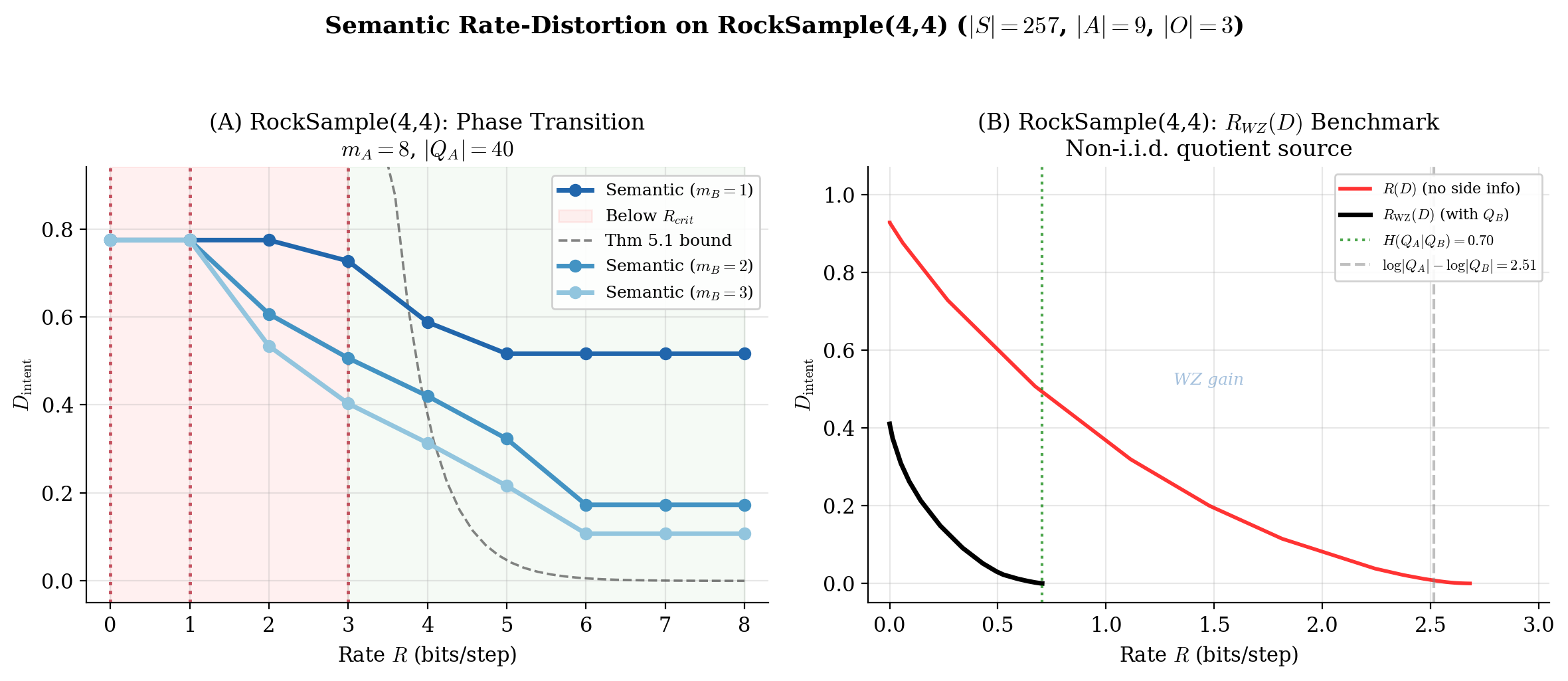
Empirical results confirm these sharp phase transitions in a variety of domains, showing abrupt drops in intent distortion as communication rate crosses (m,T)9. Structured policy examples show the WZ benchmark can be up to M0 lower than counting bounds, demonstrating the potential gain from leveraging policy-induced concentration on quotient space.
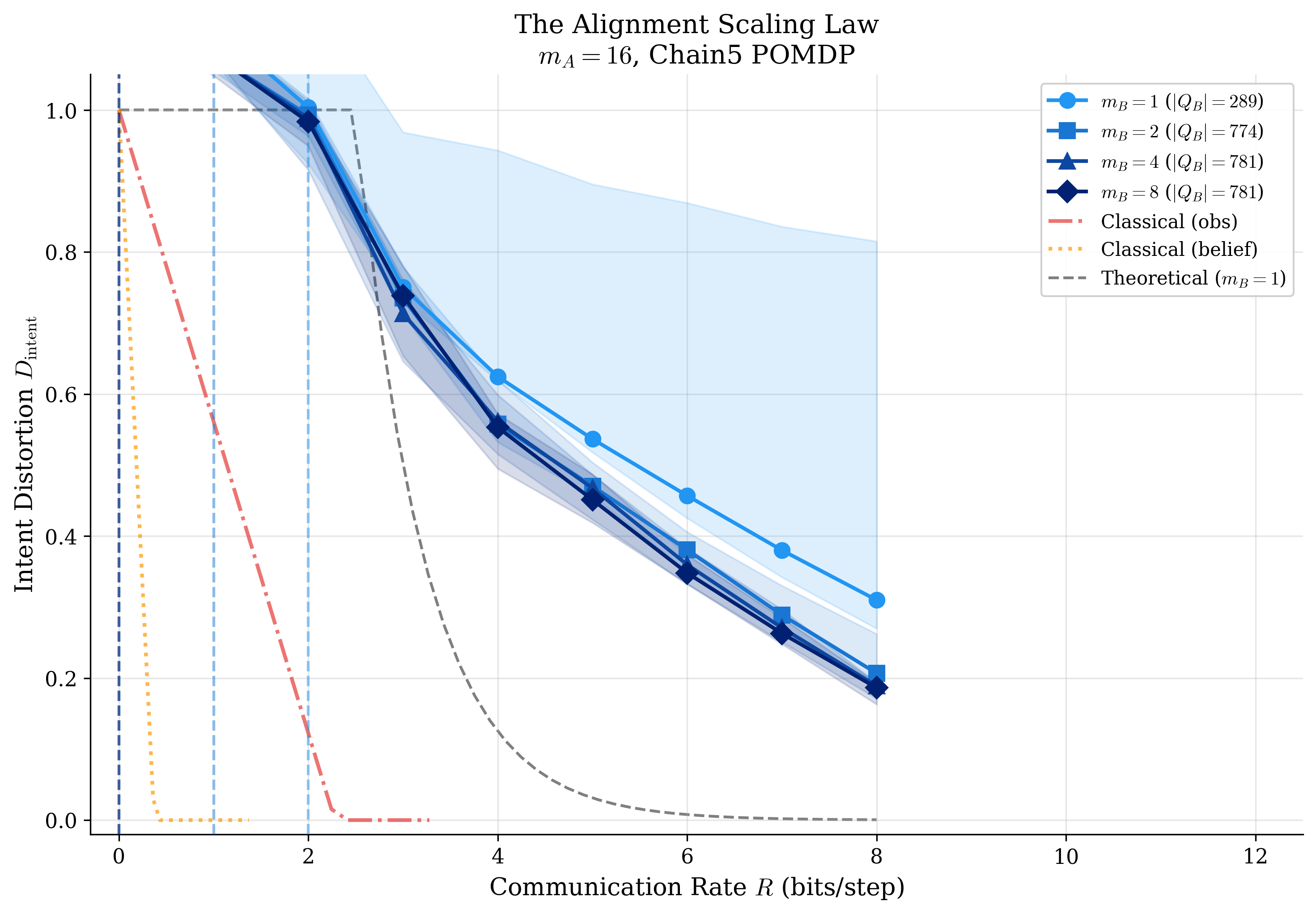
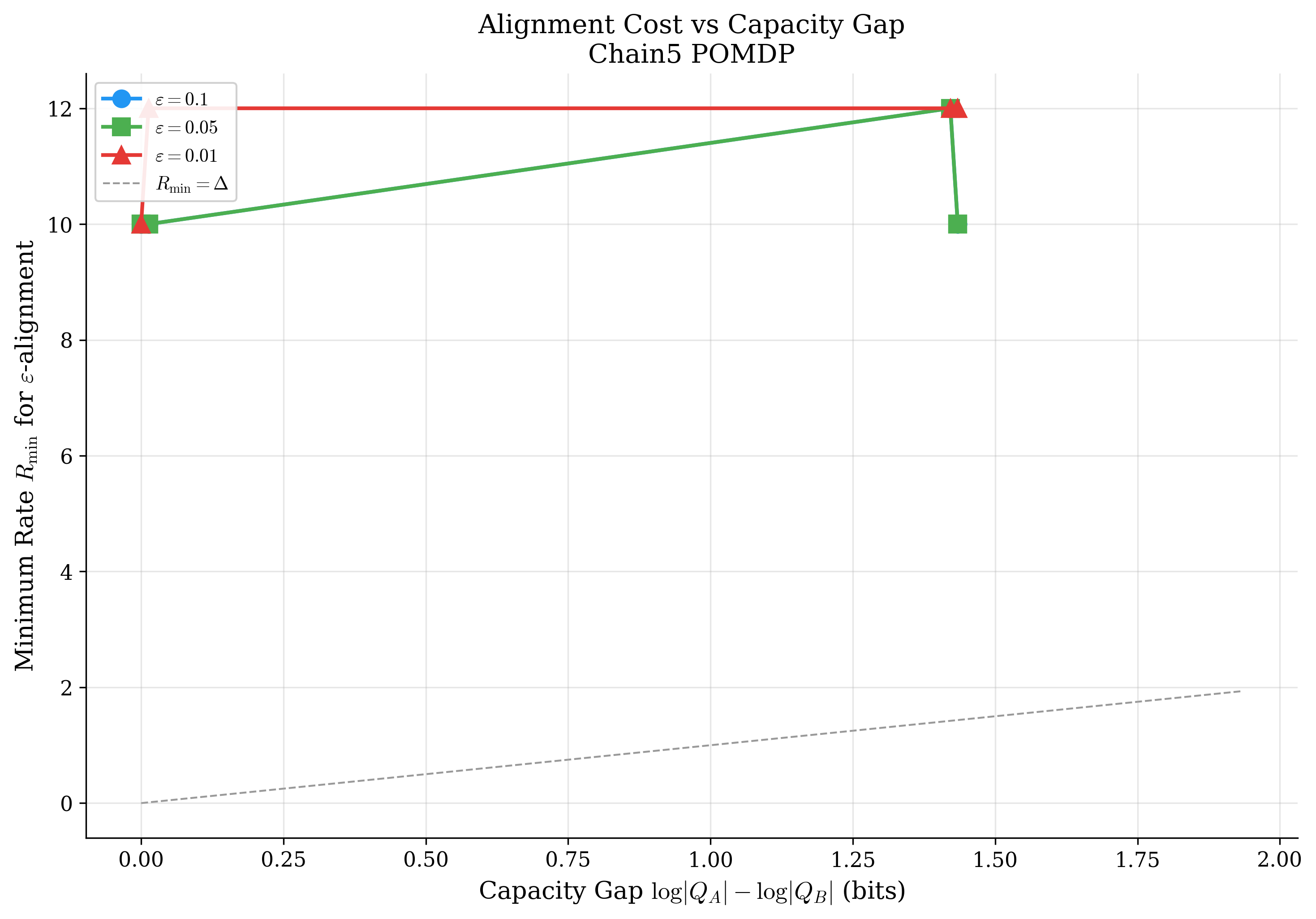
Figure 1: Chain5 rate-distortion curves for M1, M2; fixed-phase transition at M3 bits/step.
Wyner-Ziv Benchmark Identification and Memoryless Regimes
Building on the structure of quotient POMDPs, the authors establish a sharp reduction: the semantic rate-distortion problem between two bounded agents in the one-way, memoryless regime is precisely a Wyner-Ziv problem over the quotient alphabets. For i.i.d. sources (typical under random policy), the operational rate-distortion function for semantic alignment coincides exactly with the Wyner-Ziv rate with side information at the decoder, with distortion measured in intent.
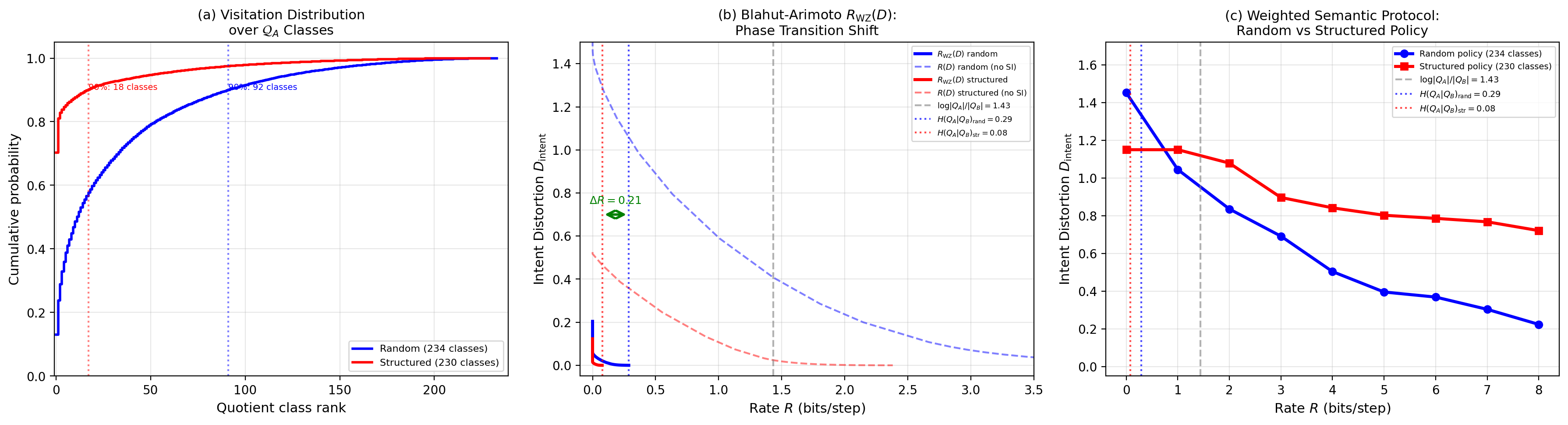
Figure 2: Wyner-Ziv benchmark curves for random vs. structured policies. Significant reduction in rate possible in the structured regime.
When the receiver's policy is derived strictly from its (coarsened) quotient, the mapping from M4 to M5 is deterministic, and the WZ single-letter rate becomes:
M6
which is upper bounded by the naive log-cardinality difference. Notably, in empirical regimes with non-uniform policy-induced visitation, M7 can be drastically lower.
One-way observability is a technical requirement for the identification: the receiver's actions must not affect the sender's observation process, aligning with many practical settings (e.g., sensor-controller, teacher-student).
Shrinking-Distortion Converse
The shrinking-distortion regime M8 is analyzed using a Fano-type converse. The minimum rate to achieve vanishing per-step intent distortion aligns with the entropy rate gap between quotient processes:
M9
for A0. This matches the log-cardinality result for uniform cases and substantiates the phase transition through an information-theoretic lower bound.
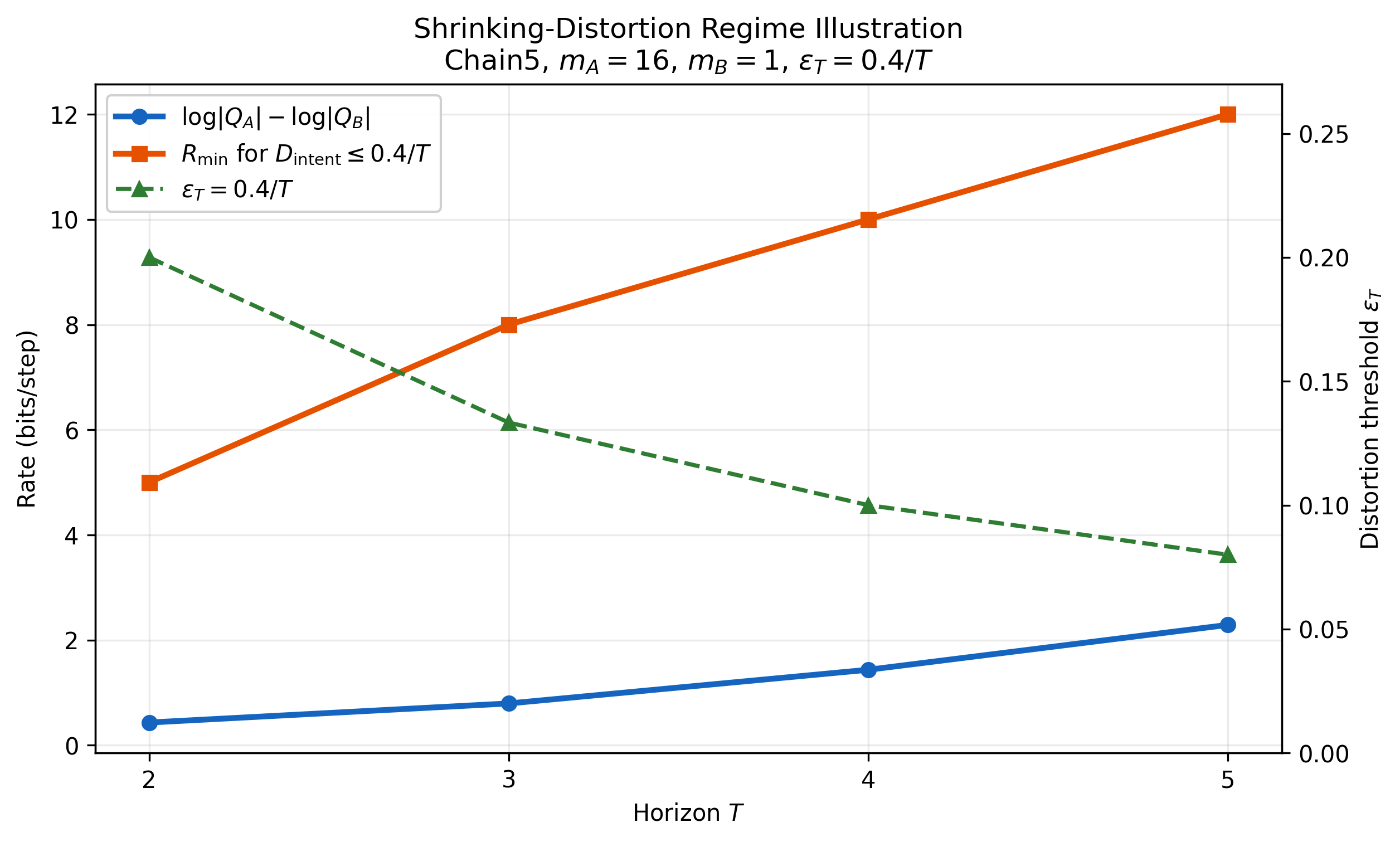
Figure 3: Empirical minimum rate as a function of shrinking distortion threshold, matching structural predictions from the converse theorem.
Alignment Traversal and Compositionality
A further theoretical contribution is compositional traversal: total alignment cost across a chain of intermediate capacity levels is upper bounded by the sum of pairwise structural rates across those levels. This provides a formal justification for "routing" alignment through sequences of increasingly capable agents or abstractions.
Applications to Alignment Theory
The framework is applied to several domains of current relevance:
- Human–AI Alignment: Modeling human as low-capacity and AI as high-capacity agent, the framework predicts a minimum feedback rate for RLHF (or debate) that is linear in the capacity gap and logarithmic in accuracy. For instance, binary preference queries exhibit an information-theoretic bottleneck; no protocol can achieve aligned behavior below A1 queries, regardless of supervision strategy.
- Model Distillation: Compression of a large model into a small one inherits the structural communication cost from their quotient mismatches.
- Multi-agent Control: Sensor–controller pairs and stepwise routing across increasing latent state abstractions experience analogous communication floors, which can be planned about or allocated in protocol design.
The alignment cost is an information-theoretically sharp lower bound; increasing feedback bandwidth is the only unconditional route to improved alignment in this framework.
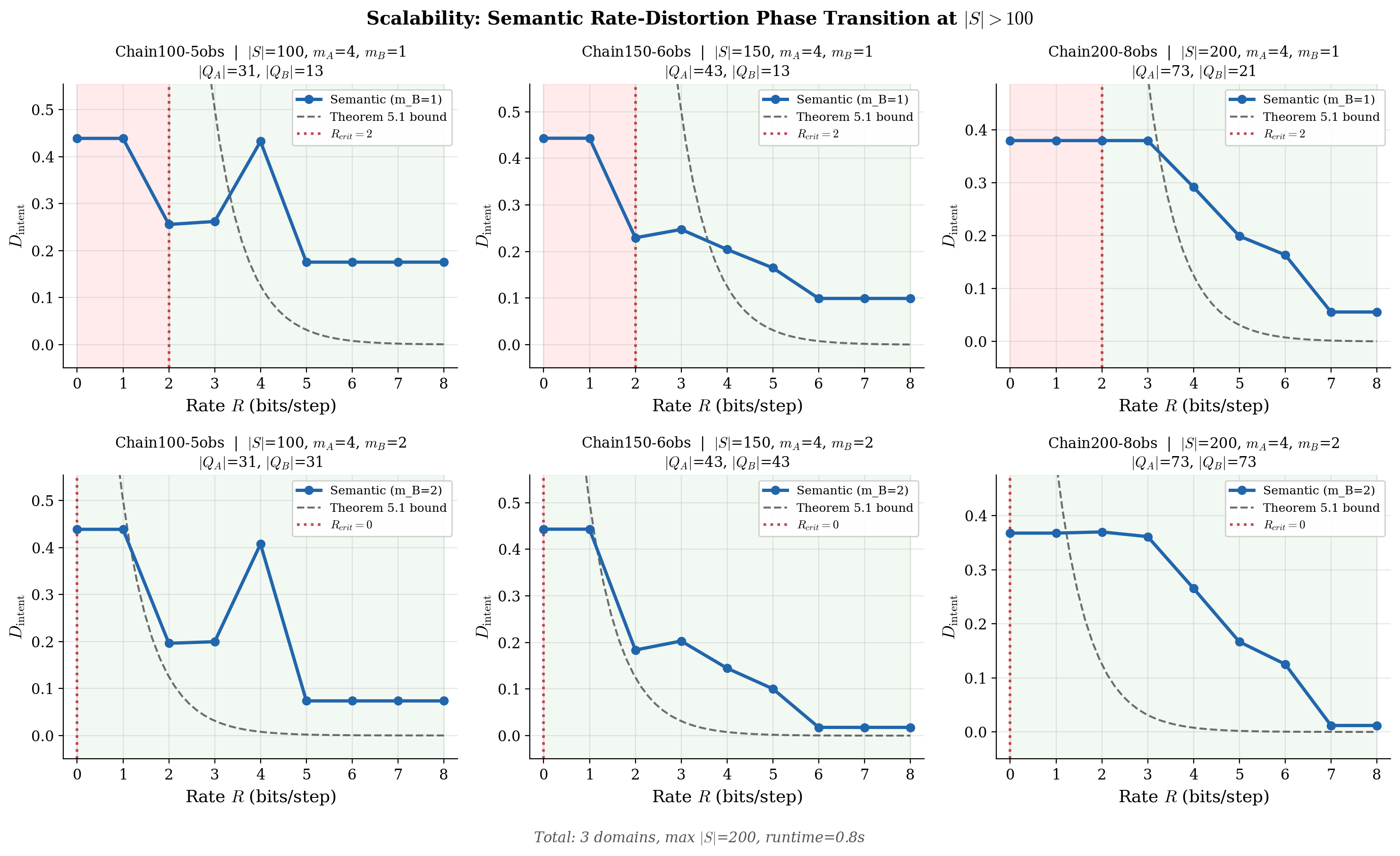
Figure 4: Phase transition in large POMDPs as capacity gap crosses critical rate—distortion floor persists until A2 is reached and disappears once A3 and A4 are matched.
Constructive Coding Schemes and Practical Protocols
The authors present practical codebook construction methods (e.g., k-means++ clustering on intents over quotient classes), achieving near-optimal performance in canonical domains. These constructs substantiate the theoretical bounds as achievable in relevant practical domains.
Encoder-only approaches (e.g., Information Bottleneck compression without side information) pay an additive penalty in communication rate relative to the semantic WZ benchmark, proportional to A5 at zero distortion, which can be large in high-capacity gaps.
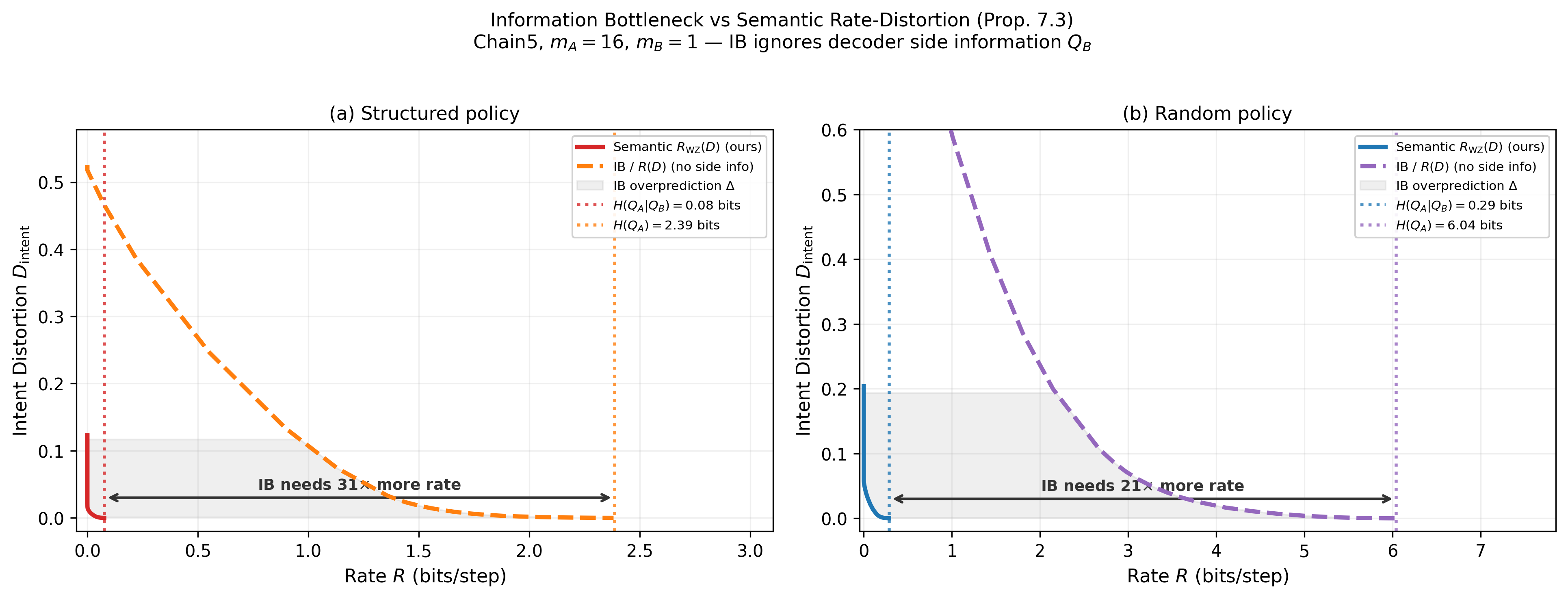
Figure 5: IB-style encoder-only compression (dashed) is strictly suboptimal relative to the semantic Wyner-Ziv-aware rate-distortion function (solid), quantifying the penalty of decoder-side ignorance.
Experimental Validation
Experiments across diverse POMDPs (Chain5, RichGridWorld, RockSample(4,4), BalancedRand8, etc.) universally display:
All code is made available for reproducibility, and the empirical methodology includes explicit quotient computation and codebook optimization.
Implications, Limitations, and Future Directions
This work advances the theoretical foundation for understanding communication complexity in heterogeneous multi-agent systems, especially in AI alignment contexts. The structural phase transition identified provides a lower bound that is robust to protocol design, reward scaling, and distortion metric details. The semantic communication cost is a function of agent capacity mismatch; the results are therefore not dependent on channel noise, designer-selected semantics, or externally imposed relevance but are intrinsic to the agents' computational structure.
Limitations:
- The framework currently applies when one-way observability holds and quotient relations are determined by capacity-based abstractions.
- Obtaining practical estimates of effective quotient cardinality for large neural networks or LLMs remains an open problem, though the paper proposes lattice-gradient and probing approaches.
- The sharpest constructive achievability (e.g., exponential decay) is proved only in i.i.d. regimes.
Future directions include extending the theory to more general two-way observation/control settings, continuous spaces (metric entropy bounds), and developing practical tools for estimating quotient partitions at neural scale, potentially through representation/probing analyses. Value-relevant quotient tightening—discounting distinctions that have negligible value impact—remains largely unexplored.
Conclusion
The semantic rate-distortion framework for bounded multi-agent communication provides an explicit answer to the question: "What does it cost for agents of heterogeneous computational capacity to align their behavior in a shared environment?" The answer is structural: the capacity-induced semantic space mismatch bounds achievable alignment, and communication must "pay the gap" determined by the quotient refinement structure. The identification with quotient-aware Wyner-Ziv coding imports the full analytical toolkit of rate-distortion theory. The implications span theory and practice in alignment, distillation, multi-agent reinforcement learning, and beyond, setting a formal baseline for what can—and cannot—be achieved in agent communication and coordination under capacity constraints.