- The paper demonstrates that the k-MENDEL sample isolates extreme emission-line galaxies with high equivalent widths using an unsupervised ASK classification method.
- Rigorous SED modeling reveals low stellar masses, high star-formation rates, and low metallicities, aligning these galaxies with reionization-era analogs.
- The study finds that many EELGs exhibit ionization conditions comparable to Lyman-continuum leakers, challenging traditional steady-state gas-regulation models.
The k-MENDEL Sample: Local Analogs to Reionization Galaxies with DESI
Introduction and Scientific Motivation
The k-MENDEL project constructs an exceptionally large, homogeneous sample of extreme emission-line galaxies (EELGs) at z<1, utilizing the wide-field spectroscopic capabilities of the Dark Energy Spectroscopic Instrument (DESI). These EELGs are critical laboratories for studying the physics of massive star formation, ISM conditions, metal enrichment, and ionizing photon escape in low-metallicity environments. The study addresses persistent knowledge gaps in the census and characterization of such galaxies, which are rare in the local Universe but prevalent at z>4 and likely analogous to sources that reionized the early Universe (2604.09516).
Automated Spectral Identification and Population Statistics
A scalable, unsupervised spectral classification framework, ASK (Automatic Spectroscopic K-means), is applied to ∼820,000 DESI spectra. The ASK procedure efficiently extracts outlier spectral types distinguished by high equivalent widths (EW), without relying on predefined emission-line measurements.
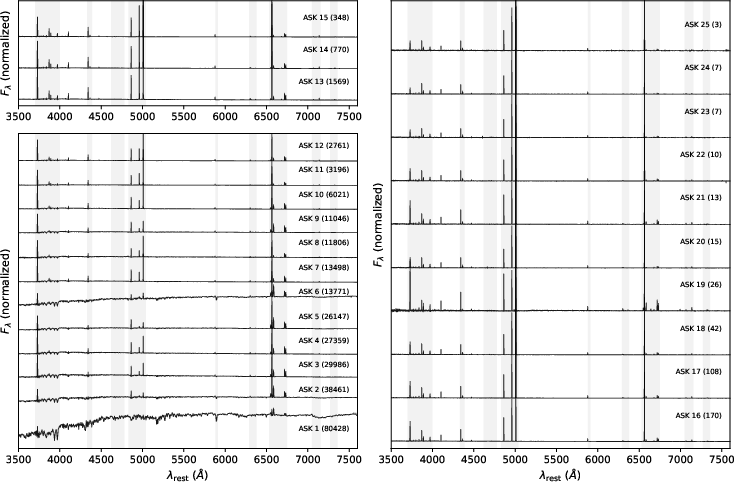
Figure 1: Median stack spectra of ASK classes, demonstrating the ability to isolate rare EELG classes with pronounced nebular emission and minimal continuum.
EELGs are operationally defined as galaxies falling within minor and outlier ASK classes, quantitatively linked to large EW[OIII] and EWHβ. The resulting k-MENDEL sample consists of 16,242 galaxies spanning $0.01 < z < 0.96$ and including both canonical "green peas" and lower-mass "blueberries".
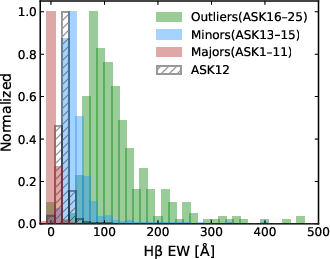
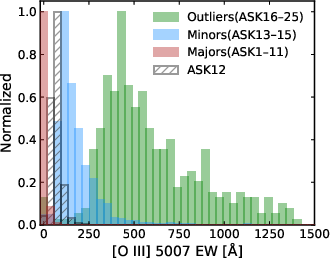
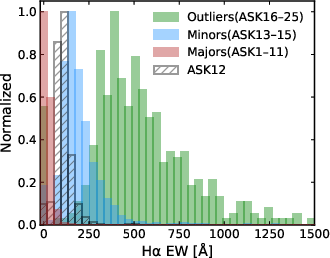
Figure 2: Emission line equivalent width distributions for major/minor ASK classes and outliers, confirming efficient isolation of high-EW EELGs.
Rigorous quality metrics and validation against direct measurements show that nearly all systems in minor/outlier classes exceed literature EELG EW thresholds, while contamination from normal star-forming galaxies (SFGs) is minimal.
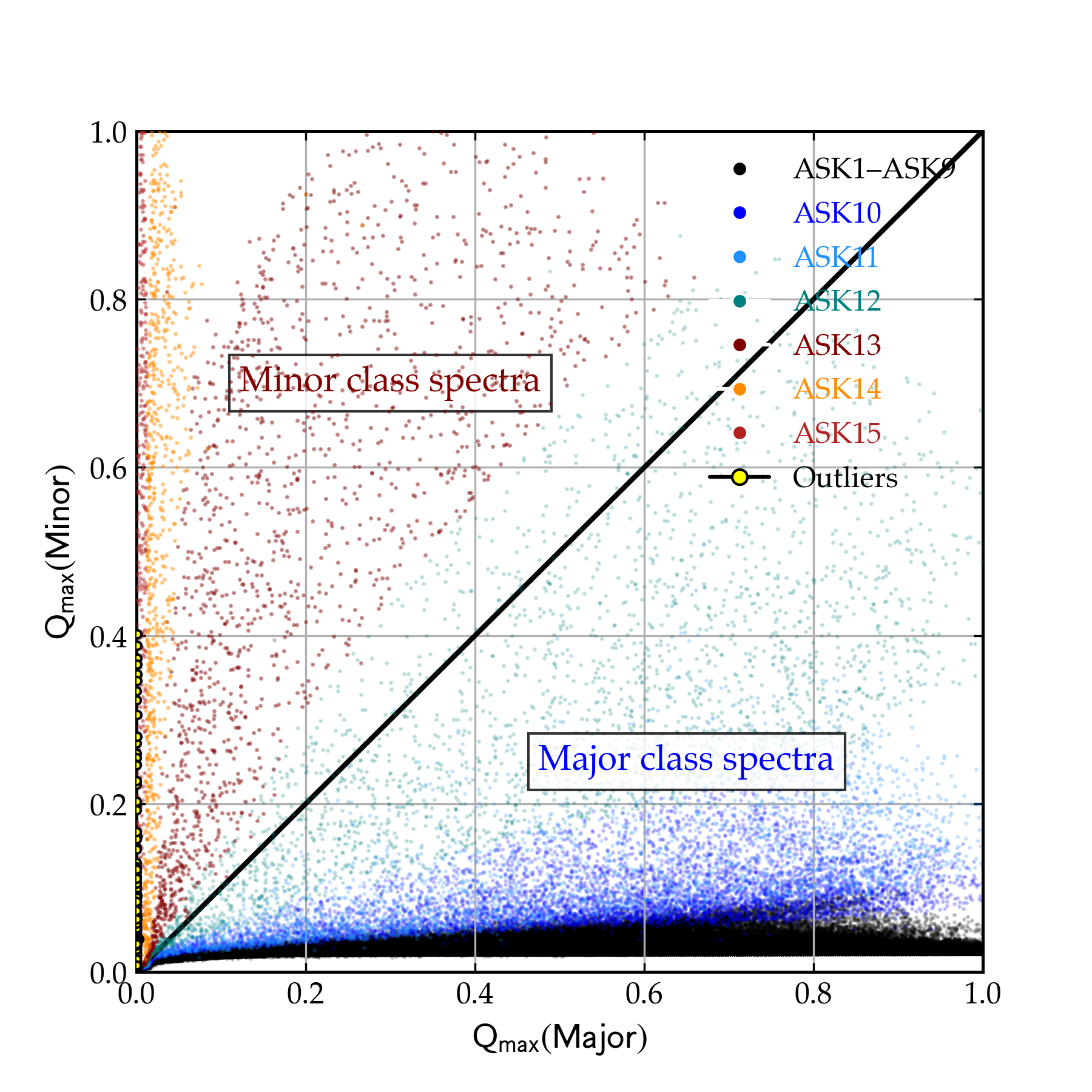
Figure 3: Scatter plot of maximum cluster assignment quality for major vs. minor ASK classes, with EELGs unambiguously separated from the main galaxy locus.
Physical Characterization and SED Modeling
With robust photometric proxies derived from filtered DESI spectra, state-of-the-art SED modeling (CIGALE) yields stellar mass, star-formation rate (SFR), and dust attenuation estimates.
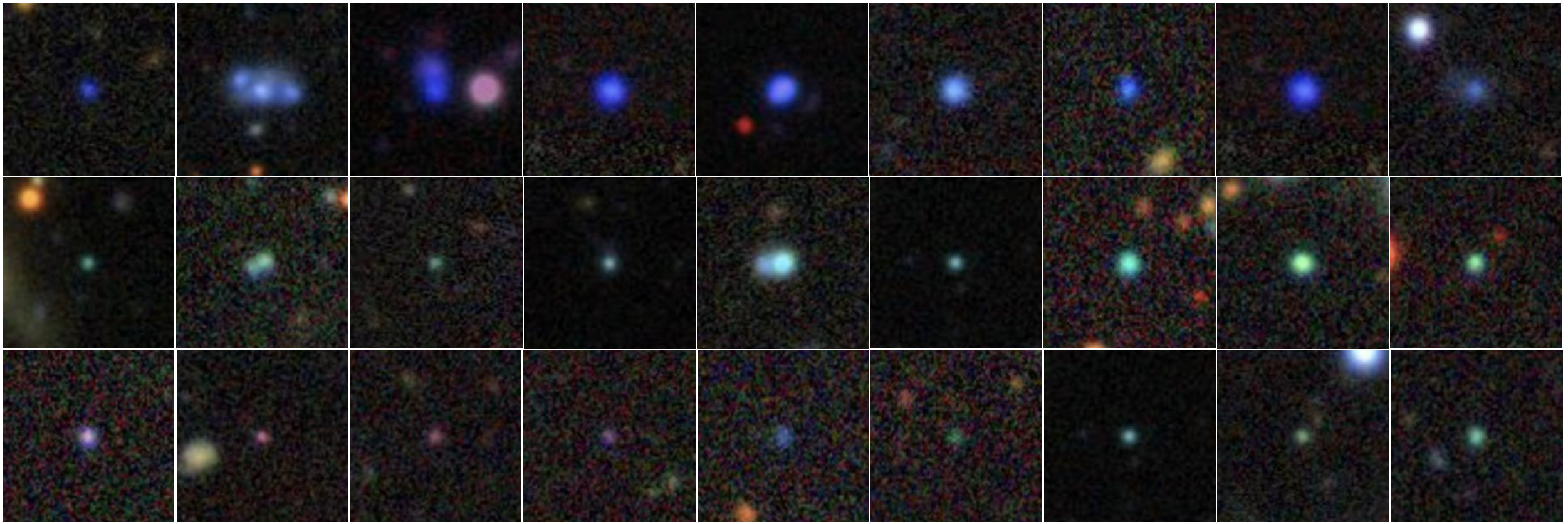
Figure 4: DESI image cutouts of representative EELGs, exhibiting compact morphologies and, occasionally, disturbed or clumpy appearances consistent with merger or intense star-formation activity.
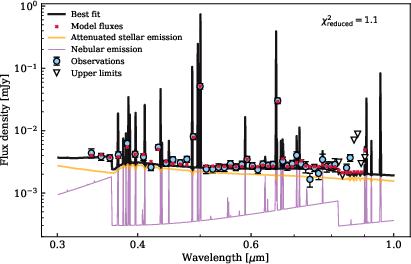
Figure 5: SED fit example for a low S/N DESI spectrum, demonstrating robust recovery of both continuum and emission-line features including strong nebular lines.
The stellar mass distribution covers 106--1010 M⊙, with SFRs up to 100 M⊙ yr−1 and specific SFRs extending to 100 Gyr−1—well above the main sequence at all redshifts probed.
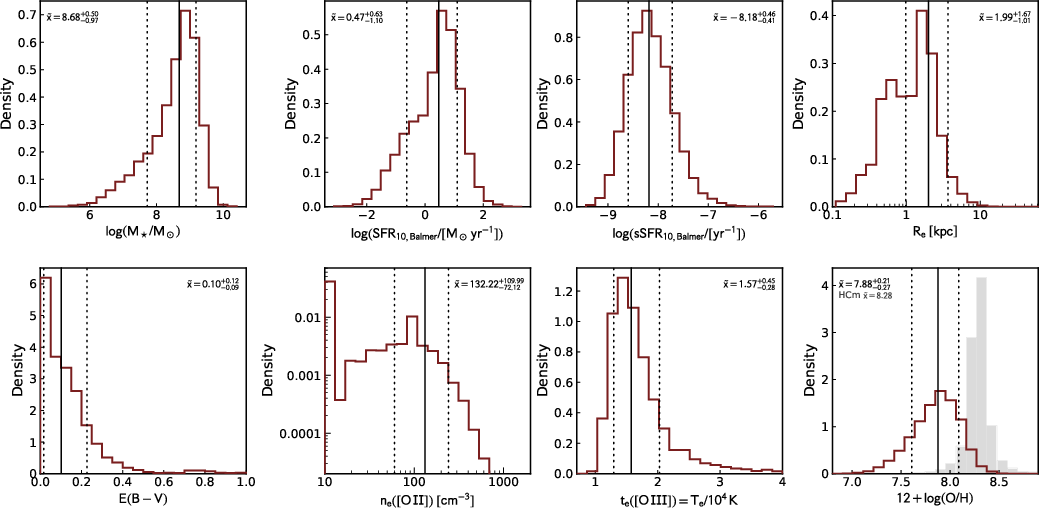
Figure 6: Distributions of derived physical and nebular parameters, highlighting the low masses, high sSFRs, and low metallicities characteristic of EELGs.
Most systems are nearly unresolved at DESI's imaging resolution, while a nontrivial minority display signs of clumpy or disturbed structure, potentially indicating dynamical interactions or feedback processes.
Emission-line diagnostics, including classical BPT and high-ionization diagrams, are used to vet AGN contamination (z>405%) and probe ISM conditions.
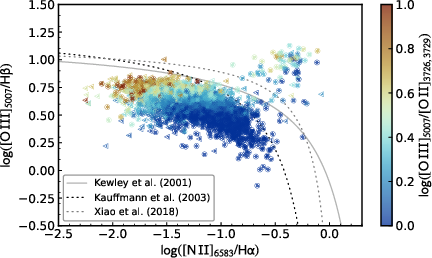
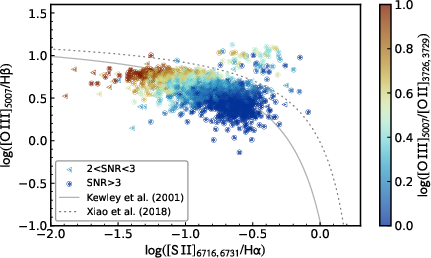
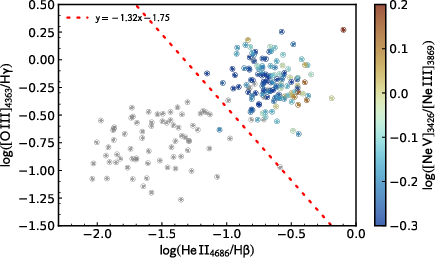
Figure 7: BPT and high-excitation diagrams for the EELG sample, separated by ionization-sensitive line ratios and S/N quality.
Stacked spectra (AGN excluded) reveal a rich inventory of nebular lines, including weak auroral transitions (e.g., [O III] z>414363), and rare features (UV Fe II*, Mg II emission), serving as powerful diagnostics for excitation, feedback and outflow properties.
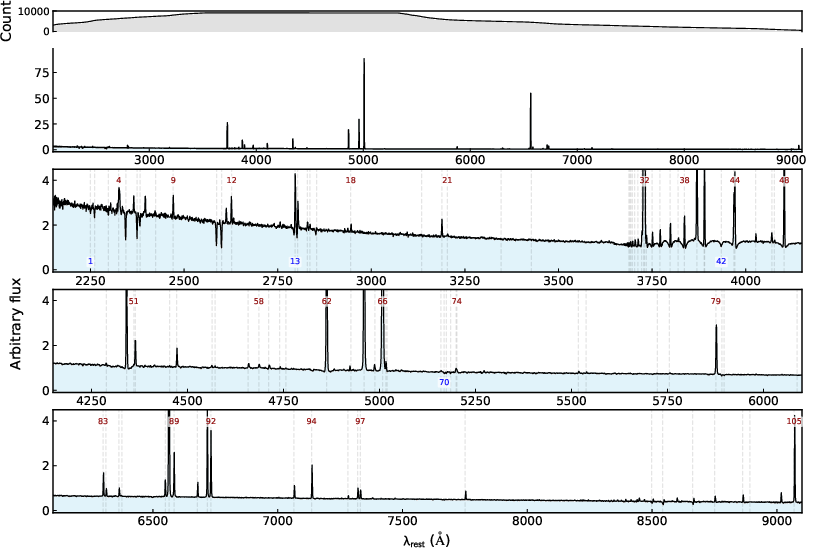
Figure 8: High S/N composite spectrum of EELGs exhibiting both extreme nebular emission and features of evolved stellar populations, confirming complex star-formation histories.
Auroral line detections permit direct z>42 metallicity determinations for z>433000 galaxies, pushing to z>44, with a median value of 7.85, i.e., z>4515% solar.
EELGs populate a tight SFR–z>46 sequence, systematically elevated with respect to the conventional main sequence, and in line with the normalization seen in z>47 JWST galaxies.
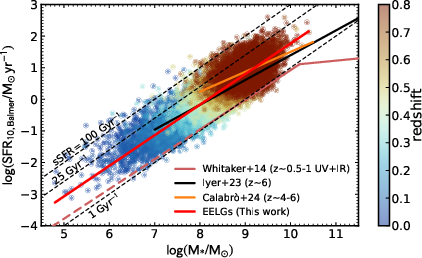
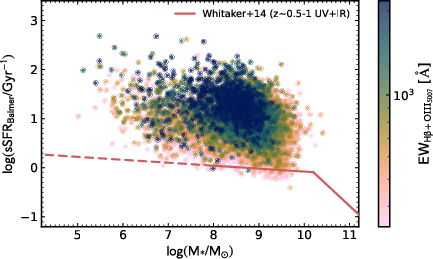
Figure 9: SFR and sSFR versus stellar mass for EELGs, demonstrating location above the SF main sequence and explicit color-coding by redshift and EW.
The mass–metallicity relation is shallow and offset by 0.3–0.5 dex from the local SFG relation, closely matching the locus of JWST galaxies observed at z>48–10 [Curti+2024; Nakajima+2023; Morishita+2024]. Notably, projection onto the FMR z>49 parameter does not reduce the large intrinsic metallicity scatter (up to 1 dex), contradictory to stationary "bathtub" galaxy evolution expectations and implying highly non-equilibrium gas accretion and feedback.
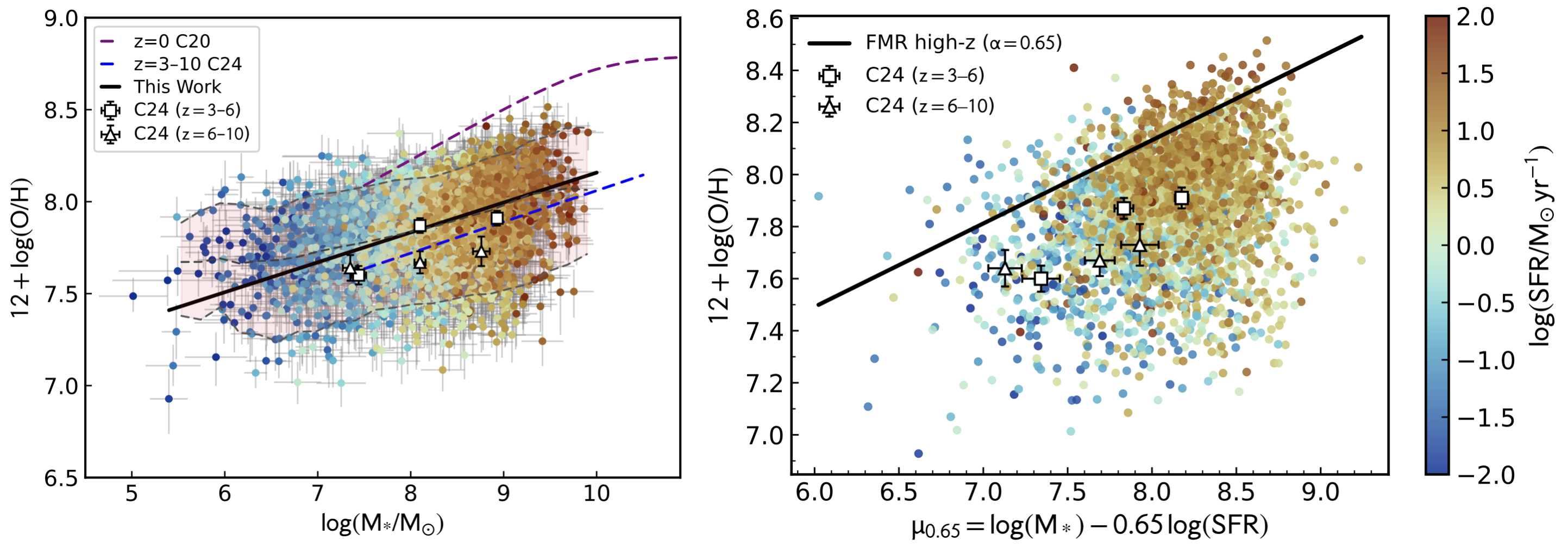
Figure 10: Left: Shallow mass-metallicity relation for EELGs, offset from the local SFG MZR. Right: Large scatter in metallicity persists in the FMR plane, inconsistent with steady-state regulation models.
Ionization Properties and Local Analogs of Reionization Era Galaxies
The EELG sample traces a high-ionization sequence in the ∼0–∼1 diagram, distinct from the local SFG population and overlapping with known low-∼2 Lyman-continuum leakers and ∼3 JWST galaxies.
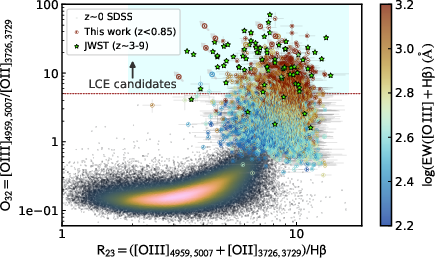
Figure 11: ∼4–∼5 diagram illustrating the high ionization and low metallicity of DESI EELGs, which populate the same regime as galaxies thought to drive cosmic reionization.
A subset of EELGs reaches ∼6–∼7, matching or exceeding observed values in confirmed LyC leakers, and strongly resembling the excitation conditions inferred for systems at ∼8.
These extreme galaxies provide a statistically significant sample for investigating ISM, feedback, and ionizing escape channels under low ∼9 and high EW[OIII]0, where theoretical modeling (via radiative transfer and hydrodynamic simulations) is currently most uncertain.
Methodological Advances and Future Surveys
The ASK spectral clustering framework, validated as both efficient and effective in DESI, is scalable to future wide-field spectroscopic surveys and adaptable to photometric surveys via synthetic low-resolution SEDs. The method robustly isolates rare EELG populations even in the presence of substantial contamination and enables both flexible definition and exploration of outlier spectral classes.
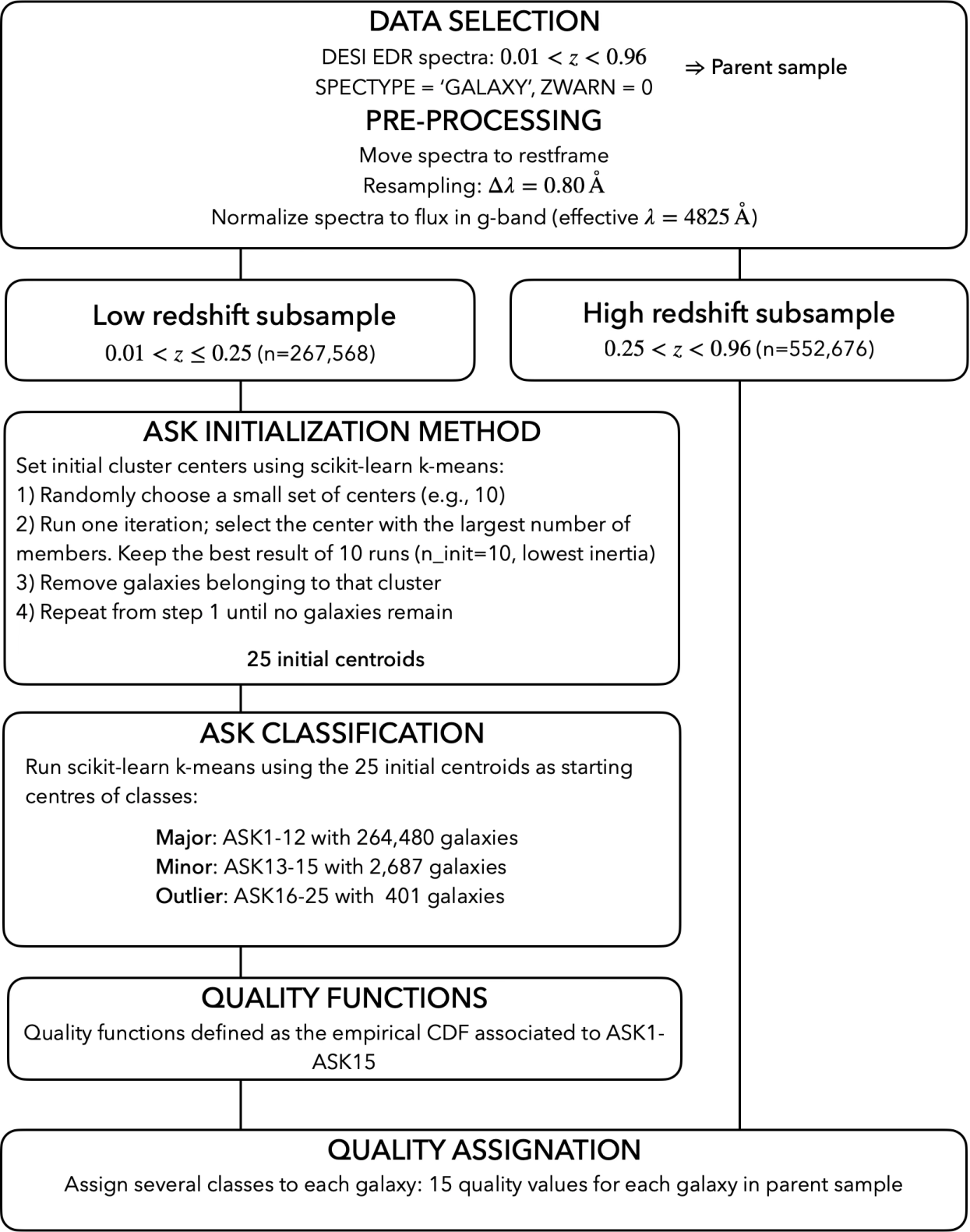
Figure 12: Flow diagram of the ASK method, illustrating its capacity as a scalable, unsupervised clustering approach for massive spectroscopic datasets.
Conclusion
The k-MENDEL EELG sample constitutes the largest, most statistically robust local analog collection to date for the star-forming systems that likely dominated cosmic reionization. The data confirm:
- EELGs occupy high-sSFR, low-metallicity, high-ionization parameter space, extending scaling relations observed with JWST for EW[OIII]1 galaxies into the local Universe with unprecedented dynamic range.
- The large scatter and systematic MZR offset for EELGs demonstrate strong departures from stationary gas-regulation models, supporting the importance of bursty, stochastic accretion and feedback consistent with predictions from high-resolution simulations [Sparre+2017; Ma+2016].
- A significant fraction of EELGs reach or exceed ionization conditions required for efficient LyC escape, providing a powerful empirical foundation for understanding reionization physics at EW[OIII]2 and future cross-survey analyses.
The ASK-based selection is well matched to next-generation spectroscopic and narrow/medium-band photometric surveys, enabling systematic discovery and characterization of rare galaxy populations, outlier line emitters, and chemically primitive systems. The resulting templates will prove critical for training machine learning classifiers, refining galaxy evolution models, and interpreting high-EW[OIII]3 JWST and Roman NIR survey data.
The implications are manifold: locally observed EELGs not only bridge the gap in understanding reionization-era galaxies but also serve as testbeds for feedback physics, ISM porosity, and burst-driven chemical evolution. The approach and findings established here set a benchmark for future studies of galaxy evolution under extreme physical conditions.