- The paper demonstrates global well-posedness of a nonlocal curve evolution model that bridges classical RFT with high-fidelity hydrodynamic dynamics.
- It employs detailed operator asymptotics and energy inequalities to control high-order derivatives and enforce the inextensibility constraint.
- The paper rigorously establishes convergence to resistive force theory at a quantitative rate, justifying RFT in the slender body limit.
Nonlocal Curve Evolution for Immersed Elastic Filaments: Global Existence and RFT Convergence
Introduction
This work advances the mathematical theory of immersed elastic filaments in 3D Stokes flow, focusing on a nonlocal evolution equation that occupies a critical position in the hierarchy of elastohydrodynamic models. Classical understanding of filament dynamics often relies on the local resistive force theory (RFT), which captures leading-order hydrodynamic effects. However, for many applications, particularly those involving high-wavenumber phenomena or detailed balance of forces, RFT is insufficient. The manuscript rigorously develops and analyzes a nonlocal curve evolution that captures the principal component of the slender body Neumann-to-Dirichlet (NtD) map, interpolating between RFT at low wavenumbers and high-fidelity nonlocal descriptions at higher frequencies.
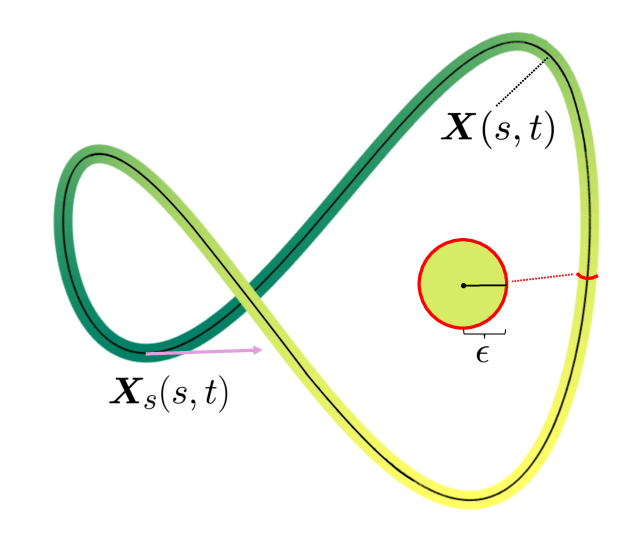
Figure 1: The geometric configuration: X(s,t) as the centerline of a filament of fixed radius 0<ϵ≪1 immersed in a 3D Stokes fluid.
The immersed filament is modeled as an inextensible elastic rod parameterized by centerline X(s,t) with constant radius ϵ. The force derived from Euler-Bernoulli beam theory is coupled to the filament velocity via a pseudodifferential force-to-velocity operator Lϵ:
∂t∂X=−Lϵ(X)[(Xsss−τXs)s],∣Xs∣2=1
The operator Lϵ has frequency-dependent behavior: at low wavenumbers, it reproduces local RFT, while at high wavenumbers, it exhibits a nonlocal, inverse-differential characteristic encoded by explicit multipliers based on the straight-cylinder NtD map. This construction avoids the ill-posedness inherent in direct nonlocal slender body models (notably at high Fourier modes), but more closely captures full boundary-value problem physics than RFT.
Analytical Properties: Well-Posedness
The principal analytical results include:
- Global Well-Posedness: The main curve evolution admits unique global solutions in the natural energy space, a property not currently established for the full slender body free boundary problem outside special cases.
- Energetics and Operator Analysis: The energy decay is formulated via the filament bending energy, with dissipation controlled by precise multipliers in tangential and normal directions. The central challenge is handling the Lagrange multiplier tension τ enforcing inextensibility, especially since the high-wavenumber properties of Lϵ modulate the regularity and nonlinearity of the system.
- Tension Regularity: The tension equation is elliptic at each instant, and the noncritical scaling afforded by the Lϵ operator enables control in the energy space with only fractional derivatives of the curve—a distinct advantage over RFT, where tension estimates are critical.
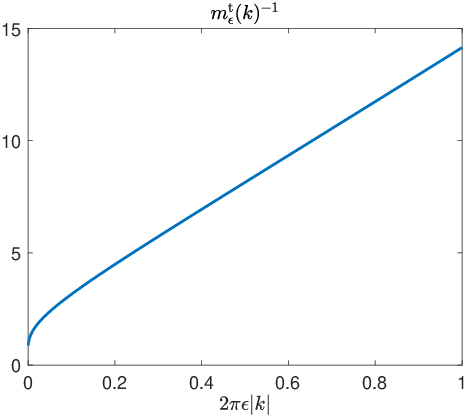
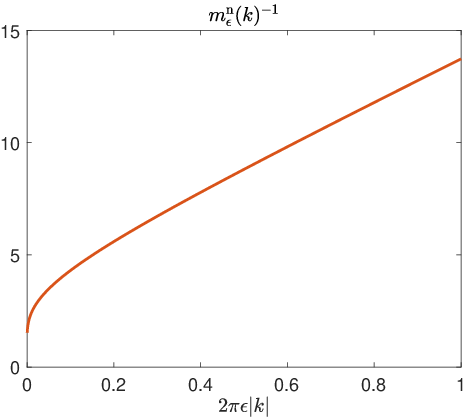
Figure 2: Inverse tangential and normal direction multipliers 0<ϵ≪10 and 0<ϵ≪11 versus 0<ϵ≪12, displaying the transition from logarithmic to linear regime as 0<ϵ≪13 increases.
Convergence to Resistive Force Theory
A key theorem rigorously establishes that, under logarithmic time rescaling, solutions of the nonlocal evolution converge to those of RFT as 0<ϵ≪14, with the following features:
- Quantitative Rate: The convergence occurs at a rate 0<ϵ≪15 in suitable Sobolev norms, reflecting the fact that RFT captures only the leading order effect of vanishing filament radius.
- Operator Asymptotics: Explicit bounds on the difference between 0<ϵ≪16 and RFT multipliers at low wavenumber demonstrate that subleading corrections are uniformly bounded for 0<ϵ≪17, which is essential in controlling the dynamics across scales.
This result provides the first rigorous dynamical connection between nonlocal curve evolution models and the classical, computationally expedient RFT, thus supplying mathematical justification for the widespread usage of RFT in the singular slender limit.
Technical Contributions
- Symbol Calculus: The paper deploys a detailed symbol calculus for the pseudodifferential operator, including high/low frequency decompositions and explicit bounds on the associated Bessel-function-based multipliers.
- Energy Method Augmented by Operator Theory: The proof of global existence leverages sharp energy inequalities, together with the spectral properties of 0<ϵ≪18, to obtain control of the highest derivatives modulo the inextensibility constraint.
- Tension Determination: The tension Lagrange multiplier is handled via a nontrivial analysis of operator-induced elliptic systems and fractional Sobolev multiplication, with continuity and Lipschitz estimates critical for stability and the contraction mapping argument.
- Framework for Generalization: The operator construction and analytic approach establish a template for more general coupled elastohydrodynamic systems involving higher-order, nonlocal, or geometry-dependent effects.
Implications and Future Directions
The analytical tools and results developed here pave the way toward understanding the global regularity of the full slender body free boundary problem in Stokes flow, which remains open. The operator decomposition and convergence technology also present new avenues for multiscale numerical methods, enabling robust simulation across physical regimes. The explicit connection between nonlocal operator structure and emergent hydrodynamic models (such as RFT) clarifies when and how leading-order theories can be justified or improved for complex biological and engineering applications.
Given that the mapping framework interpolates between local and nonlocal models, it may be adapted to study instabilities, swimmer reversal, or filament tangling at high curvature, where RFT is known to fail. Further, the approach offers potential for extension to complex fluids, viscoelasticity, or active filaments, where full free boundary coupling and higher-dimensional effects become essential.
Conclusion
This paper provides a complete and rigorous analysis of a nonlocal curve evolution for an immersed elastic filament, establishing strong well-posedness and asymptotic convergence to RFT as the filament radius vanishes. The investigation elucidates the interplay of nonlocal hydrodynamic effects, filament elasticity, and geometric constraints, and yields precise analytical tools for future developments in the mathematical theory and numerical approximation of slender body dynamics.