Published 10 Apr 2026 in cs.IT and math.NA | (2604.09477v1)
Abstract: We study the spectral recovery problem for dynamical sampling on a finite cyclic grid. Given time snapshots obtained from a fixed uniform spatial subsampling of the orbit xℓ=A<sup>ℓf, we aim to recover the spectrum of the unknown circular convolution operator A. However, in the presence of outliers, even in only a few snapshots, existing approaches often struggle to recover the spectrum. We address this challenge by proposing a novel robust spectral recovery model in the presence of time-sparse corruptions. We propose a robust pipeline that lifts the problem to a sequence of robust low-rank Hankel recovery and completion tasks, followed by Prony-type spectral estimation. Numerical experiments confirm the accurate spectral recovery of the proposed approach and exhibit its superior robustness against state-of-the-art under various settings.
The paper introduces a robust spectral recovery method that exploits the low-rank Hankel structure to accurately recover the spectrum despite time-sparse outliers.
It employs accelerated structured alternating projections and Hankel structured Newton-like descent for effective outlier detection, denoising, and matrix completion across frequency channels.
Experimental results demonstrate significant gains in spectral SNR over conventional approaches, validating its strong theoretical recovery guarantees under mixed noise conditions.
Robust Spectral Recovery in Dynamical Sampling with Time-Sparse Outliers
Problem Statement and Context
The paper addresses robust spectral recovery in the context of dynamical sampling on finite cyclic grids, where only coarse spatial samples are available at each time step. The focus is on reconstructing the spectrum of an unknown circular convolution operator A given multistep, spatially subsampled measurements of the form xℓ=Aℓf. In practical scenarios, the time series of measurements may be corrupted by gross, time-sparse outliers (such as transient sensor faults or interference), posing significant challenges to existing spectral estimation techniques that assume only additive stochastic noise. Conventional approaches, notably those based on Cadzow denoising followed by Prony's method, exhibit fragility under such structured corruptions.
The main objective is to enable stable and accurate spectral identification in dynamical sampling despite a small subset of measurement snapshots being arbitrarily corrupted. The proposed solution leverages the low-rank Hankel structure of the problem in the frequency domain, formulating a robust two-stage pipeline for denoising, completion, and Prony-based spectral estimation.
Mathematical Formulation and Structural Analysis
Dynamical Sampling Model and Corruptions
A dynamical system, governed by an unknown convolution operator A on ℓ2(Zd) with initial state f, generates signals xℓ=Aℓf. At each time step ℓ, only subsampled (by a factor m) measurements yℓ=Smxℓ∈RJ are collected. The observed samples may be contaminated according to
yℓ=yℓ+eℓ+gℓ,
where xℓ=Aℓf0 corresponds to time-sparse, potentially large-magnitude outliers (only a few xℓ=Aℓf1) and xℓ=Aℓf2 is additive Gaussian noise.
Fourier and Hankel Structures
Subsampling induces aliasing in the frequency domain, so at each frequency channel xℓ=Aℓf3, observations across time yield sequences
xℓ=Aℓf4
that are finite mixtures of exponentials due to the convolution-dynamical structure. As such, the xℓ=Aℓf5 Hankel matrix xℓ=Aℓf6 is low-rank, with rank determined by the number of distinct spectral values in the aliased set xℓ=Aℓf7. Outlier-sparse corruptions manifest as Hankel matrices xℓ=Aℓf8 with nonzero anti-diagonals at the corrupted time indices, leading to the observation model
xℓ=Aℓf9
Robust Pipeline: Hankel Recovery and Spectrum Estimation
Stage I: Outlier Detection and Low-Rank Hankel Matrix Recovery
The pipeline first attacks the outlier problem using the lowest-rank (A0) Hankel structure, which is maximally robust to sparse corruption. The decomposition problem
A1
is solved via the Accelerated Structured Alternating Projections (ASAP) algorithm. This recovers both a clean Hankel matrix A2 and an explicit estimate of the outlier support set (anti-diagonals of A3).
Stage II: Hankel Matrix Completion Across Channels
Given the estimated outlier indices, robust Hankel matrix completion is performed on each A4 frequency channel by removing outlier-infected anti-diagonals and recovering the low-rank Hankel matrix from partial (uncorrupted) entries. The paper utilizes the Hankel Structured Newton-Like Descent (HSNLD) method for efficient and robust recovery under these conditions.
Stage III: Prony-Type Spectral Recovery
Once denoised or completed Hankel matrices are available, Prony’s method is applied. The minimal linear recurrence satisfied by the time sequence at each A5 is identified, leading to the construction and root-finding of the annihilating polynomial. The roots correspond (after aliasing disambiguation) to the spectral values of the underlying convolution operator, yielding robust non-asymptotic spectral identification.
Theoretical Guarantees
The main theoretical result provides recovery guarantees based on established Hankel matrix incoherence properties. Specifically, under a A6-incoherence condition and for sufficiently long time series, the fraction of tolerable corrupted snapshots (outliers) is bounded above as
A7
where A8 denotes the worst-case condition number over all channel Hankel matrices. ASAP and HSNLD yield A9-accurate Hankel recovery across all channels with high probability. This robustifies the full pipeline in the presence of both additive noise and arbitrarily-structured outliers.
Experimental Evaluation
Spectrum Recovery Under Mixed Noise and Outliers
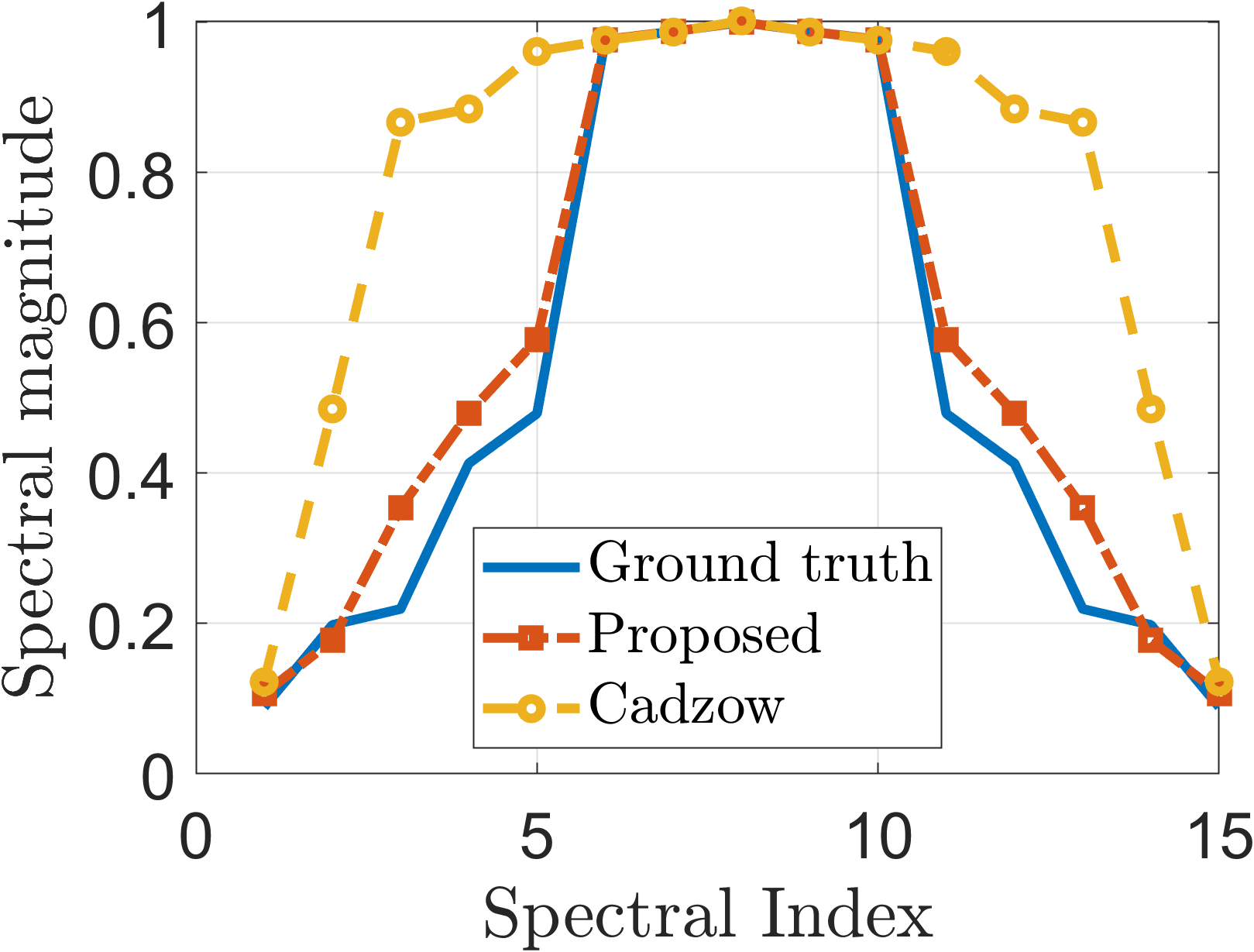
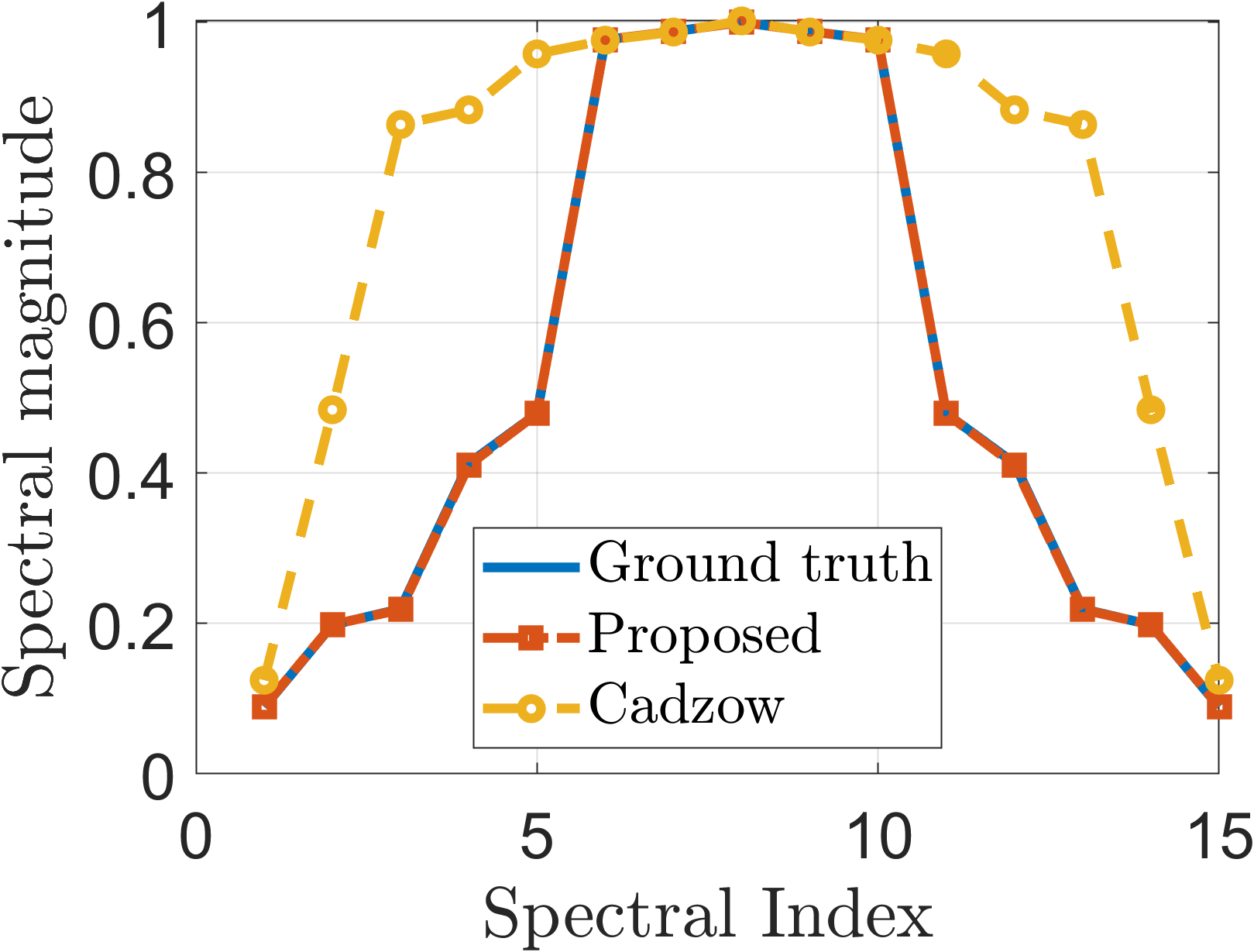
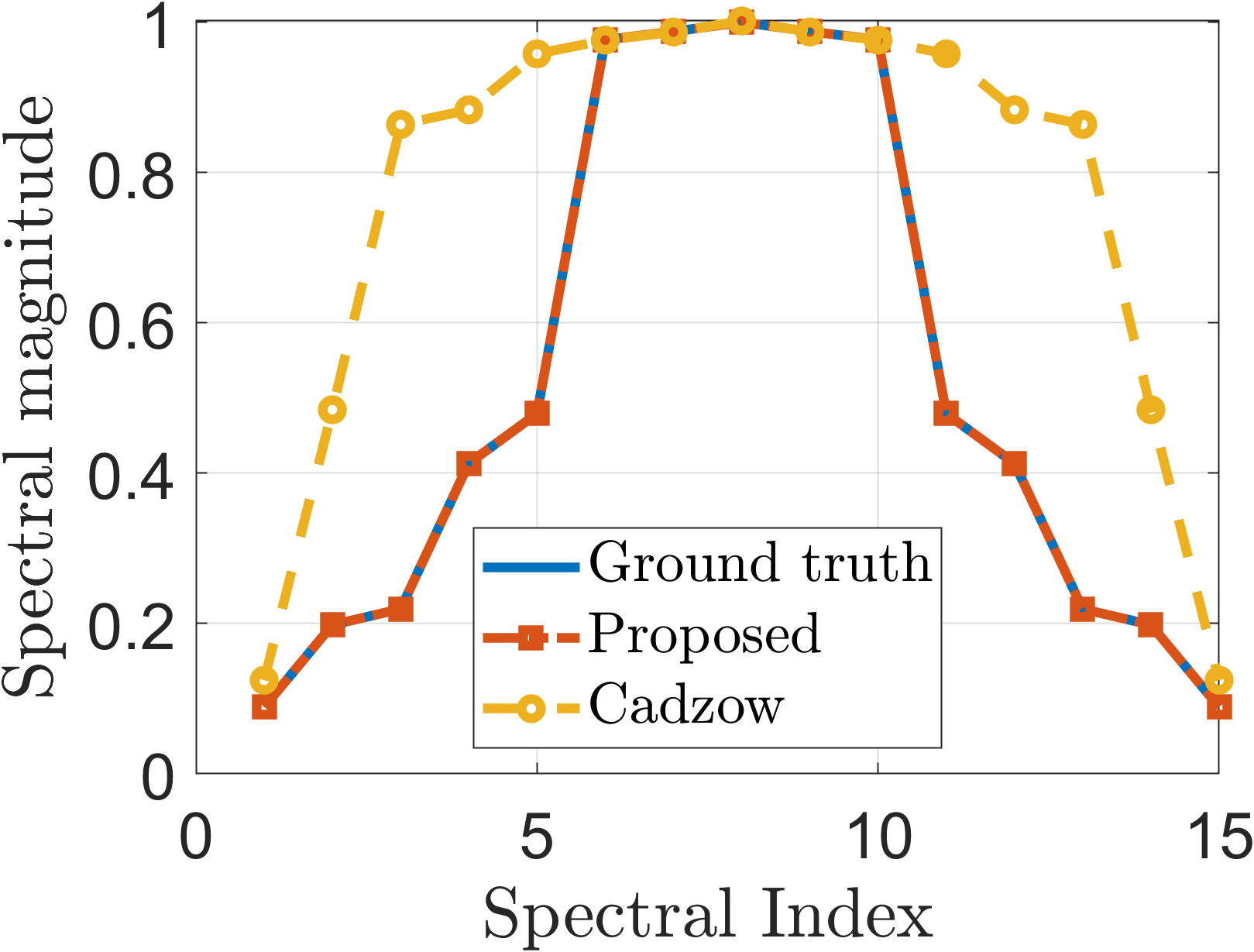
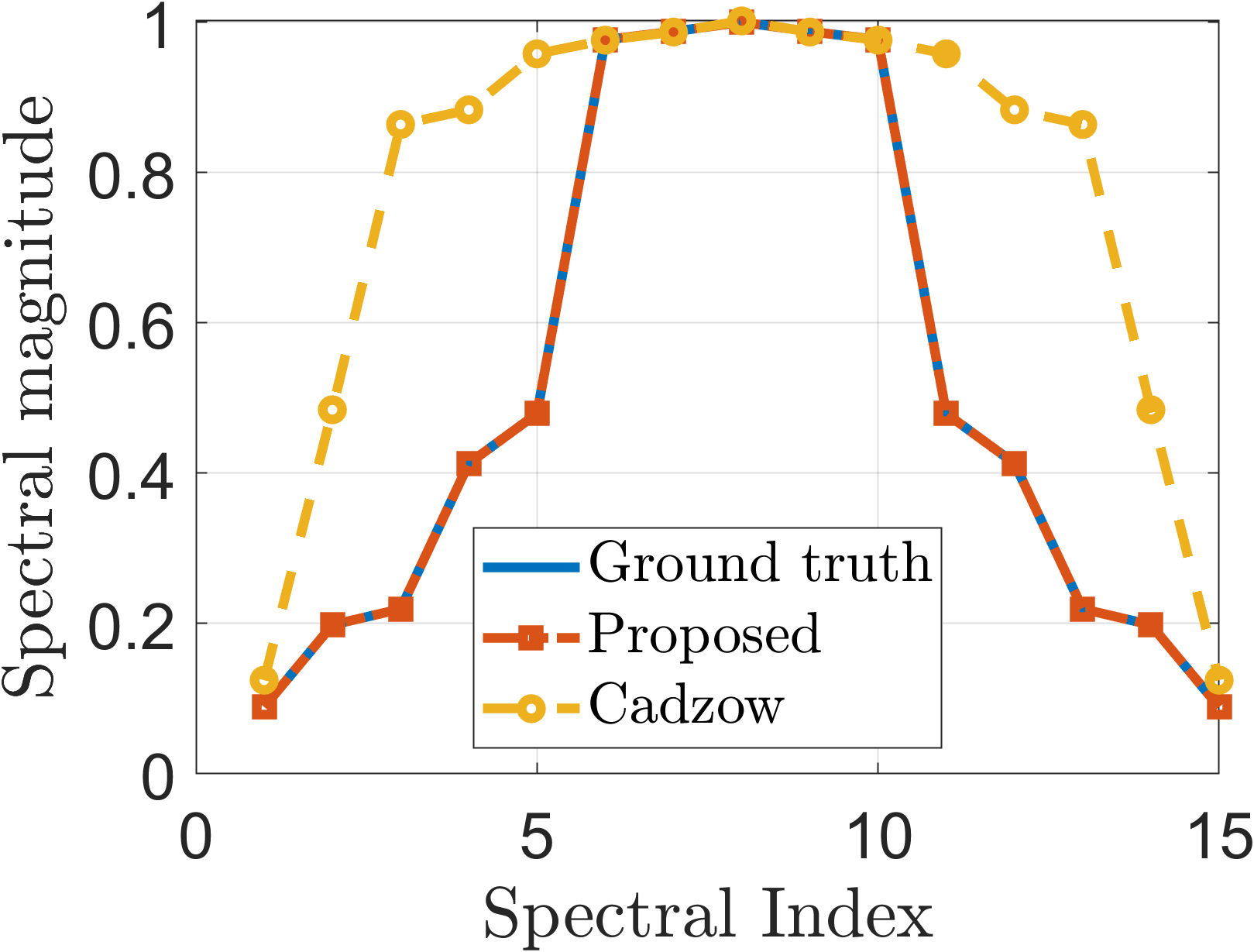
The numerical analysis evaluates the proposed robust pipeline versus the Cadzow + Prony baseline under varying levels of additive noise and time-sparse outlier rates. Results demonstrate that the proposed method recovers the spectral content with high accuracy, closely matching the ground truth as Gaussian noise decreases, while the Cadzow baseline exhibits persistent bias due to its inability to localize or isolate corruptions. Quantitative gains are evidenced in spectral SNR, with the pipeline consistently achieving much higher SNR as the noise level decreases.
Figure 1: Spectral recovery under time-sparse outliers and various Gaussian noise levels; the proposed method tracks the ground truth spectrum as noise decreases, unlike the Cadzow baseline.
Robustness to Outlier Rate
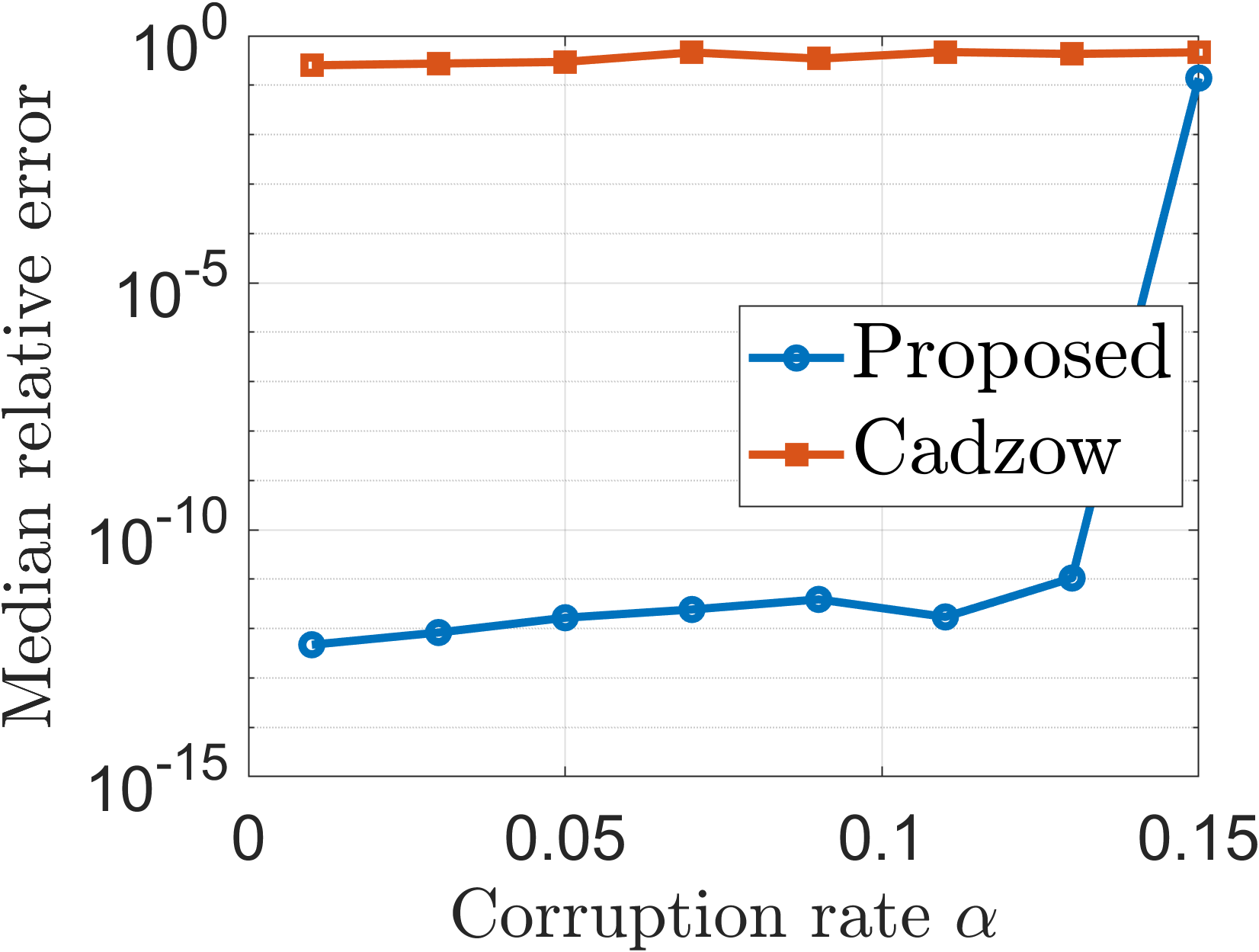
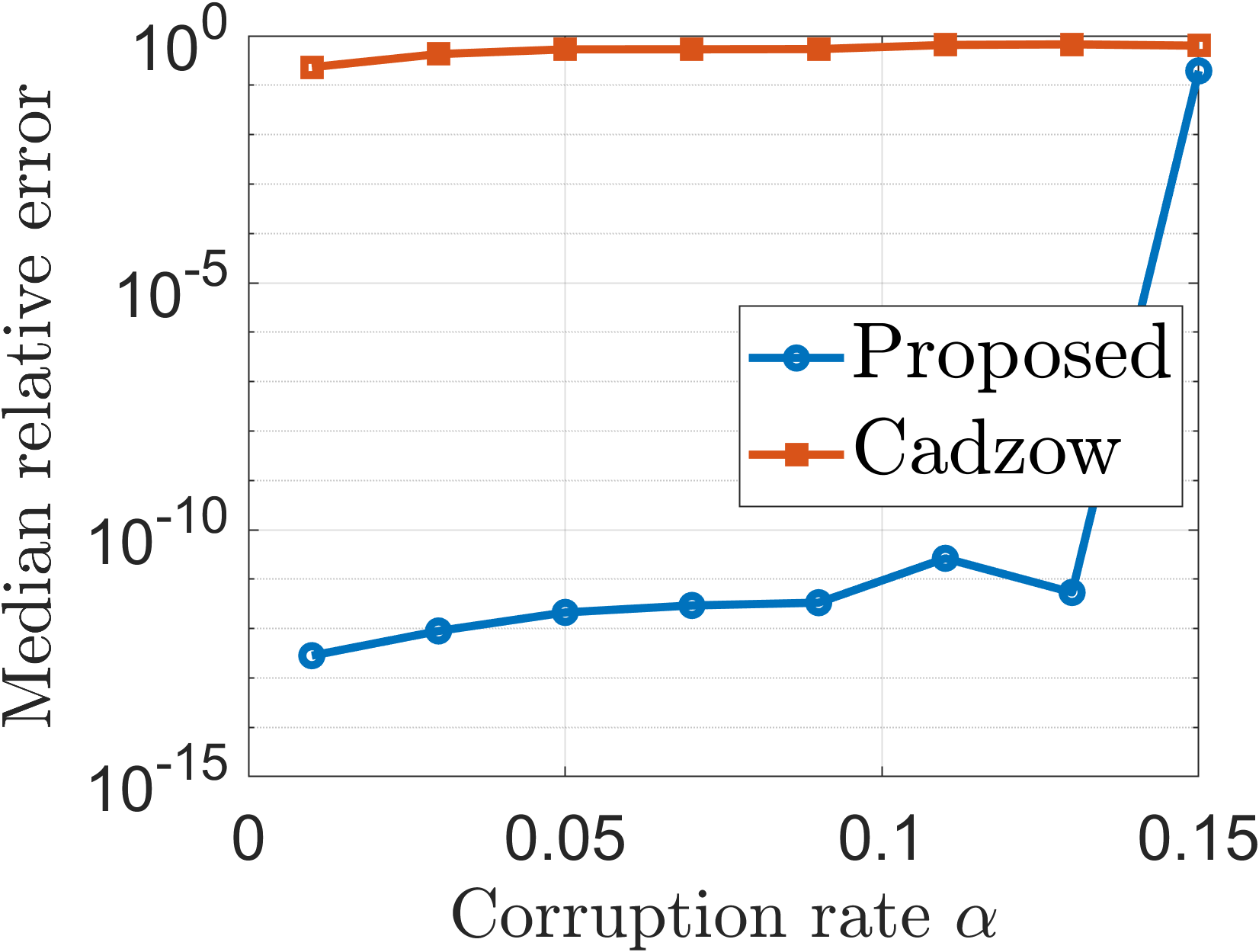
Trials with varying proportions of outlier-affected snapshots show that the method maintains near machine-precision error over a range of outlier rates, until the theoretical breakdown point is reached. In contrast, the Cadzow baseline exhibits high spectral recovery error even at low outlier rates, confirming its lack of robustness.
Figure 2: Median spectral recovery error versus corruption rate; the proposed pipeline maintains accuracy as outlier rates increase, while the Cadzow approach fails early.
Implications and Future Directions
The framework provides an explicit path to robust system identification for time-evolving physical fields and networked sensing systems under realistic, heavy-tailed corruption models. Immediate practical implications include increased resilience for sensor networks, imaging, and system identification when sporadic sensor failures or bursts of interference are common.
On the theoretical side, the decompositional strategy—leveraging the frequency-dependent rank structure of Hankel matrices—opens avenues for further analysis of fundamental tradeoffs between spatial sampling patterns, temporal snapshot complexity, and corruption resilience. Future work is expected to tighten the link between convolution spectra and Hankel matrix conditioning, extend to higher-dimensional or graph-based domains, and adapt the methodology to real-world deployment with mixed or adversarial noise models.
Conclusion
This paper develops a robust, theoretically-supported approach for spectral recovery in dynamical sampling under time-sparse outlier corruption. By lifting the problem to structured low-rank Hankel matrix recovery and integrating recent advances in optimization for outlier detection and completion, the methodology achieves both strong empirical accuracy and provable guarantees well beyond what is possible with existing heuristics such as Cadzow denoising. The proposed pipeline sets the stage for broader advances in robust system identification in distributed and resource-constrained measurement regimes.
“Emergent Mind helps me see which AI papers have caught fire online.”
Philip
Creator, AI Explained on YouTube
Sign up for free to explore the frontiers of research
Discover trending papers, chat with arXiv, and track the latest research shaping the future of science and technology.Discover trending papers, chat with arXiv, and more.