- The paper introduces Direct Conditional Distillation (DCD) to enable one-step-per-block inference, overcoming mean-field limitations in diffusion models.
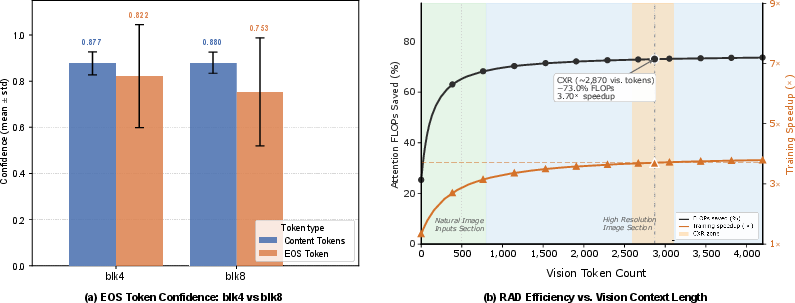
- It employs Response-Asymmetric Diffusion (RAD) to reduce training costs by 72.3% and achieve an 8× speedup in decoding compared to autoregressive methods.
- Empirical results show up to 64.3% improvement in clinical metrics while maintaining report coherence and accurate detection of rare pathologies.
Efficient Chest X-ray Report Generation with One-step Block Diffusion: A Detailed Analysis of ECHO
Introduction
Automated chest X-ray report generation (CXR-RG) represents a crucial bottleneck in medical AI, directly addressing radiologist workload in high-throughput clinical settings. While autoregressive (AR) vision-LLMs (VLMs) have established clinical accuracy for this task, their sequential decoding yields high latency. Recent developments in diffusion LLMs (dLLMs) and their extension to vision-language modalities (dVLMs) enable parallel decoding but traditionally rely on multi-step denoising, limiting their maximal throughput.
ECHO, presented as "Efficient Chest X-ray Report Generation with One-step Block Diffusion" (2604.09450), proposes a dVLM architecture and training protocol that achieves effective one-step-per-block inference, virtually maximizing decoding efficiency without degradation in output coherence or clinical accuracy. The core methodological advances—Direct Conditional Distillation (DCD) and Response-Asymmetric Diffusion (RAD)—address the weaknesses of mean-field factorized denoisers and inefficient AR-to-diffusion adaptation, respectively.
This essay provides a technical overview of the ECHO framework, critically discusses its methodological components, highlights empirical findings including strong numerical results over both AR and prior dVLM methods, and outlines future research directions in the efficient medical report generation landscape.
Motivation and Main Challenges
The standard dLLM/dVLM approach parameterizes the reverse diffusion as a mean-field (token-factorized) process, which discards cross-token dependencies. This causes severe inter-token incoherence when all tokens are predicted in parallel at high corruption (fully masked) steps, necessitating multi-step denoising for coherent output. Such requirements cap the achievable inference speed of dVLMs, preventing real-time deployment at the scale demanded in radiology.
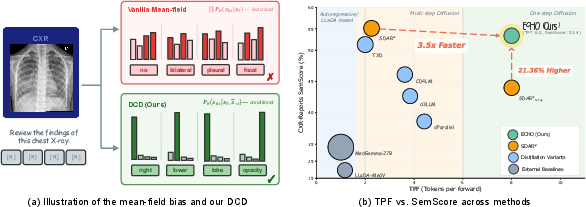
Figure 1: (a) Direct Conditional Distillation enables coherent one-step-per-block outputs, overcoming the incoherence of traditional mean-field diffusion; (b) ECHO achieves favorable trade-off between semantic quality and decoding throughput relative to AR and diffusion-based baselines.
ECHO: Model Architecture and Training Pipeline
ECHO operationalizes efficiency through a three-stage pipeline:
- Continued Pre-training (CPT): AR VLM specialization on a curated, normalized, and augmented CXR corpus, using Lingshu-7B as the base.
- Response-Asymmetric Diffusion (RAD) Adaptation: Conversion of the AR model to a block diffusion model, duplicating only the response (not vision) tokens, leveraging asymmetric block-attention masking for significant training efficiency gains.
- Direct Conditional Distillation (DCD): Distilling the multi-step block diffusion model into a one-step-per-block model by aligning the student to unfactorized, joint supervision targets extracted from the teacher’s on-policy diffusion trajectories.
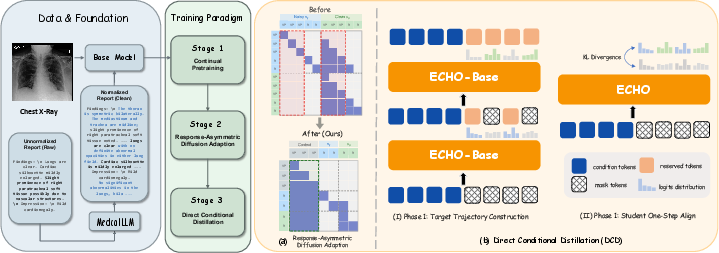
Figure 2: Overview of the three-stage ECHO training pipeline, showing efficient conversion from AR to block diffusion (RAD), and DCD's construction of joint, non-factorized supervision.
Direct Conditional Distillation (DCD)
DCD departs from prior self-distillation protocols that align only marginal (position-wise) predictions. Instead, it collects the teacher model’s full joint token distribution along confidence-heuristic denoising trajectories. The student is trained via KL divergence to match these joint, trajectory-conditioned targets in a single block-level forward pass. This addresses the mean-field bias that fundamentally impairs one-step decoding in earlier discrete diffusion models.
Response-Asymmetric Diffusion (RAD)
RAD avoids the inefficiency of duplicating long vision token contexts inherent in previous AR-to-block-diffusion conversion methods. By duplicating only the response sequence and constructing the block attention mask accordingly, it reduces fine-tuning FLOPs by 72.3%, achieving a 3.61× speedup.
Hallucination Mitigation and Report Normalization
ECHO incorporates structured report normalization, explicitly annotating both positive and negative findings for all anatomical regions. This addresses two critical hallucination modes:
Inference Paradigm Optimization
ECHO further accelerates inference via a Fused Block KV Cache, merging the key-value (KV) cache update of a previously decoded block into the current denoising forward pass. This reduces forward-pass count by half compared to conventional vanilla block KV cache designs, while maintaining computational cost.
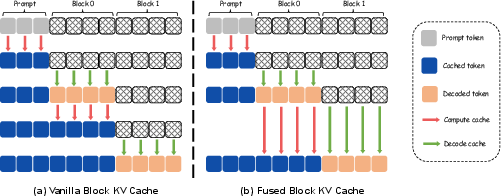
Figure 4: Fused block KV cache eliminates redundant KV update forward passes, halving the overall number of passes for one-step-per-block decoding.
Empirical Results
Numerical Superiority
ECHO achieves up to 64.3% improvement in RaTE and 60.6% in SemScore over SOTA AR models and outperforms all previous diffusion-based models in both clinical fidelity and linguistic metrics. Notably, the one-step-per-block distillation delivers 8× speedup in decoding throughput with negligible (2-5%) drops in quality across block sizes (L=4,8).
- Competing SOTA distillation methods such as T3D, CD4LM, and dParallel either (a) achieve lower speedups at equal quality or (b) incur significant clinical fidelity losses at comparable decoding rates.
- Ablation studies confirm substantial gains from report normalization and DCD components (step-wise weighting, <eos> CE loss) as essential for both coherence and coverage of positive findings.
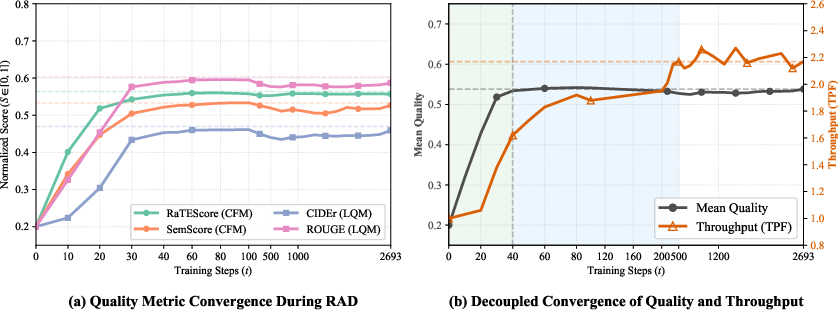
Figure 5: Impact of RAD training data scale on quality metrics and inference throughput, demonstrating that high quality saturates rapidly, with throughput continuing to improve with continued fine-tuning.
Qualitative Analysis
ECHO demonstrates marked improvements in report completeness, fluency, and clinical accuracy versus both AR and diffusion baselines—especially in challenging cases involving rare or subtle pathologies.
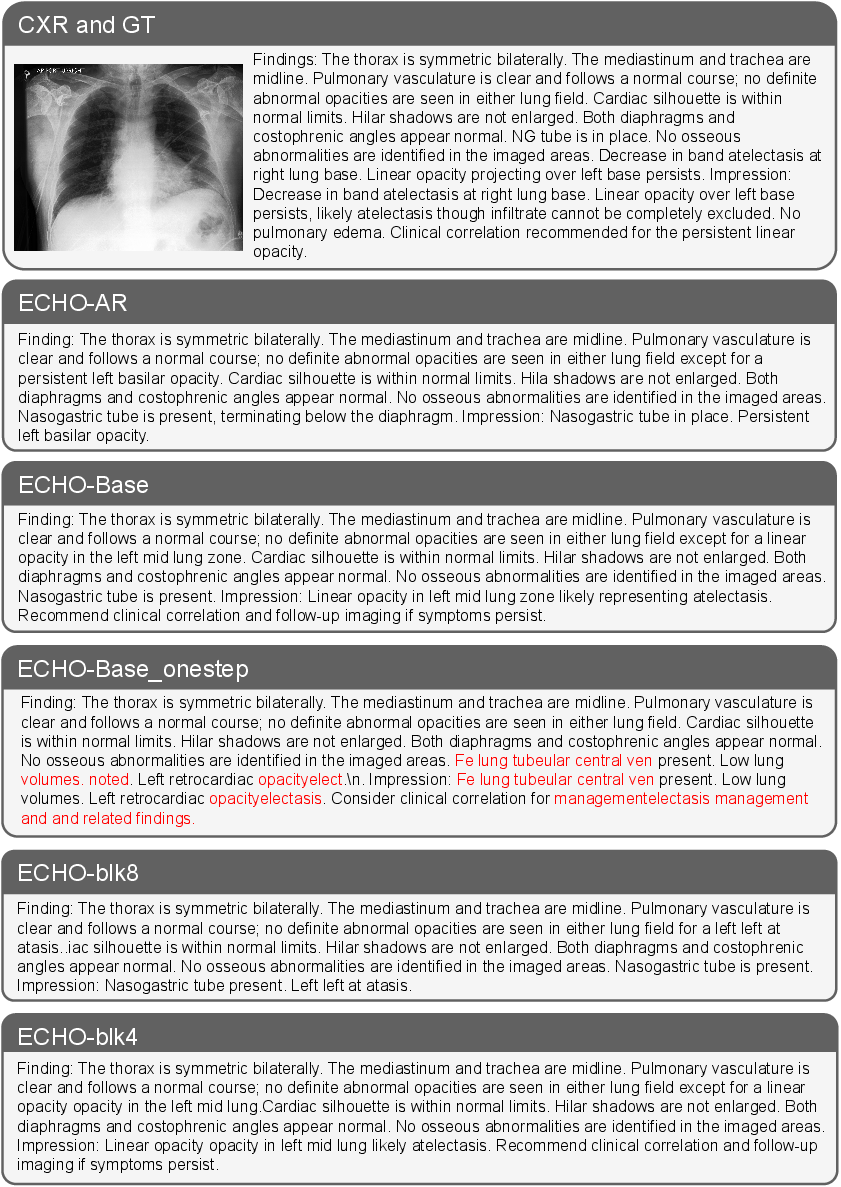
Figure 6: Qualitative comparison of report generation quality across model variants.
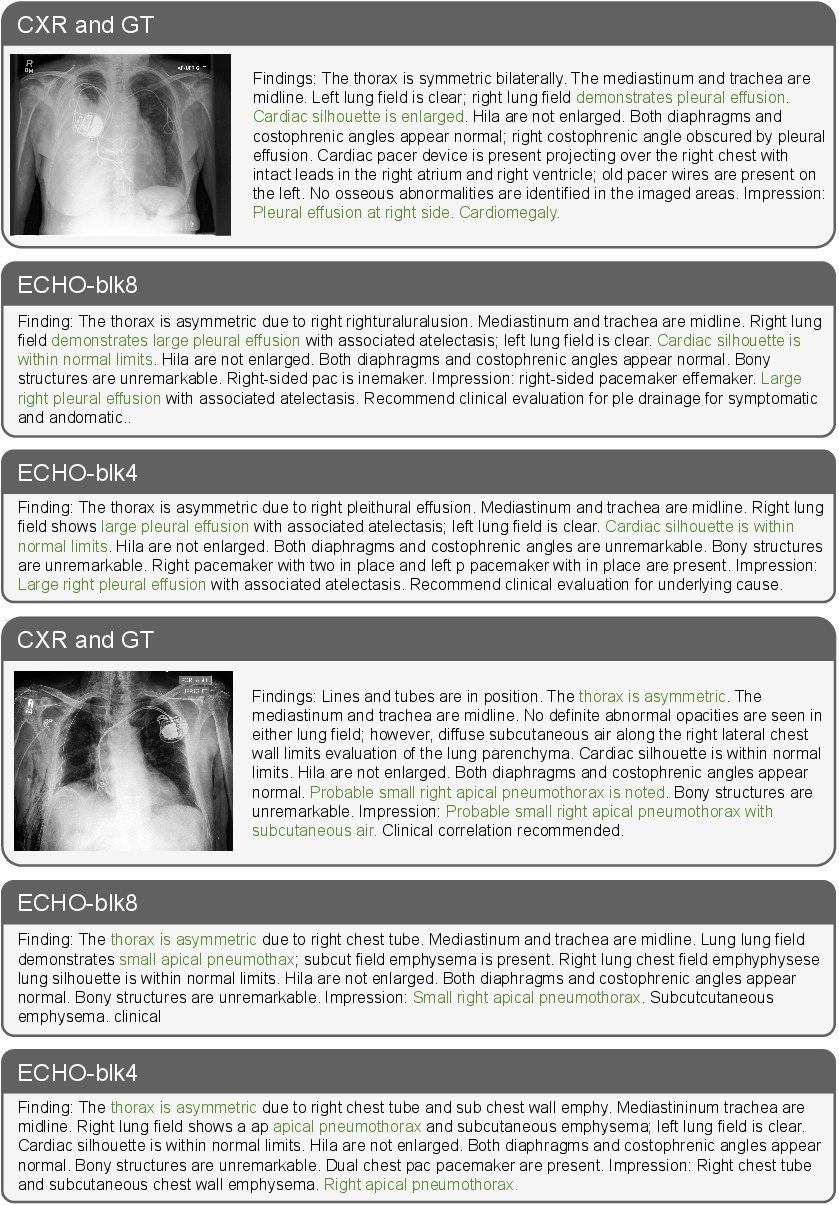
Figure 7: Examples of positive pathology detection: ECHO correctly identifies abnormal findings across a range of radiological scenarios.
Implications and Future Directions
The ECHO framework provides compelling evidence that extreme efficiency and clinical accuracy in automated report generation are not mutually exclusive. The methodological innovations—primarily non-factorized, trajectory-conditional distillation and efficient AR-to-block-diffusion adaptation—generalize beyond CXR to potentially all structured medical report generation tasks that require high annotation throughput and domain-specific accuracy.
Immediate implications include scaled deployment in radiology, cross-modal semi-autoregressive tasks (e.g., structured imaging + text summarization), and further research in multimodal, one-step diffusion models for other medical or scientific imaging domains.
Key open directions are:
- Exploration of joint vision-language block parallelism with larger or multi-modal contexts.
- Adaptation of non-factorized distillation to broader sequential reasoning tasks in science and robotics.
- Robustness analysis and transferability to other languages, imaging modalities, or report structuring conventions.
Conclusion
ECHO (2604.09450) establishes a new state-of-the-art for efficient, accurate CXR report generation by leveraging Direct Conditional Distillation to enable one-step-per-block parallel inference. The architecture consistently outperforms both AR and diffusion-based models in clinical accuracy and throughput while maintaining rigorous report quality control through structured normalization and explicit hallucination mitigation. The framework’s methodological principles furnish a robust foundation for future research into scalable, reliable, and rapid multi-modal report generation systems in medicine.