- The paper presents a generalized MCV model with temperature-dependent parameters, establishing closed-form travelling wave and soliton solutions.
- The methodology employs Taylor expansions and a travelling-wave ansatz to reduce PDEs to ODEs, enabling explicit soliton profiles.
- Results show that parameter selections dictate the emergence of dark and bright solitons, with implications for nanoscale thermal management.
Heat and Thermal Travelling Wave Solutions in Nonlinear Maxwell-Cattaneo-Vernotte Models
Introduction
The paper "Heat and thermal travelling wave solutions of a nonlinear Maxwell-Cattaneo-Vernotte equation" (2604.09432) presents an in-depth analytical treatment of nonlinear heat transfer phenomena described by a generalized Maxwell-Cattaneo-Vernotte (MCV) equation. The analysis systematically incorporates temperature-dependent material parameters—thermal conductivity and relaxation time—through polynomial (Taylor) expansions, enabling direct handling of nonlinear regimes. Explicit travelling wave solutions are derived, with special attention to soliton-like structures in one-dimensional geometries, and a mathematical characterization of the conditions required for the emergence of such solutions. The significance of these results lies in their relevance for understanding heat transport in nanoscale and low-dimensional phononic systems, where non-Fourier effects and thermal wave phenomena play a vital role.
Nonlinear Maxwell-Cattaneo-Vernotte Framework
The classical Fourier heat law leads to infinite propagation speeds, which is physically inadequate for certain materials and non-equilibrium situations. The MCV equation generalizes Fourier's law by introducing a finite relaxation time τ(T) in the constitutive relation between heat flux q and the temperature gradient, promoting hyperbolic instead of parabolic transport. The general nonlinear MCV model considered is: τ(T)∂tq+q=−λ(T)∇T
where the temperature dependence of λ and τ is prescribed via Taylor expansions around a reference temperature T0: λ(T)=i=0∑nai(T−T0)i,τ(T)=j=0∑mbj(T−T0)j
The resulting governing equations are thermodynamically consistent, explicitly satisfying the second law by construction and permitting arbitrary smooth, physically admissible temperature dependence of material properties.
Reduction to one spatial dimension yields a coupled system for the temperature field T(x,t) and heat flux q(x,t), subsequently nondimensionalized for analytical tractability. The nonlinear structure of the equations allows for various wave phenomena, including the emergence of localized, non-dispersive thermal solitons under specific parameter choices.
Analytical Methods for Travelling Wave and Soliton Solutions
Travelling wave ansatz U(x,t)=U(ξ), q0, reduces the PDEs to ODEs. The central mathematical insight is that the resulting ODE can be recast, using Hermite's theorem, into closed-form integrals for broad classes of polynomial orders q1, corresponding to the degrees of q2 and q3.
Special cases elucidate the structure of soliton-like solutions:
- Case q4: This configuration yields single-soliton solutions, with the temperature field (q5) forming a dark soliton (tanh-profile) and the heat flux (q6) exhibiting a bright soliton (sechq7-profile).
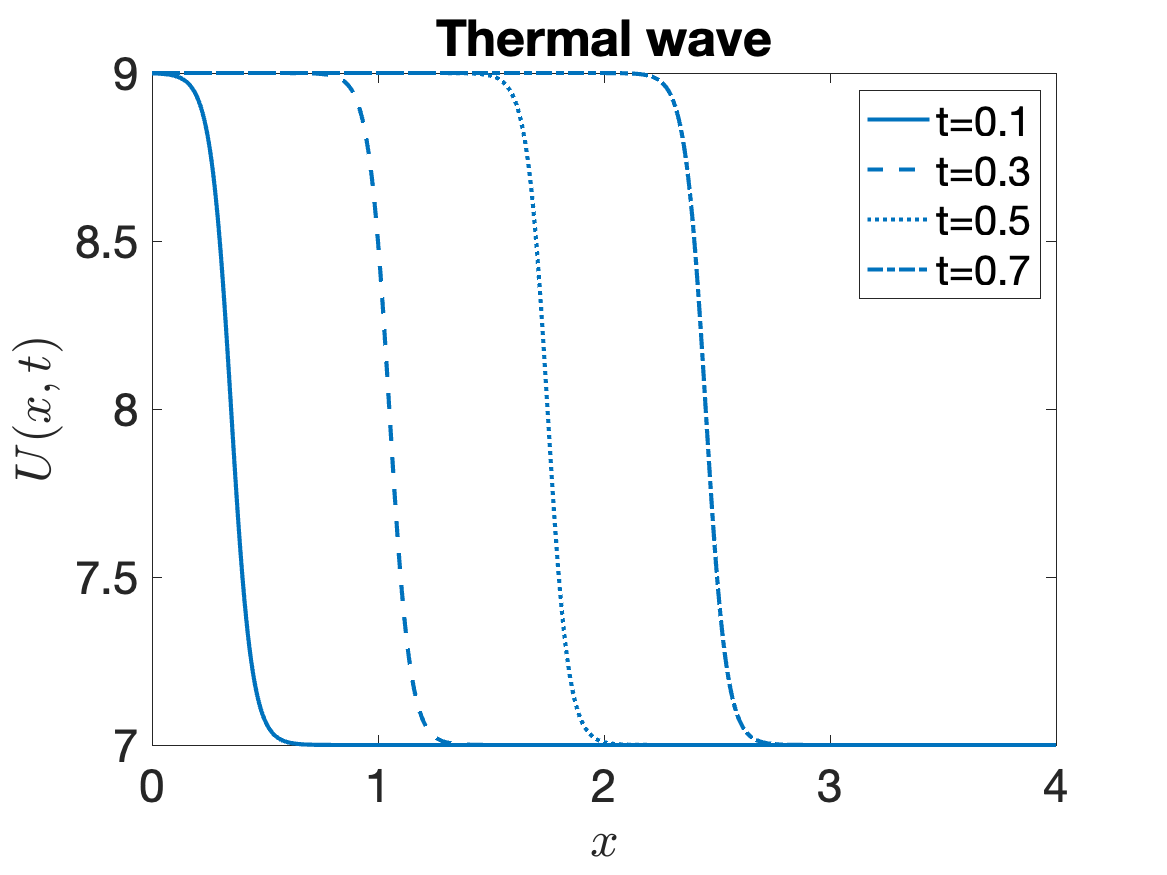
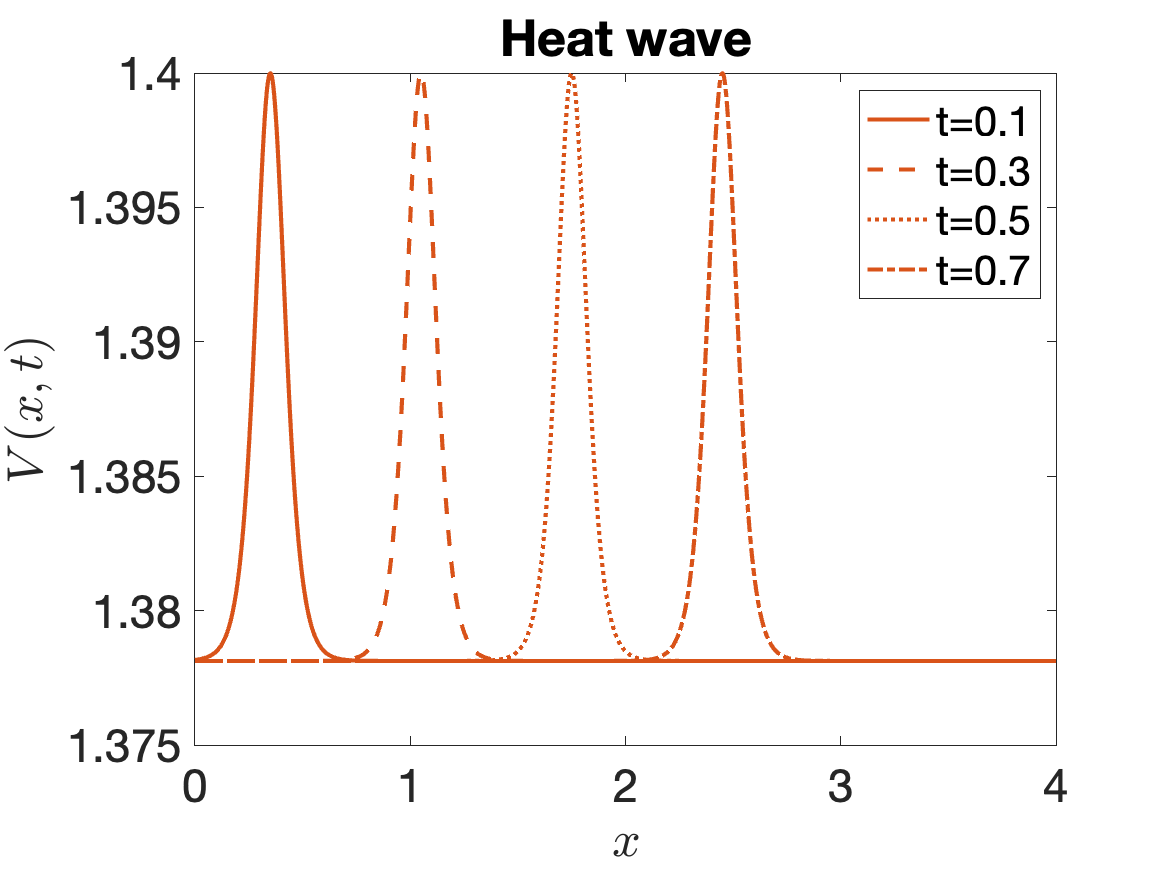
Figure 2: Plot of the soliton solutions for the dark thermal soliton q8 and bright heat flux soliton q9, confirming their localized, non-dispersive nature.
The analytical solutions for this case are: τ(T)∂tq+q=−λ(T)∇T0
τ(T)∂tq+q=−λ(T)∇T1
where parameters τ(T)∂tq+q=−λ(T)∇T2 are functions of the expansion coefficients and wave velocity.
- Case τ(T)∂tq+q=−λ(T)∇T3: By increasing the polynomial order, the solution structure allows for higher-order (train) soliton solutions, corresponding to multi-soliton superpositions. The explicit form involves linear combinations of artanh functions, resulting in complex, multi-stage localized structures.
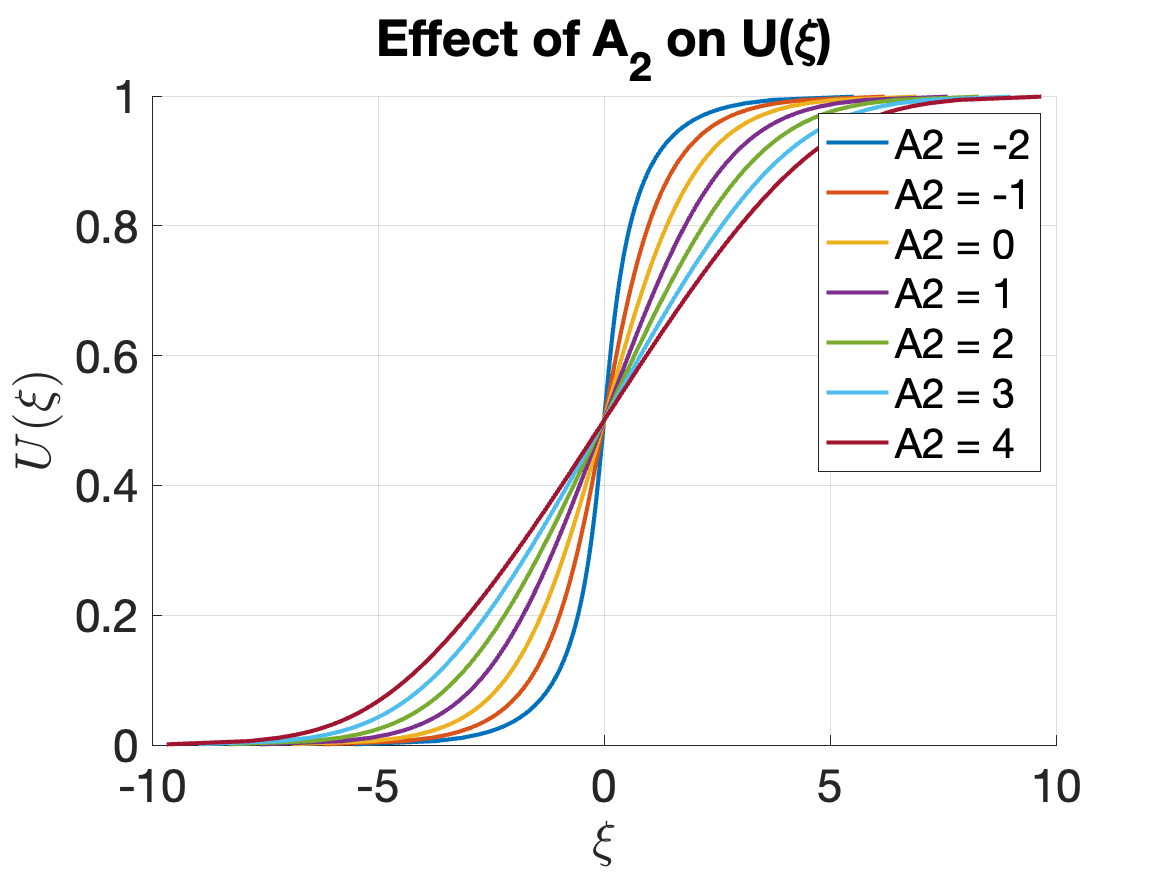
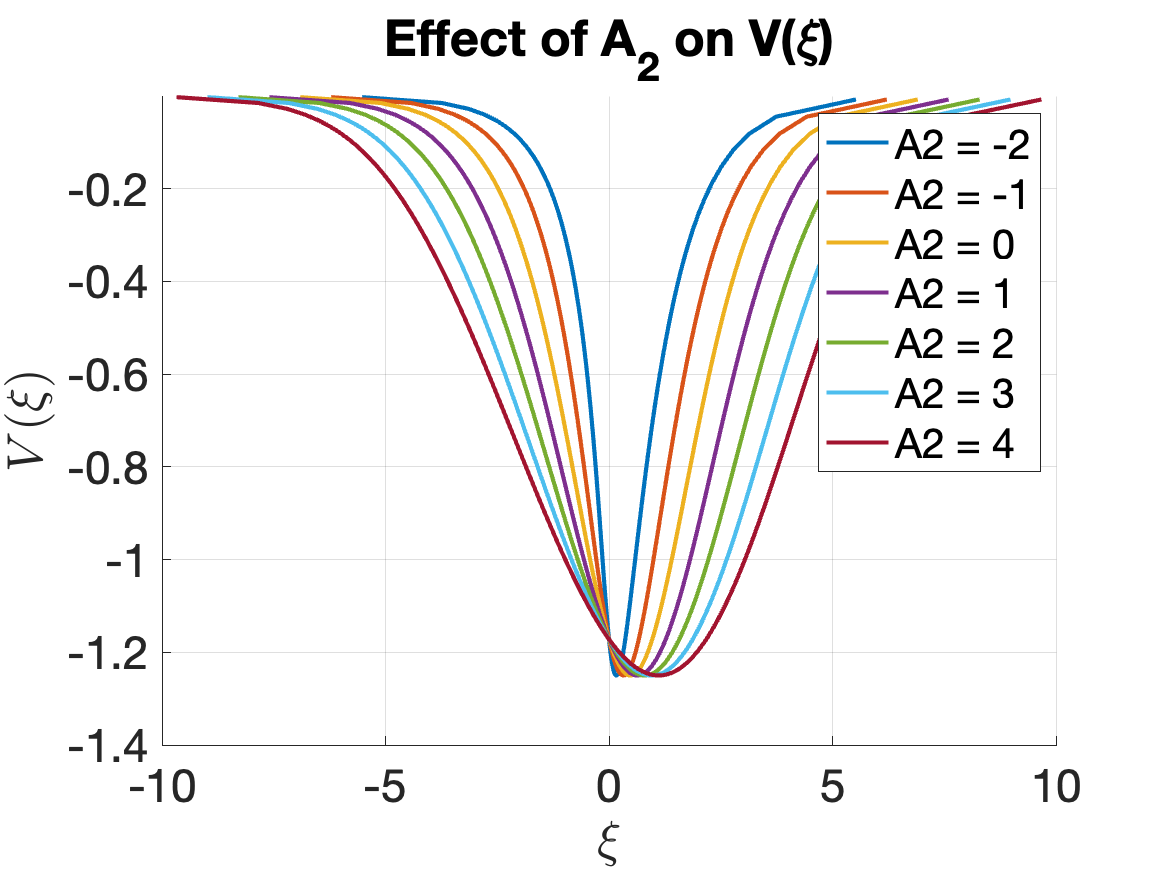
Figure 4: Plots of the dark soliton solutions for τ(T)∂tq+q=−λ(T)∇T4, τ(T)∂tq+q=−λ(T)∇T5 illustrate the multi-soliton profiles and their dependence on parameter choices.
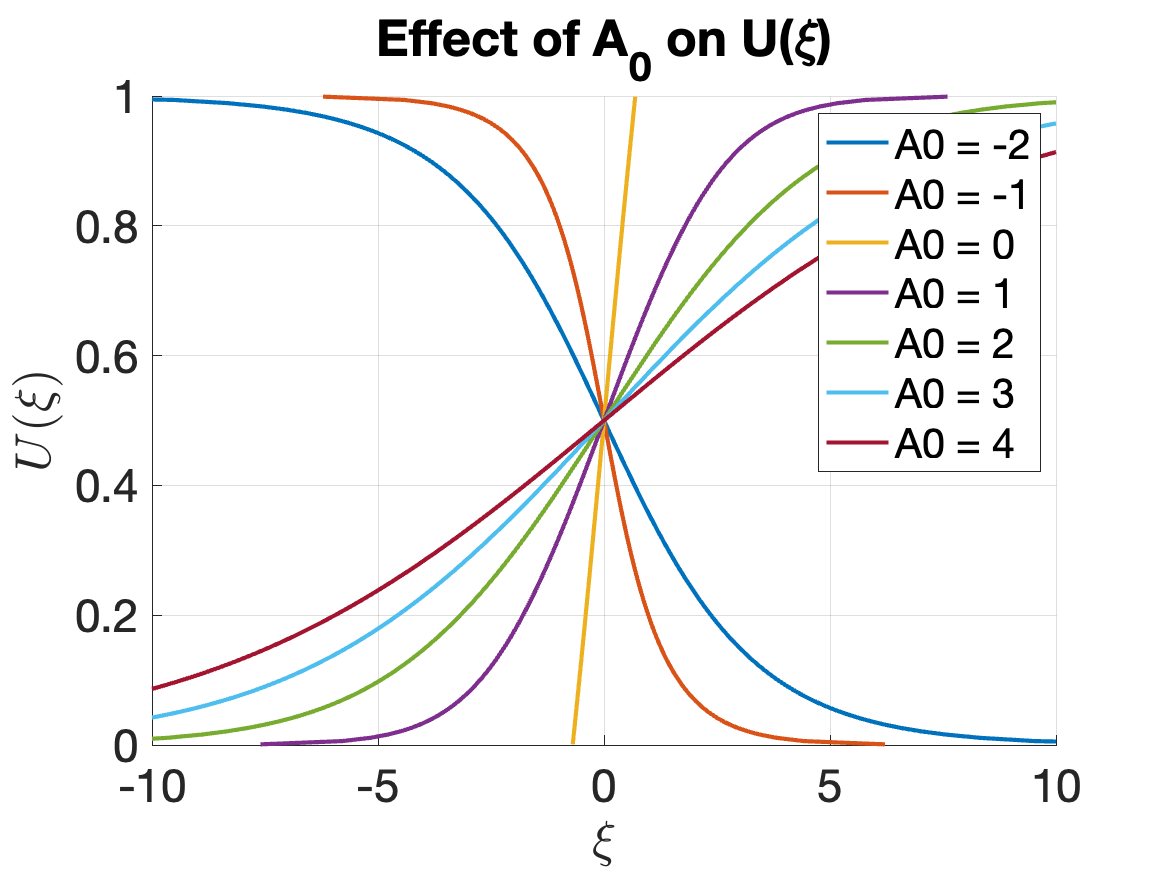
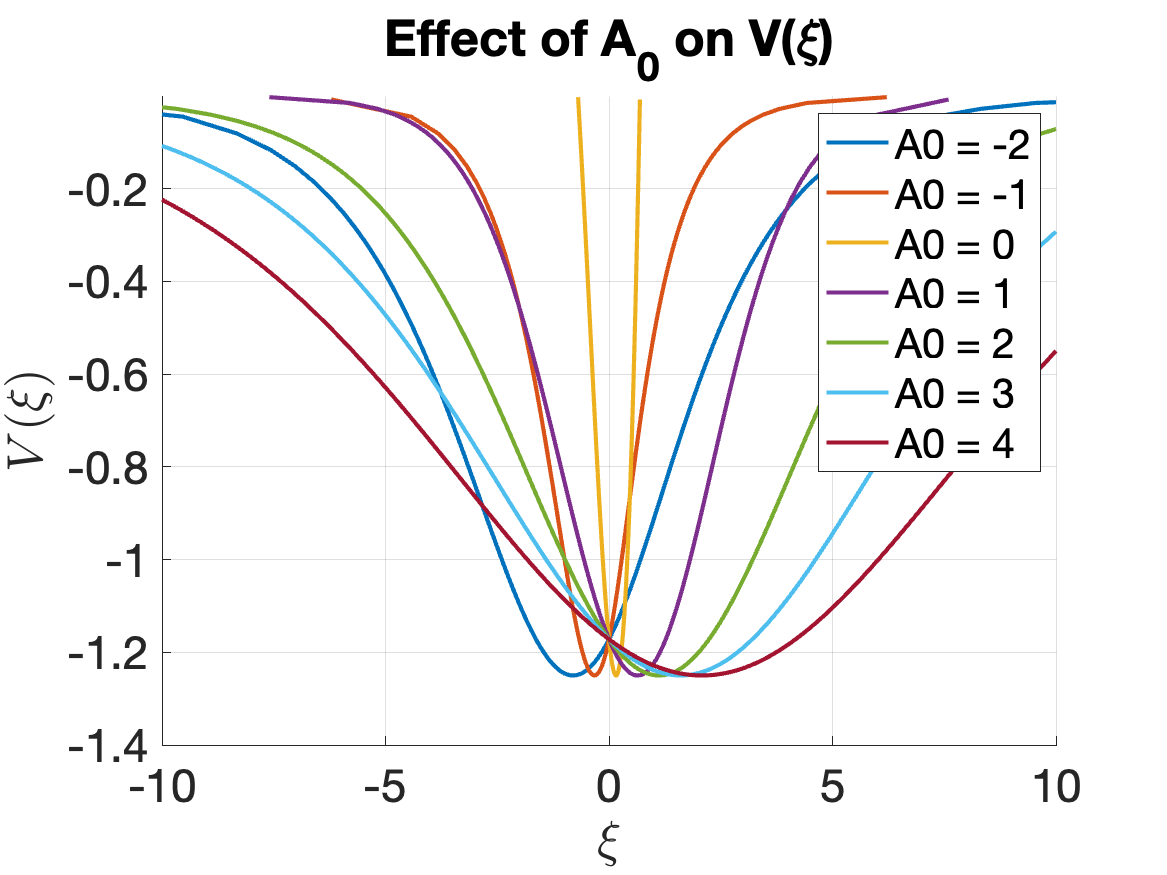
Figure 6: Additional plots for the τ(T)∂tq+q=−λ(T)∇T6, τ(T)∂tq+q=−λ(T)∇T7 case show how the soliton structure is modified as key parameters are varied.
A schematic visualization clarifies the spatial propagation and separation of these thermal and heat solitons in a one-dimensional nanowire geometry.
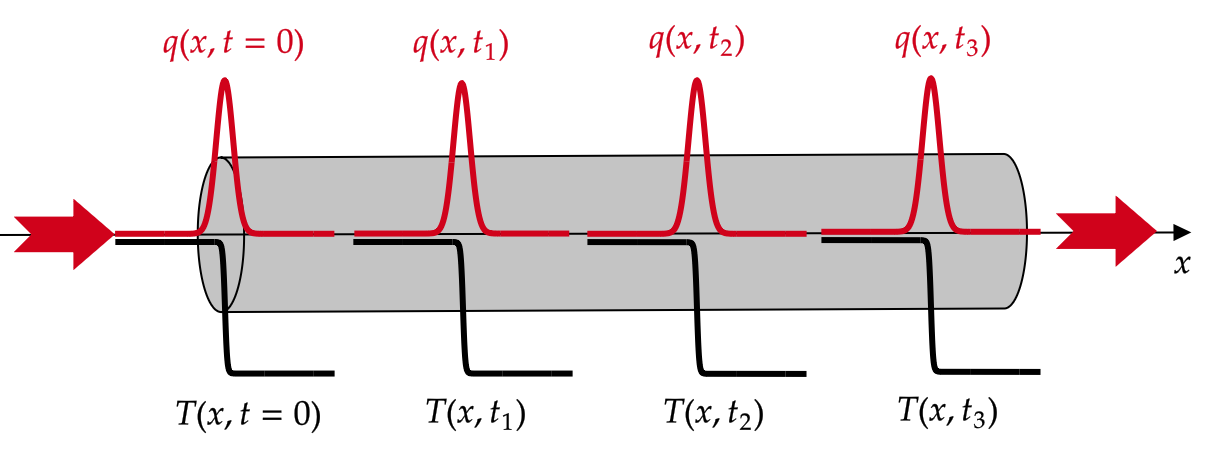
Figure 8: Sketch of two soliton modes propagating along a cylindrical wire—the heat bright soliton (red) and the thermal dark soliton (black).
The methodology flexibly extends to arbitrary polynomial order, with the number of soliton structures directly related to the degree of nonlinearity encoded in the expansions for τ(T)∂tq+q=−λ(T)∇T8 and τ(T)∂tq+q=−λ(T)∇T9.
Physical Implications and Theoretical Insights
The analytical characterization of soliton solutions in the nonlinear MCV model demonstrates that the emergence and characteristics of non-dispersive thermal waves are intricately controlled by the functional dependencies of thermal conductivity and relaxation time on temperature. The existence of multi-soliton trains is shown to be a consequence of the balance between the polynomial degrees of these expansions (in particular, cases with λ0 and λ1 odd).
These results reinforce and generalize prior findings for linearly temperature-dependent parameters and provide explicit formulae for regimes relevant to low-dimensional phononic applications, such as superfluid helium, NaF crystals, and ultrathin nanowires—settings in which second sound and ballistic heat transport are observed. The explicit soliton solutions furnish insight into the potential for information transmission via thermal signals in nanosystems, where non-dispersive propagation is critical.
Broader Perspectives and Future Work
The rigorous analytical construction of travelling wave and soliton solutions substantially extends the theoretical understanding of generalized heat transport in nonlinear media. The polynomial framework is sufficiently flexible to accommodate arbitrary smooth functional forms for material parameters, enabling matching to experimental data or numerical simulations in realistic settings.
The localization property and robust propagation of soliton solutions have implications for the emergent field of phononics, including heat-based logic, information processing, and energy transport at the nanoscale. The finding that trains of solitons can be engineered by judiciously selecting the polynomial order of temperature dependence opens avenues for the controlled design of thermal wave packets, relevant to the thermal management of nanostructures and the design of thermal signal-processing devices.
Further research directions include matching the model with experimental observations, optimizing parameter estimation procedures, and extending the approach to higher-dimensional geometries and materials displaying anisotropy or phase transitions. The general framework also suggests potential analogies with soliton dynamics in other nonlinear wave systems, enriching the cross-disciplinary landscape of nonlinear science.
Conclusion
This work delivers a comprehensive theoretical and mathematical analysis of nonlinear heat transport as described by the generalized MCV equation with arbitrary temperature-dependent material parameters. Closed-form travelling wave and multi-soliton solutions are derived for a broad class of nonlinearities, with clear physical interpretations and direct application to nanoscale thermal management and phononic information transport. The explicit link between parameter choices and soliton multiplicity details a pathway for the practical realization and control of non-dispersive thermal phenomena in low-dimensional systems.