- The paper presents a quantitative framework showing that mega-constellations can raise sky brightness by up to 1.5% and cause significant field-of-view losses.
- It employs an advanced simulation pipeline that integrates atmospheric scattering models and empirical data to assess direct trail contamination and diffuse light effects.
- The study underscores that enforcing strict limits on satellite brightness and total population is critical to preserving high-quality ground-based astronomical observations.
Effects of Large and Bright Satellite Constellations on Astronomical Observations
Introduction
The proliferation of artificial satellite constellations has initiated a critical transformation in the landscape of optical astronomy. The paper "Large or bright satellite constellations: Effects on observations, including on the background sky brightness" (2604.09427) provides a quantitative framework for assessing the direct and indirect impacts of current and proposed satellite populations—including extreme cases involving one-million-object constellations and mirror satellites—on both the visibility of astronomical objects (via image trails and saturation) and on the natural darkness of the sky background. The analysis spans expected scenarios for both moderate-sized and saturating detectors, including the Vera C. Rubin Observatory's LSST camera and traditional large-field imagers.
Methodological Framework
The study employs an advanced simulation pipeline integrating a numerical model for atmospheric scattering (both Mie and Rayleigh components), extending the foundational Krisciunas & Schaefer (1991) methodology for modeling sky brightness from moonlight to the regime of scattered and diffuse satellite light. The simulation leverages the SatConAnalytic package, synthesizing satellite distributions, instrument-specific response curves, and observing site characteristics. Validation is anchored by comparisons to an extensive body of empirical data on moonlight and starlight sky backgrounds.
Conspicuously, the analysis rigorously differentiates between three pollution channels:
- Direct trail contamination: The fraction of imaging exposures affected by visible satellite trails, parameterized by satellite cross-section, brightness, population density, and detector response.
- Diffuse light background: The cumulative contribution of undetected (i.e., below detection threshold) satellites to the overall sky luminance, integrated over the full satellite population.
- Atmospherically scattered light: Enhancement of the sky background via Rayleigh and Mie scattering of sunlight reflected by satellites, additively increasing the background emission seen by ground-based observatories.
Quantitative Results and Regime Classification
Current and Near-Future Constellation Scenarios
For satellite constellations on the scale of ∼60,000 objects, each adhering to the recommended V550km≥7 brightness limit, simulations indicate negligible impact on both field-of-view (FoV) losses (<1%) and sky background brightness (incremental contributions ∼10−4 of the natural dark sky) (Figure 1).
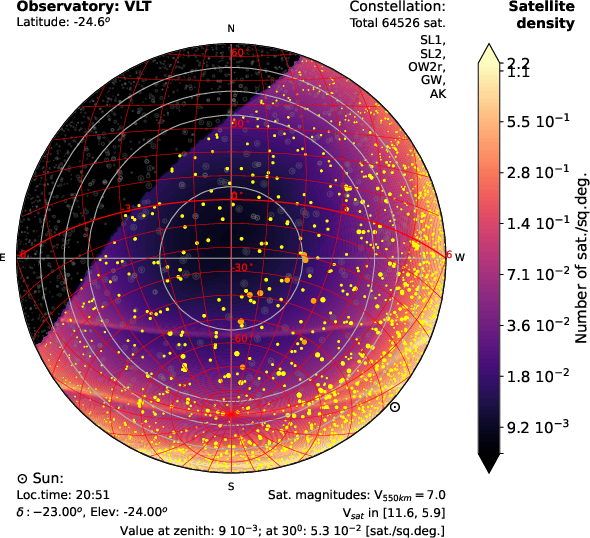
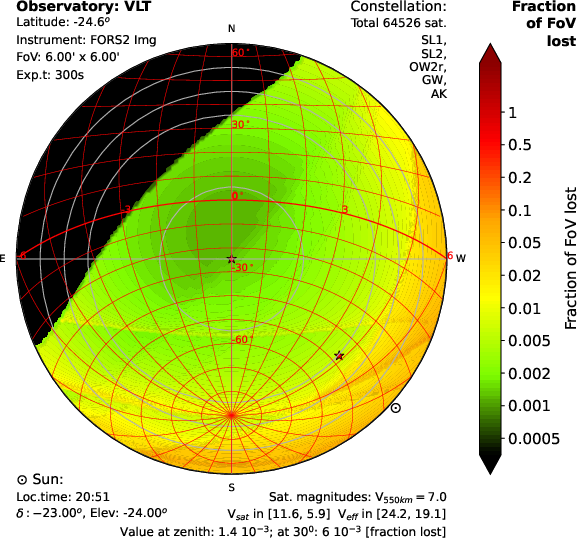
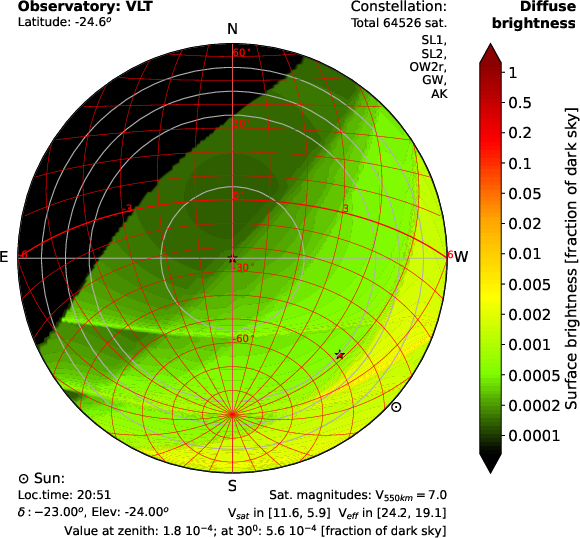
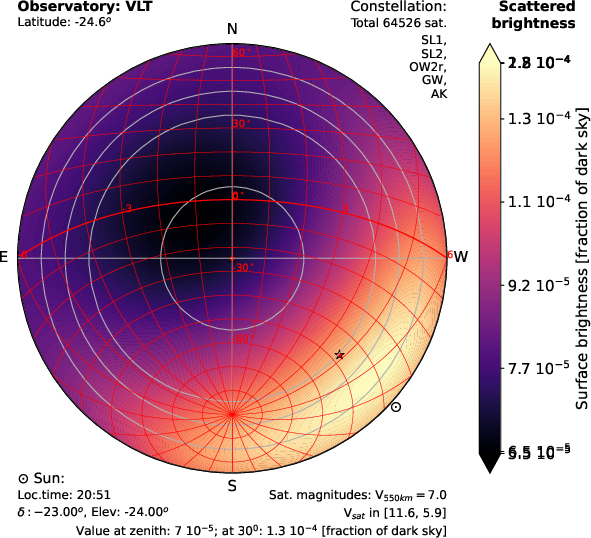
Figure 1: Sky maps and quantitative outcomes for a 64,526-satellite scenario, characterizing the direct and indirect observational impacts for near-future deployments.
Large-Scale and Ultra-Bright Constellations
When scaling to mega-constellations (up to 106 satellites at V550km=7), diffuse and scattered light components reach the 0.5–1.5% threshold of background sky brightness, already breaching the threshold for premium observatory sites. FoV losses escalate markedly, with the LSST detector subject to loss fractions approaching 10–30%, commensurate with, or exceeding, technical downtime and natural atmospheric constraints. A modest decrease in satellite magnitude exacerbates the situation discontinuously; for V550km=6, the majority of wide-field exposures become saturated by trails or ghosts induced by electronic cross-talk (Figure 2, Figure 3).
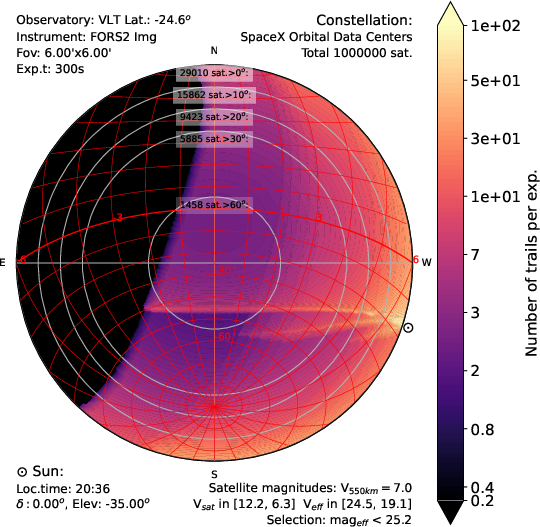
Figure 2: Simulation of a one-million-satellite constellation’s effect on a 300-second exposure at Paranal; more than half the sky is affected by multiple satellite trails even during astronomical night.
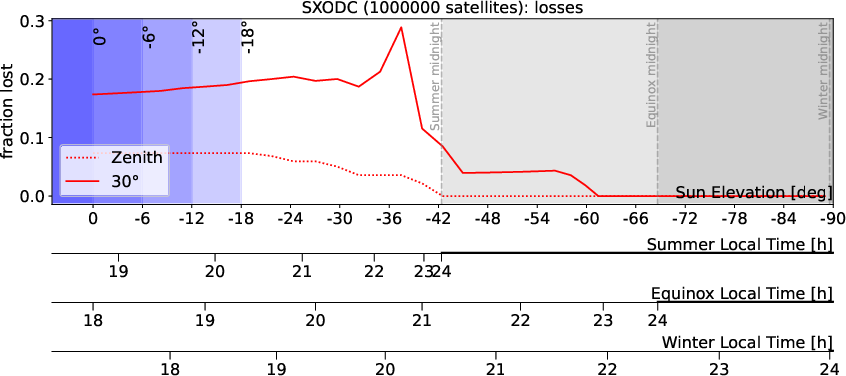
Figure 3: Visualization of FoV losses and trail density for one million satellites, highlighting catastrophic impact in bright satellite regimes.
Impact of Large, Bright Reflectors (Mirror Satellites)
Reflector-based constellations, such as those proposed by Reflect Orbital, present a scenario where each satellite can approach or exceed the apparent brightness of Venus or the full Moon. With populations of 5,000–50,000 such objects, scattered atmospheric light can raise the background brightness by 20–300% relative to the natural sky; all major optical instruments become inoperable for deep observations during large fractions of the year (Figure 4, Figure 5).
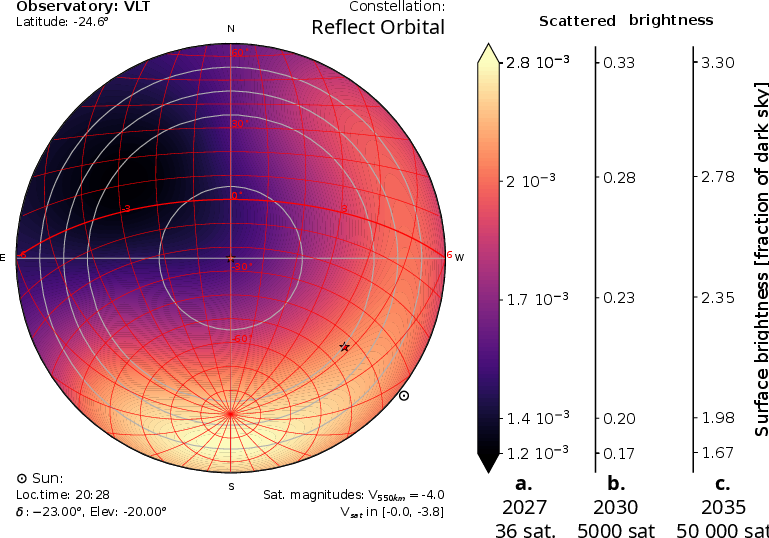
Figure 4: Fractional increase in sky brightness due to scattered light from bright satellites for configurations of 37, 5,000, and 50,000 objects.
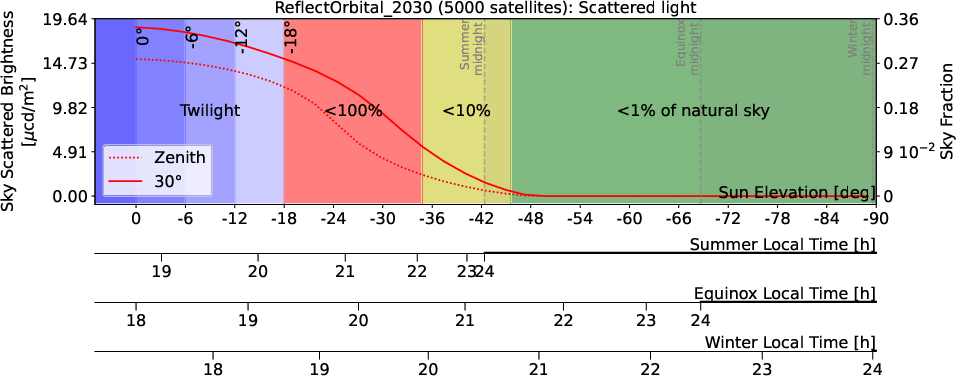
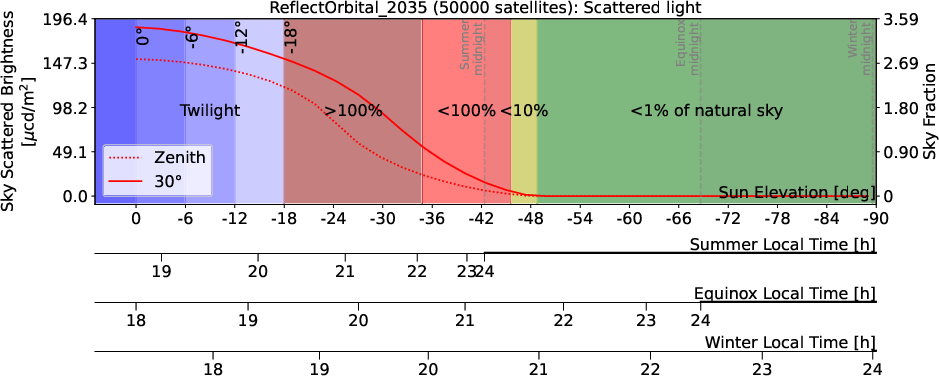
Figure 5: Time evolution of scattered light contamination as a function of solar elevation for extremely bright satellites, illustrating the near-complete loss of dark sky conditions during much of the night.
For the LSST camera, even a few thousand bright satellites with V550km≈2 yield FoV losses of up to 6%, rising to complete saturation (>100% pixels affected) for 50,000 satellites.
Generalized Scaling
The analysis demonstrates a superlinear relationship between total satellite count and both light pollution and image loss metrics. The critical thresholds for acceptable performance are extremely sensitive to both total population and the brightness distribution. For instance, only a few tens of satellites brighter than V550km=−4 are compatible with <1% light pollution, whereas several hundred thousand objects at V550km=7 might be permitted before significant losses accrue (Figure 6).
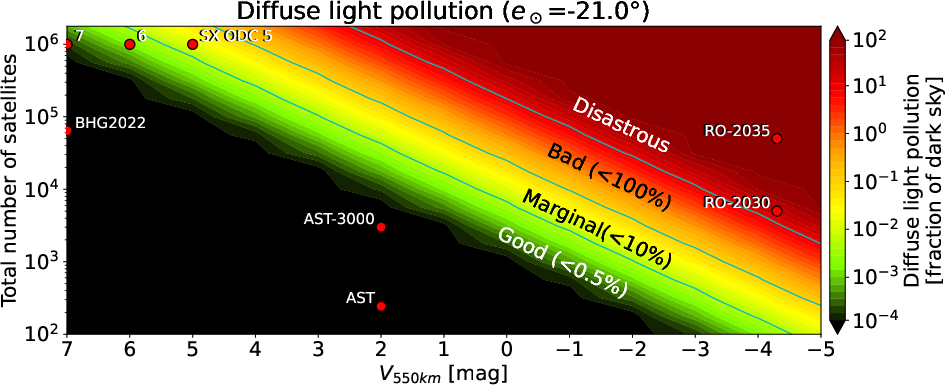
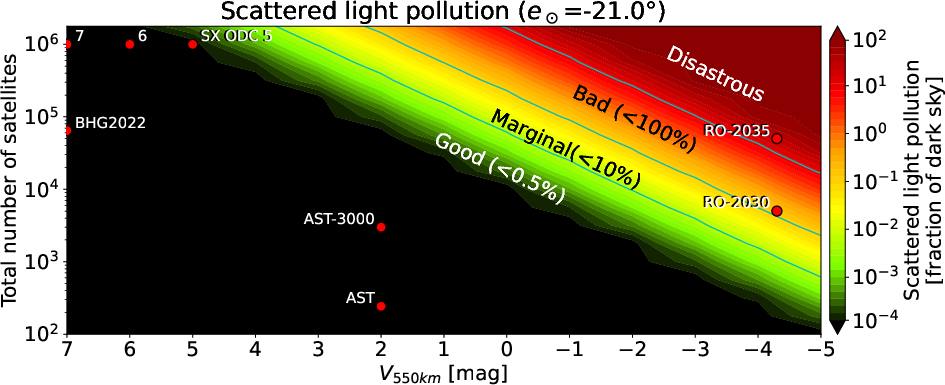
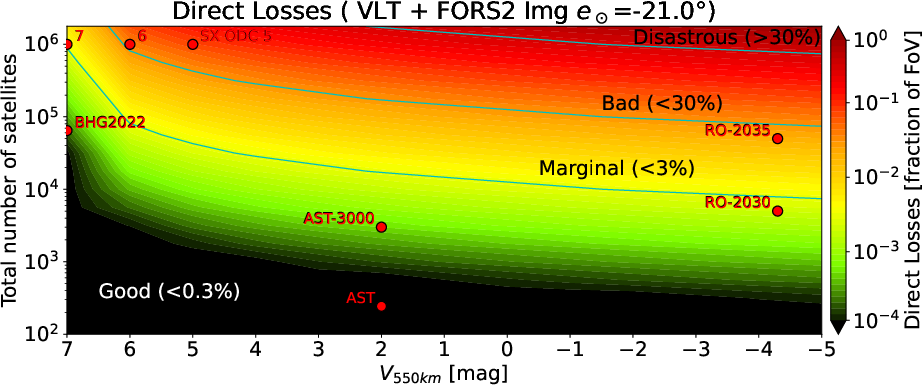
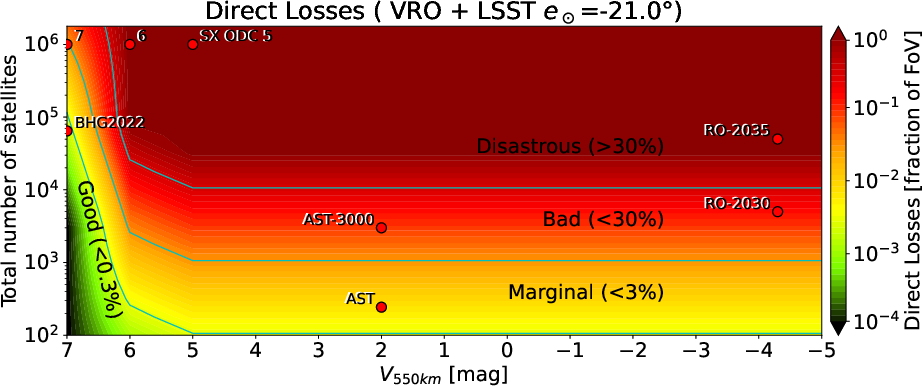
Figure 6: Generalized scaling of sky brightness pollution and FoV losses as a function of satellite count and brightness, for instruments with differing detection/saturation characteristics.
Implications for Astronomy and Policy
Instrumentation Constraints
Saturating cameras (e.g., LSST) are acutely vulnerable to bright satellite trails, resulting in image artifacts and ghosting due to CCD cross-talk. Mitigation strategies may involve satellite orientation, surface treatment, or regulatory capping of population and brightness, but any violation immediately renders significant fractions of data irrecoverable.
Observational Viability
Even under strict adherence to a V550km≥7 standard, the cumulative effect of a global satellite fleet must be maintained below V550km≥70100,000 to avoid surpassing existing technical downtime thresholds for image loss. Routine operation in the presence of mega-constellations or bright reflector fleets would fundamentally transform the night sky, largely eliminating conditions required for background-limited, deep-field, or transient astronomical studies from the ground.
Human and Environmental Context
A qualitative transformation of the night sky is anticipated if large populations of naked-eye-visible objects are deployed—on the order of thousands of artificial satellites with Venus-like brightness—surpassing the number of visible natural stars, and with persistent presence throughout the night. This intrusion has consequences not only for science but also for cultural and ecological interactions with the night environment.
Regulatory and Theoretical Perspectives
The strictly cumulative nature of these effects underscores the need for binding global regulation on maximum satellite brightness and total deployment caps. Theoretical models must incorporate both direct and atmospheric-scattering channels to fully capture the scope of threat to astronomical infrastructure and natural sky preservation.
Conclusion
This analysis establishes stringent empirical and theoretical limits on space-based infrastructure vis-a-vis impacts on ground-based astronomy. The work conclusively shows that maintaining satellite apparent magnitude above V550km≥71 and capping the cumulative constellation population below V550km≥72 are both necessary and insufficient on their own; future policy must address both channels simultaneously, especially in light of proposals exceeding 1.7 million satellites, many of which will exceed established brightness recommendations. Failure to do so will render critical astronomical observations infeasible for a significant fraction of the global astronomical community.
The findings imply that urgent, globally coordinated action is required to preserve observatory-grade skies, and further research into mitigation techniques—both technological and regulatory—is mandated as constellations transition from concept to operational reality.

