- The paper's main contribution is the introduction of a hyperbolic tetrahedral framework that relates open-sector BCFT OPE data with 3D gravity triangulations.
- It develops a novel open Virasoro TQFT construction that translates combinatorial OPE networks into state-sum gravitational path integrals using truncated tetrahedra.
- The study demonstrates explicit open-closed duality linking fixed-length and fixed-angle boundary conditions via modular transformations and Conformal Turaev-Viro theory.
Open and Closed Triangulations in 3D Gravity: The Hyperbolic Tetrahedron Perspective
Introduction and Theoretical Framework
This work systematically explores a model of 3D quantum gravity emergent from the open sector of a 2D CFT ensemble, emphasizing triangulations of hyperbolic 3-manifolds. The approach is rooted in the open Virasoro TQFT, derived as a restriction of the open-closed Virasoro TQFT, and designed to compute gravitational path integrals associated with compact 3-manifolds possessing either EOW branes (Neumann boundaries) or pleated surface boundaries. Central to the framework is the relation between this TQFT and open/closed OPE statistics in BCFT, as well as an explicit manifestation of open-closed duality connecting the open ensemble to the diagonal sector of two copies of the closed Virasoro TQFT and to the Conformal Turaev-Viro (CTV) theory.
The gravitational action is shown to interpolate between boundaries above and below the black hole threshold: fixed-length boundary data is prescribed for heavy states, while fixed-angle boundaries are associated with light states. The theory incorporates the combinatorics of open-string OPEs and the topological properties of bulk configurations, mapping them onto triangulations constructed from truncated hyperbolic tetrahedra.
Geometry of Hyperbolic Tetrahedra and Permitted Manifolds
The model restricts to hyperbolic manifolds admitting saddles, focusing particularly on those with boundaries formed by both pleated surfaces (with prescribed geodesic interval data) and EOW branes. The quantum gravitational path integral in this domain is encoded in the open Virasoro TQFT, with key geometrical objects being truncated hyperbolic tetrahedra—tetrahedra whose vertices are all hyperideal, with faces orthogonally intersecting. This construction allows for both local (face/edge) data and global (manifold topology) data to enter the calculation.
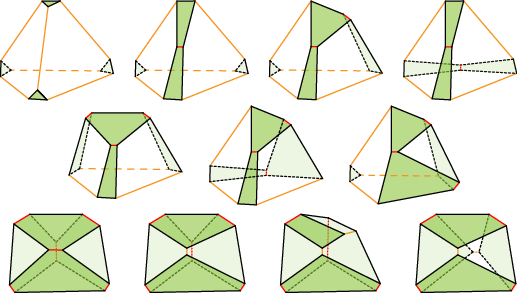
Figure 1: All allowed shapes of hyperbolic tetrahedra with hyperideal vertices, with colored faces representing EOW (Neumann) boundaries and uncolored faces corresponding to OPE faces—where OPE coefficients are inserted and pairs of pants are glued.
A pivotal combinatorial result is that, for a genus g Riemann surface with n borders, the purely open sector admits a triangulation into $2(2g+n-2)$ open pairs of pants and $3(2g+n-2)$ open Hilbert space cuts. This establishes a direct mapping between the OPE network in BCFT and a specific choice of triangulation in the bulk.
Channel Decomposition and Statistical Mechanics of OPE Data
The BCFT partition function is decomposed into open channels, each specifying a trivalent network reflecting both boundary operator spectrum and boundary OPE coefficients. The structural mapping uses the Cardy "doubling trick" to associate each open channel to a closed one, aligning the BCFT conformal blocks on bordered Riemann surfaces with those on their doubles.
Statistical averages over BCFT ensembles (motivated by wormhole effects in 3D gravity) isolate the universal, channel-dependent OPE data, which are linked directly to configurations in the gravitational path integral. For above-threshold states, the decoupling of the identity sector allows focus on moments of the universal rescaled OPE coefficients B^IJK(abc), which directly match the combinatorics of the chosen triangulation.
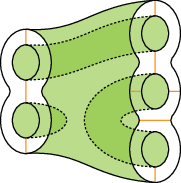
Figure 2: Example configuration contributing to OPE statistics for six B's with all operators above the black hole threshold. White pleated surfaces form the boundaries, orange geodesic intervals mark corners, and green EOW branes glue the intervals, illustrating the allowed topological sewing.
Boundary conditions are codified: Dirichlet for asymptotic moduli, Neumann for EOW branes (taken to zero tension with g-function tracking), and corners (pleats) interpolating at specified intervals.
Quantum TQFT Construction and Triangulation Algorithms
The heart of the correspondence is the realization that the open Virasoro TQFT partition function on a compact region with a Wilson network can be built by gluing open $6j$ manifolds (truncated tetrahedra with EOW and OPE faces) and performing annular surgeries when closed Wilson loops form. Each such operation has a precise combinatorial–operator-algebraic interpretation: tetrahedron faces correspond to pants, internal (glued) edges to sums/integrations over OPE indices, and EOW faces to boundary conditions.
A quantum duality emerges: gluing open $6j$ manifolds and annular surgery is combinatorially equivalent to a complete triangulation of the manifold into truncated tetrahedra. The resulting partition function is a (possibly multi-component) amplitude, integrating over all internal OPE momenta, and weighted by products of $6j$ symbols and n0-factors specified by the boundary operator data.
When below-threshold states are present, analytic continuation introduces kinks (discontinuous normal directions), modifying both the semiclassical and quantum partition functions but preserving the overall mapping.
A fundamental result is the explicit open-closed duality connecting certain partition functions in the purely open model and those in the scalar (diagonal) sector of the closed Virasoro TQFT. The CTV partition function, computed as a state-sum over triangulations using n1 symbols, is shown to be related via a modular n2-kernel (Fourier transform) to the diagonal part of the closed TQFT. The modular transform exchanges fixed-length and fixed-angle/defect boundary conditions, in line with variational principles of 3D gravity.
The open sector OPE statistics with all above-threshold states correspond to the fixed-length gravitational path integral, while the same duality guarantees that the CTV computes the fixed-angle ensemble. The duality is made concrete via the shrinking and expansion moves of tetrahedral decompositions and the algebraic action of the n3-kernel on the spectrum.
Numerical and Structural Results
- The construction provides explicit algorithms and geometric recipes for producing all admissible compact hyperbolic manifolds for OPE statistics via truncated tetrahedral decompositions and open n4 gluing.
- The combinatorics match OPE moments in the purely open BCFT sector, with n5-function accounting for brane tensions or topological contributions.
- For closed OPE statistics, the CTV partition function's scalar sector (diagonal closed TQFT) can be constructed from purely open data via open-closed duality, with the open Virasoro TQFT providing a computationally tractable partition function.
Implications and Outlook
The analysis elucidates the precise geometric–algebraic interplay between triangulations of 3D gravity and BCFT OPE data. Practically, this duality enables:
- Systematic computation of nonperturbative gravitational path integrals for arbitrary open OPE statistics.
- An optimized numerical framework using state sums, n6 symbol evaluation, and topological operation (e.g., annular surgery) algorithms for bulk partition functions.
- Insights into the structure of the purely open BCFT ensemble, showing its nontriviality and computational accessibility in contrast to the closed modular scenario.
Theoretically, the strong, constructive open-closed duality and the explicit mapping between manifold triangulation and OPE combinatorics solidify the connection between 3D hyperbolic geometry and the operator algebra of 2D BCFTs. This supports further developments in holographic reconstruction, quantum topological gravity, and holographically dual tensor models built using open n7 and pillow manifolds.
Potential future directions involve invariance under Pachner moves, incorporation of varying n8-functions and tensionful branes, and the extension of these dualities and algorithmic methods to rational and extended symmetry CFTs and nontrivial bulk topologies.
Conclusion
This work systematically formalizes the correspondence between open sector statistical OPE data in BCFT and open Virasoro TQFT partition functions, realizing these as path integrals on compact regions triangulated by truncated hyperbolic tetrahedra. Through explicit channel decompositions, state-sum constructions, and a detailed exploration of open-closed duality (and its manifestation in the relation with CTV and scalar Virasoro TQFT), a robust geometric and algebraic infrastructure emerges for the study of quantum 3D gravity. This triangulation-based approach provides a complete and tractable framework to analyze bulk-boundary correspondences, opening further computational and conceptual advances in holographic quantum gravity.

