- The paper introduces the Relearning Convergence Delay (RCD) metric to quantify a model’s resistance to relearning forgotten data.
- It proposes the Influence Eliminating Unlearning (IEU) framework, combining gradient ascent and noisy regularization for robust unlearning.
- Experimental results on image classification and generation demonstrate IEU’s superior balance between privacy protection and retention of model performance.
Efficient Model Unlearning via Maximizing Relearning Convergence Delay
Introduction
The increasing deployment of deep neural networks across sensitive data domains has intensified the demand for effective machine unlearning mechanisms, especially in the context of privacy regulation (e.g., GDPR's "right to be forgotten") and responsible AI. Conventional unlearning approaches predominantly assess success through model prediction metrics (accuracy, membership inference attack success, FID for generative tasks), which neglect the underlying model dynamics and do not account for the recoverability of forgotten information. The paper "Efficient Unlearning through Maximizing Relearning Convergence Delay" (2604.09391) introduces a theoretical and practical framework for machine unlearning that directly addresses the risk of residual forgetting set influence, even after unlearning interventions.
Relearning Convergence Delay: A New Metric
The principal contribution is the formalization of the Relearning Convergence Delay (RCD) as an evaluation metric that quantifies the model’s susceptibility to data recovery during subsequent fine-tuning. Rather than relying on prediction-based measures, RCD is grounded in the convergence properties of iterative optimization. Specifically, given an unlearned weight θTUL and a forgetting set Df, RCD evaluates the integral of the performance gap between the unlearned model and the model retrained on Df, over the relearning trajectory.
Theoretical analysis demonstrates that RCD encapsulates both the optimization landscape (via the condition number of the Hessian of the loss function) and initializing loss, yielding bounds on the achievable relearning resistance for any algorithm and optimizer. Empirical plots show strong alignment between RCD and observed relearning behaviors: models with high RCD require significantly more optimization to recover performance on forgotten data, while naive fine-tuning or random label relabeling strategies produce much lower RCD (Figure 1).
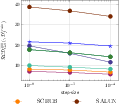
Figure 1: RCD0 vs. Relearning difficulty correlation, validating that higher RCD1 reflects slower recovery and indicates resistance to relearning attacks.
This metric directly addresses a critical deficiency of static performance-based unlearning metrics and provides clear guidance for algorithmic improvement.
Influence Eliminating Unlearning Framework
Building upon the RCD2 metric, the paper proposes the Influence Eliminating Unlearning (IEU) framework. The objective is to maximize RCD3—in other words, to make the unlearned model maximally resistant to relearning attacks—while preserving retention-set utility. The IEU algorithm integrates three mechanisms:
- Minimization of loss on retaining set: Standard cross-entropy or task loss ensures model utility is preserved for non-forgetting data.
- Gradient ascent on the forgetting set: Explicitly maximizes loss for the targeted data, directly opposing model predictions on data to be forgotten.
- Noisy Regularization (Iterative Re-initialization): Injects Kaiming-initialized random noise into weights, weighted by a hyperparameter RCD4, to worsen the condition number and degrade optimization for the forgetting set, while preserving retaining-set knowledge.
Ablation studies demonstrate that gradient ascent and noise injection individually improve unlearning, but their combination achieves the best trade-off between utility and privacy.
Theoretical Guarantees
The IEU framework is accompanied by rigorous theoretical guarantees. The convergence rate on the retaining set remains exponential in iteration count, and the upper error bound increases only polynomially in the gradient-ascent and noise coefficients. Importantly, the framework enables explicit control of the privacy-utility trade-off via hyperparameters (RCD5, RCD6), as characterized by the derived bounds.
Experimental Results
Image Classification
Extensive experiments on benchmark datasets (CIFAR-10, CIFAR-100, TinyImageNet) with ResNet and ViT architectures demonstrate the superiority of IEU across key metrics. Specifically, variants with the Noisy component display low average gap to retraining (the optimal solution), superior retention-set accuracy, and high RCD7, indicating robust resistance to relearning (Figure 2).
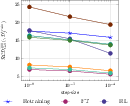
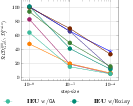
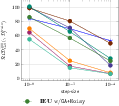
Figure 2: Relationship between Avg. Gap and RCD8 for ResNet on TinyImageNet. IEU variants maintain low utility loss and strong unrecoverability across unlearning scenarios.
Ablation on step-size further reveals that the relative method ranking is robust, provided an appropriate step-size is chosen.
Image Generation
The application of IEU to Stable Diffusion (SD) for generative unlearning (NSFW concept removal) further validates the approach. Incorporating Noisy regularization into existing ESD or SALUN baselines ensures lower nudity detection rates (measuring effective concept forgetting) and maintains superior FID on unrelated concepts (demonstrating information retention). Qualitative visualizations confirm that utility on benign prompts is preserved, while images conditioned on unlearned prompts are no longer generated (Figure 3, Figure 4).
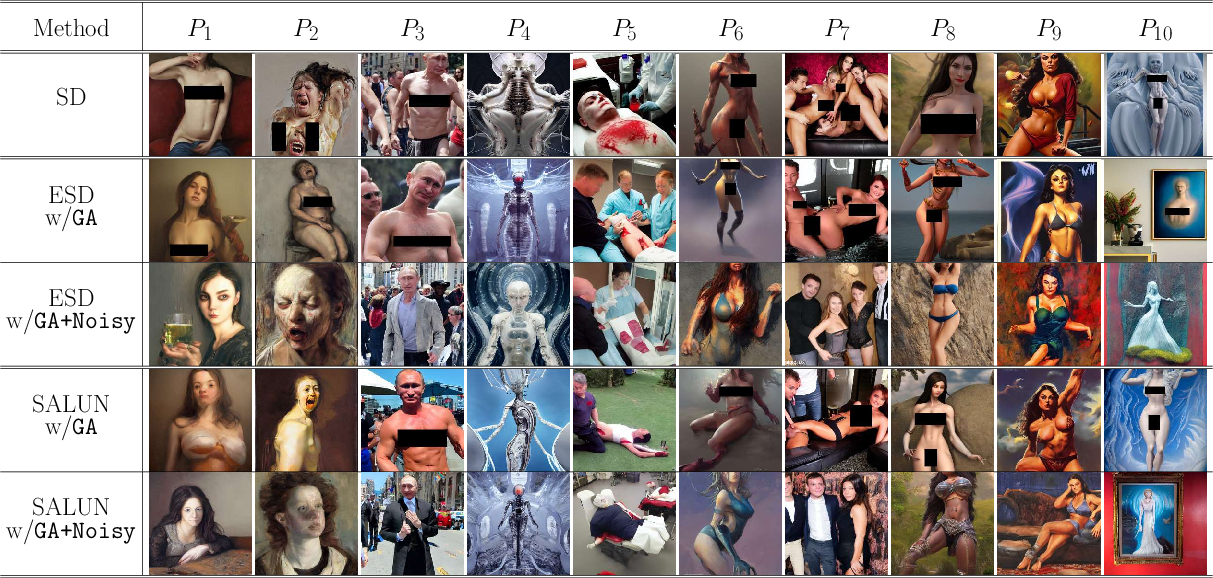
Figure 3: Examples of generated images using SD variants on I2P prompts. Noisy and GA+Noisy variants prevent generation of NSFW images while maintaining concept fidelity on other prompts.
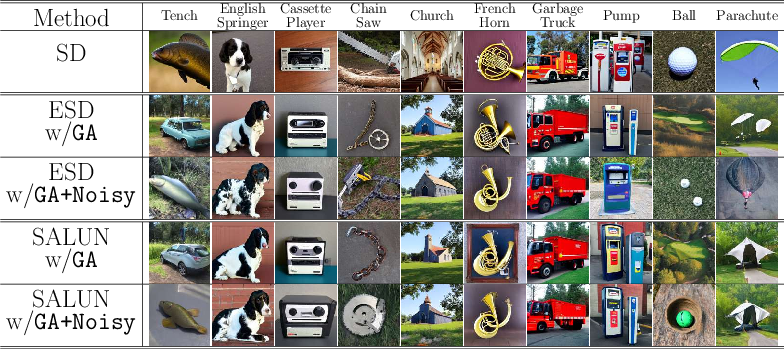
Figure 4: GA+Noisy ensures high visual quality for non-forgotten ImageNette classes, demonstrating retention.
However, experiments show that when the Adam optimizer is used for relearning (as is standard in large diffusion models), all methods—including IEU—are more vulnerable to prompt recovery, highlighting a limit of the GD-motivated approach.
Practical and Theoretical Implications
This work provides a comprehensive evaluation framework for model unlearning that accounts for susceptibility to information leakage through relearning attacks. The IEU framework yields a practical, computationally efficient approach that achieves a strong privacy-utility trade-off and is theoretically justified. The explicit analysis of the role of regularization noise and anti-loss drives future research toward designing optimizers and training regimes that are robust to both gradient- and Adam-based recovery.
Practically, the findings indicate that IEU can be integrated into production AI systems where the cost of full model retraining is prohibitive, and privacy is paramount. The RCD9 metric offers a deployable diagnostic for auditing and certifying forgetting effectiveness in deployed systems.
Towards Future Developments
While IEU demonstrates strong results on vision tasks, its extension to language, graph, and multimodal data is nontrivial—requiring adaptation of the metrics and unlearning mechanisms to complex data distributions and model architectures. The limitations of GD-based analysis for architectures typically trained with Adam optimizers suggest future work in optimizer-specific unlearning resistance.
Further directions include adversarial design of unlearning attacks for robust evaluation, fairness-aware unlearning, and interpretability of residual influence in high-dimensional representation spaces. The theoretical tools introduced here set the foundation for future research into principled, certifiable unlearning in complex AI systems.
Conclusion
The introduction of the relearning convergence delay metric fundamentally advances the rigorous evaluation of unlearning methods, directly measuring a model's vulnerability to forgetting-set recovery. The Influence Eliminating Unlearning framework, by maximizing this metric, achieves demonstrably robust unlearning while preserving task-relevant utility. This work delineates clear directions for both theoretical research and practical deployment of unlearning systems in compliance-sensitive domains.