- The paper presents the first ALMA detections and upper limits of [CII] emission, providing novel insights into the ISM of high-z quiescent galaxies.
- It employs a multiwavelength approach combining ALMA and JWST data to determine dust temperatures and identify non-stellar ISM heating from shocks and AGN feedback.
- Results reveal significant [CII] deficits, elevated dust temperatures, and low molecular gas fractions, challenging traditional ISM and star formation proxies.
[CII] 158 μm Emission and the ISM in High-Redshift Quiescent Galaxies
Introduction
This study presents the first Atacama Large Millimeter/submillimeter Array (ALMA) detections and stringent upper limits of the [CII] 158 μm emission line and its underlying dust continuum in a sample of five massive quiescent galaxies (QGs) at $2ISM in nearby galaxies, is leveraged here to probe the elusive cold gas content in galaxies where traditional Jlow CO transitions or dust continuum emission are challenging to measure, due to both low ISM mass fractions and instrumental limitations at high redshift.
The analysis explores both detections and non-detections, integrating supporting JWST NIRCam and MIRI imaging, and a combination of rest-frame optical, far-IR, and radio data. This multiwavelength approach enables the study of ISM conditions, dust temperatures, morphological disturbance, and the energetics of the ISM in galaxies shortly after star formation quenching.
Sample Selection and Observational Methodology
The targets were spectroscopically confirmed QGs with log(M⋆/M⊙)>10.5, selected to maximize line sensitivity for redshifted [CII] observations within ALMA Bands 7, 8, and 9. The sample includes the lensed system MRG-M0138 at z≈1.95, three QGs in the SSA22 protocluster at z≈3.09 (ADF22-QG1, QG2, QG3), and the ultra-compact GS-9209 at z=4.66. Observations were reduced using CASA and GILDAS, with custom uv-plane extraction and careful alignment to JWST imaging.
Integrated [CII] line fluxes and dust continuum measurements were obtained or constrained for each target, while continuum data were jointly analyzed with archival JWST and (sub)mm photometry to derive dust temperatures and IR luminosities via SED fitting with the MICHI2 code.
[CII] Emission and ISM Tracing in High-z QGs
The paper reports three secure [CII] detections (M0138, QG2, QG3), one tentative detection (QG1), and a stringent upper limit (GS-9209). Dust continuum is robustly detected in M0138 and GS-9209, and marginally in QG1.
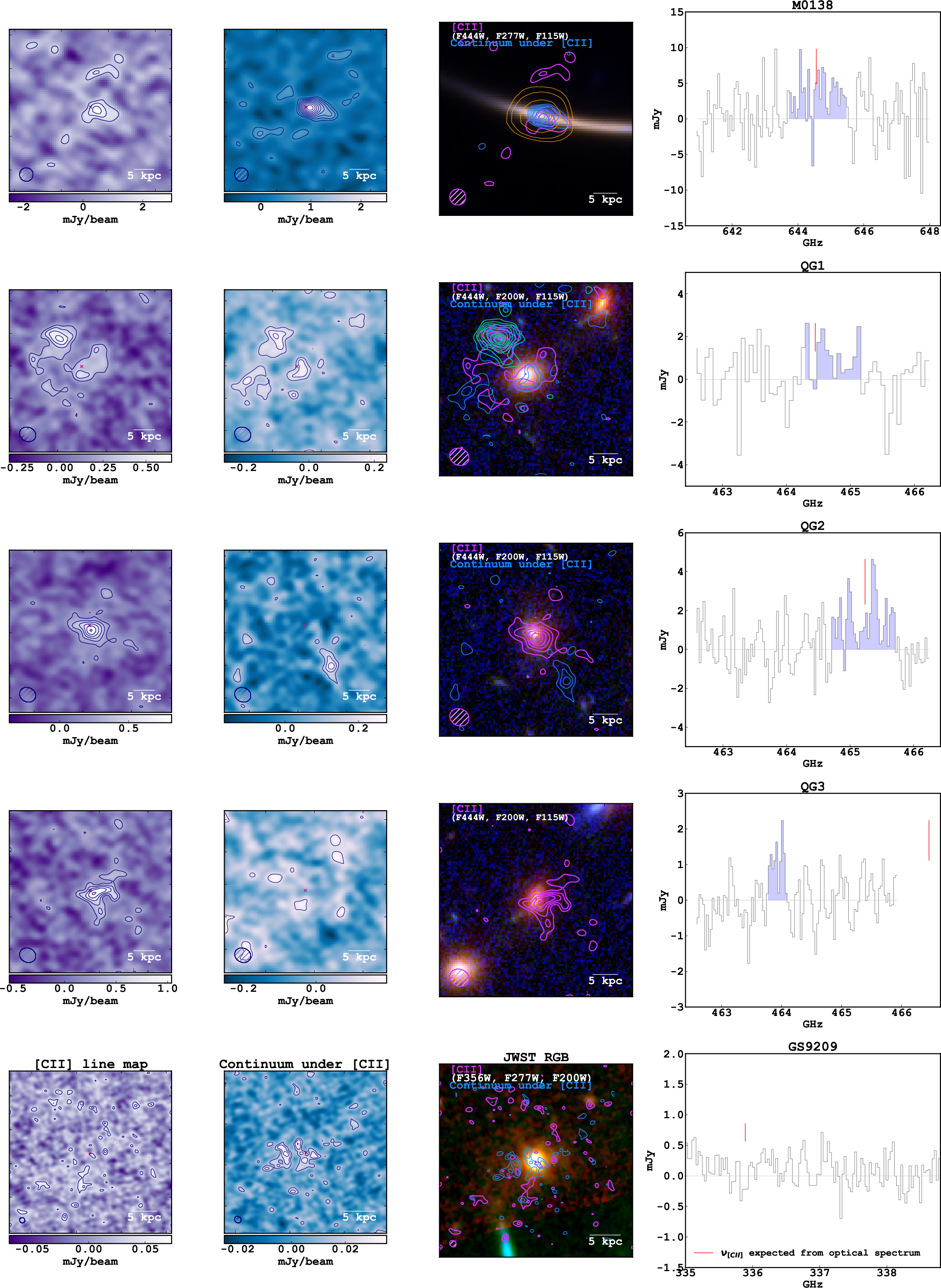
Figure 1: [CII] emission, dust continuum, and their spatial association to JWST stellar light for the sample, highlighting offsets and disturbed morphologies.
When compared with independent tracers (CO, dust continuum), [CII]-based estimates of molecular gas mass Mmol are broadly compatible with canonical α[CII] conversion factors (∼31 M⊙/L⊙), and with expectations from local ETGs and star-forming galaxies for both [CII]/CO and [CII]/IR correlations. The [CII]/CO(1-0) luminosity ratio for QG1 matches local relations, implying no significant redshift evolution or suppression in the [CII] molecule-critical phase, and hinting that the [CII]–to–Jlow0 conversion remains applicable in quiescent systems even up to at least Jlow1.
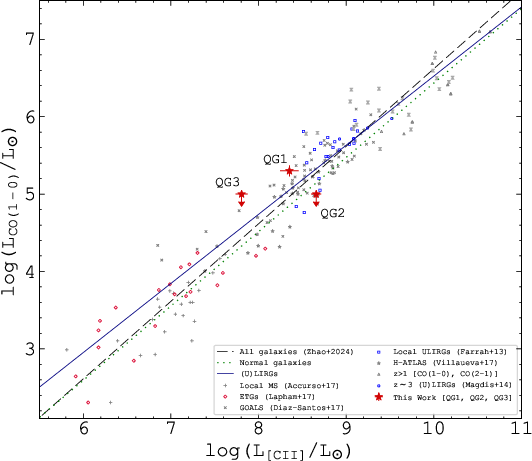
Figure 3: Relation between the [CII] and CO(1-0) luminosity in the sample and comparison galaxies; QG1 and QG2 are consistent with star-forming and local ETGs trends.
However, a pronounced [CII] deficit is identified in several sources, with Jlow2 reaching Jlow3 in some cases, typical of ULIRG-like systems yet in the absence of ongoing massive star formation.
Dust Temperatures and the Energy Budget
SED fitting reveals systematically elevated dust temperatures in several QGs: Jlow4 K for two sources (notably QG2 and GS-9209), exceeding lower redshift QG stacks and simple size-evolution expectations. This is particularly apparent using MIRI and ALMA photometry in combination. Such temperatures remain robustly high even when accounting for possible AGN contributions. The derived infrared luminosities place these systems on or even above the galaxy Main Sequence if IR-based SFR calibrations are naively applied, which is strongly at odds with their quiescent stellar populations inferred from JWST colors and Balmer absorption features.
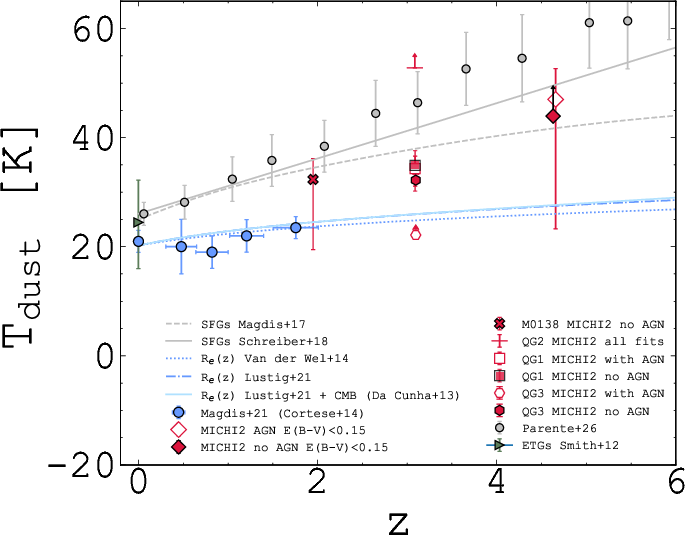
Figure 2: Dust temperature evolution with redshift for the sample; QGs at Jlow5 are significantly hotter than local ETGs and lower redshift QGS.
Notably, for GS-9209 and QG2, the bolometric dust luminosity derived from the IR SED exceeds, by an order of magnitude or more, the amount of stellar radiation that could plausibly be absorbed and reprocessed by dust given the optically measured attenuation and rest-UV–optical SED.
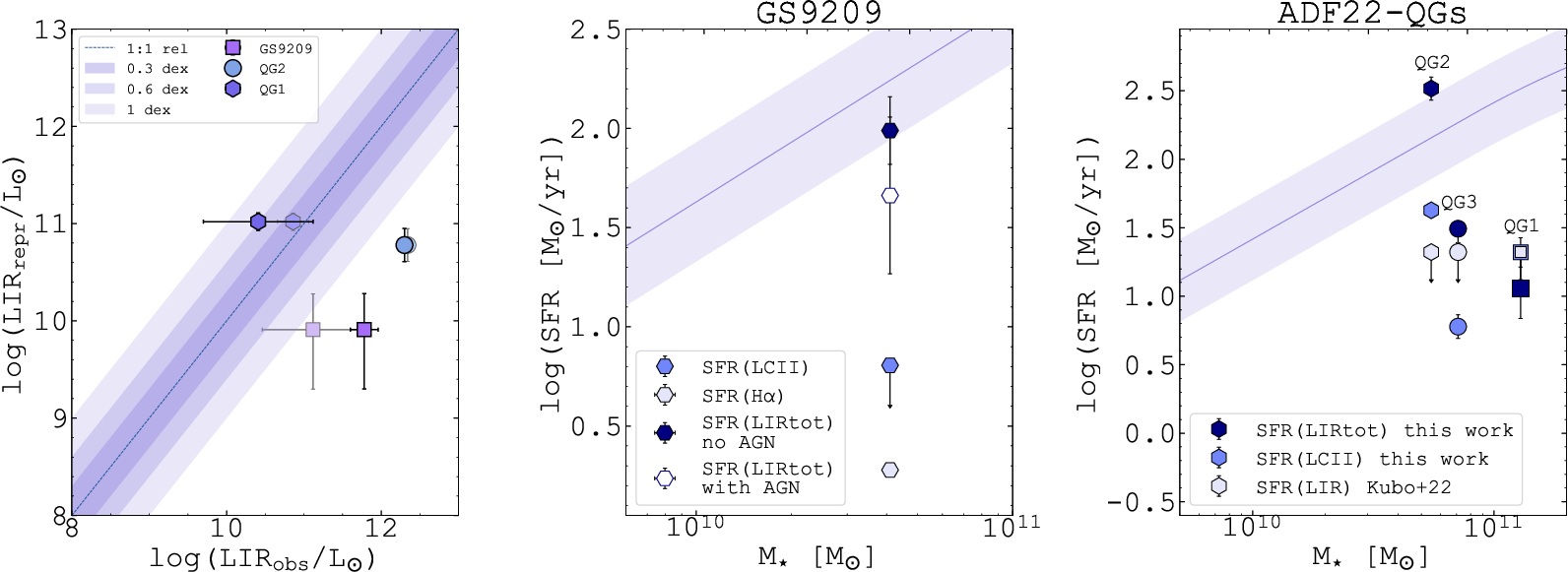
Figure 6: Observed IR luminosity compared to that expected from absorbed stellar light for the sample; multiple sources show strong IR excess.
Physical Mechanisms: Mergers, Shocks, and AGN Feedback
JWST imaging reveals widespread disturbed morphologies, signatures of past interactions or ongoing mergers, and in several cases, significant spatial offsets between the [CII]/dust emission and the compact stellar core.
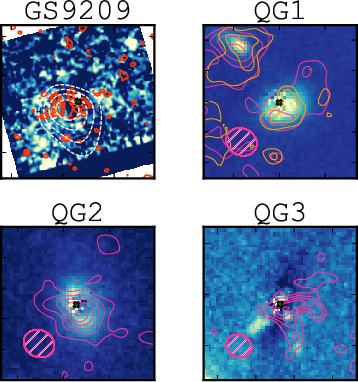
Figure 4: GALFIT residuals showing asymmetric, lopsided, or multi-component stellar structure in all QGs, with [CII] and dust contours highlighting spatial offsets.
QG2, in particular, exhibits evidence consistent with ongoing radio-mode AGN feedback, as shown by resolved radio emission, a lopsided stellar component, powerful AGN-driven [OIII] outflows, and spatially extended high-temperature dust. The radio/IR SED and morphology of QG2, along with its large [CII]/dust ratio and SFR-deficit, are consistent with ISM heating via either merger-driven shocks or AGN jet-induced turbulence—a scenario predicted by theoretical models but rarely observed at Jlow6.
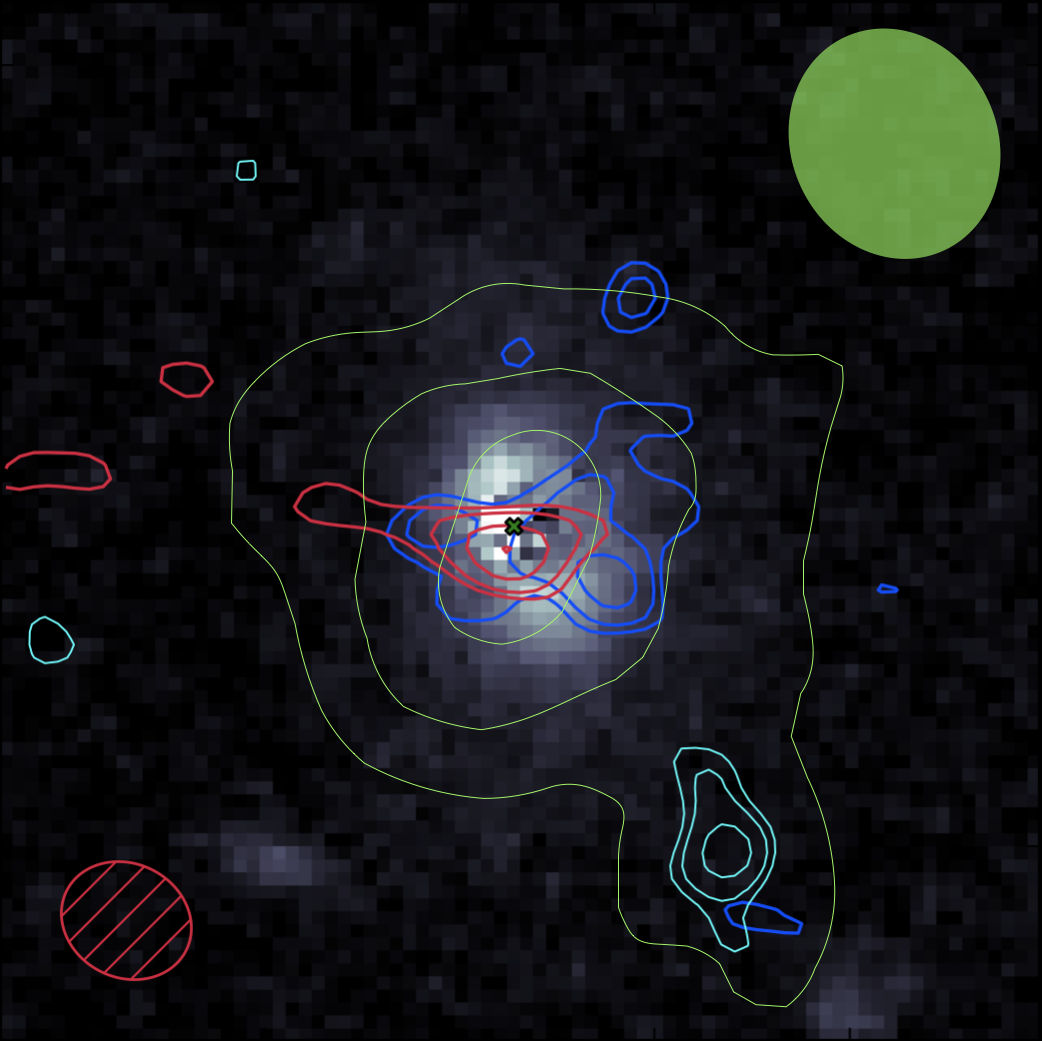
Figure 5: QG2 displays [CII] emission, radio hot-spots, and dust continuum offsets aligned with disturbed stellar features, consistent with jet-induced feedback or shock heating.
Evolution of Gas and Dust Content in QGs
The derived molecular gas fractions in most QGs remain low (Jlow75%), in alignment with extrapolated dust-continuum stacking analyses, except for QG2, whose [CII]-based Jlow8 is suspect for enhancement via non-PDR [CII] excitation, not matched by dust mass constraints.
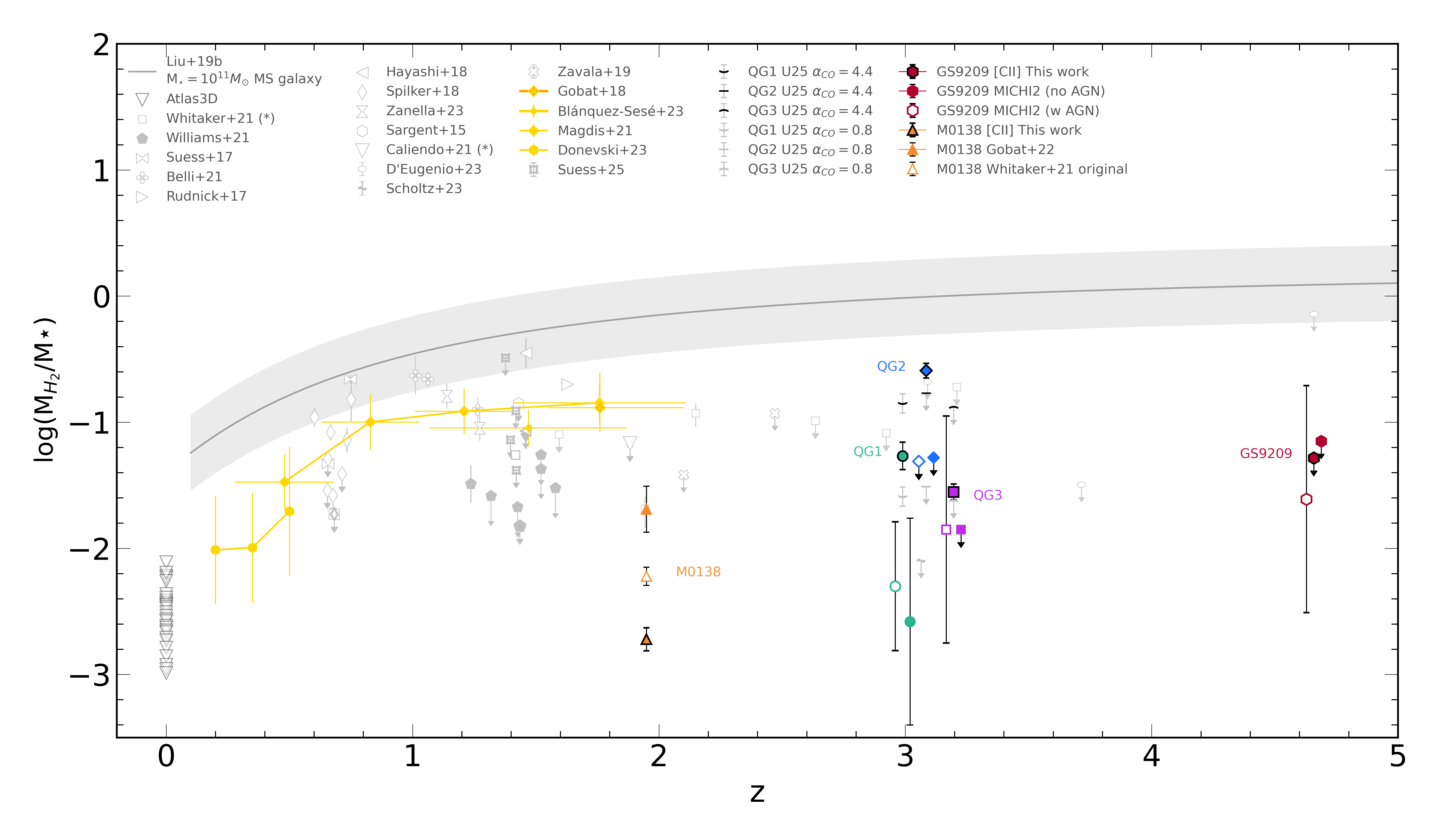
Figure 9: Gas fraction evolution with redshift; the sample's QGs continue the low Jlow9 trend seen at log(M⋆/M⊙)>10.50.
Comparisons to local post-starburst systems highlight an increased [CII] deficit and warmer dust at high redshift, with less compact IR-emitting components, possibly indicating a more turbulent, unsettled ISM in quiescence's immediate aftermath.
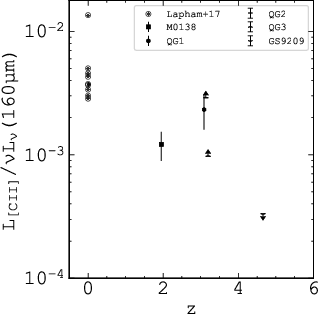
Figure 7: [CII]-to-dust continuum ratios display a pronounced deficit in the high-z QGs compared to local ETGs and PSBs.
Theoretical and Practical Implications
The evidence suggests that a significant fraction of the ISM in recently quenched massive galaxies resides in turbulent, spatially extended reservoirs subject to non-stellar heating, likely arising from merger-driven shocks and/or AGN radio jets. The standard interpretation of IR and even [CII] emission as tracers of SFR and molecular gas is, therefore, invalid for such systems, as their energetics are decoupled from direct star formation.
The persistence of ULIRG-like dust temperatures and [CII] deficits in these nascent QGs implies both rapid and violent quenching scenarios and possible ongoing ISM turbulence well after the cessation of vigorous star formation. Moreover, observational strategies aiming for ISM mass constraints should not naively use dust temperature priors from local QGs, nor single-tracer gas calibrations.
The identification of candidate cases of direct ISM heating via radio-mode AGN feedback at log(M⋆/M⊙)>10.51 provides key empirical input to feedback-modulated quenching models and underscores the value of joint ALMA+JWST mapping for dissecting physical ISM processes.
Conclusion
This work provides the first targeted [CII] measurements and complementary deep ALMA+JWST analysis of log(M⋆/M⊙)>10.52 quiescent galaxies, demonstrating:
- Secure [CII] and dust continuum detections in a heterogeneous sample of QGs at log(M⋆/M⊙)>10.53
- [CII]/CO and [CII]/dust ratios consistent with local calibrations, yet with significant [CII] deficits (down to log(M⋆/M⊙)>10.54)
- Pervasive evidence for merger-disturbed morphologies and off-nuclear ISM structures
- IR luminosities and dust temperatures incompatible with simple energy balance, implying additional heating mechanisms
- A candidate log(M⋆/M⊙)>10.55 QG (QG2) exhibiting radio-mode AGN feedback and extreme ISM energetics
The results challenge standard interpretations of ISM diagnostics in quiescent systems, highlighting the need for multi-tracer analyses and caution in using [CII] and IR continuum as SFR or log(M⋆/M⊙)>10.56 proxies for early post-starburst galaxies.
Much larger, homogeneous samples, higher-SNR ALMA mosaics, and spectroscopic MIRI follow-up targeting PAH and Hlog(M⋆/M⊙)>10.57 lines will be decisive for establishing the prevalence and physical drivers of non-stellar ISM heating in the early quiescent galaxy population.