- The paper introduces a Lie algebraic construction that maps Cartan and root generators to Fock states, defining lattice dimensionality and connectivity.
- It demonstrates practical realizations using Heisenberg-Weyl, su(2), and su(3) models, linking quantum optics and simulation to synthetic Hilbert-space lattices.
- The approach extends to Lie superalgebras, enabling analysis of hybrid bosonic, fermionic, and topologically nontrivial quantum systems.
Algebraic Structure and Physical Implications of Fock-State Lattices
Overview
The paper "Algebraic structure of Fock-state lattices" (2604.09341) establishes a rigorous framework for analyzing Fock-state lattices (FSLs) through the formalism of Lie algebras and superalgebras. By systematically associating the weight lattice and transitions of a physical system to the Cartan and root generators of a Lie algebra, the work elucidates the symmetry, dimensionality, and underlying geometric structure of synthetic Hilbert-space lattices found in quantum simulation, many-body physics, and quantum optics contexts.
Lie Algebraic Construction of Fock-State Lattices
The central thesis posits that an FSL is optimally described by identifying a generating Lie algebra. The Cartan generators provide a simultaneous eigenbasis corresponding to Fock (number) states, which serve as the lattice sites; the root generators (non-diagonal elements) induce site-to-site transitions (i.e., allowed "hopping" on the FSL). The dimensionality and connectivity of the FSL emerge directly from the algebra’s rank and root system.
Notably, when such an algebraic structure is present, FSLs inherit several geometric features from the associated Lie-algebra phase space (LPS). The curvature and topology of the LPS—in cases such as non-Abelian or noncompact algebras—are mirrored in the synthetic Hilbert-space dynamics of the FSL, allowing realization of quantum phenomena akin to transport in curved spaces.
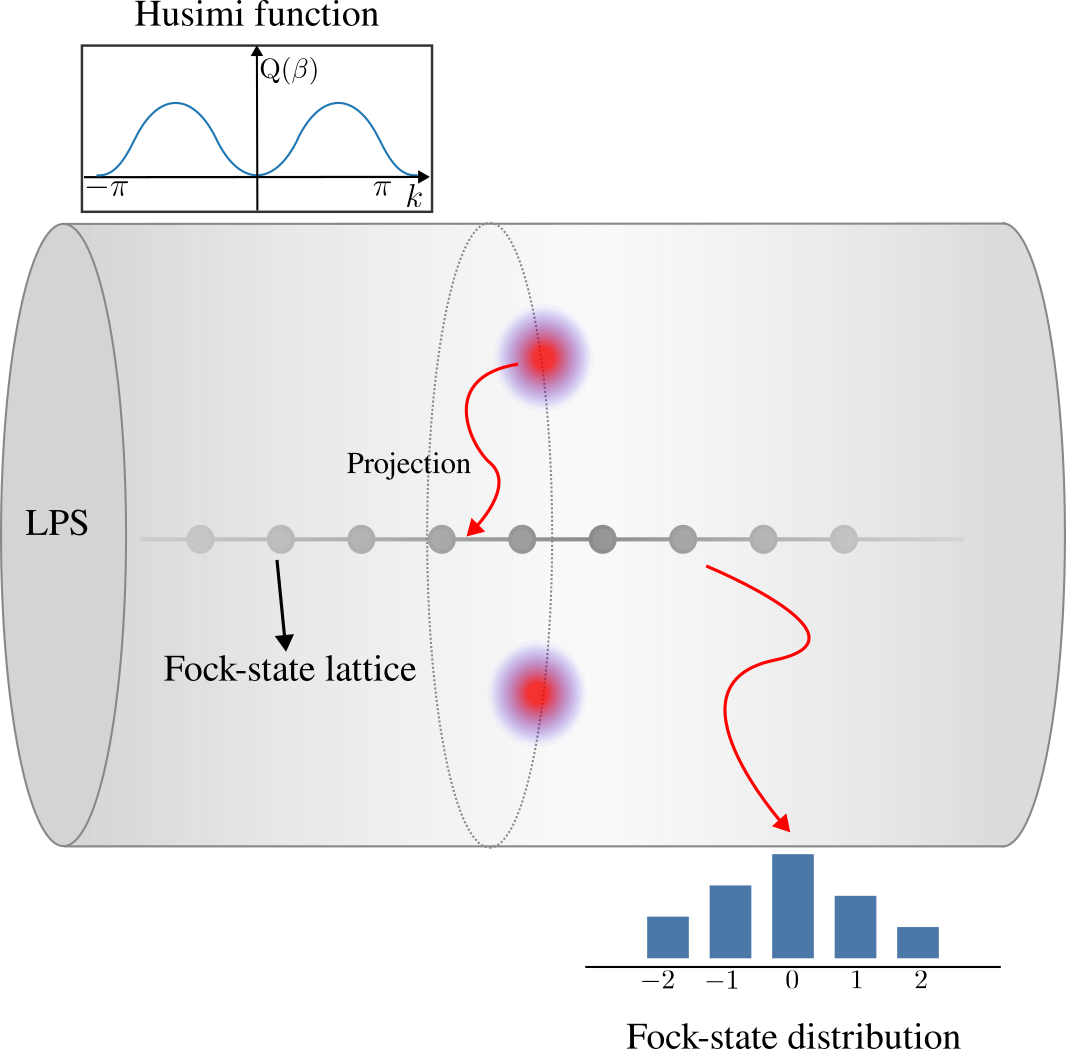
Figure 1: Lie-algebra phase space (LPS, gray cylinder) and its mapping to the discrete Fock-state lattice (FSL, black dots); the Husimi function Q(β) visualizes quantum state localization over the LPS, with projections onto the FSL.
Prototypical Examples and Physical Realizations
The method is concretely illustrated by mapping familiar physical models onto Lie algebras, showing how their Hamiltonians correspond to specific Lie algebra representations and thus to weighted synthetic lattices:
- Heisenberg-Weyl (hw) Algebra: Bosonic Fock states (∣n⟩) form a semi-infinite chain with creation/annihilation as ladder operators; the phase space is the standard complex plane.
- su(2) Algebra: Spin-S systems or two-mode bosonic models yield finite one-dimensional lattices, with LPS as a sphere (Bloch sphere).
- su(3) Algebra: Three-mode bosonic systems produce finite two-dimensional triangular FSLs. Here, the six root generators define transitions on the lattice axes, and the phase-space manifold is four-dimensional and compact.
Distinctly, the inclusion of synthetic gauge fields (nontrivial Peierls phases in hopping terms) in higher-rank cases leads to lattice models carrying flux, enabling the exploration of topological phenomena in FSLs.
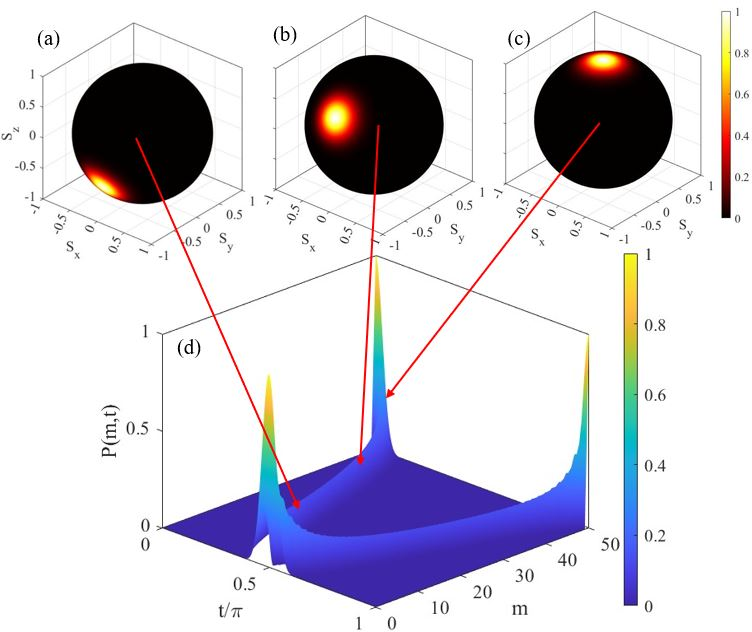
Figure 2: Time evolution in the FSL (d) and corresponding Husimi function evolution on the LPS (a-c) for the su(2) model; oscillatory population transfer and perfect revivals are evident.
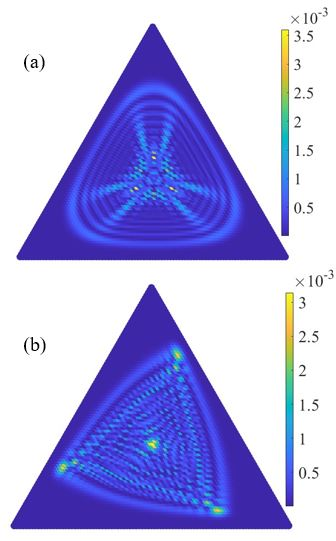
Figure 3: Distributions P(na,nb,N−na−nb,t) at different times for the su(3) triangular FSL, demonstrating the effect of time-reversal symmetry breaking via a synthetic magnetic flux.
Beyond familiar constructions, the paper introduces analyses of more complex algebras, such as so(5), demonstrating the emergence of higher-dimensional FSLs (e.g., compact square lattices with both nearest and next-nearest-neighbor couplings, and intricate connectivity reflecting the underlying algebraic structure).
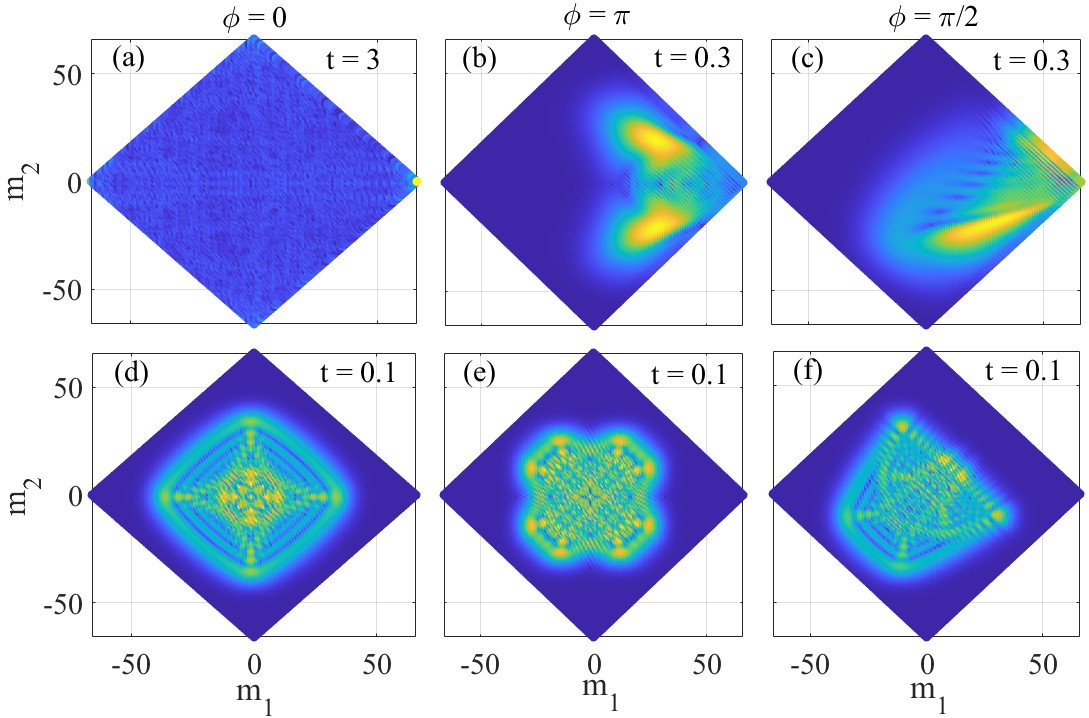
Figure 4: Snapshots of the (fourth-root) FSL distribution for the hw0 model, emphasizing the effects of broken time-reversal symmetry and the role of initial state localization in FSL dynamics.
Lie-Algebra Phase Spaces and Coherent State Correspondence
The authors formalize the construction of the LPS as the manifold of generalized (Perelomov) coherent states generated by the action of the Lie group on a reference (highest-weight) state. This framework enables the definition of phase-space quasiprobability distributions, notably the Husimi hw1 function, intrinsically tied to the algebraic structure.
Such a phase-space picture allows the visualization of quantum dynamics in terms of smooth manifold evolution (often with nontrivial curvature), and yields insight into transport, revival, and localization phenomena on the associated FSL. In many cases, however, there is a nontrivial mapping from the LPS to the FSL—the geometry is inherited from the algebra (e.g., spherical, hyperbolic, or more intricate non-flat manifolds), and localization properties can differ significantly between LPS and FSL.
Algebraic Constraints and Limitations
A critical analysis is presented on the mutual implication of Hamiltonian integrability and closed Lie algebraic structure. While any Hamiltonian linear in the generators of a finite Lie algebra yields a closed, integrable system whose dynamics are fully captured by the algebra, the converse fails in general: integrable models—particularly those nonlinear in the generators or involving mixed degrees of freedom—do not always admit a finite-dimensional Lie algebra correspondence.
The authors precisely categorize which quadratic Hamiltonians (bosonic, fermionic, and their mixtures) possess closed underlying algebras (e.g., hw2, hw3), and they clarify the role of symmetries and the reduction of FSL dimensionality. The extension to Lie superalgebras is shown to be necessary for models with mixing between bosonic and fermionic (or spin) degrees of freedom (e.g., Jaynes-Cummings, Tavis-Cummings models). This provides a systematic way to recover the algebraic structure and FSL connectivity for a much broader class of integrable quantum systems.
Implications and Future Directions
The algebraic construction of FSLs provides an explicit, systematic link between symmetry, lattice geometry, and synthetic quantum matter phenomena. Physically, it allows the design of quantum simulators in Hilbert space with tunable curvature, synthetic gauge fields, and higher-dimensional connectivity—all determined by the choice of algebra and representation. The matrix between underlying algebra and synthetic lattice topology is made precise, facilitating studies of quantum transport, localization, and topological effects in abstract dynamical settings.
Furthermore, this paradigm motivates new theoretical developments, such as:
- Analytical techniques for quantum dynamics in curved or topologically nontrivial synthetic spaces.
- Engineering of synthetic dimensions in quantum simulation platforms using internal (nonspatial) degrees of freedom.
- Deeper understanding of the limitations of algebraic solvability for interacting and hybrid quantum models.
The identification of Lie superalgebras as the natural language for mixed quantum systems opens the door to new classes of synthetic lattice models, with connections to both quantum information theory and fundamental studies of symmetry in dynamical many-body systems.
Conclusion
By establishing a systematic algebraic approach to the construction and analysis of Fock-state lattices, the paper provides a comprehensive foundation for the exploration of complex synthetic quantum systems. The mapping between Lie (super)algebra generators and FSL structure not only clarifies the geometric and dynamical properties of Hilbert-space lattices but also points to new avenues for engineering and probing exotic quantum behaviors beyond conventional spatial dimensions. This framework will be essential for future investigations in quantum simulation, topological phases, and the interplay of symmetry and dynamics in controlled quantum systems.

