- The paper extends Pólya’s shire theorem to transcendental functions by characterizing zero asymptotics on Voronoi cells of singularities.
- It employs Darboux and Wright saddle-point methods to describe both global zero distribution and microscopic clustering near essential singularities.
- The study establishes convergence of normalized zero-counting measures, linking analytical recurrence relations with potential theory.
Pólya's Shire Theorem Extended: Zero Asymptotics for Functions with Essential Singularities
Introduction and Historical Context
The paper presents a substantial extension of Pólya's classic shire theorem, originally concerned with the zero asymptotics of the successive derivatives of meromorphic and entire functions, to a broader class of transcendental functions with essential singularities. Specifically, the work addresses the zeros of derivatives of functions of the form
f(z)=Q(z)P(z)exp(T(z)S(z)),
where P,Q,S,T are polynomials over C, with (P,Q)=(S,T)=1 and T nonconstant.
Historically, Pólya's theorem characterized the accumulation sets of zeros of f(n) for meromorphic f in terms of the Voronoi diagram generated by its poles; for entire functions of exponential type, the zero accumulation sets become rays emanating from a center determined by the exponential term.
Main Results: Uniform Zero Asymptotics in the Presence of Essential Singularities
The paper's principal results concern three phenomena:
- Uniform Asymptotics of Zeros on Voronoi Cells: The zeros of the polynomial factor (denoted Bn) in the nth derivative f(n) asymptotically concentrate on the Voronoi cells of the finite singularities P,Q,S,T0. On cells adjacent to poles, the zeros display classical Darboux asymptotics, while cells attached to essential singularities (poles of P,Q,S,T1) exhibit a multi-saddle (Wright) expansion with precisely P,Q,S,T2 saddle contributions when the singularity is of order P,Q,S,T3.
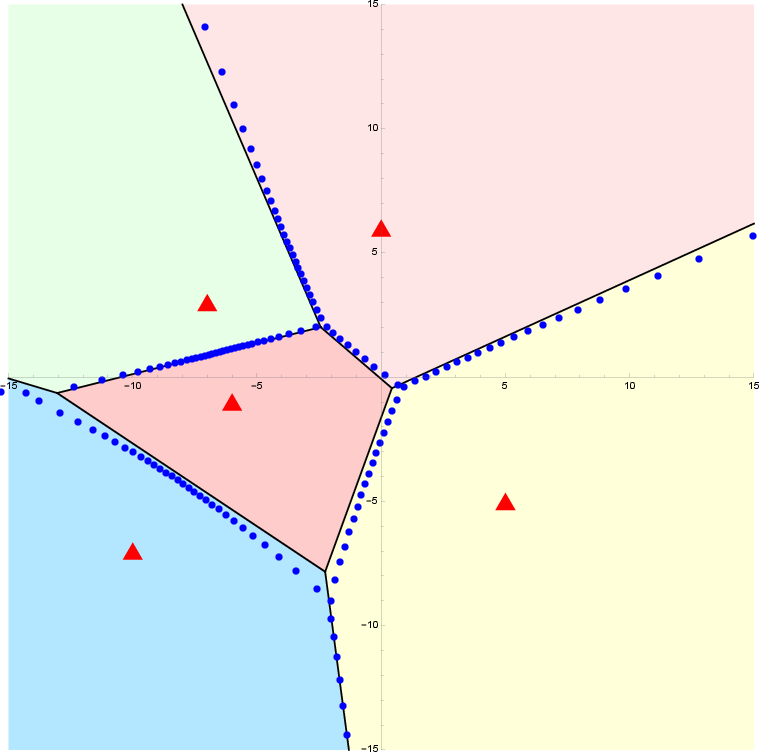
Figure 1: The Voronoi diagram determined by the five poles (red triangles) of some rational function P,Q,S,T4, together with the zeros of P,Q,S,T5 (blue dots).
- Microscopic Models at Essential Singularities: The zeros that cluster near essential singularities, when appropriately rescaled, are described by Sheffer sequences associated to higher-order Laguerre-type polynomials (for P,Q,S,T6) or the classical Laguerre polynomials when P,Q,S,T7. The limiting zero measure in the microscopic regime generalizes the Marchenko–Pastur law, with the measure supported on a finite interval depending on the order of the singularity.
- Global Zero Law and Convergence of Zero-Counting Measures: The normalized zero-counting measures for the P,Q,S,T8 converge, in the vague topology, to an explicit measure supported partly on the Voronoi edges (with density proportional to edge geometry) and partly as atomic mass at the essential singularities. The measure at infinity precisely tracks the polynomial part in the exponential; mass escapes to infinity when the degree of P,Q,S,T9 in the decomposition C0 is positive.
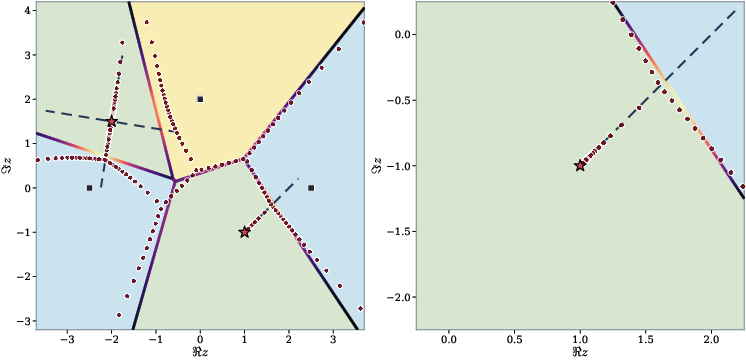
Figure 2: Zeros of C1 for a function with an essential singularity, exhibiting both global scaling and local clustering near the essential points.
Analytical Techniques and Recurrence Structures
A core technical advance is the decomposition of the C2th derivative:
C3
where the zeros of C4 encapsulate the zeros away from the singular set C5. The sequence C6 satisfies a specific recurrence:
C7
with C8, and C9 a rational function collecting data from all singularities.
This structure allows the authors to deploy asymptotic analysis:
- Darboux's method for cells attached to poles.
- Wright's saddle-point method for essential cells, producing local uniform expansions valid across compact subsets and across the Stokes phenomenon loci, with sharp (P,Q)=(S,T)=10 convergence rates as (P,Q)=(S,T)=11.
The exact local factorizations at singular points yield the multiplicity and scaling behavior of zeros near each type of singularity. Through potential theory and subharmonic functions, the authors establish the convergence of logarithmic zero potentials to specific limits associated to each Voronoi cell, furnishing complete control over the asymptotic zero geometry.
Microscopic Zero Clustering: Sheffer Sequences and Generalized Laws
At essential singularities, the limiting arrangement of zeros after blow-up scaling is governed by universal polynomials:
- For (P,Q)=(S,T)=12 (simple essential singularity), the local model corresponds to generalized Laguerre polynomials, whose zeros, after scaling, are distributed according to the Marchenko–Pastur law.
- For (P,Q)=(S,T)=13, the relevant Sheffer sequence yields (P,Q)=(S,T)=14-orthogonal polynomials, with a limiting zero distribution supported on (P,Q)=(S,T)=15 and an explicit determinantal formula for the Cauchy transform. The full (P,Q)=(S,T)=16 microscopic scaling provides a refined description of the cluster at each essential singularity.
Implications and Further Directions
Theoretical Implications
This work generalizes and unifies prior results on the zero sets of derivatives—encompassing rational, meromorphic, and finite-exponential type entire functions—under a Voronoi-theoretic lens that now includes essential singularities of finite order. The combination of Darboux and Wright asymptotics within a single theoretical schema is particularly robust, offering a toolkit for further analysis of transcendental and Liouvillian functions with finite singular sets.
The explicit identification of the limiting zero measure as a union of atomic (essential singularity), continuous (Voronoi edge), and possibly escaping mass at infinity gives a complete geometric and measure-theoretic description relevant for potential theory, value distribution theory, and random matrix analogies.
Numerical and Analytical Impact
The recurrence relations and saddle analysis enable effective computation and asymptotic estimation of zeros for large derivative order, enhancing both symbolic and numerical investigations in computationally intensive contexts (e.g., in algorithmic D-finite functions and special function asymptotics).
Future Developments
Potential avenues for future exploration include:
- Transition Asymptotics: A microscopic transition theory across dominant Stokes rays and near Voronoi vertices may unveil new kernels and universality classes in zero statistics.
- Generalization to Non-Liouvillean/Multivalued Contexts: Adapting these techniques to functions on Riemann surfaces or with branch point singularities.
- Random Matrix Theory and Multiple Orthogonality: The connection with higher-order multiple orthogonal polynomials points toward Riemann–Hilbert approaches and applications in random matrix theory, particularly for understanding spectra of non-selfadjoint or perturbatively structured operators.
Conclusion
This paper develops a comprehensive asymptotic theory for zeros of derivatives of a broad class of transcendental functions with both meromorphic and essential singularities, extending Pólya's shire theorem and integrating classical, potential-theoretic, and modern saddle-point techniques. The joint global and microscopic structural results, along with explicit analytic formulas for limiting measures and recurrence relations, make this a substantial contribution to the theory of analytic function zeros and their asymptotic distributions.