- The paper introduces a two-photon probing regime where both entangled photons interact with the sample, inducing a quadratic transformation on polarization correlations.
- It shows that this method, TPP, amplifies sensitivity to depolarization parameters, enabling high-fidelity reconstruction of the sample’s Mueller matrix.
- Experimental results confirm the theory with strong agreement between measured outcomes and simulations, highlighting TPP’s potential in quantum-enhanced optical characterization.
Quadratic Quantum Polarimetry with Entangled Photon Pairs
Introduction
The paper "Quadratic Quantum Polarimetry with Entangled Photon Pairs" (2604.09257) fundamentally extends the polarimetric characterization of optical channels by introducing a two-photon probing regime, where both photons of a polarization-entangled pair simultaneously interact with the same scattering sample. Unlike conventional approaches—where typically only one photon probes the sample and the other functions as a reference—this configuration induces a quadratic transformation on the two-photon polarization correlation tensor, thus accessing second-order polarization properties that are strictly inaccessible to classical or single-photon polarimetry. This facilitates a fundamentally new metrological paradigm for quantum-enhanced characterization of polarization channels, especially in complex or highly depolarizing media.
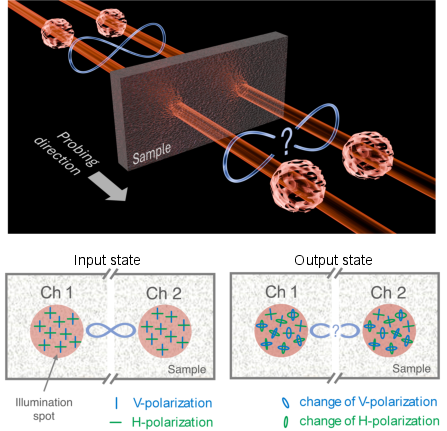
Figure 1: Schematic of quantum two-photon polarimetry, where polarization-entangled photon pairs are injected into two spatially separated illumination channels traversing the same sample, with output correlations analyzed for quantum state tomography.
Theoretical Framework
The classical description of optical polarization transformations via the Stokes-Mueller formalism only accounts for first-order polarization moments. Quantum extensions, in which photon pairs are entangled, have until now left channel characterization at an essentially linear response, as only one photon underwent sample interaction.
This work demonstrates that when both photons traverse a channel described by a Mueller matrix M, the two-photon polarization correlation tensor K evolves quadratically: K′=MKMT. This congruence transformation reflects a fundamentally higher-order mapping, which reshapes the observable dependence on channel parameters and enhances the susceptibility of polarization metrics—such as purity and entanglement concurrence—to depolarizing effects. Importantly, while the one-photon regime encodes state evolution linearly in M, the two-photon configuration amplifies depolarization effects quadratically, as observables like the output purity manifest quartic dependence on the depolarization coefficients.
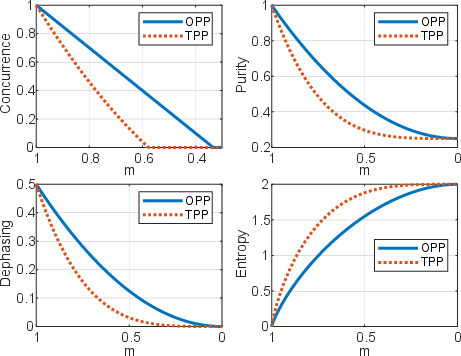
Figure 2: Analytical comparison of OPP and TPP for a diagonal depolarizing channel, highlighting the substantially increased sensitivity and nonlinearity of TPP in response to m (channel parameter).
This theoretical result is constructed on the basis of the CPTP formalism for quantum channels and the direct mapping between the Mueller matrix and Kraus operators for polarization evolution in scattering media. The induced nonlinearity directly translates to higher responsiveness in the decay of quantum correlations.
Experimental Methodology and Results
The experimental platform employs polarization-entangled photon pairs generated via spontaneous parametric down-conversion (SPDC) in a Mach-Zehnder interferometric configuration based on type-II periodically poled KTP crystals. Photon pairs are co-propagated through tissue-mimicking scattering phantoms with tunable effective optical thickness η, providing a controlled model for sample-induced depolarization. Full polarization state tomography is performed on both photons post-sample using coincidence measurements and a basis-complete quantum analyzer, allowing for reconstruction of the joint two-photon density matrix.
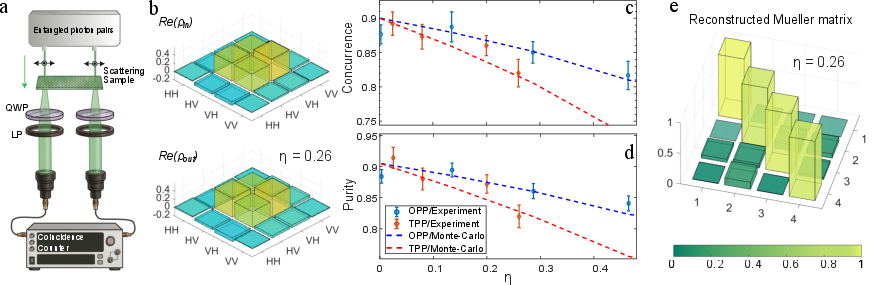
Figure 3: (a) Experimental setup for TPP; (b) Input and output density matrix (real parts); (c) Measured concurrence as a function of effective thickness η for OPP and TPP, with Monte Carlo theory; (d) Measured purity; (e) Reconstructed depolarizing Mueller matrix.
The experimental findings systematically confirm the quadratic sensitivity enhancement: purity and concurrence degrade substantially more rapidly as a function of sample thickness in the TPP regime relative to OPP, consistent with quartic versus quadratic dependence on the depolarization parameter, affirming the key theoretical predictions. Monte Carlo simulations employing stochastic propagation of entangled photons through the scattering medium demonstrate high fidelity with both the empirical results and the quantum channel model used.
Additionally, the approach enables robust reconstruction of the depolarizing Mueller matrix for the sample directly from two-photon input-output tomographic data, with experimental parameters showing 97% agreement with simulated expectations.
Channel Reconstruction and Uniqueness
The established quadratic congruence transformation, while boosting sensitivity, also introduces stabilizer-induced non-uniqueness in Mueller matrix reconstruction for generic polarization channels. Specifically, for a single input state, the nonlinear mapping can be invariant under certain transformations of the Mueller matrix, hence, without careful design, reconstruction may not be unique. However, for diagonal or isotropic depolarizing matrices—the relevant class for the experiment—uniqueness is achieved, and high-dimensional reconstructions remain precise.
Numerical inversion strategies using multiple orthogonal input states enable restoration of reconstruction uniqueness for general Mueller matrices up to a global sign. Simulation-based reconstructions of two-dimensional, spatially-varying depolarization maps demonstrate reconstruction errors below 10−8. This situates TPP as a resource-efficient alternative to full quantum process tomography for a large class of practical channels.
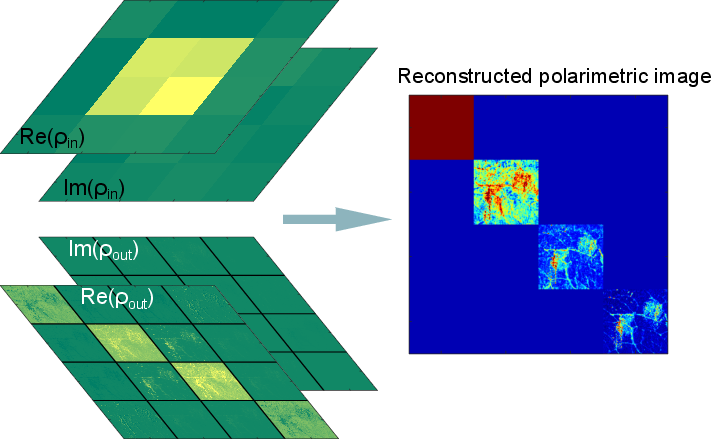
Figure 4: Pixel-resolved reconstruction of a depolarizing sample via TPP, with high-fidelity mapping of the depolarization parameters over a 2D grid.
Implications and Future Directions
This work positions quantum two-photon polarimetry as a new regime in quantum-enhanced measurement, fundamentally altering the identifiability and sensitivity landscape for optical channel characterization. The quadratic dependence of observables on channel parameters implies that TPP is not merely a sensitivity boost but provides qualitatively new information, especially regarding higher-order polarization correlations. These results have direct implications for quantum and classical imaging, communications through scattering or turbid domains, and studies of complex mesoscopic environments.
Potential extensions include utilization for non-isotropic and time-varying channels, quantum imaging modalities where higher-order polarization moments are diagnostic, and integration with quantum process learning frameworks. The minimal measurement overhead and demonstrated statistical robustness suggest the adaptability of TPP to real-world metrology, biomedical diagnostics, material science, and quantum photonic information processing.
Conclusion
Quantum two-photon polarimetry redefines optical channel characterization by harnessing the quadratic transformation of polarization correlation tensors enabled by entangled photon pairs traversing the same medium. The regime offers enhanced sensitivity and direct access to higher-order polarization properties, validated both theoretically and experimentally. For anisotropic depolarizing channels, TPP supports unique, resource-efficient Mueller matrix reconstruction, underpinning new applications in polarization quantum sensing and imaging. These findings open the avenue for systematic exploration of higher-order quantum measurement protocols in the characterization of complex and dynamic optical environments.

