- The paper presents an adaptive control-based method for topology identification and synchronization in undirected signed networks with both cooperative and antagonistic links.
- It employs persistency of excitation and edge-based representations to recover unknown weights, ensuring uniform global asymptotic stability and practical convergence.
- Numerical simulations on a 12-agent network validate the approach, demonstrating effective distributed estimation despite instability from negative interactions.
Topology Identification in Dynamical Signed Graphs: A Control-Theoretic Approach
Introduction and Background
The problem of topology identification in complex dynamical networks has drawn substantial attention in recent years due to its relevance in diverse domains, including social networks, multi-robot systems, and biological networks. This paper, "Topology Identification of Dynamical Signed Graphs" (2604.09079), addresses the challenging case of undirected signed networks, where agents interact through both cooperative and antagonistic (positive and negative) relationships. The interaction topology, crucial for synchronization and control, is typically unknown and potentially unstable due to the presence of negative links, which violate the standard assumptions leveraged by most identification techniques.
Existing approaches for topology identification span prediction error methods, Lyapunov equation-based methods, causality-based inference, and adaptive control-based schemes. However, almost all prior adaptive control solutions, as discussed in [zhu_new_2021], assume purely cooperative networks. By contrast, this work systematically extends adaptive control-based topology identification to signed networks described by repelling Laplacians—a nontrivial generalization, as such Laplacians can yield indefinite dynamics and marginal or full instability. The proposed method integrates edge-based network representations, persistency of excitation (PE) conditions, and a distributed adaptive protocol capable of achieving both synchronization and weight identification even in the presence of instability and unknown topology.
The network under consideration consists of N agents, each described by
x˙i=fi(xi)−j=1∑Naij(xi−xj)+ui,
with unknown adjacency weights aij that can be positive (cooperation) or negative (antagonism), parameterizing the interaction topology via a symmetric but potentially indefinite repelling signed Laplacian L. Expressing L as L=EWsE⊤, with E the incidence matrix and Ws the diagonal matrix of (signed) edge weights, the adaptive identification objective is to recover the unknown weights wsk and ensure synchronization (convergence of agent states) with only local information, and without any global information about the signed topology.
To convert topology identification to a tractable parameter estimation problem, a complete signed graph representation is constructed, parameterizing all possible agent pairs and assigning wˉsk=0 for nonexistent edges. The identification task is thus reformulated as estimating the nonzero elements of x˙i=fi(xi)−j=1∑Naij(xi−xj)+ui,0 through an adaptive protocol, while regulating the network to synchronize.
Adaptive Protocol and Theoretical Results
Synchronization and topology identification are achieved by augmenting the dynamics with an auxiliary trajectory x˙i=fi(xi)−j=1∑Naij(xi−xj)+ui,1, which is enforced to be persistently exciting by design. The external input takes the form:
x˙i=fi(xi)−j=1∑Naij(xi−xj)+ui,2
Here, x˙i=fi(xi)−j=1∑Naij(xi−xj)+ui,3 is the current estimate of the Laplacian, and the weights of the network are updated according to
x˙i=fi(xi)−j=1∑Naij(xi−xj)+ui,4
The auxiliary system's state x˙i=fi(xi)−j=1∑Naij(xi−xj)+ui,5 evolves as
x˙i=fi(xi)−j=1∑Naij(xi−xj)+ui,6
where x˙i=fi(xi)−j=1∑Naij(xi−xj)+ui,7 is designed to be (uniformly) persistently exciting (u-PE or x˙i=fi(xi)−j=1∑Naij(xi−xj)+ui,8-PE), a property fundamental for parameter convergence in nonlinear systems [panteley2001relaxed, loria2005nested].
Key Propositions
- Proposition 1 establishes uniform global asymptotic stability (UGAS) of the estimation errors and ensures both accurate topology recovery and network synchronization, provided: (1) x˙i=fi(xi)−j=1∑Naij(xi−xj)+ui,9 is uaij0-PE, and (2) the input gain aij1 compensates for the smallest eigenvalue of the (generally indefinite) Laplacian, i.e., aij2.
- Proposition 2 addresses the lack of global knowledge of aij3 by leveraging a graph-theoretic bound: if edge weights are normalized (i.e., aij4), then for any aij5 (with aij6 nodes), stability and convergence still hold—enabling a fully distributed protocol.
- Proposition 4 relaxes the persistency of excitation requirement, establishing uniform semiglobal practical asymptotic stability (USPAS) of the estimation errors even when aij7 is uaij8-PE strictly with respect to the state synchronization error, via an intricate composite Lyapunov analysis and application of USPAS theory [chaillet2008uniform].
Numerical Simulation and Empirical Insights
A simulation involving aij9 agents on a connected, nontrivially signed graph empirically validates the theoretical findings. The protocol successfully identifies the graph topology and synchronizes the network, despite the presence of antagonistic links and without global parameters. As illustrated in the following, estimation and synchronization errors converge to small neighborhoods ensuring practical accuracy.
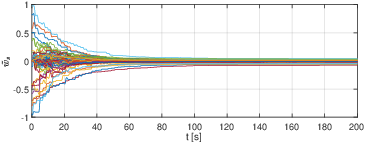
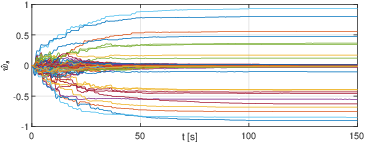
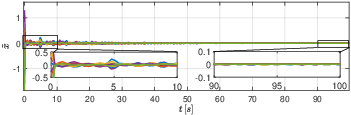
Figure 1: (a) Estimation errors L0, (b) Estimated weights L1, (c) Synchronization errors L2 across trajectories, confirming simultaneous topology identification and network synchronization.
Crucially, while exact parameter convergence may not be achieved in finite time for all initializations (due to practical limitations in excitation and adaptation gains), the error neighborhoods can be arbitrarily reduced by gain tuning.
Implications and Future Directions
This work rigorously extends adaptive topology identification to the class of undirected signed networks, overcoming several obstacles: instability due to negative interactions, lack of global knowledge, and the necessity of distributed execution. By synthesizing persistently exciting auxiliary dynamics with a control-theoretic adaptive protocol, the framework achieves both synchronization and accurate recovery of edge weights. The results have broader ramifications for distributed estimation, robust control, and inference in adversarial or cooperative-antagonistic environments, as commonly encountered in social, economic, and robotic multi-agent systems.
Potential extensions and open questions include:
- Identification for signed networks with weights L3.
- Extension to discrete-time dynamics and time-varying topologies.
- Incorporating agent arrivals/departures (open multi-agent systems).
- Generalization to directed signed graphs or more complex interaction kernels.
Conclusion
The paper provides a comprehensive solution for topology identification in dynamical signed graphs through an adaptive control protocol that is provably stable and distributed under modest structural assumptions. The integration of persistency of excitation conditions with edge-based adaptive identification closes a key gap in the literature on network inference, enabling practical recovery of complex, possibly unstable, signed network topologies (2604.09079). This advances the theoretical and applied state-of-the-art in adaptive estimation and collective control of cooperative-antagonistic multi-agent systems.