- The paper demonstrates that conversational AI can provide accessible, standardized screening for neurocognitive disorders using at-home assessments.
- It employs a qualitative, human-centered speculative design with semi-structured interviews to reveal stakeholder needs in traditional NCD screening.
- The study underscores the need for clinical legitimacy, privacy-preserving data collection, and context-sensitive design for effective CAI deployment.
The Speculative Future of Conversational AI for Neurocognitive Disorder Screening: A Multi-Stakeholder Perspective
Introduction and Motivation
Neurocognitive disorders (NCDs), including Alzheimer's disease and related dementias, continue to increase globally, presenting substantial public health and care coordination challenges. Screening methods for NCDs are bottlenecked by the scarcity of specialists and inadequate early-stage assessment, leading most at-risk individuals to receive a diagnosis only after irreversible cognitive decline. Early intervention is crucial given emerging therapies targeting prodromal phases of disease progression. This context motivates scalable and socially acceptable screening mechanisms that transcend the limitations of hospital-centered care.
Conversational artificial intelligence (CAI) systems represent a promising technological avenue for interactive, self-administered NCD screening. While previous research has developed CAI prototypes for cognitive assessment, the deployment and social acceptance of these technologies remain underexplored, particularly regarding their integration into clinical workflows and community-based screening. The paper "The Speculative Future of Conversational AI for Neurocognitive Disorder Screening: a Multi-Stakeholder Perspective" (2604.09070) addresses these gaps through qualitative investigation, emphasizing the heterogeneous expectations and concerns of clinicians, individuals at risk, and caregivers.

Figure 1: The main procedure of this study.
Methodology
A human-centered, speculative design approach was employed, grounded in semi-structured interviews with 36 stakeholders: 24 at-risk older adults, 7 informal caregivers, and 5 experienced clinicians from urban China. Participants engaged with video scenarios depicting both traditional and CAI-administered NCD screening—using core tests such as the MoCA and the HK-GSDT—before offering their perspectives. The methodology leveraged thematic analysis and journey mapping to identify convergent and divergent stakeholder needs across clinical and social dimensions.
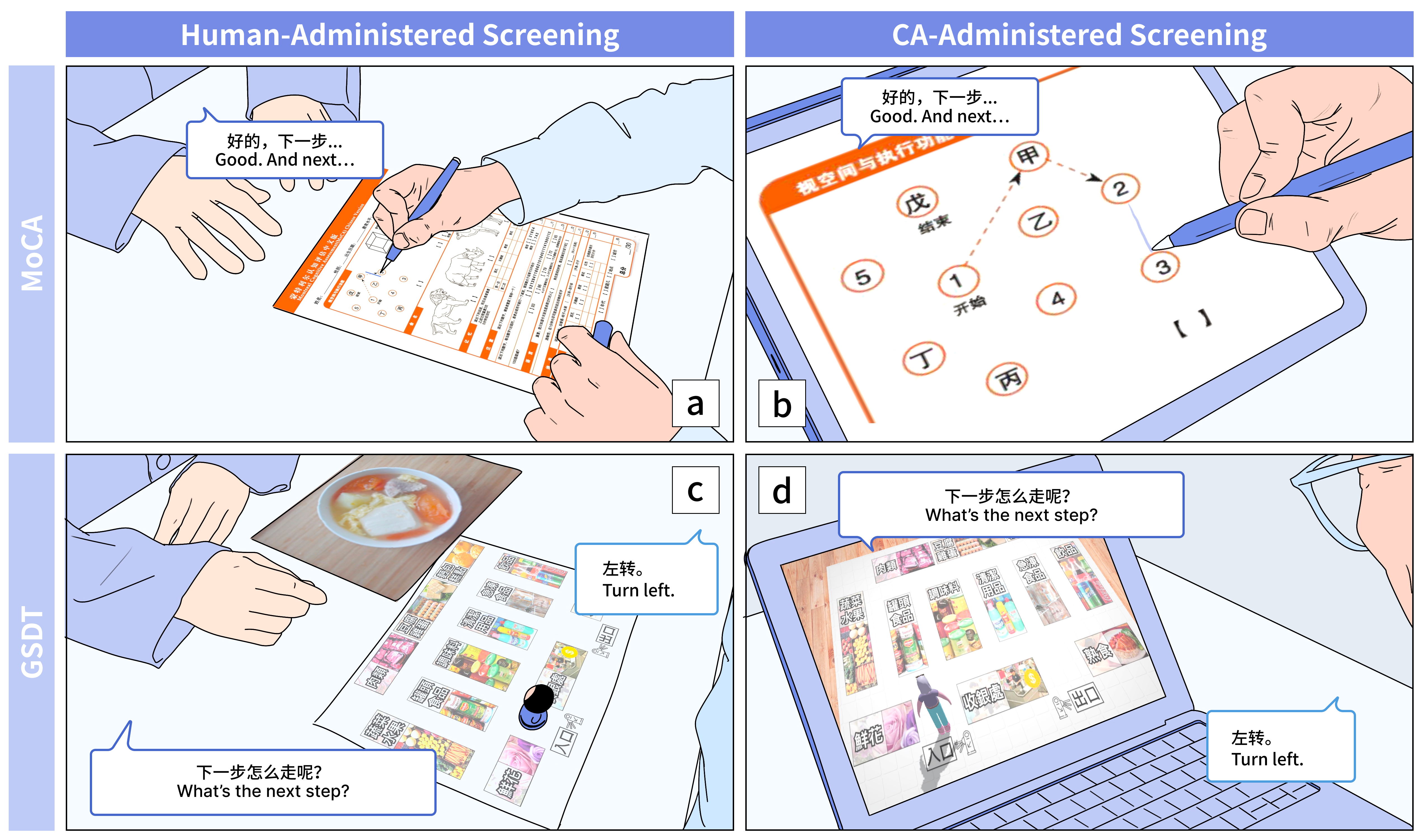
Figure 2: Four scenarios presented to participants, contrasting clinician- versus CAI-administered MoCA and GSDT assessments.
Current State of NCD Screening Practices
Interviews revealed that NCD screening remains predominantly symptom-driven and hospital-centric, with routine screening rarely integrated into annual check-ups. Delays in seeking care are exacerbated by limited disease awareness, perceived stigma, and logistical burdens placed on both patients and caregivers. Community clinics are infrequently trusted for comprehensive assessment, and in major hospitals, overwhelmed clinicians lack the capacity to conduct in-depth or empathetic evaluations. These system- and culture-specific barriers, however, map onto structural issues common to NCD care internationally.
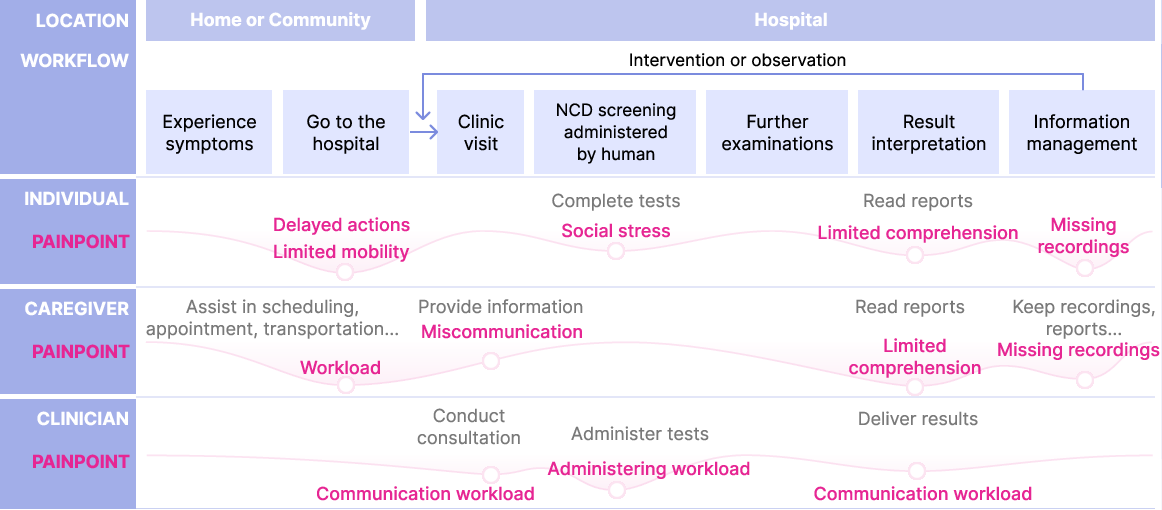
Figure 3: The original user journey map of hospital NCD screening, highlighting pain points such as delayed diagnosis, social stress, and fragmented communication.
Stakeholder Expectations: Agreements and Conflicts
Shared Expectations
There is consensus that CAI could:
- Enable comprehensive, battery-based cognitive assessment accessible from home or community centers, reducing logistics and social distress.
- Provide consistent, standardized administration accompanying concise, comprehensible result delivery—especially critical for individuals and caregivers with limited medical literacy.
- Reduce the clinical burden and streamline communication by offering clinicians longitudinal patient data ahead of in-person visits.
- Save time and labor for both caregivers and clinicians, while improving accessibility for individuals with mobility constraints.
Divergent and Contradictory Expectations
The investigation exposed strong areas of stakeholder divergence:
- Diagnosis authority: Individuals and caregivers prefer immediate, algorithmic diagnostic feedback, whereas clinicians require CAI to act solely as a decision-support, recommending follow-up rather than providing formal diagnoses—a stance underpinned by concerns about the limitations of single-sourced data and medico-legal liability.
- Emotional support and standardization: Individuals desire encouragement and reassurance during difficult tasks, sometimes requesting the opportunity for repeated attempts. Clinicians raise concerns about how excessive emotional scaffolding or "second chances" might compromise test validity.
- Result Communication: There are disparate opinions on how, and to whom, adverse results should be communicated (directly to patients, via caregivers, or not at all), with clinicians favoring nuanced, context-sensitive approaches.
- Screening frequency: Individuals with high health anxieties seek frequent (even daily) self-assessment, risking learning effects and invalid scores. Clinicians recommend structured, interval-based screening adapted to clinical stage and intervention targets.
- Privacy: Older adults and caregivers exhibit divergent attitudes toward privacy, with caregivers (especially from younger cohorts) expressing increased awareness and concern regarding data stewardship and bystander information capture.
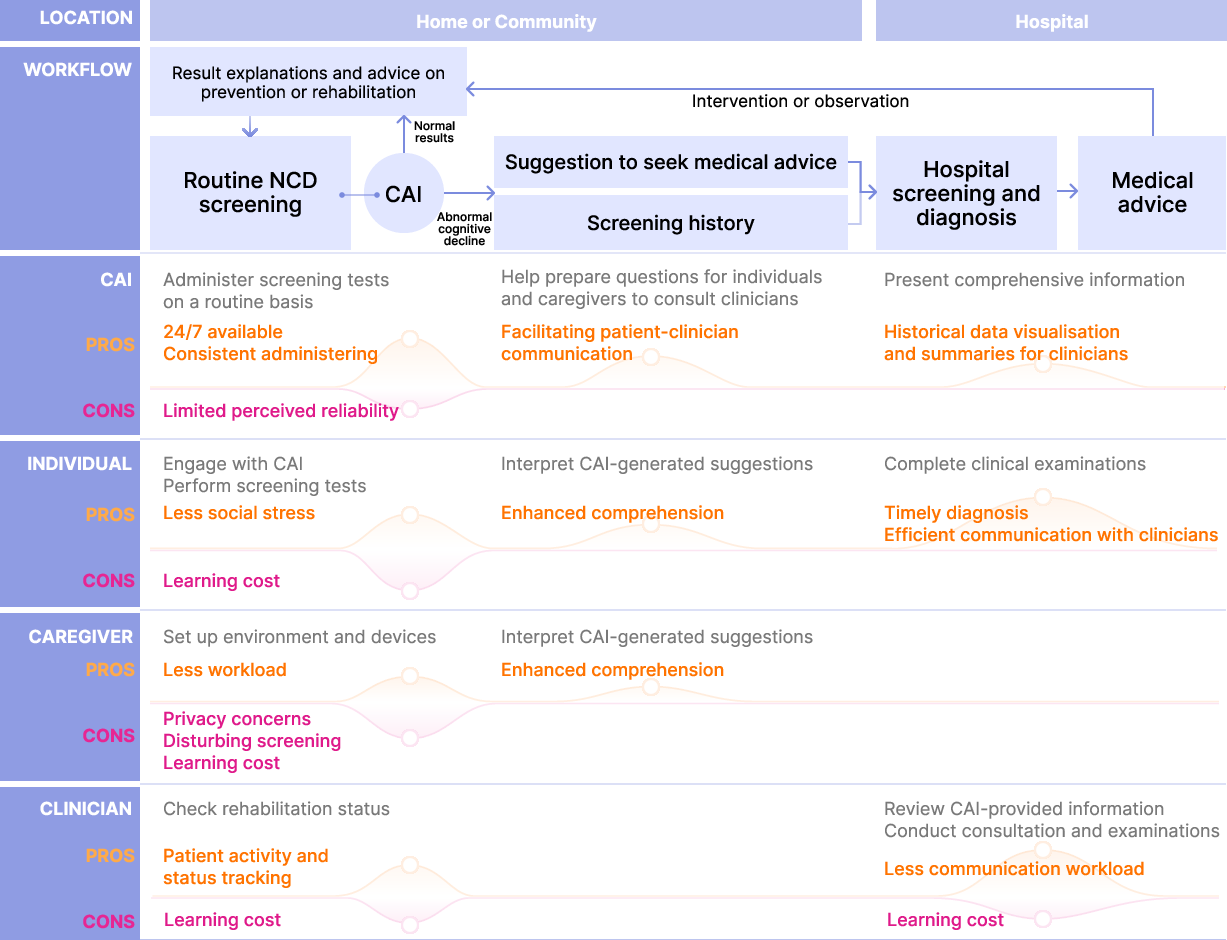
Figure 4: Speculative user journey map for routine NCD screening with CAI at home or in the community, supporting proactive management and comprehensive clinical handoff.
Implications for the Design and Deployment of CAI Systems
Transparency and Clinical Legitimacy: CAI trust hinges on explicit disclosure of institutional origins, expert validation, and process transparency. Systems must avoid conflating screening support with diagnostic closure, particularly in user-facing communications.
Contextualization and Environment: Community- or home-based CAI reduces social stigma and logistical burden but must address confounds such as environmental noise, device usability, and multi-user interactions in unstructured environments.
Personalization and Multimodal Support: The system should automatically adapt to sensory and linguistic competencies (e.g., dialect, literacy, hearing loss); guidance, assistance, or escalation flows should be tailored accordingly.
Granularity and Access Control in Result Reporting: Raw assessment data, domain-level analytics, and full process logs should be selectively accessible—to clinicians for decision-support, and to patients/caregivers in digestible formats.
Privacy-Preserving Data Collection: Consent-driven privacy mechanisms must protect both user and bystander data—potentially leveraging privacy-preserving computation (e.g., 3D wireframe reconstructions as in [Kunchala_2023_WACV]).
Scope of Emotional and Motivational Support: Empathetic conversational strategies (e.g., speech emotion recognition, affective language) should be bounded by clinical efficacy guidelines to prevent undermining assessment validity.
Empirical and Theoretical Impact
This research situates the future NCD screening landscape within a collaborative, technology-mediated workflow, where CAI acts as coordinator among distributed stakeholders. The iterative user journey maps concretely illustrate how CAI integration could shift screening from event-driven, hospital-based detection to proactive, continuous monitoring.
The findings challenge designers to balance empathy, accessibility, and standardization, negotiating tensions that emerge at the intersection of clinical rigor and daily lived experience. Theoretically, the work affirms the importance of multi-stakeholder, context-sensitive approaches in the introduction of AI tools into healthcare pipelines [callahan2006effectiveness, frost2021Implementing]. Generalization to healthcare systems outside China appears justified for macro-level workflow redesigns, though the particulars of result communication, emotional support, and privacy must remain sensitive to local cultural and regulatory norms.
Directions for Future Work
Empirical validation of CAI utility at scale—particularly long-term engagement and impact on diagnosis timelines—remains pending. Future research should extend beyond qualitative design to participatory prototyping and real-world deployment studies, attending to data triangulation and population diversity. Moreover, speculative design could expand the modalities and interfaces of CAI, integrating with sensor networks or groupware for collective monitoring tasks.
Conclusion
This paper provides a stakeholder-grounded framework for designing CAI-based NCD screening, revealing nuanced agreements and pronounced contradictions in expectations across clinical, social, and technological domains. It formulates actionable implications for human-centered, transparent, and context-sensitive CAI development that foregrounds trust, accessibility, and clinical appropriateness, thereby supporting the distributed, proactive management of neurocognitive disorders (2604.09070).