- The paper presents advanced MHD simulations and population synthesis modeling that capture disk instability dynamics driving rapid giant planet formation.
- It demonstrates that rapid cooling and magnetic regulation yield clumps with masses between 1–20 MJ, aligning simulation results with observed wide-orbit giants.
- The study integrates multi-wavelength observations with simulation outcomes to establish disk substructures as key indicators of the disk instability process.
Introduction
The disk instability (DI) model constitutes a primary alternative to core accretion in the theory of giant planet formation. DI offers a direct gravitational fragmentation pathway that can account for the rapid emergence of massive planets, especially in outer disks, around low-mass stars, and at early times—regimes not easily accessible to core accretion. This essay presents an expert synthesis of "Giant Planet Formation by Disk Instability" (2604.09042), emphasizing the physical principles, advances in numerical MHD and population synthesis modeling, the role of collisions, and the integration of multi-wavelength observational constraints.
Theoretical Foundation and Dynamics of Fragmentation
The DI mechanism is dictated by the interplay between self-gravity, thermal support, and angular momentum in protoplanetary disks. Local collapse follows the Toomre instability for Q<1, but nonlinear fragmentation requires efficient cooling (tcool≲tdyn) to counteract spiral shock heating and sustain overdensities. Regions susceptible to DI are typically located in the outer tens of AU in young, massive disks with rapid radiative cooling.
Numerical simulations have established that spiral instabilities precede fragmentation (typically at Q<1.7), and the threshold for non-axisymmetric fragmentation is modulated by hydrodynamics, radiative transfer, and, critically, magnetic fields. The onset of fragment formation is thus contingent upon both global (disk mass, opacity, irradiation) and local (density, turbulence, ionization) parameters.
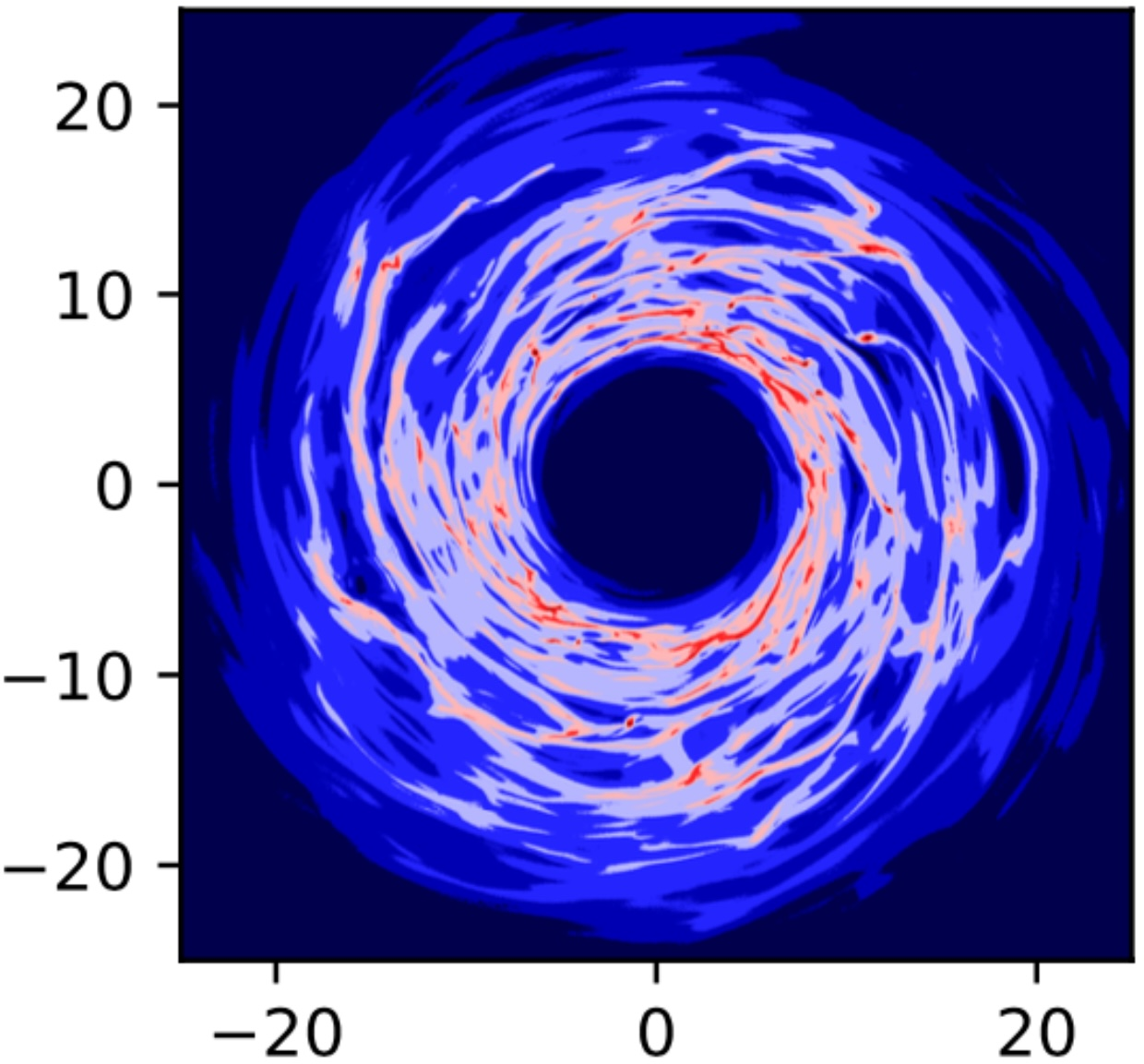
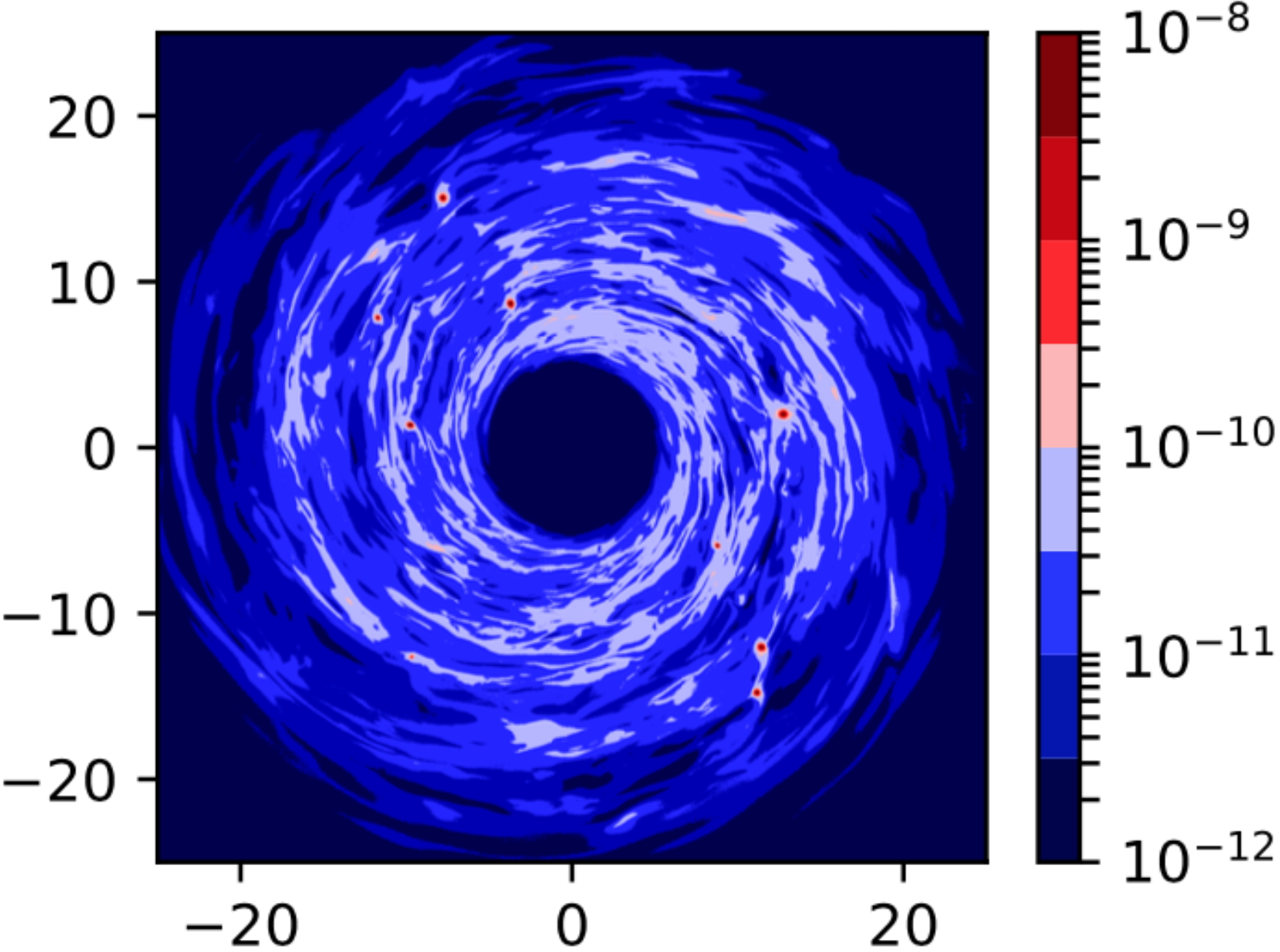
Figure 1: Magnetohydrodynamic (MHD) simulations demonstrate the rapid formation of sub-Jovian, gravitationally bound clumps in a self-gravitating disk, with magnetic fields promoting fragmentation at reduced mass scales.
Evolution and Physical Properties of DI Clumps
Mass Spectrum and Growth Pathways
The initial clump mass is set near the Toomre mass but is strongly modulated by local overdensity physics and non-ideal MHD effects. Early simulations typically yield initial masses in the ∼1–10MJ range, but high-resolution global radiation-MHD simulations find distributions extending up to ∼20MJ, with pronounced sensitivity to magnetic field topology and accretion geometry.
Subsequent evolution features both rapid gas accretion (with disk-limited or self-limited rates) and merger/collision events. Importantly, MHD effects confine accretion, thus suppressing the high-mass tail and potentially explaining the observed statistical scarcity of wide-separation giants relative to lower-mass objects.
Thermal History and Collapse Dynamics
The evolution proceeds through distinct pre-collapse (extended, cold molecular phase), dynamical collapse (triggered by H2 dissociation at Tc∼2000 K), and post-collapse (Kelvin-Helmholtz contraction) phases. Pre-collapse lifetimes are strongly mass-dependent, with higher-mass clumps contracting more rapidly and therefore being less susceptible to tidal disruption. The compositional and structural evolution—core formation, grain sedimentation, and envelope stripping—diverge significantly from the core accretion paradigm.
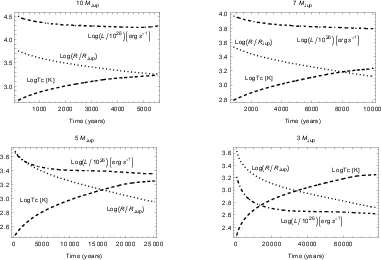
Figure 2: The pre-collapse contraction of DI clumps, with more massive objects evolving orders-of-magnitude faster due to their rapid temperature rise and enhanced radiative cooling.
Magnetic Fields and Angular Momentum Regulation
Global MHD simulations (particularly with spiral-driven dynamos) underscore the nontrivial role of magnetization in redistributing angular momentum. Magnetic tension supports fragmentation on smaller spatial scales and constrains accretion, thereby yielding intermediate-mass fragments. The specific angular momentum of magnetized clumps is found to be orders-of-magnitude lower than in purely hydrodynamic (HD) analogues, reconciling theoretical predictions with Solar System constraints.
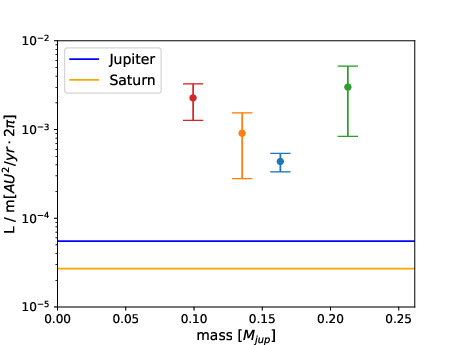
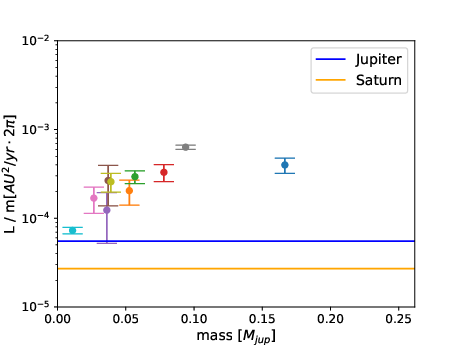
Figure 3: MHD clumps exhibit specific angular momenta comparable to Jupiter/Saturn, resolving the angular momentum excess issue endemic to pure hydrodynamic DI scenarios.
Migration and Survival
DI-formed clumps are subject to rapid Type I/II-like migration, compounded by stochastic kicks from turbulent spiral structure and direct N-body encounters with other clumps. Detailed torque analyses indicate that migration is predominantly driven by material within a few Hill radii, and while clump-clump scattering can induce large excursions, disk torques dominate over long timescales.
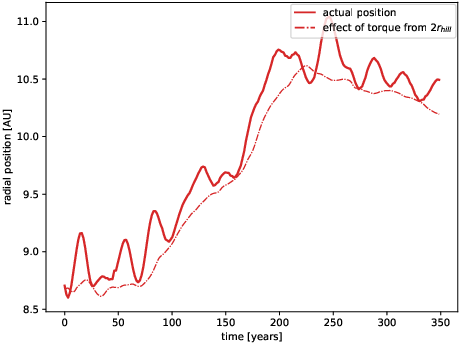
Figure 4: Tracking of an individual DI clump reveals stochastic radial migration patterns, primarily regulated by local disk torques rather than multi-body scattering.
Population Synthesis: DIPSY Advancements
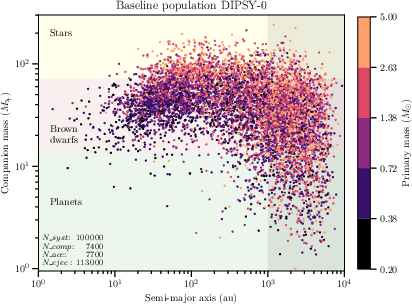
Population synthesis modeling has become essential in bridging high-fidelity, small-sample hydrodynamic studies with statistical exoplanet demographics. The DIPSY (Disc Instability Population SYnthesis) project incorporates the star/disk assembly phase, parameterized fragmentation physics, detailed migration and accretion recipes, and N-body integration of fragment orbits and collisions.
Key outcomes from DIPSY synthesis include:
Collisional Outcomes and Their Dynamical Impact
Collisions among pre-collapse DI clumps have been thoroughly explored via SPH simulations. The outcomes are demonstrably diverse:
- Perfect mergers are rare except at low impact velocity and small impact parameter.
- Most interactions lead to substantial erosion, mass loss, or complete disruption due to the shallow gravitational binding of extended clumps.
- Hit-and-run events preserve multiple clumps but redistribute mass and angular momentum.
- Kinetic heating in collisions may trigger premature dynamical collapse, thus protecting clumps from tidal destruction but accelerating their evolutionary clock.
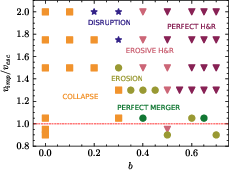
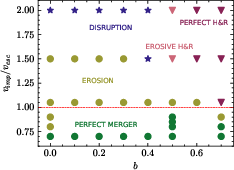
Figure 6: 3D hydrodynamic impact simulations reveal that clump-clump collisions are generally non-merger events, often leading to erosion, mass exchange, or early collapse initiation.
Observational Diagnostics and Constraints
Disks: Substructure as a Fingerprint of DI
High-resolution ALMA observations reveal that massive, cold disks routinely develop rings, gaps, and prominent spiral arms. While many are explicable via planet-disk interactions, the outer, broad features—especially those >50 AU—are difficult to reconcile with core accretion time-scales and are prime DI candidates. Dynamically measured disk masses and Toomre Q-profiles enable stringent a priori assessment of DI-favorable environments.
Direct Imaging: Wide-Orbit Giants and Brown Dwarfs
Direct imaging surveys have uncovered systems such as HR 8799, hosting multiple massive gas giants at tcool≲tdyn0 AU. Survey-level analyses find that brown dwarfs are more compatible with DI signatures, while the observed scarcity of planetary-mass objects at very wide separations is challenging for naive DI predictions. The integration of dynamical mass constraints, age-independent luminosities, and detailed atmospheric characterizations is critical for disentangling formation channels.
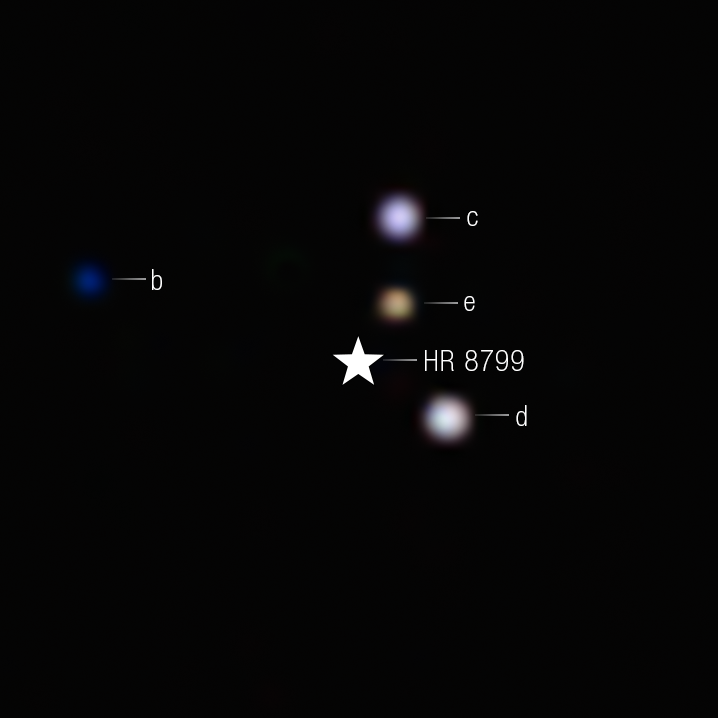
Figure 7: The HR 8799 system, directly imaged with JWST/NIRCam, typifies a wide-orbit giant planet system with masses and architecture suggestive of non-core accretion processes.
Conclusion
Research in the DI framework has advanced through high-resolution MHD simulations, improved understanding of clump dynamics, and detailed population synthesis that unifies multi-physics modeling with demographic prediction. Nevertheless, the frequency, final mass spectra, and compositions of DI-formed companions remain uncertain due to the complex interplay of accretion, migration, collisions, and disk parameters.
Observationally, the ubiquity of substructure in disks and the discovery of wide-orbit giant planets and brown dwarfs provide strong, but not yet exclusive, support for DI as a viable planet formation channel. Theoretical advances in modeling irradiation, magnetic regulation, and collision outcomes, combined with upcoming ELT/JWST-class characterization of protoplanets and disks, will be decisive in refining or falsifying the DI scenario. Going forward, a hybrid formation paradigm appears necessary, with DI complementing core accretion in massive, cold, or rapidly evolving disks.
Reference:
Ravit Helled et al., "Giant Planet Formation by Disk Instability", (2604.09042)