- The paper introduces HyMUSE, a novel framework that uses hypergraph neural networks to efficiently perform MUS and MSS enumeration.
- It employs a reinforcement learning agent with AllSetTransformer layers to drive effective shrink/grow operations over hypergraph representations.
- Empirical results demonstrate up to 2.46x improvement in enumeration rates across various CSP domains, validating its domain-agnostic versatility.
Hypergraph Neural Networks for Efficient MUS Enumeration: An Expert Review of HyMUSE
Introduction
The paper "Hypergraph Neural Networks Accelerate MUS Enumeration" (2604.09001) introduces HyMUSE, a novel domain-agnostic framework leveraging Hypergraph Neural Networks (HGNNs) to accelerate Minimal Unsatisfiable Subset (MUS) and Maximal Satisfiable Subset (MSS) enumeration in constraint satisfaction problems (CSPs). Existing machine-learning approaches for MUS enumeration predominantly rely on variable-constraint graph structures, restricting applicability to Boolean domains. HyMUSE circumvents this limitation by operating exclusively on hypergraphs formed by constraints and incrementally discovered MUSes/MCSes, enabling applicability to arbitrary CSPs, including those with real-valued or higher-order constraints.
The problem addressed is central to automated reasoning, explainable AI, and formal verification, where MUS and MSS provide concise, irreducible explanations of infeasibility and optimality. However, the search space for enumeration grows exponentially with problem size, often requiring a prohibitive number of expensive satisfiability checks. HyMUSE aims to reduce this bottleneck by learning efficient heuristics for shrink/grow operations using reinforcement learning.
Methodology
HyMUSE models the evolving search state as a hypergraph: constraints are vertices; listed MUSes and MCSes form two types of hyperedges. At any step t, the hypergraph H(t)=(V,EMUS(t),EMCS(t)) encodes known MUS/MCS structure without explicit reference to variable relationships, making the approach fully domain-agnostic.
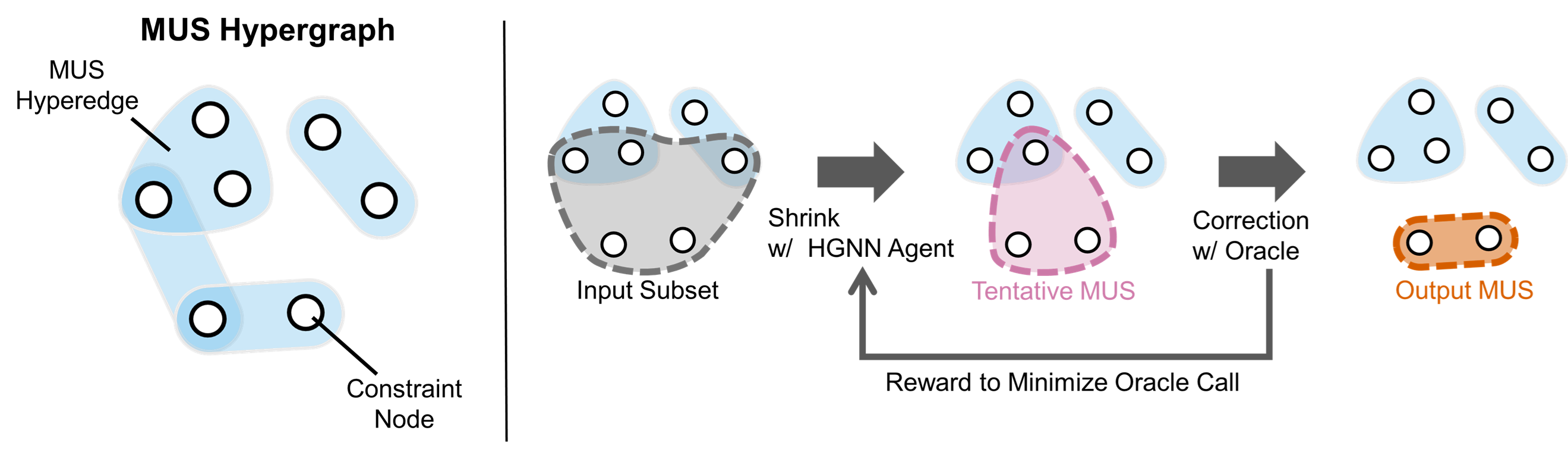
Figure 1: Overview of HyMUSE, illustrating the domain-agnostic HGNN-driven framework for MUS/MSS enumeration.
HGNN-Based RL Agent
The HGNN-based agent accepts as input the current hypergraph H(t) and the subset S of constraints targeted for shrink/grow actions. Vertex features are initialized with spectral embeddings derived from the normalized hypergraph Laplacian and subsequently updated by several AllSetTransformer layers, treating MUS and MCS hyperedges separately prior to linear projection aggregation.
Policy and value estimation leverage two distinct transformer decoders operating over candidate constraints (the subset S for shrink, or the complement for grow). The action space contains element-wise delete/add decisions or a finish signal, enabling sequential refinement of the candidate MUS/MSS.
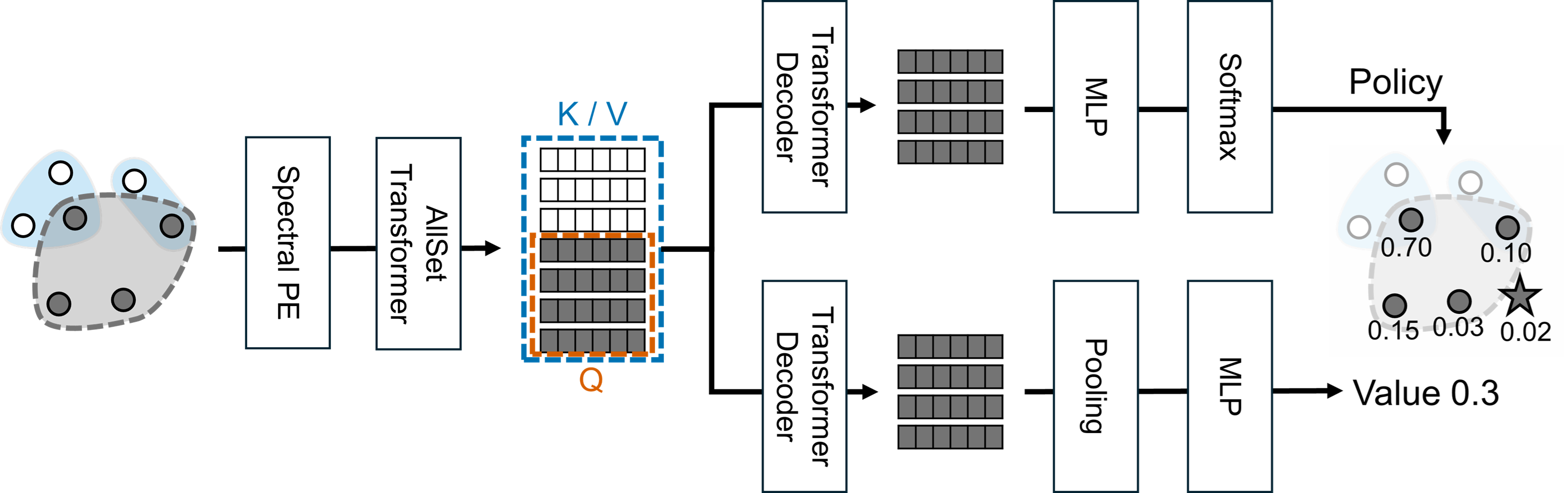
Figure 2: HGNN architecture—spectral initialization, AllSetTransformer layers, and cross-attentive transformer decoders for policy/value prediction.
Correction Mechanism and RL Training
Since the agent's selections are heuristic, a lightweight correction procedure ensures outputs are minimal or maximal (as appropriate), leveraging an oracle solver. The RL objective is explicitly designed to minimize the number of expensive satisfiability checks during this correction phase, incentivizing precise policy development. The agent is optimized by Proximal Policy Optimization (PPO) using synthetic CNF data as training distribution.
Empirical Evaluation
Setup
The agent is trained on random CNF instances (variables: 5–20), and evaluated on four datasets: original CNF distribution (SATsmall), a larger CNF variant (SATlarge), Graph Coloring instances (GC), and Satisfiability Modulo Theory problems (SMT) containing constraints not reducible to CNF. Integration with MARCO, TOME, and ReMUS enumeration algorithms is examined, with efficiency measured by the count of MUSes/MSSes found within a fixed satisfiability check budget.
Numerical Results
Performance benchmarks (see Table 1 and corresponding figures) show that with MARCO, adding the HyMUSE agent yields a mean 1.74× to 2.46× increase in enumerated MUSes/MSSes within the same check budget, particularly pronounced in SATlarge.
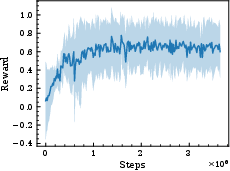
Figure 4: Training reward progression indicating successful RL convergence for the HGNN agent.
MARCO with HyMUSE unambiguously dominates standard MARCO in all practicable settings and generalizes effectively to new CSP distributions. In SMT domains—where variable-constraint graphs are not available—HyMUSE achieves a H(t)=(V,EMUS(t),EMCS(t))0 gain, showing domain-agnostic versatility. Additionally, the agent demonstrates transfer to heterogeneous distributions and robustness to distributional shift (see performance in GC and SMT).
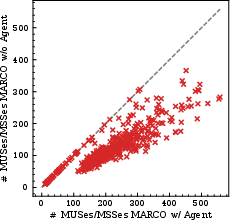
Figure 6: Comparison of MUS/MSS enumeration with and without HyMUSE on H(t)=(V,EMUS(t),EMCS(t))1; improvements cluster below the H(t)=(V,EMUS(t),EMCS(t))2 baseline.
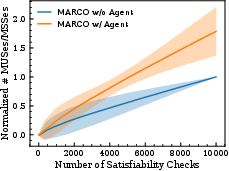
Figure 3: MUSes/MSSes count as a function of satisfiability checks, demonstrating consistent efficiency gains due to the HyMUSE agent.
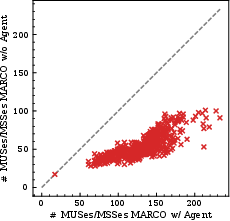
Figure 5: Superior performance of MARCO+HyMUSE on H(t)=(V,EMUS(t),EMCS(t))3 compared to baseline MARCO.
Performance improvement with TOME and ReMUS is less pronounced, likely due to the highly optimized subset selection heuristics already present in those algorithms. The authors emphasize that training the agent in tandem with an enumeration algorithm maximizes synergy.
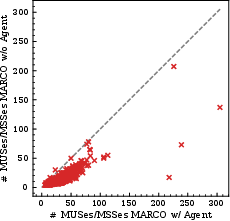
Figure 7: Gains in enumeration for Graph Coloring CNF instances when augmenting MARCO with HyMUSE.
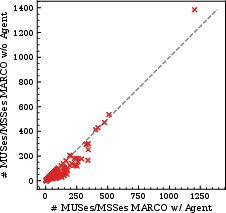
Figure 8: Enumeration efficiency for MARCO+HyMUSE on SMT benchmarks, highlighting the method's CSP-agnostic applicability.
Theoretical and Practical Implications
Theoretical Significance
HyMUSE establishes a new architectural paradigm for ML-driven CSP heuristics, using hypergraph representations that generalize beyond the limitations of literal-variable graphs. The method is not merely task-specific; it illustrates that RL-based agents can discover heuristics effective even when explicit problem structure is obscured or unavailable, provided relational data is encoded at the hypergraph level.
Practical Relevance
In industrial and scientific CSP domains—such as design verification, software configuration, and explainable AI—where explicit variable-constraint graphs are missing or constraints are non-Boolean, HyMUSE provides a practical, trainable route to accelerate enumeration. The improvement in enumeration rate directly translates to faster debugging, analysis, or certification workflows, especially when underlying satisfiability checks are expensive.
Furthermore, HyMUSE's policy generalizes across problems and distributions unseen during training, reducing model-specific retraining floors. Given that the correction routine guarantees output minimality/maximality, practitioners can deploy this framework without sacrificing enumeration correctness.
Limitations and Forward-Looking Directions
Although HyMUSE demonstrates strong transfer and scalability, improvements over more specialized enumeration frameworks (TOME, ReMUS) are marginal unless the agent is co-trained with them. Extending the method's generalization further may require multi-distribution, multi-algorithm RL curricula, or meta-learning approaches.
Research avenues include:
- Training on diverse real-world CSP and SMT instances for universal policies.
- Using more complex, possibly recursive, subset representations as hyperedges (e.g., augmenting with MSS/MUS complements).
- Investigating agent interpretability via XAI to extract transferable symbolic heuristics.
- Co-training agents across enumeration algorithms to merge domain-agnostic and algorithm-specific reasoning.
Conclusion
HyMUSE introduces an efficient, domain-agnostic approach to MUS and MSS enumeration by combining hypergraph neural network architectures and reinforcement learning. The method substantially reduces satisfiability solver calls, generalizes across diverse CSP forms, and is applicable even in settings where standard variable-constraint graphs are unavailable. The empirical evidence supports both the practical utility and the conceptual expansion—the marriage of RL and hypergraph learning—for accelerating core logic reasoning tasks in AI and formal methods.