- The paper demonstrates direct experimental evidence that orbital torque and orbital pumping are reciprocal processes, confirmed by symmetric S-parameter measurements.
- It employs ST-FMR and S-matrix techniques on Ru/Ni, Ru/Pt/CoFeB, and Co/Cu/SiO2 devices to extract resonant parameters and validate charge–orbital–spin interconversion.
- The work establishes orbital angular momentum as an efficient transport channel, broadening spintronics and paving the way for scalable spin-orbitronic devices.
Introduction
This work addresses charge-orbital-spin interconversion in normal-metal/ferromagnet (NM/FM) heterostructures, focusing on the emergent role of orbital angular momentum as a fundamental degree of freedom, complementary to spin, in solid-state transport. The study provides a direct experimental demonstration that orbital torque and orbital pumping—facilitated through mechanisms such as the orbital Hall effect (OHE), orbital Rashba-Edelstein effect (OREE), and their inverses—are reciprocal processes, establishing Onsager reciprocity relations in charge-orbital-spin dynamics across Ru/Ni, Ru/Pt/CoFeB, and Co/Cu/SiO2 devices.
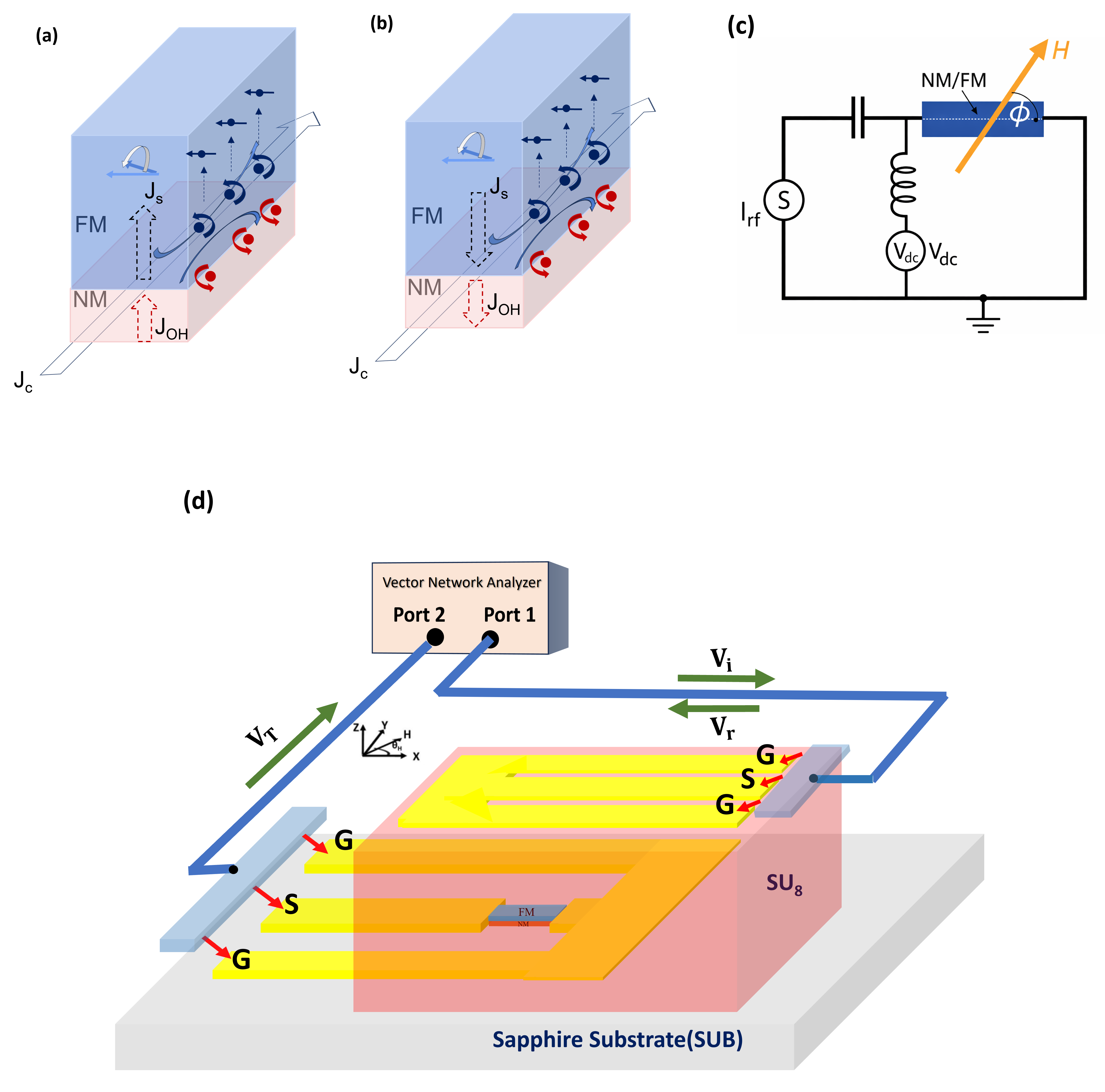
Figure 1: Schematic representation of charge, orbital and spin interconversion mechanisms and experimental device topology.
Theoretical Background and Motivation
Conventional spintronics relies on spin-orbit coupling (SOC) to enable interconversion between charge and spin currents, with key phenomena including the spin Hall effect (SHE) and the Rashba-Edelstein effect (REE). While SOC is typically associated with heavy metals, recent theoretical advances have identified that orbital currents can be generated and harnessed even in materials with weak SOC [17_jo2018gigantic, 22_go2020orbital]. These orbital currents, through SOC, can be converted into spin currents inside ferromagnetic layers, resulting in orbital torques.
Orbital pumping, in which the magnetization precession in a ferromagnet emits a pure orbital current, is predicted as the reciprocal phenomenon to orbital torque [46_go2025orbital, 34_hayashi2024observation]. Despite recent observations of orbital-pumping-induced signals, systematic experimental studies validating their mutual reciprocity—especially with respect to Onsager symmetry—have been limited.
Experimental Approach
The study employs two-port S-matrix measurements on lithographically defined multilayer stacks:
- Ru(4)/Ni(8): Orbital current generated in Ru is injected into Ni and converted to spin current.
- Ru(4)/Pt(1)/CoFeB(3): Pt serves as the converter for orbital to spin current, which subsequently acts on CoFeB.
- Co(6)/Cu(5)/SiO2(15): Orbital currents are generated via OREE at the Cu/SiO2 interface and injected into Co.
The samples are integrated into devices with coplanar waveguides and characterized via spin-torque ferromagnetic resonance (ST-FMR) and frequency-domain S-parameter (scattering matrix) measurements. The two measurement ports probe charge-to-orbital-to-spin and the reciprocal processes via electrical excitation and detection.
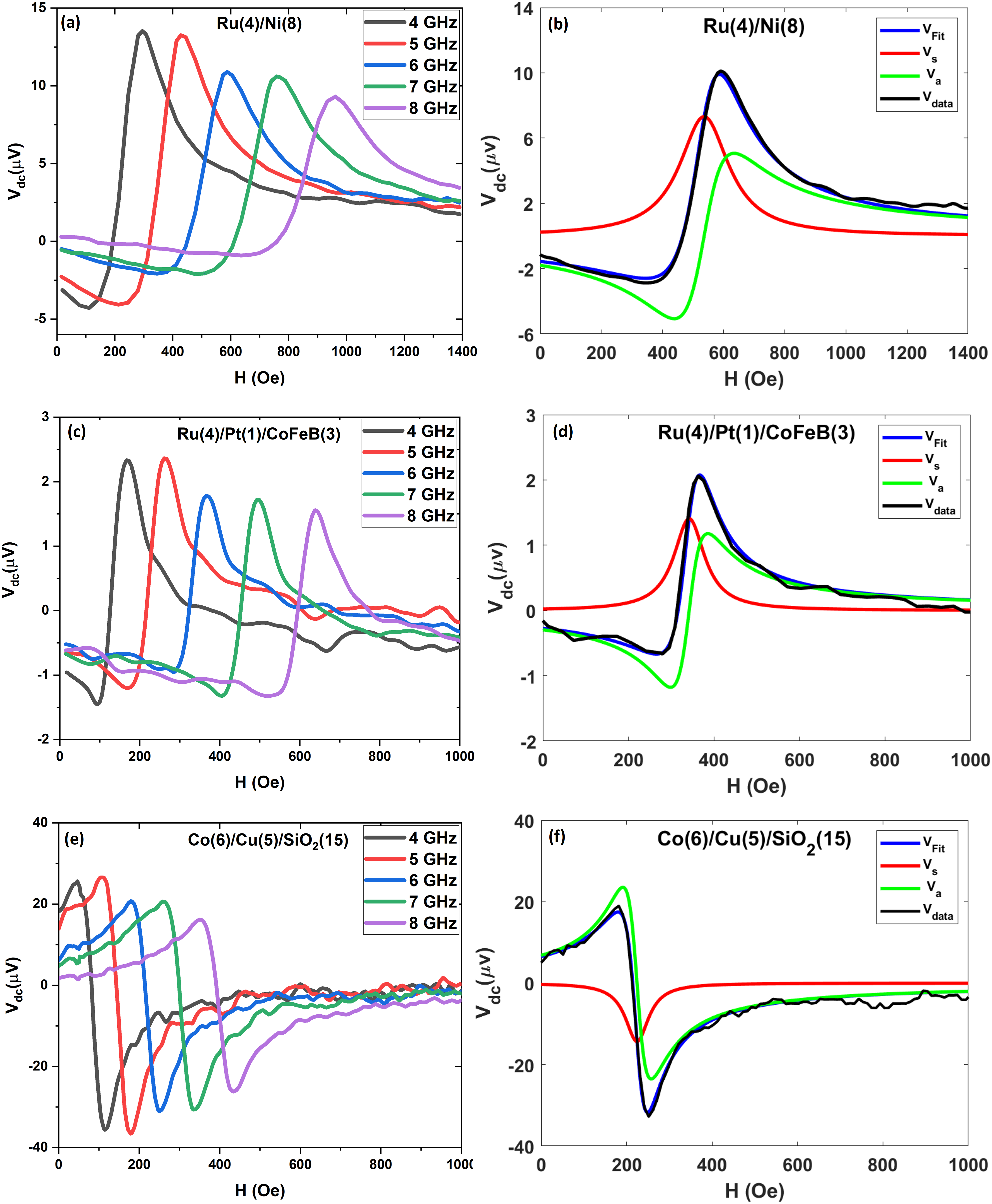
Figure 2: ST-FMR voltage signals and Lorentzian fits for Ru/Ni, Ru/Pt/CoFeB, and Co/Cu/SiO2 as a function of in-plane magnetic field and frequency.
Key Results
ST-FMR Verification of Orbital Torque
The ST-FMR measurements confirm efficient excitation of ferromagnetic resonance through orbital torque and Oersted fields in all tested heterostructures. The resonance fields and linewidths extracted from Lorentzian fits at 6 GHz are as follows:
- Ru/Ni: Δ=200.7 Oe, Hr=572.6 Oe
- Ru/Pt/CoFeB: Δ=87.15 Oe, Hr=338 Oe
- Co/Cu/SiO2: Δ=66.44 Oe, 20 Oe
These strong resonant signals validate the FM layers' current-induced dynamic response, driven by orbital-mediated torques.
Onsager Reciprocity of Charge-Orbital-Spin Transport
The transmission coefficients (21 for port 2 to 1, 22 for port 1 to 2) are measured and found to be symmetric with respect to the applied magnetic field direction for all devices, satisfying the generalized Onsager relation 23.
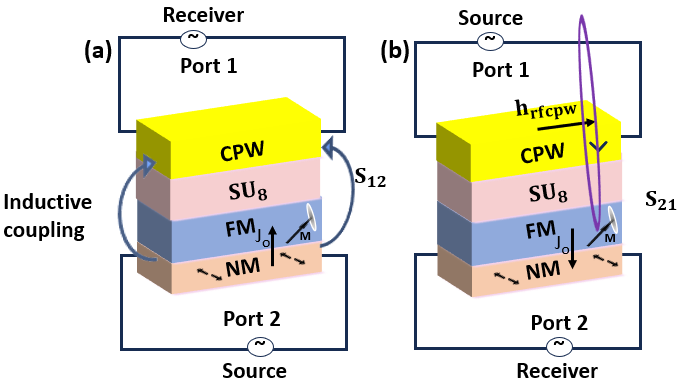
Figure 3: Device schematic illustrating the reciprocal processes—(a) OHE plus orbital torque, (b) orbital pumping plus inverse OHE.
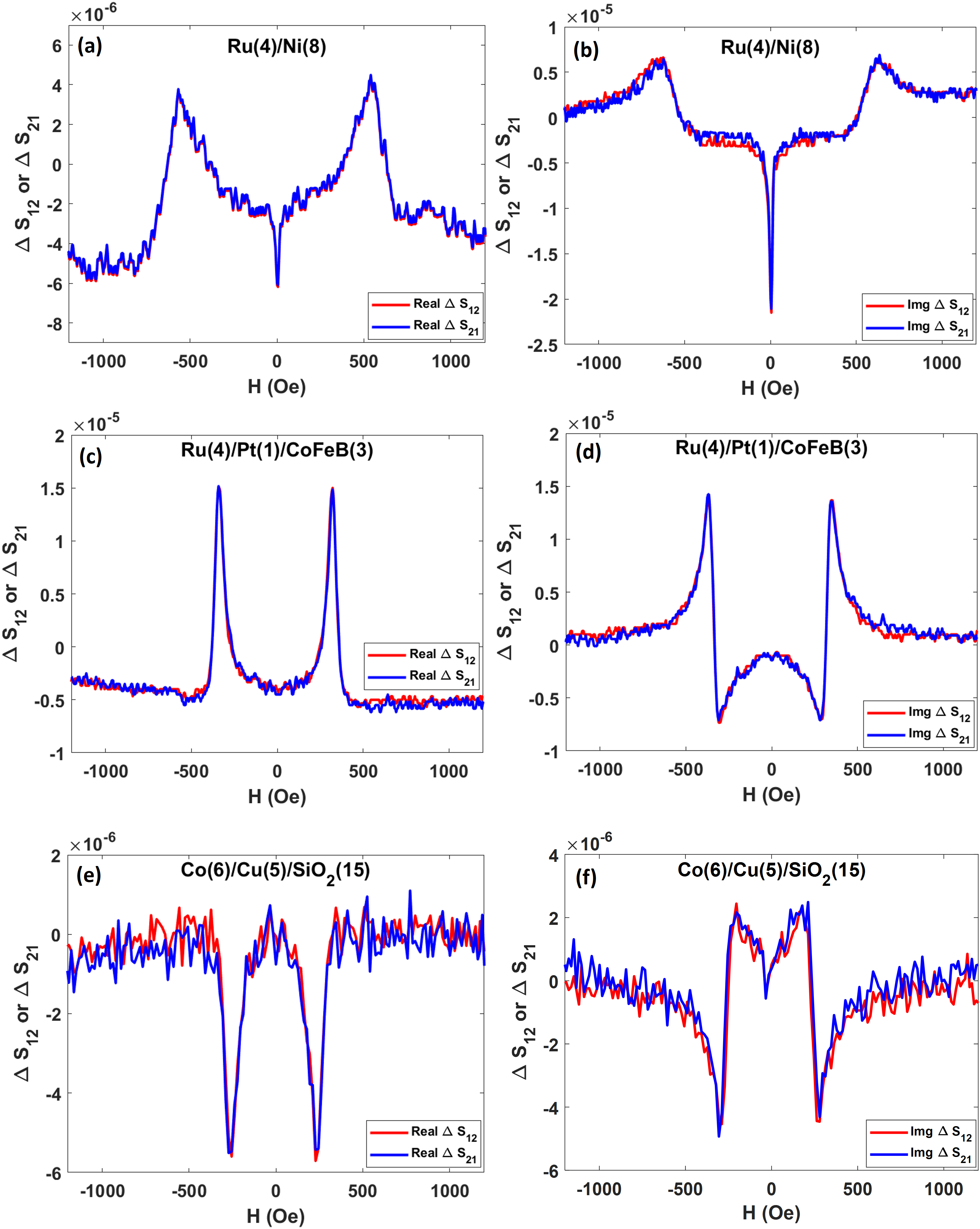
Figure 4: Real and imaginary parts of the differential transmission coefficients 24 and 25, showing reciprocity and symmetry with respect to magnetic field in all device classes.
These results provide direct evidence that orbital torque (OHE or OREE-driven) and orbital pumping (iOHE or iOREE-driven) are reciprocal processes, even in the presence of different orbital current generation mechanisms and interface types.
Reflection Coefficient Analysis
The reflection coefficients 26 and 27 exhibit expected dissipative and dispersive characteristics, with real parts peaking at resonance and imaginary parts displaying typical dispersive line shapes, further corroborating that orbital currents contribute to dissipative dynamics under strong magnetization oscillations.
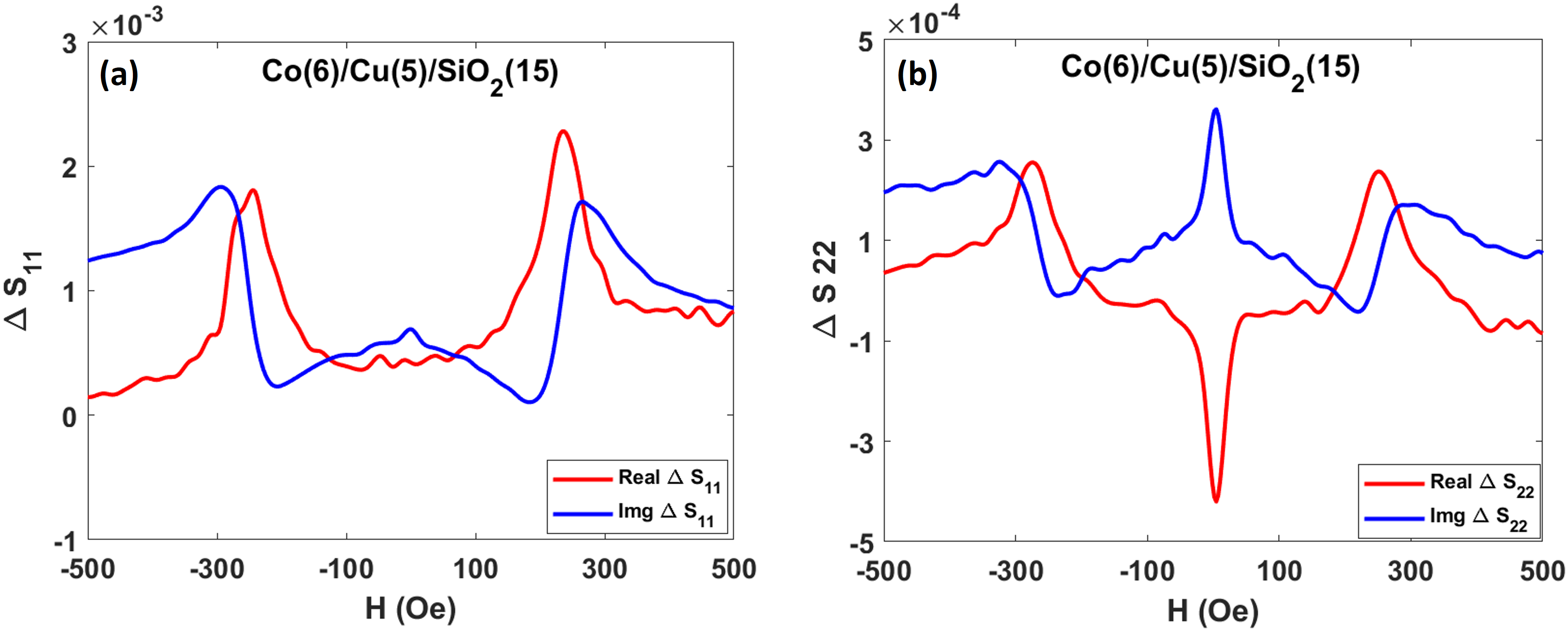
Figure 5: Real and imaginary parts of the reflection coefficients 28 and 29, highlighting resonance and dissipation in the system.
Discussion and Implications
The experimental demonstration of Onsager reciprocity in both charge-to-orbital and orbital-to-charge conversion consolidates the theoretical expectation that orbital angular momentum constitutes an independent, reciprocal transport channel beyond spin. The robust symmetry in transmission signals across structurally and mechanistically diverse devices shows these reciprocity relations are not contingent on a specific material realization of OHE or OREE.
This finding has key implications for spin-orbitronics:
- Unified Framework: The results establish a platform-agnostic framework for the manipulation and detection of orbital angular momentum currents, enabling new device architectures where orbital torque and pumping are interchangeable by Onsager symmetry.
- Device Applications: The extension of reciprocal relations to orbital-based effects increases the scope for utilizing light metals and interfaces previously considered ineffective due to weak SOC, with practical relevance for MRAM, magnetic sensors, and magnonic logic.
- Contrast with Magnon-Mediated Transport: The paper notes that prior studies in magnon-mediated systems have shown deviations from reciprocity [35_ledesma2025nonreciprocity, 40_mendoza2024efficient, 47_kashiki2026violation], indicating the centrality of orbital current–spin conversion at proper interfaces for Onsager symmetry to hold.
- Scalability and Linear Response: All measurements confirm linear behavior up to 10 dBm input power, indicating the effects are robust under practical operating conditions.
Conclusion
This work provides a rigorous experimental validation that charge-orbital-spin transport in NM/FM heterostructures, mediated via both OHE and OREE mechanisms, adheres to Onsager reciprocity. It demonstrates, using both ST-FMR and S-parameter analysis, that orbital torque and orbital pumping are exact reciprocal processes, establishing orbital angular momentum as a robust carrier for efficient angular-momentum interconversion. These findings motivate the design of new spin-orbitronic and orbitronic devices leveraging reciprocal orbital processes and suggest further inquiry into device applications where orbital and spin angular momenta are independently accessible and interconvertible.
Reference: "Reciprocity of Charge-Orbital-Spin Transport in Normal-Metal/Ferromagnet Heterostructures" (2604.08989)

