- The paper introduces the H-MRS algorithm, which uses a novel moment-ratio criterion to ensure exact parent recovery in positive-valued DAGs.
- It combines log-scale ridge regression to capture multiplicative relationships with ElasticNet for sparse and robust parent selection.
- Empirical results show high F1-scores and precise DAG recovery on synthetic and real financial data, validating its practical efficiency.
Hybrid Moment-Ratio Scoring for Positive-Valued DAG Structure Learning
Introduction and Motivation
Learning directed acyclic graphs (DAGs) from observational data is fundamental for distinguishing causal relationships, with applications spanning genomics, economics, and epidemiology. Standard causal discovery methods—often based on additive-noise models—are theoretically and practically inadequate when variables are strictly positive and connected by multiplicative relationships, a scenario prevalent in domains like gene expression or asset prices. The work introduces the Hybrid Moment-Ratio Scoring (H-MRS) algorithm, targeting these positive-valued settings by leveraging a log-linear SEM and a novel moment-ratio scoring procedure, ensuring both computational efficiency and theoretical identifiability.
Methodological Framework
The foundational model posits that the logarithm of each variable is a linear combination of its parents’ (raw-scale) values and an independent noise term, i.e.,
logXj=θj+k∈Pa(j)∑βkjXk+ϵj
where all Xj>0. This semi-log model diverges from the classical log-log (Cobb-Douglas) settings, yielding well-behaved moments and supporting identifiability in positive domains.
Log-Scale Ridge Regression for Conditional Estimation
To operationalize the approach, H-MRS initially estimates conditional expectations via Ridge regression on the log-transformed data. This step captures the underlying multiplicative structure, producing robust and stable predictors for subsequent scoring.
Raw-Scale Moment-Ratio Scoring
Central to the algorithm is the moment-ratio criterion:
M(j,S)=E[(E[Xj∣S])2]E[Xj2]
This score is minimized if and only if S contains all true parents of Xj, under mild conditions established in the moment-ratio plateau property. Critically, the criterion is invariant to multiplicative rescalings and not sensitive to marginal variances, avoiding pitfalls that affect “varsortability”-based heuristics.
ElasticNet-Based Parent Selection
After greedy ordering via moment ratios, parent sets are refined using ElasticNet regression, which efficiently resolves sparse support in the high-correlation regime common to financial or genomic datasets. The separation of regression strategies—Ridge for unbiased scoring and ElasticNet for sparsity—addresses conflicting statistical demands between accurate ordering and minimal edge recovery.
Theoretical Analysis
H-MRS offers several formal guarantees:
- Identifiability: The moment-ratio criterion admits a plateau only when all parents are included in the conditioning set, supporting exact ordering under optimal population conditions. Any omission induces a strict increase in the ratio.
- Finite Sample Control: The empirical estimator of the moment ratio concentrates at the parametric rate Op(n−1/2) relative to its theoretical counterpart, enabling reliable recovery in moderately large samples.
- Computational Scalability: The complexity is O(p2) Ridge regressions and O(p) ElasticNet fits, with each regression cost scaling as O(nq2) or better, making H-MRS tractable for graphs with p≤100 given contemporary hardware.
Empirical Evaluation
Synthetic Data
Simulated log-linear DAGs of varying size (Xj>00–30) and complexity (max degree Xj>01) established the superiority of H-MRS compared to baseline DAG learners (PC, GES, DirectLiNGAM) applied in their standard configurations. H-MRS consistently yielded high F1-scores (0.733–0.900) and perfect or near-perfect precision for smaller graphs, demonstrating robust support recovery even as graph complexity scaled.
Real-World Financial Application
H-MRS was deployed on financial statement data from 2,223 companies, featuring 19 positive-valued financial variables (encompassing assets, liabilities, equity, income, expenses, and valuation metrics). The learned DAG reveals:
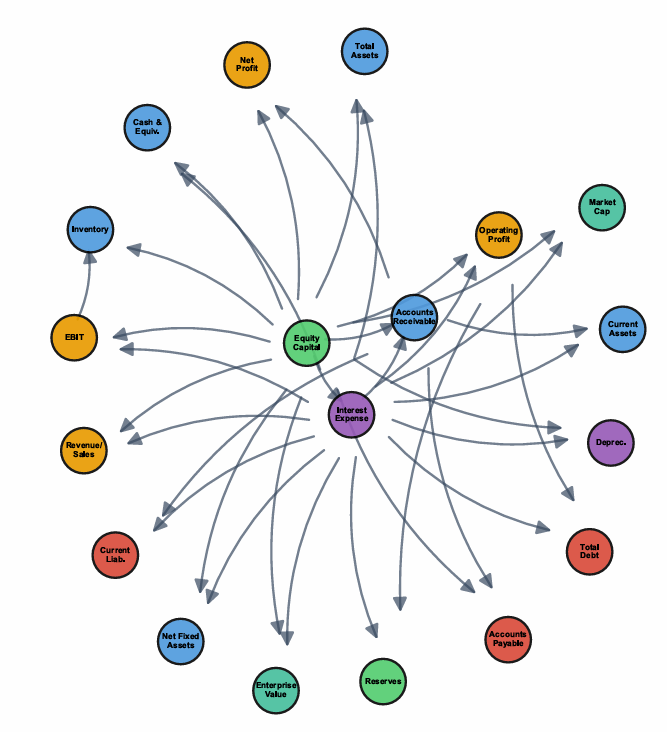
Figure 1: The estimated causal DAG from H-MRS applied to financial data, highlighting Equity Capital and Interest Expense as central upstream nodes influencing a broad array of financial outcomes.
- Equity Capital emerges as a fundamental upstream driver with 13 outgoing edges impacting operating, capital, and valuation variables.
- Interest Expense acts as a pervasive constraint, transmitting the cost of financing across asset, liability, and valuation structures, evidenced by its 15 outgoing edges.
- Profitability-Leverage Tension: The DAG captures the classical tension of firm growth and debt capacity via directed edges from operating profit to total debt, supporting established theoretical arguments such as those of Merton (1974) and Myers (1984).
- Terminal Structure: Market Capitalization and Enterprise Value sit at terminal nodes, determined by core financial drivers Equity and Interest Expense.
This recovered structure aligns with economic theory, supporting both the exogeneity of equity as the foundation for operations and the global propagation of financing costs through the system.
Implications and Future Work
Practically, H-MRS equips researchers and practitioners with a scalable, interpretable, and theoretically sound approach to causal modeling in settings where positivity and multiplicativity are inherent. Its invariance properties and tailored score function directly address the misspecification risks of classical methods in such domains.
Theoretically, H-MRS establishes a bridge between log-scale parametric estimation and raw-scale score-based identifiability, suggesting broader potential for moment-ratio-based scoring in non-Gaussian or positive-valued settings.
Several future avenues naturally arise:
- Temporal Extensions: While the current formulation is cross-sectional, adapting the moment-ratio criterion to time series or panel data could yield major dividends for econometrics and genomics.
- Zero-Inflated Modeling: The current theory and implementation assume strict positivity. Incorporating zero-inflated or hurdle components would expand the framework to genomic count data and other sparse domains.
- Cyclic or Feedback Structures: Extending beyond acyclic graphs to equilibrium systems or models with cycles remains an open challenge worth exploring.
Conclusion
The Hybrid Moment-Ratio Scoring algorithm presents a principled framework for DAG learning from positive-valued data, coupling log-scale regression, moment-ratio identifiability, and sparse estimation methods. Numerical evidence supports its competitive performance and interpretability, both on synthetic benchmarks and real economic systems. H-MRS sets the stage for further methodological advances in causal discovery tailored to the ubiquitous but previously underserved domain of positive-valued, multiplicative systems.
Figure 1: The DAG learned by H-MRS on financial data, showing the dominant influence of Equity Capital and Interest Expense in shaping firm-level financial structure.

