- The paper introduces stringology-based cryptanalysis using modified KMP and Boyer-Moore algorithms to detect word-aligned and rotation-induced patterns in EChaCha20.
- It demonstrates that full-state diffusion is achieved within three rounds, with negligible statistical anomalies at 16- and 32-bit granularities.
- The methodology attains high precision (0.97) and throughput (3.6GB/s), offering a scalable approach to assess ARX cipher resilience.
Stringology-Based Cryptanalysis of EChaCha20: A Technical Analysis
Introduction and Motivation
"Stringology-Based Cryptanalysis for EChaCha20 Stream Cipher" (2604.08862) investigates the structural properties of the Extended ChaCha20 (EChaCha20) ARX stream cipher using algorithmic stringology—specialized pattern matching techniques conventionally used outside cryptology. The paper identifies that standard randomness test suites (NIST SP 800-22, TestU01, PractRand) are inadequate for uncovering localized, word-aligned, or rotation-induced artifacts in complex ARX permutations such as EChaCha20. The motivation is to deploy Knuth-Morris-Pratt (KMP) and Boyer-Moore (BM) algorithms at the 32-bit word level, adapting them for ARX analysis, to efficiently enumerate and quantify non-random m-gram patterns, rotational biases, and differential trail susceptibility in EChaCha20’s keystreams.
EChaCha20 Structural Innovations
EChaCha20 extends ChaCha20 by expanding the state from a 4×4 matrix (512 bits) to 6×6 (1152 bits) and enhancing the QR-F by adding 4-bit and 2-bit rotation constants.
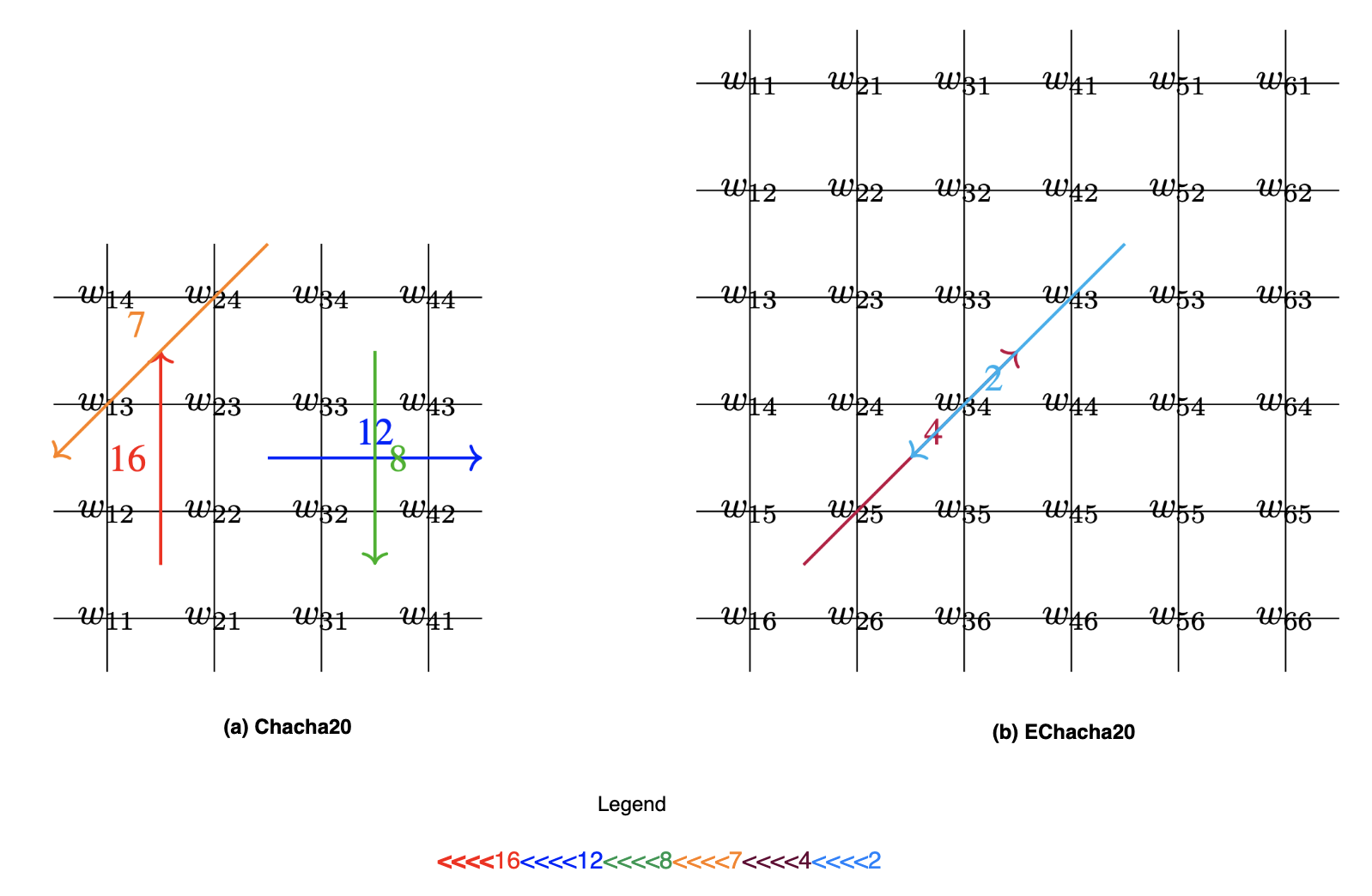
Figure 1: Architectural evolution from ChaCha20’s 4×4 state (left) with four rotation constants to EChaCha20’s 6×6 state (right) with two additional rotations, strengthening diffusion and disrupting rotational symmetries.
This change increases the theoretical diffusion density by 2.25× and is intended to thwart distinguishers that exploit regular power-of-two rotations. The enhanced QR-F is expected to deliver stronger resistance against rotational differentials and enable near-complete state diffusion within three rounds.
Threat Modeling and Cryptanalytic Scope
The analysis is framed in the Bellare-Rogaway paradigm, but the focus is on distinguisher-based structural cryptanalysis, not direct key-recovery attacks. Both Known Plaintext Environment (KPE) and Chosen Plaintext Environment (CPE) attacker models are addressed, with adversaries aiming to identify statistically significant non-random substrings or rotational artifacts in the keystream.
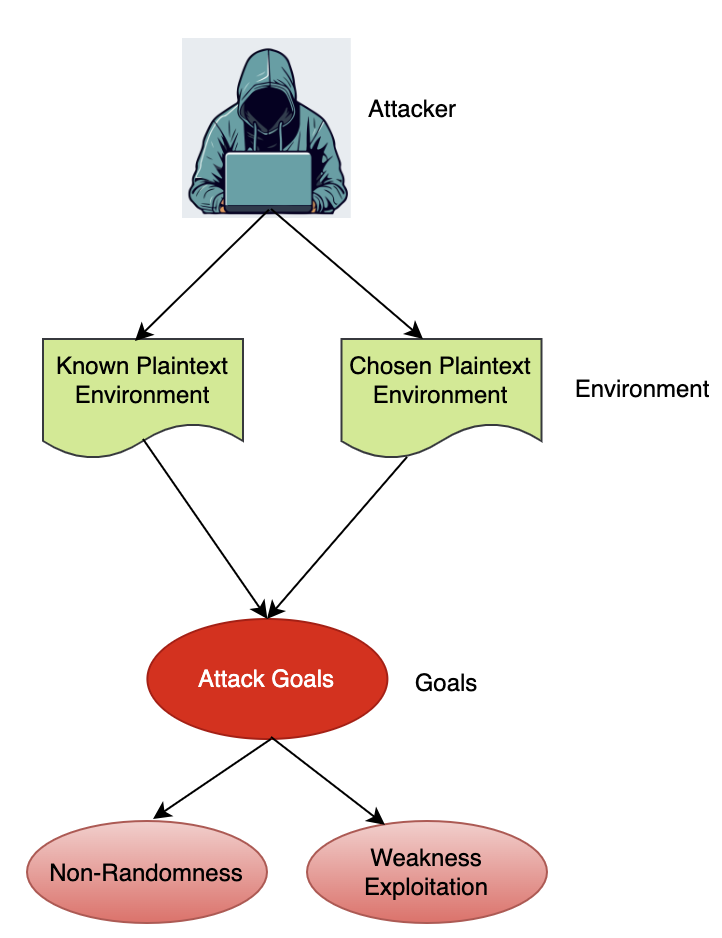
Figure 2: Threat model bifurcation: KPE and CPE, with respective attack vectors tailored to known and chosen plaintext scenarios.
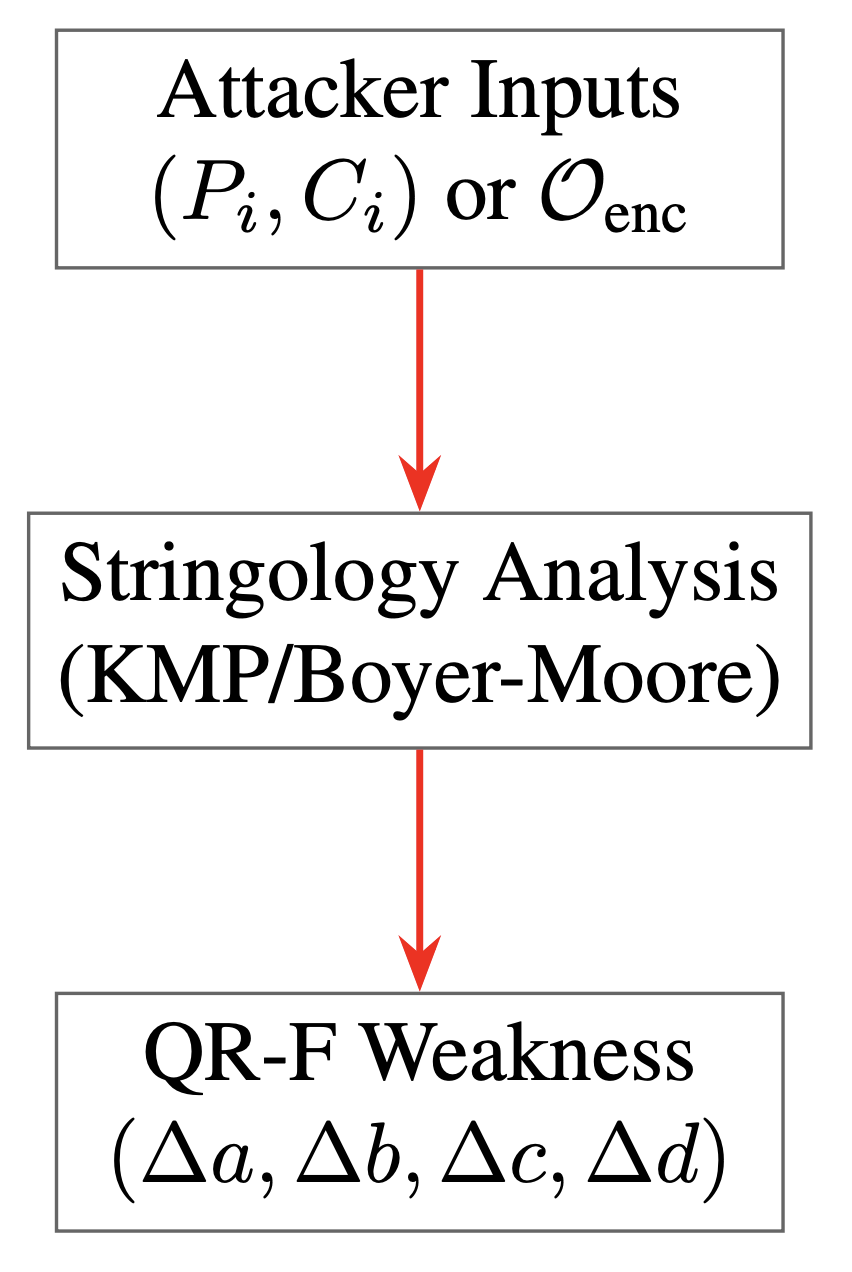
Figure 3: Attacker workflow in the proposed model: Inputs are mapped through structural pattern detection phases, converging on QR-F weakness analysis via stringological search.
The key goal is not to demonstrate a break, but to empirically reveal or rule out statistical or differential irregularities that reduce EChaCha20’s margin against future cryptanalytic advances.
Methodological Framework
The methodology is formalized in three phases: input post-processing (state matrix flattening, encoding), hybrid pattern search, and differential analysis.
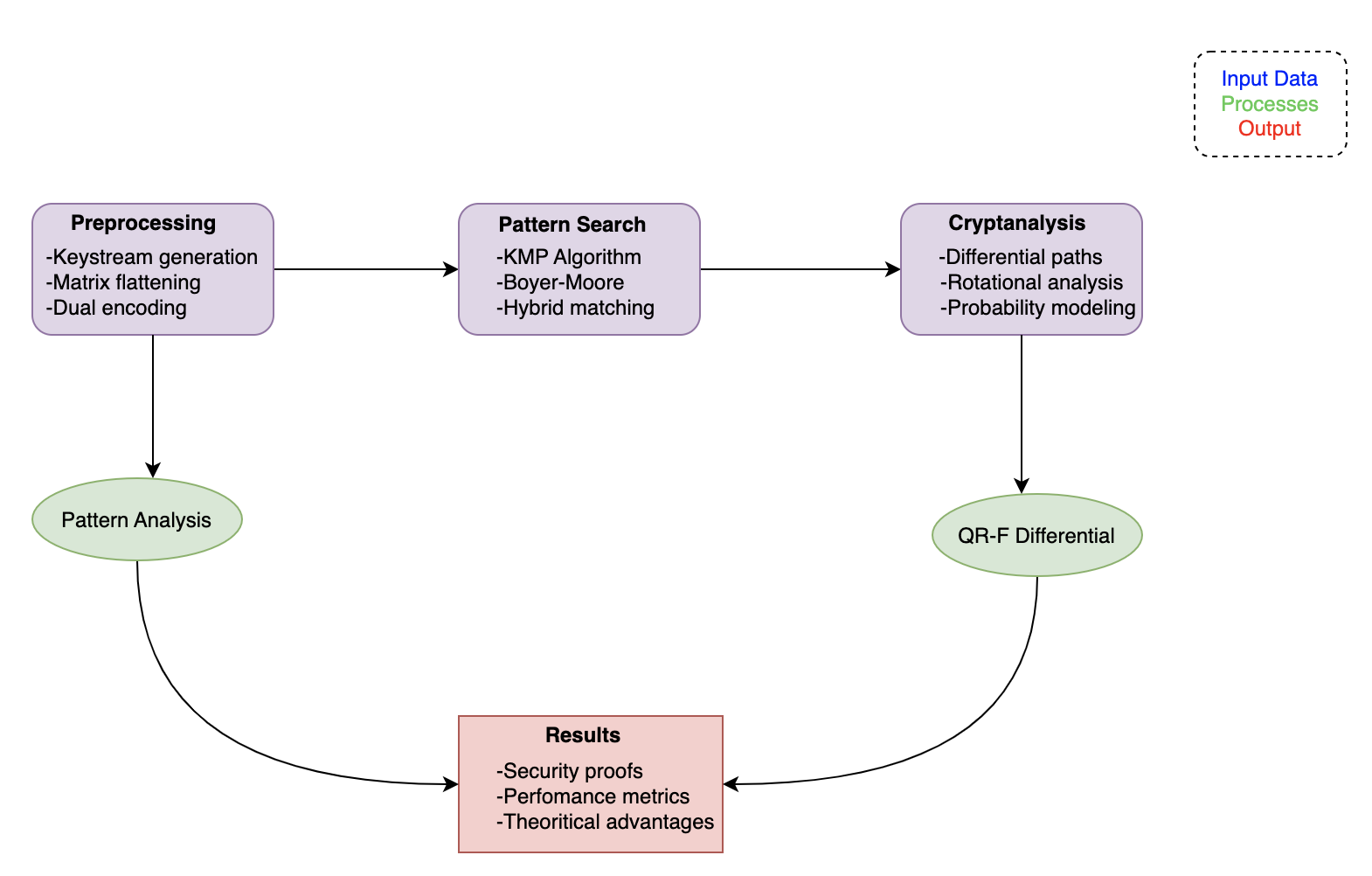
Figure 4: Methodological flowchart. Blue: data ingestion and encoding; green: core stringological and cryptanalytic analyses; red: result aggregation and validation.
Pattern analysis operates at bit, byte, and word levels, but is optimized for 32-bit slices to match ARX dataflow. The hybrid KMP-BM algorithm uses jump-ahead heuristics, sliding windows, and χ2-filtered statistical significance to efficiently scan >106 keystream blocks for anomalous m-gram frequencies.
Experimental Results: Pseudorandomness and Pattern Distribution
Experiment 1 examines 1 million keystream blocks, applying the adapted KMP and BM algorithms to find the most frequent patterns of size m∈{8,16,32}.
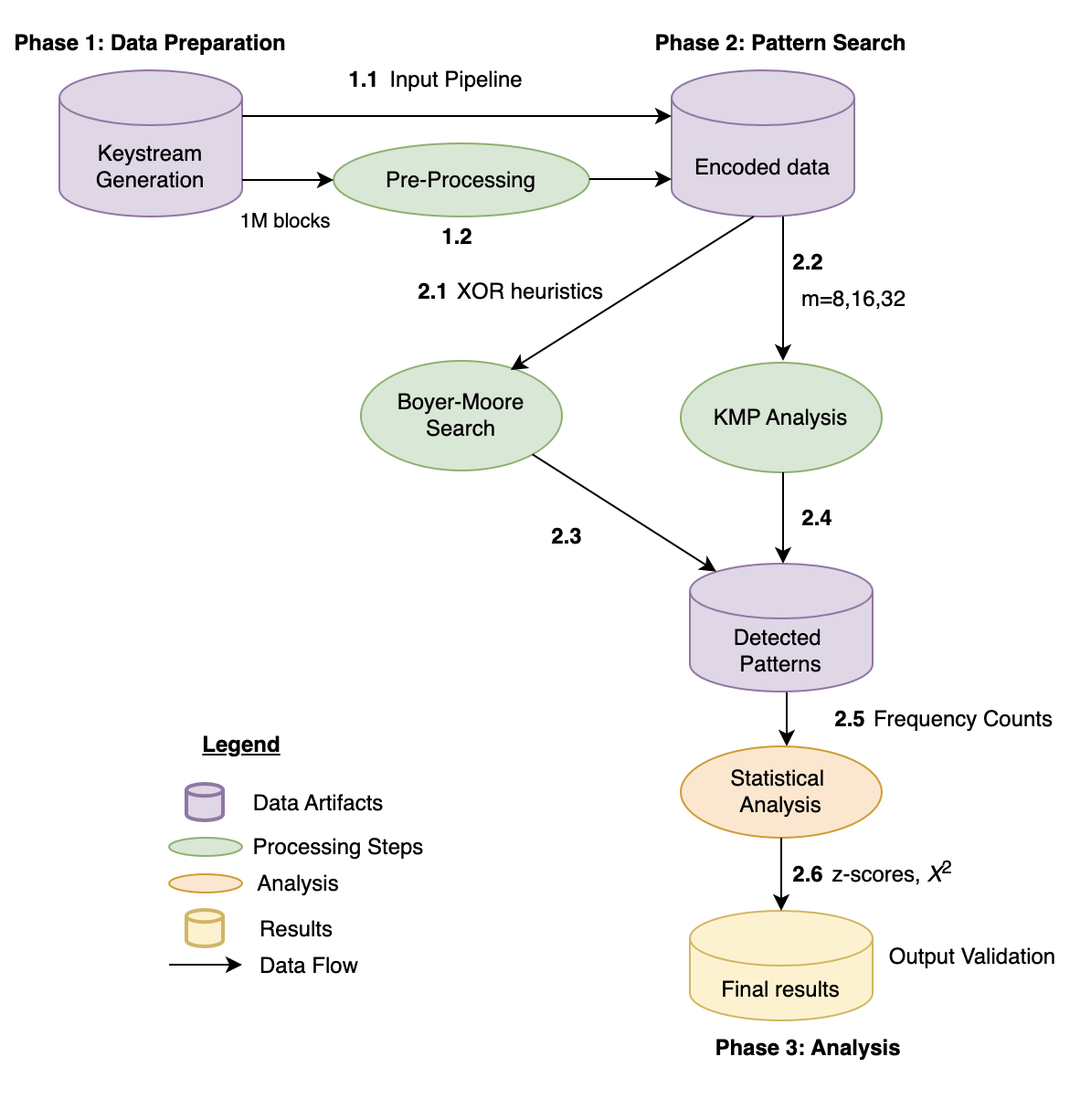
Figure 5: End-to-end pattern frequency analysis workflow over 4×40 EChaCha20 blocks: generation, encoding, pattern search, and statistical validation.
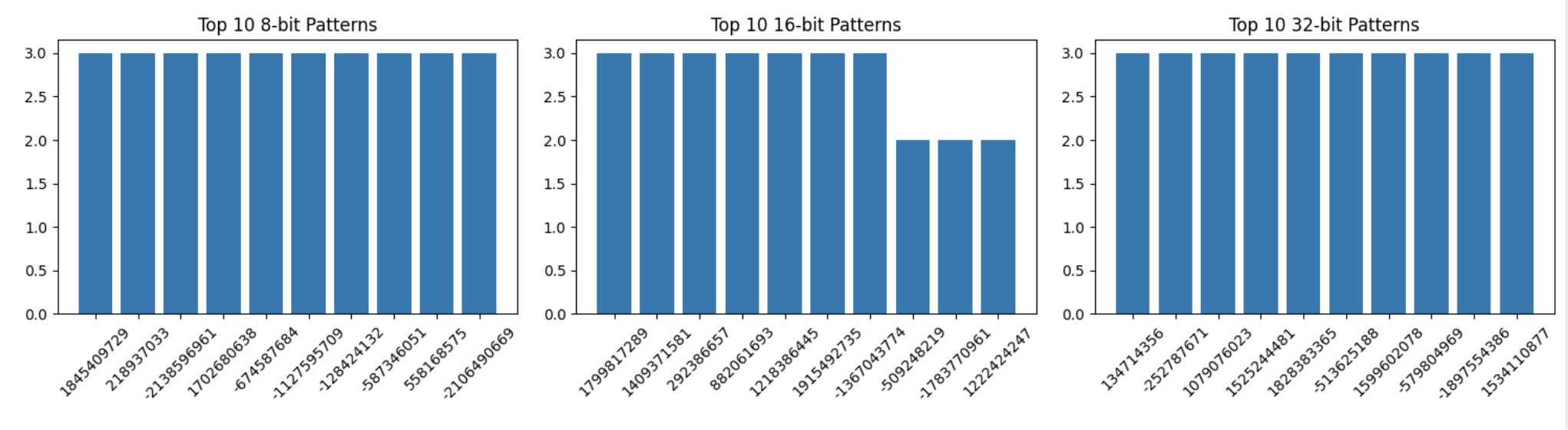
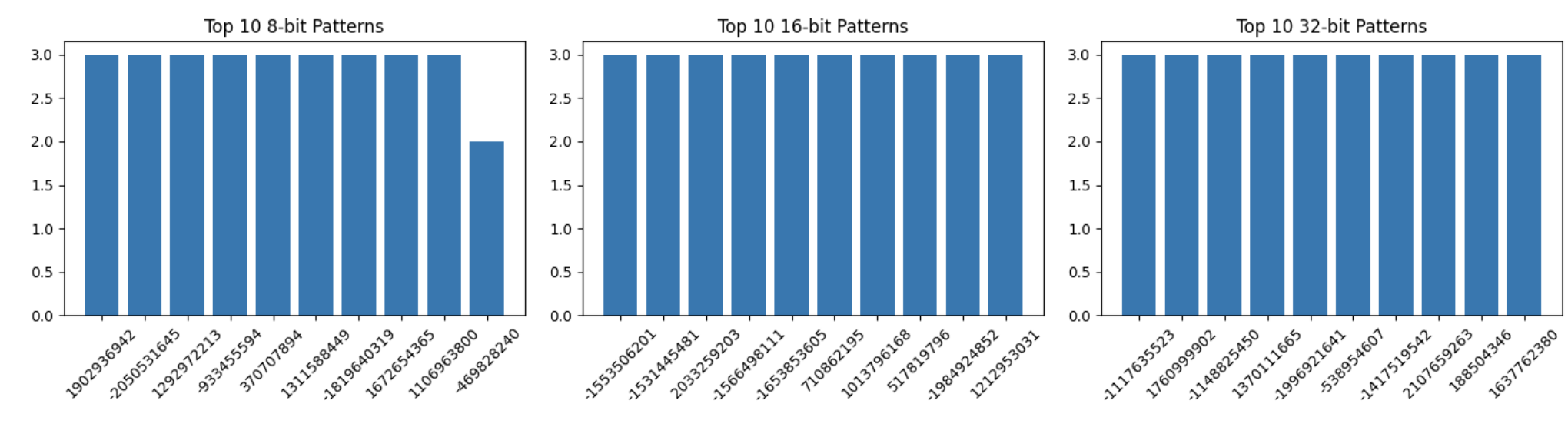
Figure 6: Top 10 most frequently occurring 4×41-bit patterns for 4×42 over 4×43 blocks. Uniformity at 16/32 bits, minor bias in the 8-bit domain.
Figure 7: Frequency distribution over 4×44 blocks. Pattern frequencies remain consistent, supporting EChaCha20's robustness against frequency attacks; the 8-bit domain alone shows marginal deviation in fixed-key conditions.
Notably, at 16- and 32-bit granularities, all patterns appear with frequencies matching uniform expectations, and the 4×45-score for the most frequent 16/32-bit patterns is well below the threshold for anomaly detection. In the 8-bit domain, small non-uniformities are detected for the lowest-entropy patterns, manifesting exclusively under fixed-key, deterministic nonce seeds. These vanish with random keys, indicating a transient—non-structural—effect.
Differential Cryptanalysis and Rotational Diffusion
Experiment 2 seeds rotational differentials into the QR-F using statistically flagged 32-bit patterns. The analysis quantifies collision probabilities at 1, 2, 3, and 4 rounds, seeking to identify any rotational or partial-state collision that may indicate bias.
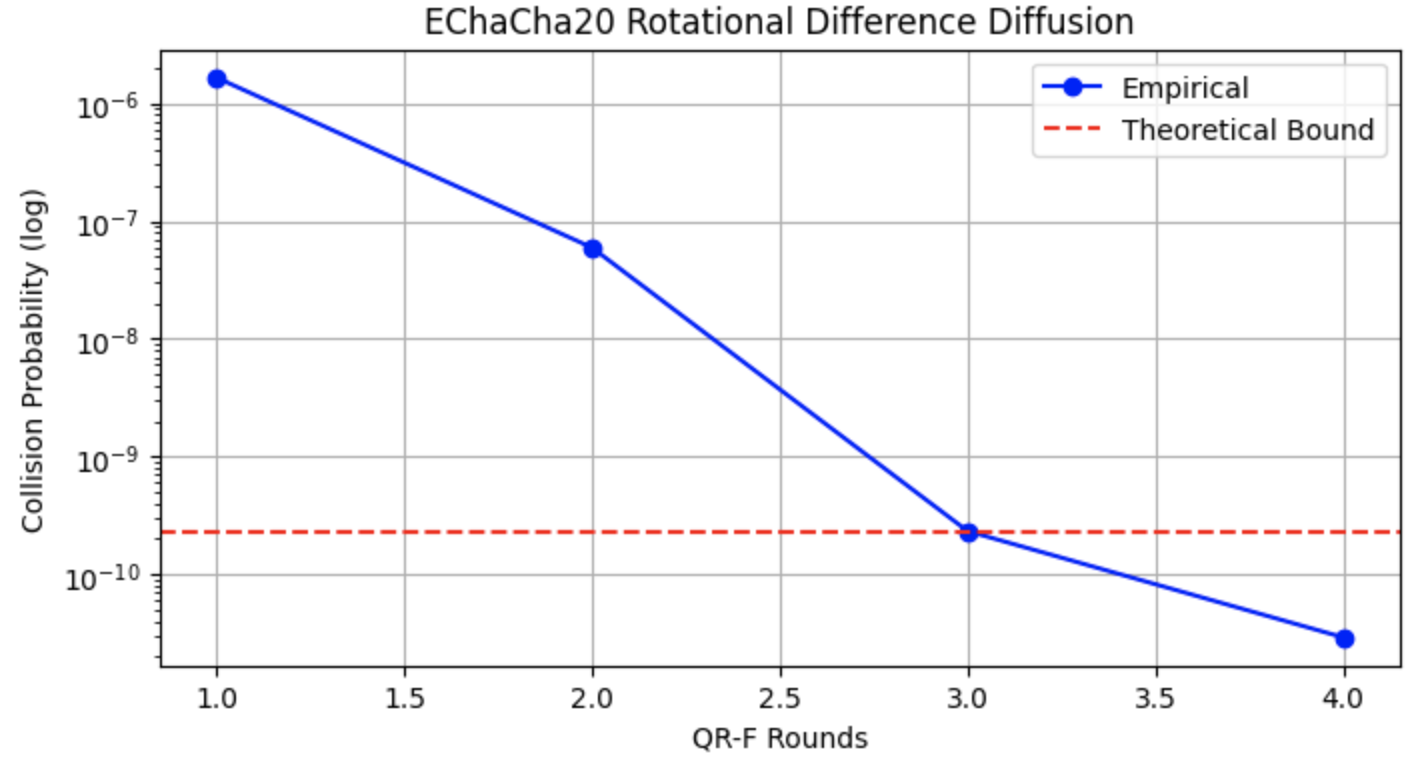
Figure 8: Empirical collision probabilities for seeded rotational differentials; probabilities decay exponentially and fall below 4×46 after two rounds. Diffusion outpaces theoretical bounds, with full diffusion by round 3.
The collision probability is 4×47 after one round, diminishes to 4×48 after two, and drops below the measurable threshold after three. No full-state collisions are recorded beyond the third round over 4×49 trials, even in fixed-key configurations.
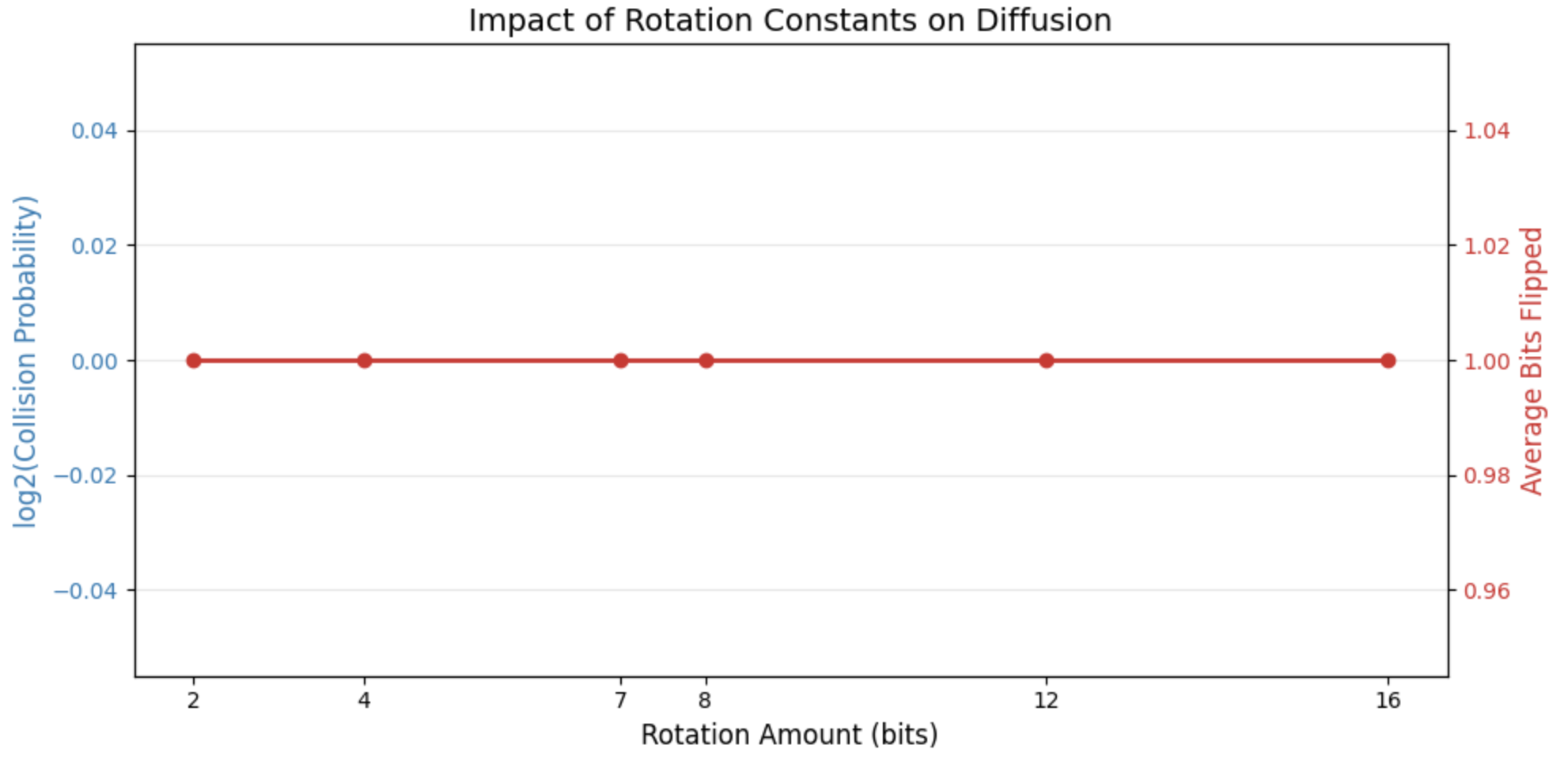
Figure 9: Collision probability and mean flipped bits are invariant with respect to the rotation constant; diffusion is parameter-insensitive, indicating robust mixing independent of specific rotation values.
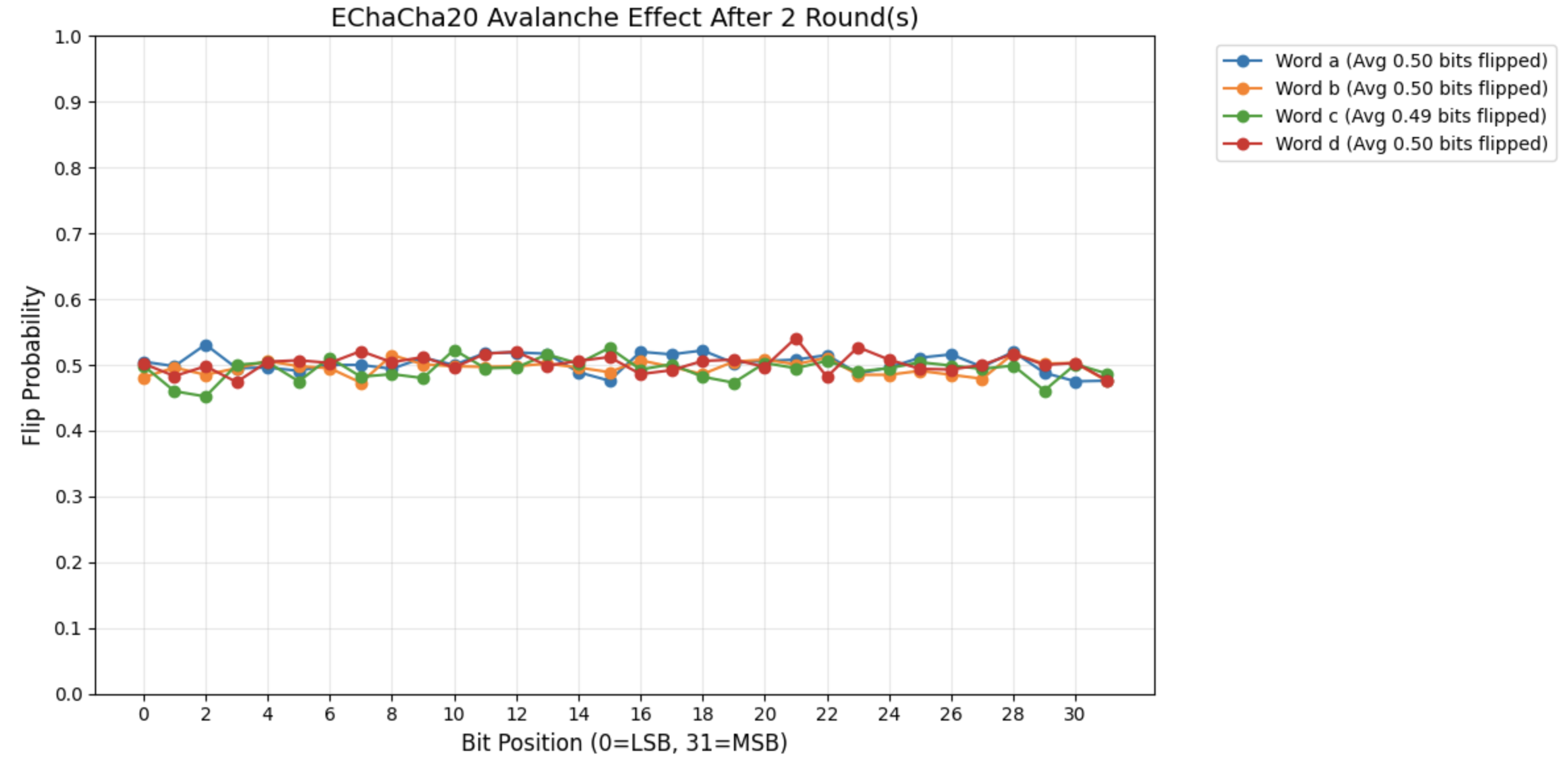
Figure 10: Avalanche effect after two QR-F rounds: each bit position achieves a flip probability close to 0.5 across all state words, validating rapid diffusion and confirming idealized avalanche properties.
Bold empirical claim: The experimentally observed full-state diffusion and rotational decorrelation are achieved by the third round, exceeding (i.e., outperforming) theoretical minimums expected for ARX permutations with such state size and rotation parameters.
Technical Implications and Theoretical Context
Complementarity to Standard Cryptanalysis
The stringology-based framework does not replace classical statistical or differential cryptanalysis, but offers a structurally-aligned tool for detecting word-level, rotation-based, and position-dependent artifacts that bitwise test suites frequently overlook. The large-scale, high-throughput KMP-BM hybrid algorithm is particularly suited for ARX ciphers with high state parallelism.
Empirically, the hybrid KMP-BM attained 0.97 precision and 3.6 GB/s throughput on large EChaCha20 keystreams—a 6×60 speedup over brute-force. This makes exhaustive pattern-space search practical at ARX block size.
Cipher Security Margins
No statistically significant pattern, collision, or rotational bias was found at 16- and 32-bit levels, and only negligible, non-persistent 8-bit irregularities exist under worst-case fixed-key initialization. No full-state collision or partial-collision bias persists under random key/nonces, confirming the EChaCha20 mixing layer's resilience.
Limitations and Future Work
While the methodology identifies non-random artifacts undetectable by NIST or Diehard batteries, it is still an empirical framework and does not constitute a reduction-based security argument. The analysis is limited to linearized, one-dimensional pattern domains; higher-order matrix or algebraic correlations in the 6×61 state are left for future work. Full formalization of the statistical indistinguishability bounds under dynamic key/nonce scheduling and evaluation against quantum stringology accelerations are proposed directions.
Conclusions
This work establishes stringology-based algorithmic search as a robust, sensitive, and efficient analytic tool for ARX cipher structural analysis, demonstrated through EChaCha20’s evaluation. Strong numerical results—such as zero statistical anomalies at 32-bit granularity, full-state diffusion within three rounds, and parameter-invariant rotational decorrelation—provide empirically grounded support for EChaCha20’s cryptanalytic resilience. The stringology approach is recommended as a complementary assessment method for future, larger ARX cipher designs, particularly those employing non-trivial state expansion or non-power-of-two rotation constants.
The research highlights the importance of integrating structurally-aware pattern detection with classic bit-level statistical approaches, and sets the foundation both for future analysis of EChaCha20 variants and for advancing the role of stringology in symmetric cipher cryptanalysis.