- The paper introduces NUMINA, a training-free 'identify-then-guide' pipeline that improves numerical alignment in text-to-video diffusion models.
- It leverages discriminative attention heads and PCA-based layout extraction to ensure precise object counting and semantic fidelity.
- Experimental results demonstrate up to 7.4% improvement in counting accuracy and robust temporal consistency across multiple architectures.
NUMINA: Training-Free Framework for Numerically Aligned Text-to-Video Diffusion
Motivation and Problem Statement
Text-to-video diffusion models, particularly those leveraging Diffusion Transformers (DiTs), have substantially advanced video synthesis from textual prompts. Despite impressive strides in visual fidelity and semantic alignment, a persistent deficiency is the misalignment between textual numerals and visual object counts. Existing models frequently fail to respect explicit numerical constraints specified in prompts, which undermines their reliability for applications necessitating precise cardinality such as manufacturing, instructional content, or scientific visualization.
The paper introduces NUMINA, a training-free "identify-then-guide" pipeline to resolve this numerical misalignment. NUMINA exploits discriminative attention heads during early denoising to construct a countable latent layout, then uses explicit structural guidance to refine and steer video generation toward numerically correct outputs—achieving this without retraining or augmentation.
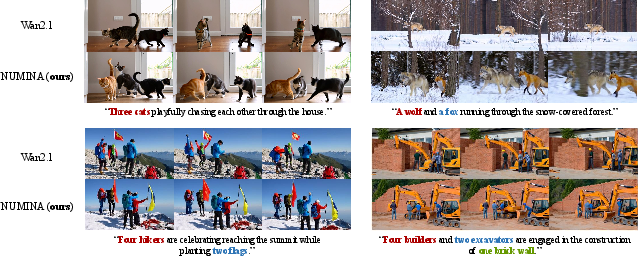
Figure 1: NUMINA substantially improves object-count accuracy in text-to-video diffusion while preserving temporal and spatial quality.
Analysis of Attention Dynamics and Numerical Misalignment
Investigations into DiT-based architectures reveal two main causes of misalignment:
- Semantic Weakness of Numerals: Cross-attention activations for numerals are diffuse, lacking the localized concentration shown for nouns/adjectives (see visualization of attention maps in Figure 2), which impedes grounding of counting constraints in the latent space.
- Instance Ambiguity: Heavy spatial downsampling and latent compression degrade separability of instances, resulting in unstable count control.
Conventional remedies such as retraining or dataset augmentation impose prohibitive computational overhead and do not easily accommodate the complexity of cardinality constraints, especially at higher counts.
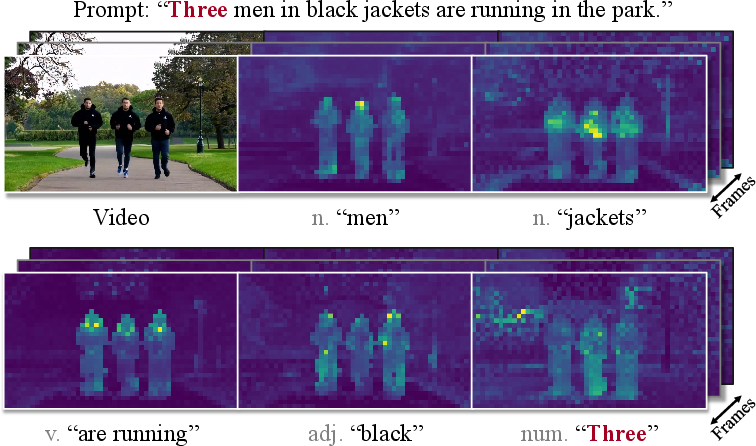
Figure 2: Cross-attention maps show numerals have significantly weaker, more diffused activations versus other word types.
NUMINA Framework: Identify-then-Guide Paradigm
NUMINA operates in two distinct phases:
- Identification of Numerical Misalignment: Early in denoising, NUMINA dynamically selects attention heads—one self-attention head for maximal instance separability and one cross-attention head for each noun token (category specificity). Instance-level layouts are derived via PCA and clustering approaches, fusing spatial and semantic signals to yield a foreground mask. Regions are filtered by overlap scores to construct a semantically countable layout.
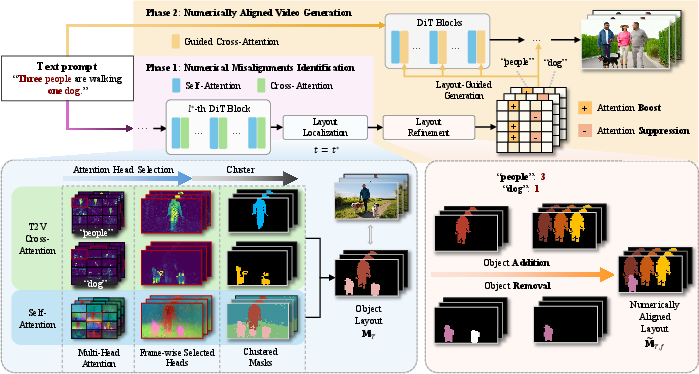
Figure 3: NUMINA's pipeline: dynamic attention-based layout extraction followed by refinement and layout-guided generation.
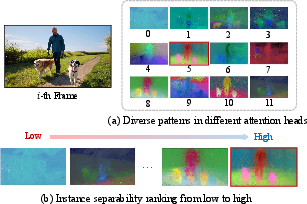
Figure 4: PCA visualization reveals head diversity and enables selection of heads with sharp instance separation.
- Numerically Aligned Video Generation: The extracted layout is conservatively refined at the instance level. Remediation occurs via addition (template-based placement with spatial/contextual cost minimization) or removal (smallest-region deletion), preserving spatial scene structure. Regeneration leverages modulated cross-attention, guided by a monotonic intensity function to achieve maximal correction early in denoising while protecting fine details at later stages.
Experimental Results
NUMINA is evaluated on the CountBench benchmark (210 prompts, object counts 1–8, multiple categories) across Wan T2V models (1.3B, 5B, 14B) and CogVideoX. Quantitative findings are:
- Counting Accuracy: For Wan2.1-1.3B, NUMINA improves counting accuracy by 7.4% over baseline, reaching 49.7%. On Wan2.2-5B and Wan2.1-14B, gains are 4.9% and 5.5%, respectively. NUMINA reliably outperforms prompt enhancement and seed search strategies, even enabling smaller models to surpass larger baselines.
- Semantic Alignment: NUMINA consistently increases CLIP scores, confirming improved text-video alignment.
- Temporal Consistency: Intervention maintains or slightly improves temporal count stability—no flickering or artifacts are introduced.
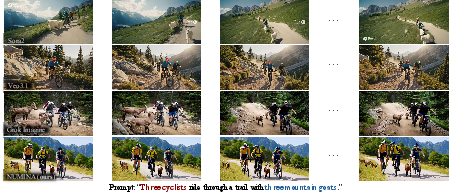
Figure 5: NUMINA qualitatively outperforms advanced commercial T2V models in numerically correct generations.
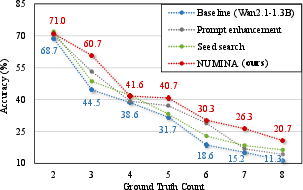
Figure 6: Numeral-specific breakdown confirms NUMINA’s scalability; substantial gains for higher-count prompts.
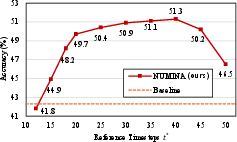
Figure 7: Ablation: Choice of reference timestep for head selection is critical for optimal instance separation.
Qualitative analysis shows NUMINA's success in producing precise counts in both simple and composite scenes, even when baselines fail. Per-number stratification illustrates largest improvements in high-cardinality scenarios.
Ablation and Analysis
Extensive ablations confirm key architectural and procedural choices:
- Attention Head Selection: "Top-1" head selection via discriminability scoring outperforms random or averaged alternatives.
- Layout Construction: Native attention-derived layouts surpass detector-based alternatives (e.g., GroundingDINO) for guiding generation.
- Layout Refinement Costs: Synergistic effects of spatial overlap, center proximity, and temporal stability yield peak accuracy.
- Object Addition/Removal: Both drive accuracy improvement; addition is more impactful, but combining maximizes gain.
- Resource Efficiency: Integration with runtime-adaptive caching (EasyCache) minimizes VRAM and time overhead.
Failure Cases and Limitations
NUMINA’s major limitation is over-segmentation, where discriminative attention heads occasionally fragment salient parts of a single object (e.g., head vs. body), yielding irrecoverable count errors.

Figure 8: Representative failure—mis-segmentation decouples heads from bodies, producing incorrect counts.
Additionally, NUMINA does not yet scale to dense-array instance scenarios (e.g., tens/hundreds of objects). Further work is needed to introduce holistic perceptual grouping or stronger geometric priors.
Representative Examples and Generalization
NUMINA is robust across architectures (tested with Wan and CogVideoX family) and composition scenarios, faithfully generating the requested number of objects.
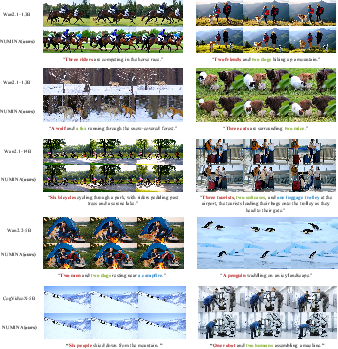
Figure 9: NUMINA reliably generates correct object counts in diverse compositional scenes and architectures.
Implications and Future Directions
NUMINA demonstrates that structural guidance grounded in model-native attention can circumvent longstanding limitations in numerically aligned text-to-video generation. Practically, this unlocks T2V pipelines for applications where count fidelity is paramount—industrial planning, scientific analysis, and instructional media. Theoretically, NUMINA reveals latent instance-separable geometry in attention heads, suggesting new directions for training-free editing, controllable generation, and instance-level compositionality.
Future development should pursue scaling NUMINA to ultra-dense scenes, integrating more perceptually holistic grouping criteria, and coupling with pretrained segmentation or grouping models. There is further potential for extending this paradigm to multi-modal, multi-prompt and conditional tasks in generative modeling.
Conclusion
NUMINA presents a training-free, attention-guided method for numerical alignment in text-to-video diffusion. The approach reliably boosts counting accuracy—especially at higher cardinalities—without compromising video quality or coherence. Structural layout guidance is validated as a powerful complement to seed search and prompt engineering. NUMINA lays the groundwork for count-accurate, compositional generative modeling, expanding the effective and practical applicability of text-to-video pipelines (2604.08546).