A dimension descent scheme for the positive mass theorem in high dimensions
Abstract: We describe how the Schoen-Yau proof of the positive mass theorem can be extended to arbitrary dimensions. To overcome the problem of singularities, we propose a new inductive scheme. To carry out the inductive step, we use a combination of several techniques, including the shielding principle of Lesourd-Unger-Yau, as well as a conformal blow-up argument in the spirit of Bi-Hao-He-Shi-Zhu. Our arguments also rely on the Cheeger-Naber bound for the Minkowski dimension of the singular set.
Paper Prompts
Sign up for free to create and run prompts on this paper using GPT-5.
Top Community Prompts
Explain it Like I'm 14
Overview
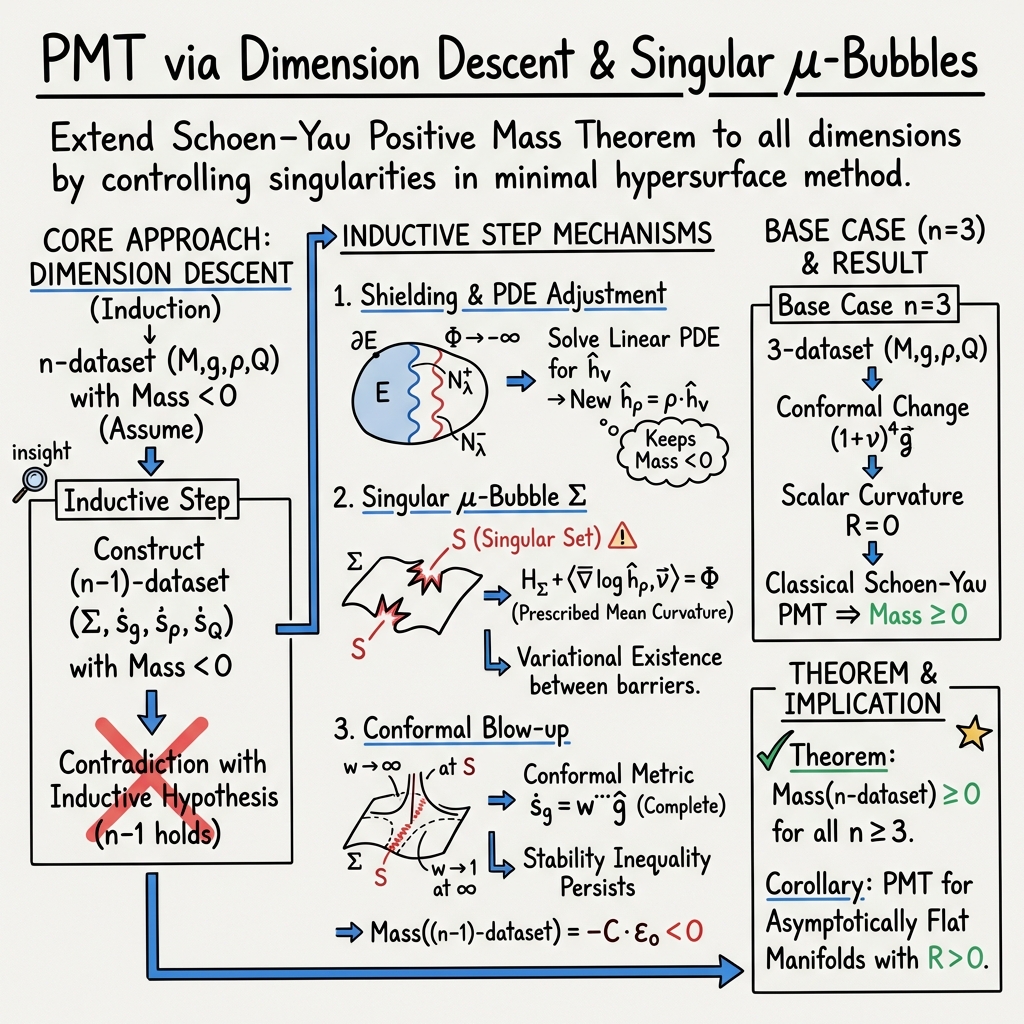
This paper tackles a famous idea from geometry and physics called the Positive Mass Theorem. In simple terms, it says that if a space (think: a curved “universe”) looks flat far away and has no “negative energy” inside, then its total mass can’t be negative. Earlier proofs worked for spaces up to certain dimensions (like up to 7, then 11, then 19). This paper describes a way to prove it in any dimension by “stepping down” the dimension one at a time.
What the paper is asking
- Can we extend the classic Schoen–Yau proof to show that total mass is never negative in every dimension, not just in low or medium dimensions?
- How can we handle the tricky parts where the objects we build (like special surfaces) might have tiny, sharp “singular” spots?
- Can we set up a careful argument that, if a negative-mass space existed in dimension n, it would force a negative-mass space to exist in dimension n−1, and so on—until we reach a contradiction with the known 3D case?
How the authors approach it
Here’s the high-level plan, with technical terms translated into everyday language:
The setting: spaces that look flat far away and a notion of “mass”
- The authors study curved spaces that, far away from everything, look like ordinary flat space. Think of a landscape that becomes flat as you walk further and further out.
- They introduce an “n-dataset,” which is a package of data: the space itself, a weight function ρ (rho), and another function Q that measures certain curvature/energy properties. Far away, these functions have specific “decay rates” (they get small in a precise way).
- The mass they study is computed from the leading terms of how the metric (the ruler of the space) and ρ look far away. If those leading terms have coefficients α and β, the “mass” is defined as (n−1)α + 2β.
The main goal
- Show that for any n-dataset in any dimension n ≥ 3, this mass is ≥ 0.
The overall strategy: induction (dimension descent)
- Induction is like a chain of dominoes: prove it for dimension 3 first. Then show that if it’s true for dimension n−1, it must be true for dimension n.
- The “dimension descent” idea says: if you could somehow find a negative-mass space in dimension n, the authors construct a special hypersurface (a one-dimension-lower slice) and then carefully modify it to get a negative-mass space in dimension n−1. That would contradict the induction assumption that n−1 dimensions are already safe. So dimension n must be safe too.
Key tools and ideas
- Shielding principle (Lesourd–Unger–Yau): Imagine trying to study just one “end” of the space (the part that goes out to infinity). The shielding principle helps isolate that region so what’s happening elsewhere doesn’t mess up the analysis—like putting soundproof walls around the section you want to study.
- Building “μ-bubbles”: These are like soap films that try to minimize area but with a twist—they feel a pressure (coming from a function Φ and the weight ρ), so they settle into a shape balancing curvature and pressure. Formally, they satisfy a “weighted mean curvature” equation. In everyday terms: you blow a soap film in a wind (pressure), and it stabilizes to a shape that balances tension and push. These μ-bubbles may have tiny “singular” spots (sharp points or edges).
- Handling singularities: Singularities are where the geometry isn’t perfectly smooth. The Cheeger–Naber results show these singular sets are small in a precise sense (they’re “thin,” with low Minkowski dimension), so they don’t take over the space. The authors then use a special trick—see next point—to keep working despite these rough spots.
- Conformal blow-up: A conformal change rescales the geometry locally by multiplying distances with a positive function. A “blow-up” is choosing this function to go to infinity near bad spots so those singularities end up infinitely far away in the new geometry. Picture redrawing the map so that the rough region is stretched and pushed to the boundary at infinity, making the new space smooth and complete for analysis.
- PDE step (solving a linear equation): The authors solve a carefully chosen linear partial differential equation (PDE) to create a helper function v. This v is used to adjust ρ to a new weight, ρ̂ = ρ·v, that behaves better for the μ-bubble construction and the later steps. Solving this PDE is like finding the right “tuning” so all the later balances work out.
- Barriers and calibrations: To build and control the μ-bubble, the authors construct “barriers” near the boundary and near infinity—special surfaces that the μ-bubble can’t cross due to curvature inequalities. They use vector fields with positive divergence (with respect to the weighted measure ρ̂) to guarantee these surfaces act as one-way gates. This keeps the μ-bubble in a manageable region and gives control over its geometry.
The base case (dimension 3)
- In 3D, they solve a PDE to build a function v and then rescale the metric by (1+v)4. That new metric has zero scalar curvature (loosely, zero “average bending” at each point). The classic Schoen–Yau positive mass theorem applies here, proving that the mass can’t be negative. In the paper’s coefficients, this shows α + β ≥ 0, and since the 3D mass is 2(α + β), it’s nonnegative.
The inductive step (from n−1 to n)
- Assume there’s a negative mass n-dimensional space. Use shielding and the PDE to produce a good weight ρ̂ and a pressure function Φ. Construct μ-bubbles balancing curvature against Φ and ρ̂.
- Show that, after a conformal blow-up near any singularities, the hypersurface (now seen as an (n−1)-dimensional space with one end) becomes complete, asymptotically flat, and inherits a negative mass in the sense of the paper’s definition. That contradicts the induction hypothesis (which says negative mass doesn’t happen in dimension n−1). Therefore, no negative mass n-dimensional space can exist.
Main findings and why they matter
- The authors set up a complete “dimension descent” framework that extends the Schoen–Yau approach to all dimensions. Their main theorem says: for any “n-dataset” (a geometric setup that looks flat far away and satisfies certain positivity and decay conditions), the mass (given by (n−1)α + 2β) is nonnegative.
- A direct corollary: If the scalar curvature is positive everywhere (this is a geometric way to say there’s positive gravitational energy everywhere), then the total mass is nonnegative. This aligns with physical expectations from general relativity.
- The techniques combine several modern advances: the shielding principle (to isolate ends), μ-bubbles (to produce hypersurfaces with stability properties), conformal blow-up (to make spaces complete despite singularities), and bounds on singular sets (Cheeger–Naber), all woven into a clean inductive argument.
What this means going forward
- Conceptually: It strengthens the bridge between geometry and physics by confirming, in a very general setting, that gravity doesn’t give you “negative total mass” if the space behaves nicely and is well-behaved at infinity.
- Methodologically: The toolkit introduced—especially the way the authors control singularities and descend in dimension—can be used in other problems where you need to pass from higher-dimensional geometry to lower-dimensional slices while keeping control over errors and rough spots.
- Historically: It advances a cornerstone result beyond the dimensions previously established by classical and recent works, offering a unified, robust path that works in all dimensions.
Knowledge Gaps
Knowledge gaps, limitations, and open questions
Below is a single, concrete list of issues the paper leaves unresolved or requires further clarification, aimed at guiding future work to make the dimension descent scheme fully rigorous and broadly applicable.
- Precise control of singular sets in the μ-bubble step: The scheme relies on Cheeger–Naber’s Minkowski dimension bound and a “generalization of the Schoen–Yau identity” on hypersurfaces with singularities, but the paper does not detail how to justify integration by parts, stability inequalities, and curvature estimates across the singular set; a complete treatment of varifold/rectifiable current regularity and the applicability of the identity in the singular setting is needed.
- Conformal blow-up near singularities: The conformal factor w on the hypersurface Σ is asserted to “blow up at a controlled rate” to produce a complete metric while preserving positivity of the quadratic form; the construction lacks explicit asymptotics near the singular set, quantitative blow-up rates, and a proof that the induced (n−1)-dataset satisfies the required decay and integrability hypotheses (including the L1 conditions and the asymptotic expansion with a positive decay parameter δ).
- Propagation of asymptotic decay through induction: Each inductive step replaces (M,g,ρ,Q) by an (n−1)-dimensional dataset with modified asymptotics (α̂,β̂,δ̂); the paper does not track how δ degrades across steps or prove that a strictly positive decay exponent persists all the way down to n=3. A rigorous bookkeeping of decay loss and uniform control on higher derivatives is needed.
- Preservation of the “dataset inequality” under restriction and conformal change: It is claimed that the positivity of a certain quadratic form is preserved after restricting to Σ and applying conformal blow-up. The paper does not provide a proof that the transformed (n−1)-dataset still satisfies the defining inequality for all admissible test functions, especially when Σ is incomplete before the blow-up and has singularities.
- Completeness and asymptotic flatness of the reduced manifold: After restricting to Σ and conformal blow-up, the argument assumes the resulting (n−1)-manifold is complete and has a single asymptotically flat end with the specified expansions; detailed verification (charts at infinity, parity conditions, higher-order asymptotics) is not presented.
- Existence, uniqueness, and subsequence-independence of the μ-bubble limit: The truncation-by-slabs construction yields minimizers in bounded regions; passing to the limit as s_j→∞ requires a compactness argument showing convergence (as sets/varifolds) to a global μ-bubble Σ that is independent of the subsequence, does not “leak mass” at infinity, and does not touch the artificial boundaries. These steps are sketched but not completed.
- Quantitative shielding and barrier dependence: The construction of the shielding domain E and the function Φ (with Q + ½Φ2 − 2|∇Φ| > 2ĤQ > 0) depends on choices of parameters (s_0,s_1) and cutoffs; the robustness of the argument under different choices, and explicit bounds guaranteeing the barriers for all large scales, are not provided.
- Stability of the PDE step with respect to ω and Λ: The coercivity of the linear operator and the asymptotics v ~ γ r{2−n} rely on the choice of the Hardy weight ω and parameter Λ; the paper does not analyze uniqueness/stability of v, dependence of γ on these auxiliary choices, nor optimality of ω to maximize coercivity and asymptotic control.
- Compatibility with multiple ends: While the shielding principle isolates the chosen end E_0, the paper does not state (or prove) a version that simultaneously yields nonnegativity of mass on all ends or systematically handles interactions between ends during the μ-bubble construction in higher dimensions.
- Equality and rigidity: The paper establishes nonnegativity of the mass for datasets but does not address the rigidity case (mass = 0). It remains open to show that equality implies the manifold (or the dataset) is isometric to Euclidean space (or a precise rigid model) under the dataset framework, and to characterize the behavior of intermediate μ-bubbles and the conformal factor in the equality case.
- Extension beyond smooth settings: All arguments assume smooth metrics and smooth positive ρ,Q with high-order decay. It is open whether the scheme extends to weaker regularity (e.g., C{1,1} metrics, weighted Sobolev/Holder asymptotics), and what minimal decay assumptions suffice for the PDE, barrier, and calibration arguments.
- Scope of the dataset framework: Beyond the special case ρ=1, Q=R/2 with R>0, the paper does not classify or construct broader classes of (ρ,Q) for which the dataset inequality holds; a structural characterization (e.g., in terms of scalar curvature, potentials, or weighted Sobolev inequalities) would clarify the range of geometries covered by the theorem.
- Generality of “Schoen–Yau identity” generalization: The argument hinges on a generalized identity on (possibly singular) hypersurfaces; its precise statement, hypotheses (e.g., integrability of curvature terms, boundary behavior), and proof in the present high-dimensional, singular context are deferred.
- Asymptotic coordinate and mass normalization issues: The mass is defined as (n−1)α + 2β based on expansions in a chosen AF chart. The paper does not discuss invariance under admissible coordinate changes, parity conditions, or how β from ρ interacts with standard ADM mass normalization, especially after multiple conformal and restriction steps.
- Potential applications and extensions: The scheme is tailored to asymptotically flat manifolds in the time-symmetric (scalar curvature) setting. It remains open whether analogous dimension descent techniques can handle asymptotically hyperbolic ends, initial data with extrinsic curvature (non-time-symmetric PMT), or ALE/ALF asymptotics.
- Technical completeness and typographical accuracy: Several displayed formulas appear with missing brackets or absolute value bars (likely transcription errors). For reproducibility, a fully detailed, error-checked presentation of all inequalities (including exact constants and norms) is still needed, especially where subtle sign and decay estimates are crucial.
Practical Applications
Immediate Applications
The following items translate the paper’s results and techniques into concrete uses that can be prototyped or adopted now, together with sector links and feasibility notes.
- Sector: Academia (geometry, general relativity); Software (symbolic/numeric)
- Actionable use case: Reference framework for ADM mass nonnegativity in asymptotically flat (AF) manifolds across all dimensions
- What: Use Theorem pmt and Corollary special.case to certify nonnegative mass for AF datasets that satisfy the stated decay and curvature conditions.
- Tools/workflows:
- Symbolic/numeric routines (e.g., in SageMath/Mathematica) to extract asymptotic coefficients α (metric) and β (ρ) from numerical/analytic AF initial data and compute mass (n−1)α+2β.
- A “mass certificate” script to verify hypotheses (decay rates, L1 integrability) and report whether nonnegativity is guaranteed by the theorem.
- Assumptions/dependencies: Requires AF structure with prescribed decay, availability of asymptotic expansions for g and ρ, and a Q satisfying the dataset inequality; reliable numerical asymptotics are necessary in computational use.
- Sector: Numerical relativity; Software (finite elements/finite volumes)
- Actionable use case: Barrier-based domain design for AF simulations (“shielding”)
- What: Adapt the shielding principle (via the constructed Φ and E, Ê) to create computational subdomains with absorbing/controlling boundaries that “shield” the AF end while permitting arbitrary complexity elsewhere.
- Tools/workflows:
- Preprocessing step that constructs Φ with Φ→−∞ on ∂E and enforces Q + ½Φ² − 2|∇Φ| > 0 numerically to localize computation without corrupting the AF end.
- Integration with Einstein Toolkit, deal.II, or FEniCS to set Dirichlet/Robin conditions informed by Φ.
- Assumptions/dependencies: Must compute Φ that satisfies the inequalities; needs robust estimation of Q and ∇Φ; practical tuning of s0, s1 parameters.
- Sector: Numerical analysis/PDEs; Software (FEniCS/Firedrake/deal.II)
- Actionable use case: Stable linear solvers using coercivity estimates and Hardy-weighting
- What: Implement coercivity-guided weak formulations for the weighted linear PDE in the paper to obtain positive solutions with Dirichlet data on ∂Ê.
- Tools/workflows:
- FEM modules that include the weighted bilinear form with ρ and Q, and an automatic choice of Λ, κ (Hardy inequality) to guarantee coercivity.
- A posteriori checks based on integration-by-parts identities (divergence structure) to validate solution behavior at infinity.
- Assumptions/dependencies: Reliable mesh handling on large AF ends; correct numerical handling of weights decaying like r−2 and r2−n.
- Sector: Optimization/geometry processing; Computer vision and graphics
- Actionable use case: Weighted minimal hypersurface solvers with “calibrations” and region forces (μ-bubble analogue)
- What: Use the paper’s functional F(Ω)=∫∂*Ω ρ̂ dH{n−1} − ∫ χΩ ρ̂ Φ dHn to design segmentation/shape optimization energies combining perimeter with a region term, with vector-field calibrations ensuring barrier adherence and optimality.
- Tools/workflows:
- Implement “calibration vector fields” X with div(ρ̂X)>0 in designated slabs to prevent leakage across barriers (practical analogue of Propositions X.is.a.calibration and Y.is.a.calibration).
- Plug into level-set or graph-cut segmentation as a principled “balloon force” tied to Φ, with provable one-sided optimality in constrained regions.
- Assumptions/dependencies: Requires constructing Φ and ρ̂ from data (can be chosen as application-specific potentials/weights); needs only Euclidean background for many vision tasks.
- Sector: Computational geometry; Meshing and regularization
- Actionable use case: Conformal blow-up as a regularization near singular sets
- What: Use conformal reweighting (w{(n+1)/(n−3)}) near singularities to complete metrics and preserve positivity of quadratic forms, guiding mesh refinement and stable computation near defects.
- Tools/workflows:
- Mesh-adaptive reweighting modules that scale local metrics using a blow-up factor w to control geodesic completeness and conditioning.
- Integration with existing adaptivity frameworks to protect solvers from pathological regions while retaining key variational positivity.
- Assumptions/dependencies: Requires a function w with controlled blow-up rate; needs estimates on singular set size (cf. Cheeger–Naber bound) to justify where/when to apply.
- Sector: Education/pedagogy
- Actionable use case: Graduate modules on modern positive mass techniques
- What: Teach dimension descent, shielding, μ-bubbles with singularities, and conformal blow-up as a unified scheme for scalar curvature problems.
- Tools/workflows: Lecture notes, problem sets reproducing core coercivity and barrier arguments, coding labs for the weighted PDE and μ-bubble functional.
- Assumptions/dependencies: None beyond standard grad prerequisites in geometry and PDE.
Long-Term Applications
These items are plausible but require further research, scaling, or translation from pure theory to applied practice.
- Sector: Theoretical physics (gravity beyond 4D, string/braneworld models)
- Application: Stability and viability filters for higher-dimensional spacetime models
- What: Use the all-dimension positive mass guarantee to constrain admissible compactifications/initial data sets in higher-dimensional theories by eliminating negative-energy pathologies.
- Potential tools/products: “Model viability checker” for compactification geometries, incorporating mass computation and curvature inequalities as pre-screening.
- Assumptions/dependencies: Mapping from model assumptions to an n-dataset framework (choice of ρ, Q); verifying AF-like asymptotics in higher-dimensional settings; community consensus on the physical interpretation of mass in these models.
- Sector: Numerical relativity; Gravitational-wave science
- Application: Robust initial-data generation and validation with singularity-tolerant schemes
- What: Adapt μ-bubble-based barrier methods and conformal blow-up regularizations to produce/validate 3+1 initial data that may exhibit localized high curvature while preserving global energy positivity.
- Potential tools/products:
- Initial-data solvers that embed shielding regions to localize complexity and certify outer mass positivity.
- A posteriori “mass positivity checks” integrated into simulation workflows to flag discretization-induced spurious negative masses.
- Assumptions/dependencies: Careful translation from general n to 3+1 numerics; practical estimators for α and β from discrete data; handling gauge issues in ADM mass measurement.
- Sector: Materials science and interface engineering
- Application: Design of membranes/interfaces under external fields via weighted mean curvature
- What: Treat H + ⟨∇log ρ̂, ν⟩ = Φ as a target balance for interfaces subject to spatially varying fields (e.g., chemical potential, temperature), guiding shape design and stability analysis.
- Potential tools/products: Inverse-design solvers for ρ̂, Φ that yield desired interface geometry; calibration-guided fabrication constraints ensuring no “leakage” past safety boundaries.
- Assumptions/dependencies: Physical identification of ρ̂ (weight) and Φ (forcing) with measurable material fields; validation that continuum geometric model matches microscale behavior.
- Sector: Machine learning on manifolds; Geometric deep learning
- Application: Variational regularizers and constraints inspired by μ-bubbles and shielding
- What: Use perimeter-plus-region energies with calibration-like divergence constraints as loss terms for learning signals defined on manifolds/meshes (denoising, segmentation, clustering).
- Potential tools/products: PyTorch/JAX layers implementing weighted perimeter (total variation) with divergence-based certificates; training curricula that gradually introduce shielding barriers to stabilize learning near “singular” regions.
- Assumptions/dependencies: Efficient differentiable approximations to weighted perimeter; scalable evaluation of divergence constraints; task-specific mappings from data to ρ̂, Φ.
- Sector: Computational geometry; Scientific computing
- Application: Singular-set aware solvers exploiting Cheeger–Naber bounds
- What: Algorithms that treat singular sets as lower-dimensional, applying specialized quadrature/meshing and reweighting to guarantee stability while ignoring negligible subsets.
- Potential tools/products: Libraries that automatically detect and de-emphasize sets of small Minkowski dimension; certified-error integrators that account for the negligible measure.
- Assumptions/dependencies: Practical singular set detection or proxy indicators; rigorous error control translating measure/dimension bounds to discretization tolerances.
- Sector: Standards and policy for scientific software reliability
- Application: Verification protocols for geometric PDE codes
- What: Create community guidelines leveraging coercivity inequalities and divergence identities as “unit tests” for solvers handling AF geometries and weighted scalar curvature problems.
- Potential tools/products: A test-suite of canonical AF problems with known asymptotics; automated checks for positivity of quadratic forms and correct asymptotic decay.
- Assumptions/dependencies: Agreement on benchmark problems; reproducibility infrastructure; sustained maintenance by research consortia.
Notes on cross-cutting assumptions and dependencies
- AF structure and decay: Many applications rely on being able to model or approximate asymptotically flat geometries with specified decay rates and to extract asymptotic coefficients (α, β). Numerical pipelines must reliably fit these from finite domains.
- Positivity/inequality verification: Several workflows require constructing Φ and verifying inequalities (e.g., Q + ½Φ² − 2|∇Φ| > 0). In applied contexts, conservative numerical overestimates or certified interval arithmetic may be required.
- Singular set control: Techniques that invoke conformal blow-up and Cheeger–Naber bounds presume singular sets are sufficiently small in Minkowski dimension; practical proxies for detecting/estimating such sets are needed.
- Translation to physical models: For non-mathematical domains (materials science, physics beyond 4D), mapping ρ and Φ to physical fields and validating geometric models against experiments/simulations are essential before deployment.
Glossary
- Asymptotically flat: Describes manifolds whose geometry approaches that of Euclidean space at infinity. Example: "asymptotically flat manifolds of dimension ."
- Asymptotically flat end: An end of a manifold modeled on the complement of a ball in Euclidean space with controlled decay of the metric. Example: "has an asymptotically flat end"
- Asymptotic expansion: A series describing how a function or metric behaves at infinity, identifying leading-order coefficients. Example: "the coefficient in the asymptotic expansion of "
- BV functions: Functions of bounded variation; their compactness properties aid in variational problems. Example: "compactness theorem for BV functions."
- Caccioppoli set: A set of finite perimeter used in geometric measure theory and variational problems. Example: "the collection of Caccioppoli sets"
- Cheeger–Naber bound: A result controlling the size (dimension) of singular sets in geometric analysis. Example: "the Cheeger-Naber bound for the Minkowski dimension of the singular set."
- Coercivity: A property of a quadratic functional ensuring a uniform lower bound, crucial for existence of minimizers. Example: "Proposition [Coercivity]"
- Conformal blow-up: A conformal rescaling that increases the metric near a set (often singular) to achieve completeness or other properties. Example: "a conformal blow-up argument"
- Conformal factor: The scalar function multiplying a metric in a conformal change. Example: "The conformal factor is obtained"
- Conformal metric: A metric obtained by scaling another metric by a positive function. Example: "construct a conformal metric"
- Covariant derivative: The derivative operator compatible with the metric, capturing how tensors change along the manifold. Example: "denotes the covariant derivative of order "
- Dirichlet boundary condition: A boundary condition fixing the value of a solution along the boundary of a domain. Example: "with Dirichlet boundary condition on "
- Divergence theorem: A fundamental result relating volume integrals of divergence to flux integrals over the boundary. Example: "it follows from the divergence theorem that"
- Elliptic regularity theory: Results ensuring smoothness of solutions to elliptic PDEs under appropriate conditions. Example: "By elliptic regularity theory, is a smooth solution"
- End (of a manifold): An unbounded connected component of the complement of a compact subset. Example: "has no ends other than ."
- Foliation: A decomposition of a region into a family of disjoint hypersurfaces. Example: "form a foliation."
- Hardy inequality: An analytic inequality providing weighted L2 control of functions by their gradients. Example: "By Hardy's inequality"
- Hypersurface: A submanifold of codimension one within a Riemannian manifold. Example: "Then is a smooth hypersurface in "
- Inductive step: The stage in a proof by induction where truth for dimension n−1 implies truth for dimension n. Example: "the proof of the inductive step."
- Linear PDE: A partial differential equation linear in the unknown function and its derivatives. Example: "a positive solution of the linear PDE"
- Mean curvature: The average of principal curvatures, representing the first variation of area. Example: "the mean curvature of the hypersurface "
- Minkowski dimension: A notion of fractal dimension quantifying the size of a set (often of singularities). Example: "the Minkowski dimension of the singular set."
- Minimizer: A function or set that achieves the infimum of a given functional. Example: "minimizes the functional"
- Mu-bubble (μ-bubble): A hypersurface solving a weighted prescribed mean curvature problem, used as a variational tool. Example: "construct a -bubble"
- n-dataset: A structured collection (M,g,ρ,Q) with analytic and geometric conditions tailored to the proof. Example: "An -dataset consists of"
- Positive mass theorem: A fundamental result asserting nonnegativity of mass for suitable asymptotically flat manifolds. Example: "the positive mass theorem"
- Quadratic form: A bilinear form applied to a function, often arising from second variation or stability inequalities. Example: "a certain quadratic form on is positive."
- Reduced boundary: The measure-theoretic boundary capturing the essential interface of a set of finite perimeter. Example: "the reduced boundary of "
- Riemannian manifold: A smooth manifold equipped with a smoothly varying inner product on tangent spaces. Example: "a complete Riemannian manifold of dimension ."
- Scalar curvature: A scalar invariant measuring the intrinsic curvature of a Riemannian manifold at a point. Example: "the scalar curvature of is positive"
- Schoen–Yau identity: An identity underpinning stability and positivity arguments in the positive mass theorem. Example: "the famous Schoen-Yau identity"
- Shielding principle: A method ensuring geometric/analytic barriers to control behavior near certain regions. Example: "the shielding principle of Lesourd-Unger-Yau"
- Stability inequality: An inequality derived from second variation indicating nonnegativity of a certain quadratic form. Example: "satisfies a stability inequality."
- Strict maximum principle: A principle asserting that nontrivial solutions to certain elliptic PDEs cannot achieve interior minima or maxima unless constant. Example: "Using the strict maximum principle"
- Transversally: Intersecting with nonzero angle; ensures well-posed geometric configurations. Example: "intersects and transversally."
- Tubular neighborhood: A neighborhood of a submanifold diffeomorphic to its normal bundle. Example: "the tubular neighborhood "
- Unit normal vector field: A choice of unit-length normals along a hypersurface. Example: "We choose the unit normal vector field along "
- Variational problem: An optimization problem over functions or sets, typically minimizing an energy or area functional. Example: "we consider a variational problem on the domain"
- Weighted mean curvature: Mean curvature modified by a density or weight function (here, involving ). Example: "with positive -weighted mean curvature"
Collections
Sign up for free to add this paper to one or more collections.

