- The paper introduces PG-MDP, a profile-guided technique that statically labels loads to bypass unnecessary memory dependence checks in constrained cores.
- The method reduces the dynamic predictor working set by 79%, enabling a 64-entry predictor to achieve IPC near that of a 1024-entry design.
- The approach improves IPC by up to 5.6% in high false-dependency workloads while offering significant power and area efficiency.
Profile-Guided Memory Dependence Prediction in Area-Constrained Cores
Introduction
The paper "PG-MDP: Profile-Guided Memory Dependence Prediction for Area-Constrained Cores" (2604.08445) presents a software/hardware co-design methodology for optimizing memory dependence prediction (MDP) in out-of-order processors, specifically targeting area-constrained cores where predictor resources are extremely limited. While traditional solutions attempt to increase predictor size to mitigate high false dependency rates, this work demonstrates that reducing the active predictor working set using compiler-driven, profile-guided static load labelling can enable small predictors to match the performance of much larger structures. The core innovation is PG-MDP, a profile-guided method that statically identifies loads unlikely to be memory-dependent and marks them for bypassing the hardware MDP at dispatch, entirely via opcode annotation, at zero hardware or instruction bandwidth cost.
Core Concepts and Methodology
PG-MDP is motivated by two observations: (1) in Store Set-like predictors, the rate of false dependencies is dominated not just by limited hardware capacity but by the unnecessary inclusion of memory-independent loads in the working set; and (2) substantial fractions of loads in general-purpose software are consistently memory-independent. The methodology operates in three core phases: (a) instrumentation and profiling, (b) selection of labelling candidates using store distance statistics, and (c) recompilation with annotated load instructions.
During profiling, each load is tracked for the dynamic minimum distance to its most recent store with matching address. Loads that are memory-independent or only sporadically dependent (i.e., store distance equals infinity or is large in at least 95% of executions) are labelled. At recompile, loads eligible for labelling are emitted using an alternate opcode, which the microarchitecture interprets as "speculatively memory independent," thus bypassing Store Set querying and immediately issuing. Crucially, any misprediction (actual dependency) is resolved by the normal processor recovery mechanism—rollback without installing new Store Set entries—preserving correctness.
Impact on Predictor Effectiveness
A central result is that PG-MDP drastically reduces the dynamic MDP working set—by an average of 79% on SPEC2017 intspeed workloads. This translates directly into improved predictor efficacy at small hardware budgets.
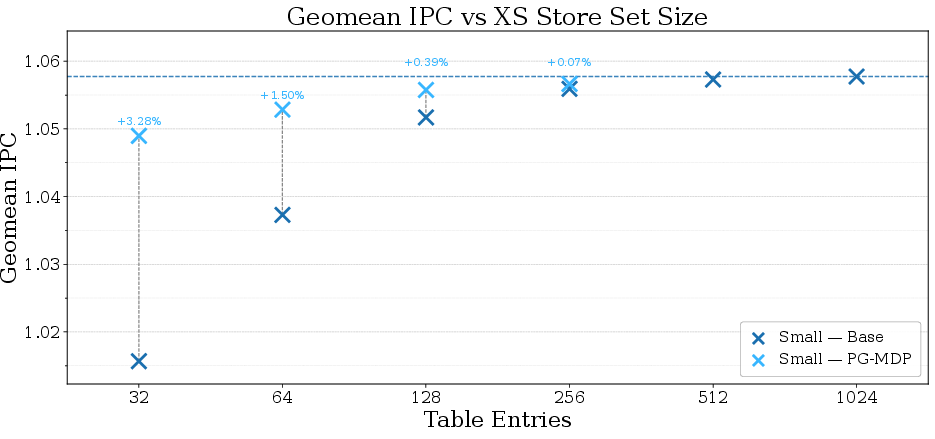
Figure 1: Base and improved IPC for increasing XS Store Set sizes; 64 entries with PG-MDP match within 0.5% of a 1024-entry predictor.
The analysis shows that a 64-entry memory dependence predictor augmented with PG-MDP achieves a geometric mean IPC within 0.5% of what is obtained using a 1024-entry predictor, effectively closing the area-performance gap with no area or bandwidth increase. This result is robust across both small and medium core configurations.
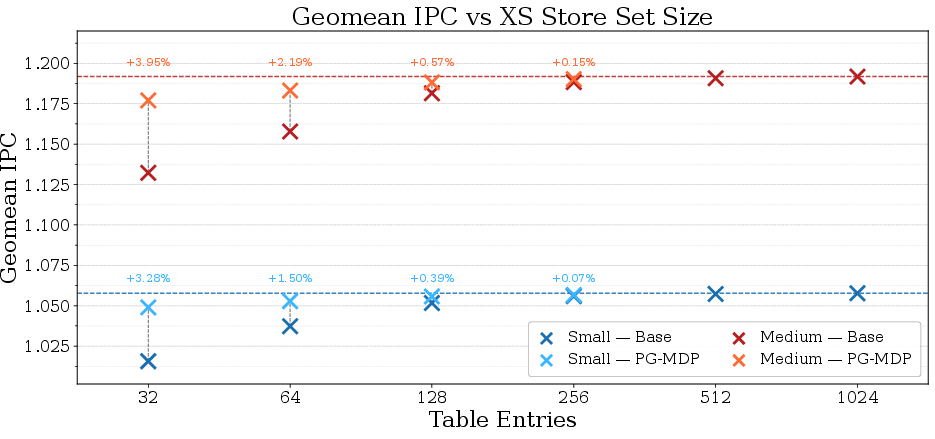
Figure 3: Impact of PG-MDP on IPC across SPEC2017 CPU intspeed for varying XS Store Set sizes; both small and medium core predictors see significant reduction in IPC gap.
PG-MDP's reduction in hardware lookup pressure is also quantified.
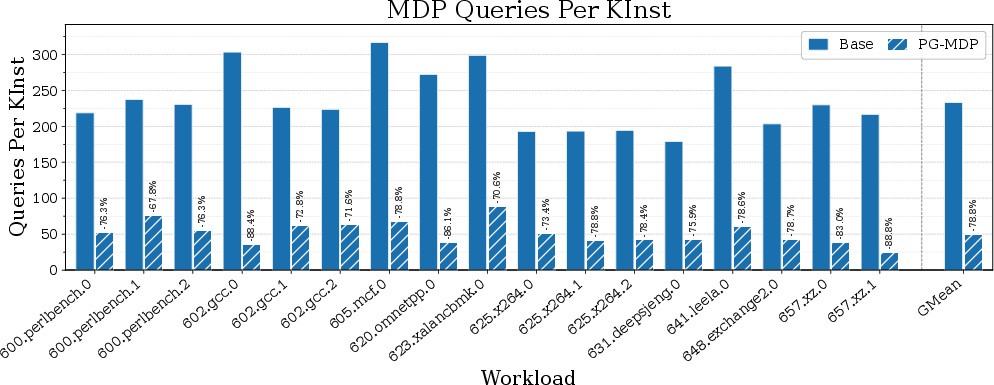
Figure 5: Percent change in MDP queries per kilo-instruction; approximately 77% reduction, confirming a drastic working set shrink.
The technique's improvements target workloads with high baseline false dependency rates; for these, up to 5.4% IPC gain is attained, while others are largely unaffected.
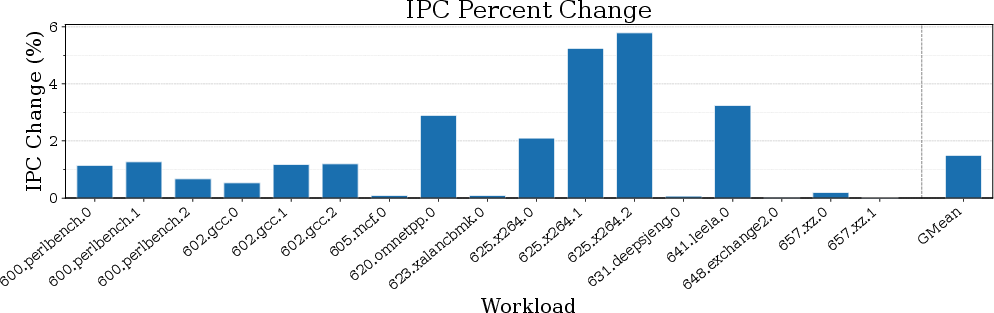
Figure 2: IPC % improvement with PG-MDP for each workload on the small core configuration; workloads with high baseline false dependencies benefit most.
Consistency is also observed in the significant, workload-agnostic reduction of false dependencies per kilo-instruction.
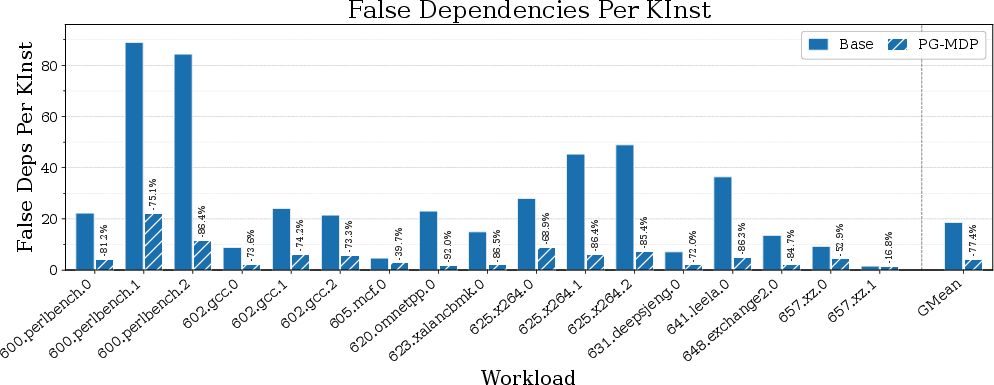
Figure 4: Percent change of false dependencies per kilo-instruction; large reductions across all workloads, especially those with high original rates.
The rate of actual memory order violations increases due to rare, mislabelled loads, but absolute occurrence remains insignificant, and overall net IPC is consistently improved.
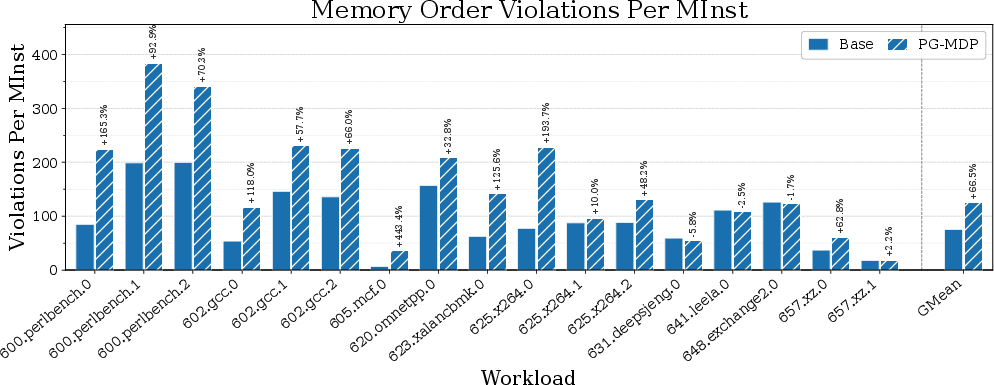
Figure 6: Percent change of memory order violations per Mega-instruction; relative increases are high in some workloads, but absolute values remain minor.
Architectural and Practical Implications
The findings have two immediate implications:
- Predictor Table Sizing: For area-bound out-of-order designs (e.g., efficiency cores in heterogeneous SoCs), a Store Set table 16x smaller can produce nearly the same IPC when combined with PG-MDP. This has direct implications for silicon area allocation and power.
- Scalability and Generality: PG-MDP is effective across different core sizes, and because the profiling is orthogonal to hardware state, per-core or per-workload thresholds can be tuned, or generic ones used, without regressions.
The approach also produces meaningful reductions in predictor power consumption. On a large core with PHAST-like predictors, the MDP query count and power usage are reduced without IPC loss.
Interaction with Microarchitectural Constraints
Realistic dispatch width is often throttled by MDP read port limitations. PG-MDP enables increased dispatch throughput by reducing demand for these ports, amplifying IPC improvements in realistic pipelined implementations.
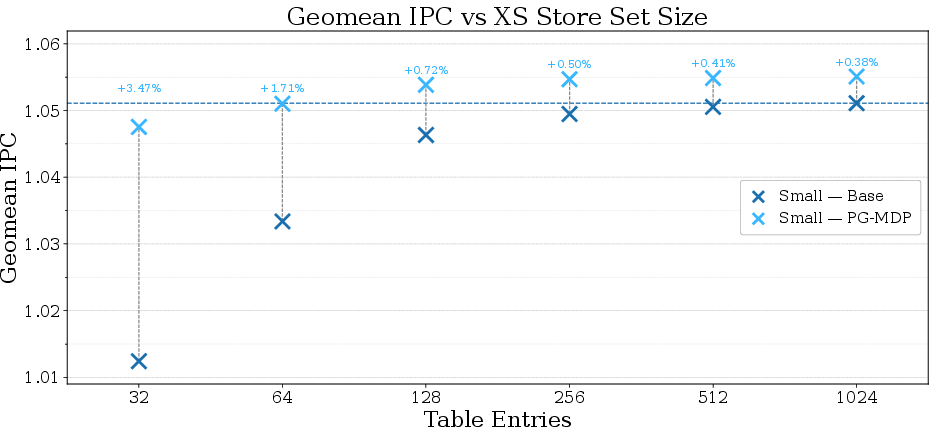
Figure 7: IPC as a function of predicted XS Store Set size when simulating limited MDP read ports; PG-MDP allows outsized throughput gains, especially for small predictors.
PG-MDP achieves a geomean IPC gain of 1.47% (up to 5.6% in some workloads), substantially exceeding static analysis-based load labelling approaches, which realize at best 0.1% IPC increase and often regress on more sophisticated predictors. In contrast to mechanism such as store-distance encoded ISA hints, PG-MDP imposes no additional instruction encoding bandwidth or hardware state, and is robust against profile coverage misses. In relation to large pure-hardware approaches (e.g., Constable, PHAST), PG-MDP achieves area- and power-efficient performance boosts with significantly reduced complexity, making it especially attractive for resource-constrained designs.
Potential Limitations and Future Directions
Implementation on legacy ISAs with limited encoding space (e.g., x86) may be challenging but alternatives exist (overloading register specifiers or adding metadata bits at decode). Compilation model assumptions (e.g., profile-guided thresholds) are modest relative to modern industry compiler practices. The method is compatible with further refinements such as per-workload thresholds, just-in-time compilation, and application to serverless workloads with consistently cold instruction streams. Adoption in JIT or runtime-compiled environments is an open avenue, especially given the dynamic profile-based approach's synergy with such execution models.
Conclusion
PG-MDP revisits the memory dependence prediction bottleneck in area-constrained out-of-order processors, reframing the central challenge from hardware capacity to predictor working set size. By integrating a profile-guided static labelling mechanism, prediction efficacy is robustly improved at negligible area, power, and complexity costs, with near-equivalent IPC to much larger predictors. This demonstrates that sophisticated, software-guided ISA-labelling holds significant promise for enabling high ILP and efficiency in resource-optimized microarchitectures.

