- The paper develops an analytical framework to determine the optimal timing of NPIs for reducing either the infection peak or the final epidemic size.
- It employs both classical SIR ODEs and degree-based mean-field network models to derive closed-form expressions for critical infection thresholds.
- The results indicate that interventions reducing transmission rates better control the overall outbreak size, though they may result in a higher infection peak.
Non-Pharmaceutical Interventions in SIR Epidemic Models: Infection Peak versus Final Epidemic Size
The paper "Analysis of non pharmaceutical interventions with SIR epidemic models: decreasing the infection peak vs. minimizing the epidemic size" (2604.08420) rigorously investigates the dynamical implications of temporary non-pharmaceutical interventions (NPIs) in classical and networked SIR epidemic models. The primary thrust is a detailed comparative analysis of two distinct public health objectives: minimizing the height of the infection peak versus minimizing the final epidemic size (R∞). The work systematically characterizes the critical points of the infectious time series under a variety of optimized NPI timings, accounting for both population-wide mean-field dynamics and heterogeneous contact structures.
A central contribution is the analytical characterization of scenarios that arise from single NPIs, with a specific focus on the effect of intervention timing as parameterized by the fraction Sb of susceptible individuals at NPI initiation. The research extends previous work by Atias and Assaf (2025) in two dimensions: (i) development of a full analytical apparatus for the infection peak minimization, complementing established results on final size minimization, and (ii) the explicit comparison between NPIs targeting transmission rate reduction (e.g., masks, ventilation) and contact structure modification (lockdowns, distancing) using degree-based mean-field (DBMF) network models.
Analytical Structure of SIR with Temporary NPI
The system follows a classic SIR ODE framework, where an NPI of fixed duration Δt and efficacy ξ (relative transmission suppression) is implemented when the susceptible population reaches Sb. This event-driven control policy is analytically tractable by rescaling to a natural timescale τ:
S˙=−B(t)SI,I˙=B(t)SI−I
where B(t)=β or ξβ depending on the NPI period.
The analysis yields exact critical point locations (potential peaks/minima of I(t)) by considering both continuous and discontinuous changes in the infection rate at the NPI boundaries. The architecture of possible epidemic trajectories reveals precisely six distinct scenarios, which are fully characterized by permutations of four key event times (Sb0, Sb1, Sb2, Sb3).
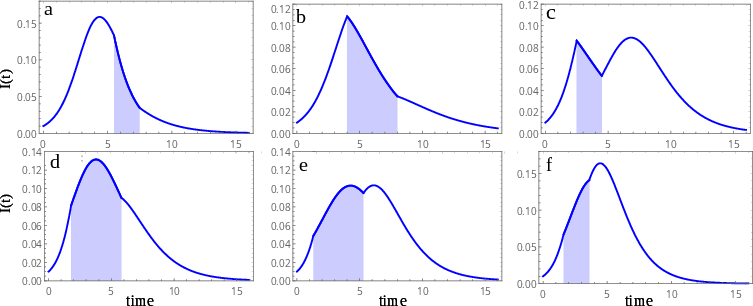
Figure 1: Representative Sb4 profiles for all six dynamical scenarios induced by a single temporary NPI across varying Sb5, illustrating peak formation before, during, and after the intervention.
The derivation includes closed-form expressions for Sb6 at each candidate critical point in terms of system parameters (Sb7, Sb8, Sb9, Δt0, Δt1), except for post-NPI events that depend on the integrated infectiousness during the NPI (Δt2). For this, a new analytical approximation to Δt3 is introduced—based on a hyperbolic sine mapping of the integration kernel—allowing extended validity beyond the short-NPI expansion in prior work. This approximation is benchmarked and yields accurate results when Δt4, with quantified bounds for its practical use.
Optimization: Infection Peak vs. Epidemic Size
Numerical and analytical investigations reveal a fundamental distinction: minimizing the epidemic size (Δt5) and the infection peak require different, non-overlapping optimal intervention windows. In all cases, the infection peak is minimized by initiating the NPI at a larger Δt6 (i.e., later into the outbreak), compared to the minimizer of Δt7.
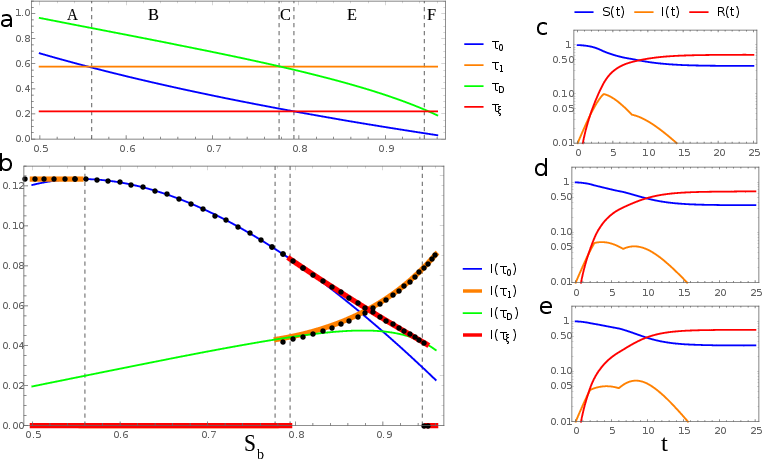
Figure 2: Values of Δt8 at all critical points as a function of Δt9, with vertical demarcation of transitions between dynamical scenarios. Optimal ξ0 for infection peak and ξ1 minimization are separated in the parameter space.
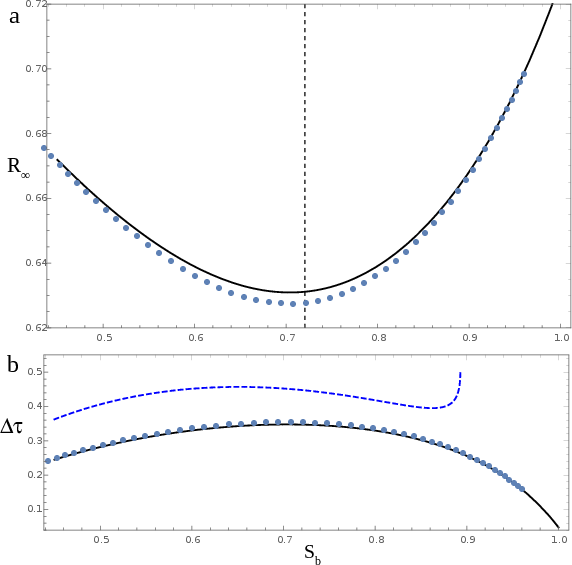
Figure 3: Final epidemic size ξ2 as a function of ξ3; both analytic and numerical results are shown, including the optimal ξ4 from a prior Taylor expansion-based approximation.
Key results include:
- The “cost” of prioritizing infection peak minimization is a modest increase in ξ5 (~5% for examined parameters), whereas prioritizing ξ6 minimization may lead to a substantially higher infection peak—a critical difference for health system overload management.
- The sequence and structure of scenarios are non-universal and traverse with ξ7, with double-peak solutions arising at intermediate intervention timings.
Network Effects and Disaggregated NPI Efficacies
Transitioning from the homogeneous SIR model, the paper employs a DBMF framework to incorporate heterogeneity in contact structure, implemented by Poisson degree distributions.
NPIs are classified as:
- Type I (Individual/Environmental): Temporary reduction in ξ8 (e.g., masking, ventilation).
- Type II (Lockdown/Social distancing): Temporary reduction in mean degree ξ9 (network rewiring).
- Combined: Simultaneous partial reduction in both.
The critical finding is that, when normalized for the same effect on the basic reproductive number Sb0, Type I NPIs more effectively suppress final epidemic size and second peak amplitude than Type II, though the latter may outperform in suppressing the primary peak during the NPI. The optimal timing for Type II interventions, when focused on peak minimization, shifts later (higher Sb1) than for Type I.
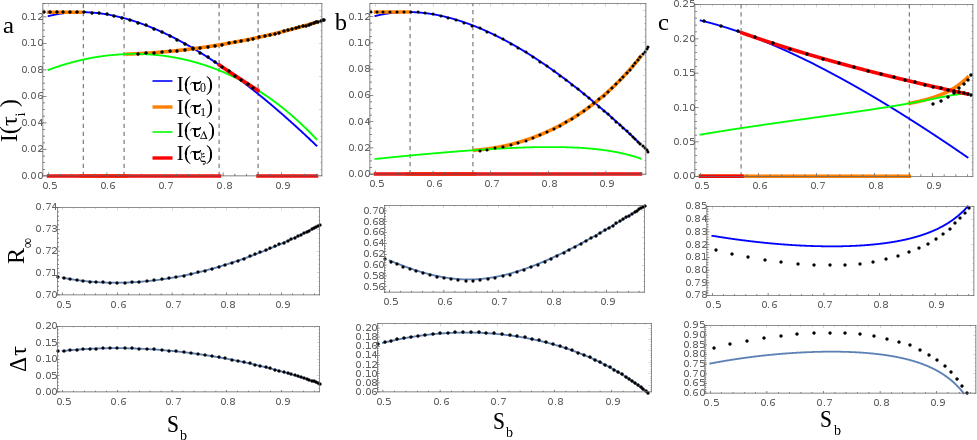
Figure 4: Comparison of local maxima of Sb2 (infection peaks) as a function of Sb3 for NPIs that reduce Sb4 (solid), reduce Sb5 (dashed), or both (dotted). Type I yields lower post-NPI peaks and smaller Sb6.
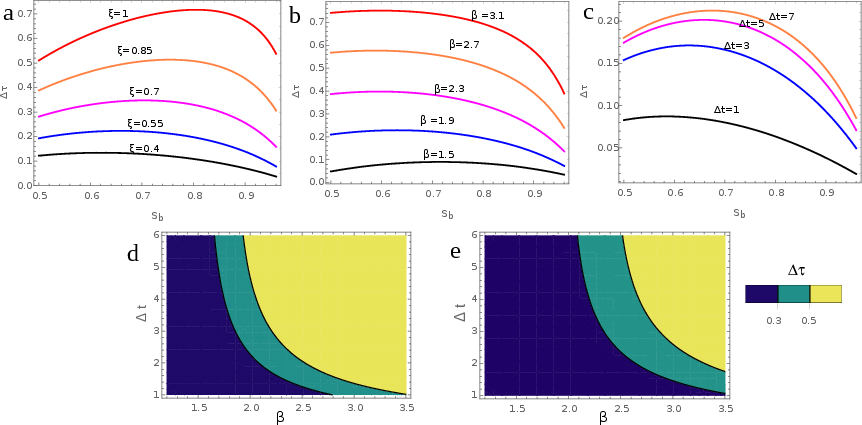
Figure 5: Analytical approximation for Sb7 (integral metric of infection activity during the NPI) across a range of parameters, serving as a validity check for the asymptotic approximations.
These conclusions are robust across a range of parameterizations, and the distinction between the NPI types is theoretically significant since standard SIR models cannot differentiate their impacts when calibrated only by Sb8.
Implications and Future Directions
The results underscore the necessity of distinguishing between objectives in epidemic control: minimizing the peak load on health infrastructure often requires fundamentally different policies (delayed but more timely NPIs) compared to strategies seeking to minimize attack rate (Sb9). The explicit demonstration that NPIs targeting individual-level transmission are more effective in reducing total outbreak size than structurally driven contact limitations (when scaled for the same τ0 effect) provides concrete guidance for policy allocation of resources during emerging epidemics.
The analytical developments—especially the approximation for τ1—enable tractable computation for more complex control policies and may inform the development of real-time adaptive triggers for interventions. The extension to network models elucidates how social structure modulates the effectiveness of different NPI modalities beyond what is observed in mean-field SIR models.
For future theoretical work, the framing invites generalization to models with multiple interventions, variable durations, stochasticity, and more realistic network topologies. The results highlight the need for dynamic, multi-objective optimization in public health: integrating τ2, peak size, and economic/social cost terms.
Conclusion
This work establishes a comprehensive analytical and computational framework for the timing and assessment of NPIs in both homogeneous and structured SIR models. It demonstrates that the optimal implementation parameters for minimizing infection peaks and final outbreak size are fundamentally misaligned and quantifies the trade-offs involved. The explicit consideration of NPIs' mechanisms clarifies that interventions reducing transmission rate outperform contact-structure modifications in minimizing final epidemic size, a finding with direct implications for public health strategy. The developed methodology offers a basis for further investigation into the interplay of timing, type, and intensity of NPIs in controlling epidemic outbreaks.