- The paper establishes a tight lower bound of Ω((log n)²) quantum queries for locating Tarski fixed points on 2D grids.
- It introduces a novel nested ordered search embedding and a composition theorem for the spectral adversary method.
- The analysis extends to higher dimensions, showing that quantum algorithms match classical lower bounds in lattice-ordered search problems.
Quantum Query Complexity of Tarski Fixed Point Search on the 2D Grid
Introduction and Problem Setting
This work addresses the quantum query complexity of finding a Tarski fixed point for a monotone function on the 2D grid lattice Ln2={1,…,n}2, ordered coordinatewise. Tarski’s fixed-point theorem guarantees the existence of such fixed points for monotone self-maps over complete lattices. The computational task considered is, given black-box access to a monotone f:Ln2→Ln2, locate a fixed point x such that f(x)=x, using as few oracle queries as possible, specifically in the quantum setting.
The main result is a tight lower bound: any bounded-error quantum algorithm for finding a Tarski fixed point on the 2D grid requires Ω((logn)2) queries, matching the best-known deterministic classical upper bounds. The result extends to higher-dimensional settings, proving an identical lower bound for all k≥2.
Techniques: Nested Ordered Search and Herringbone Hardness
The analysis exploits the deep connections between Tarski search and the classical nested ordered search problem, previously established for the 2D setting. Existing lower bounds for randomized query complexity have exploited families of “herringbone” functions—a construction where the unique fixed point is effectively concealed along a hard-to-locate path, the “spine”, embedded within the 2D grid. Classically, algorithms must perform binary search along the spine, and each step itself involves binary search perpendicular to the spine, leading to a randomized lower bound of Ω((logn)2).
In the quantum setting, lower bounds for standard ordered search are well-understood, but less so for compositions such as nested ordered search. The central innovation is to formalize and exploit this compositional structure in the context of quantum adversary methods.
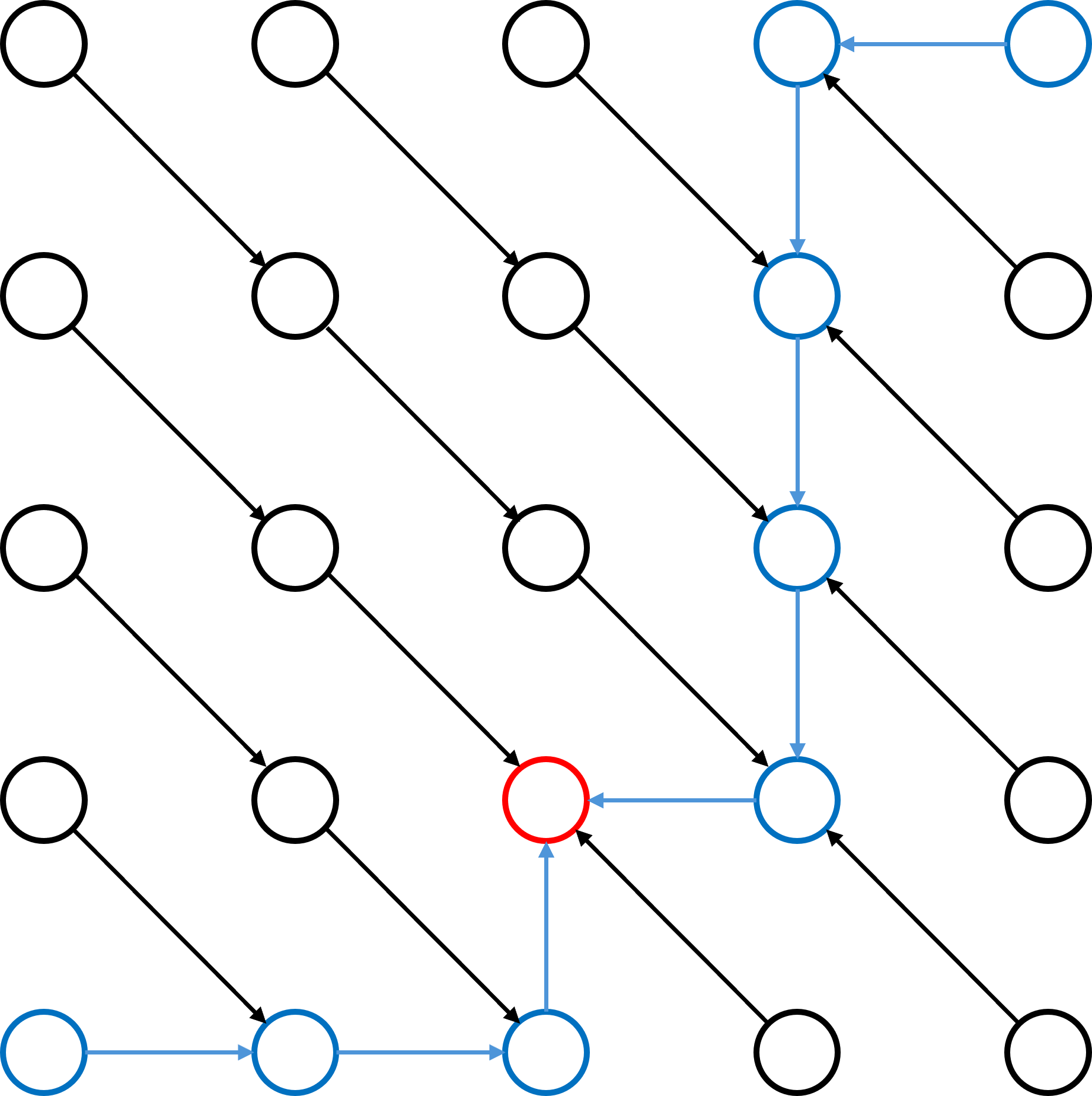
Figure 1: An example herringbone function for TARSKI(5,2). The blue nodes describe the spine, traversing the red fixed point; blue arrows indicate flow along the spine, while black arrows flow diagonally towards it.
Quantum Lower Bound via Compositional Adversary Arguments
The backbone of the proof is a composition theorem for the spectral adversary method, an established technique to give quantum query lower bounds. The spectral adversary lower bound SA(f) is evaluated via specially constructed matrices (adversary/distinguisher matrices) and provides a lower bound on quantum query complexity. The novel composition theorem proved here shows that, for a function h=f∘(g1,...,gk) where the f:Ln2→Ln20 are generalized search functions (i.e., each query either provides no information or completely reveals the answer), the adversary bound satisfies:
f:Ln2→Ln21
This generalizes known Boolean function composition theorems to settings with non-Boolean range and supports the desired argument given the specific structure of Tarski search and ordered search embeddings.
This composition theorem is then applied to “nested ordered search”, where the upper-level function is a standard ordered search and the lower-levels are generalized hidden-symbol ordered searches; each ordered search block further encodes an adversarial search subproblem.
Strong Claim: By embedding nested ordered search into a Tarski instance on a 2D grid, the work shows that any quantum algorithm for 2D Tarski must incur the lower bound for each level of the nested ordered search, i.e., f:Ln2→Ln22 total.
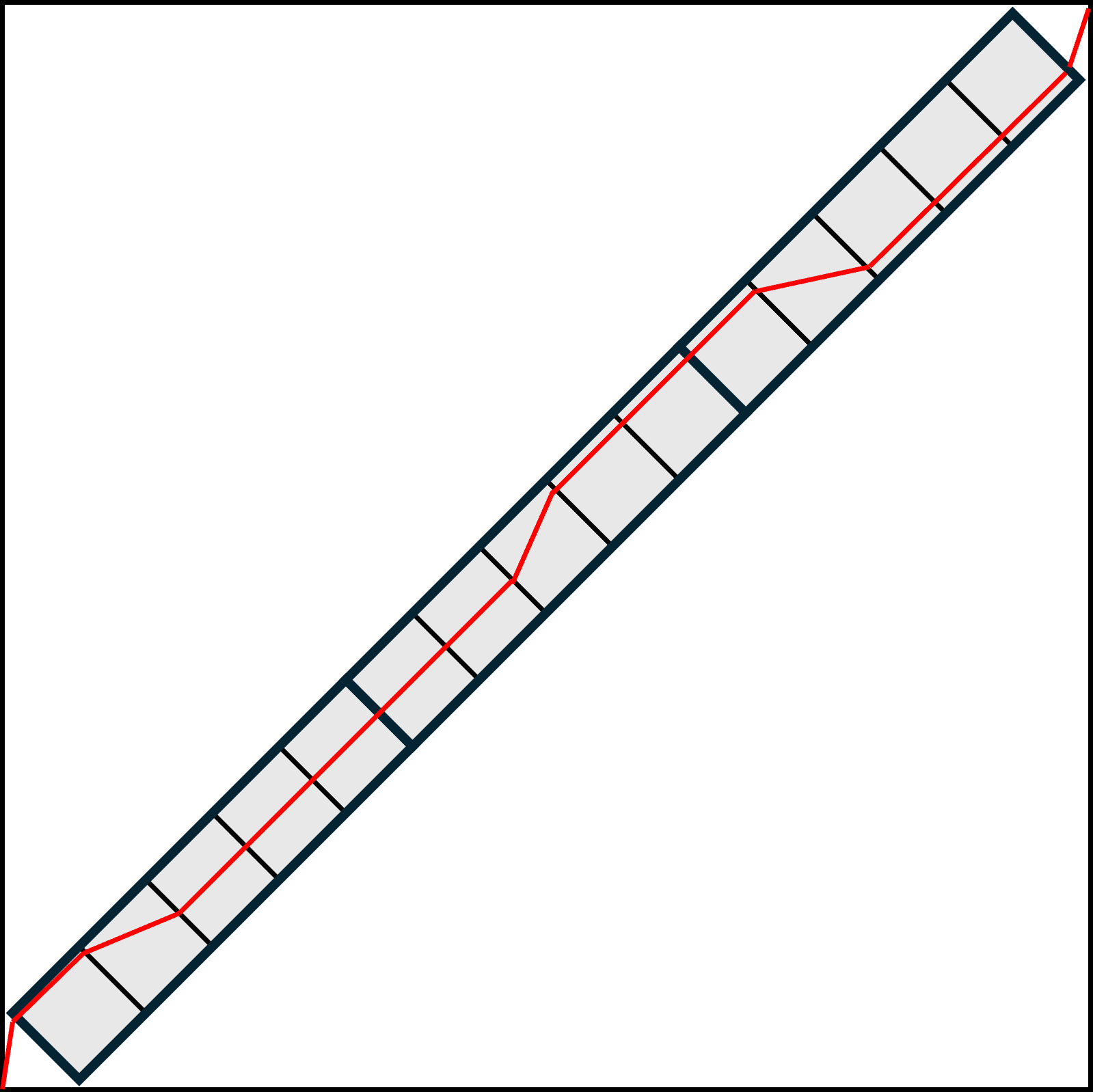
Figure 2: Illustration of a chunked spine constructed via concatenated grid segments, a tool for tightly embedding nested ordered search instances in the Tarski grid.
Technical Construction and Analysis
A family of “chunked spine” herringbone functions is constructed, parameterized to exactly encode all possible nested ordered search problem instances on an f:Ln2→Ln23 grid of size f:Ln2→Ln24. The grid is partitioned into “chunks” and “regions” in order to correlate decisions between the levels of the search and manage the dependency structure—mirroring the recursive nature of nested ordered search.
A crucial technical contribution is to show that, in this family, the location of the fixed point and the structure of the spine encode the input to the hidden-symbol search, and any distinguishing query essentially must “play” the same as optimal queries in the original search problem. Through careful adversary matrix analysis, the proof shows that quantum algorithms cannot circumvent this embedding or “shortcut” the structure; every effective query must resolve a nested search component, resulting in multiplicative lower bounds.
Additionally, monotonicity arguments extend the result to higher dimensions, as fixing the other dimensions reduces to the 2D case.
The work formally proves that the bounded-error quantum query complexity for the Tarski fixed point problem on f:Ln2→Ln25 with f:Ln2→Ln26 satisfies:
f:Ln2→Ln27
This closes the gap with deterministic and randomized classical algorithms for small f:Ln2→Ln28. Notably, this matches upper bounds known from recursive, slice-based fixed-point computation algorithms in the classical model, confirming quantum algorithms do not yield superpolynomial speedup on this fundamental lattice-ordered problem class.
Implications and Future Directions
The result demonstrates that the quantum adversary method—when extended compositionally—even in non-Boolean range settings, is sufficiently robust to match classical lower bounds for lattice-ordered monotone fixed-point search. This further suggests that quantum algorithms are tightly limited by the inherent combinatorial structure of the Tarski search problem in “natural” black-box settings.
For f:Ln2→Ln29, the picture is less clear: recent classical upper bounds break the direct x0 barrier. It is thus open whether quantum speedups are possible in high dimensions or whether yet stronger composition theorems and adversarial embeddings can extend the x1 barrier, possibly with additional layers of nested search or new hard function constructions.
Finally, the methods introduced here—particularly, the explicit compositional framework for the spectral adversary method—provide a pathway for future quantum lower bounds on structured search problems beyond Boolean function classes, and open the door for sharper complexity-theoretic analyses in total function search domains and equilibrium computation.
Conclusion
This work establishes, via a novel compositional adversary framework and a refined embedding of nested search structures into the 2D Tarski fixed-point problem, that quantum query algorithms for monotone lattice fixed-point search in two (or more) dimensions can achieve, at best, polynomial speedup and no more: x2 queries are necessary and sufficient. The analysis advances both the quantum lower bound toolset and our understanding of fixed-point search complexity in lattice-ordered spaces (2604.08223).