- The paper introduces a hybrid model combining PCA-reduced semantic embeddings with lightweight baitness and informativeness heuristics for robust clickbait detection.
- It evaluates classifiers like XGBoost, GraphSAGE, and GCN, with GraphSAGE achieving an F1-score of 0.8572 and a 25% reduction in inference time compared to XGBoost.
- Findings underscore that a minimal, interpretable feature set can effectively replace complex architectures for real-time clickbait detection.
Efficient Hybrid Detection of Clickbait: Balancing Feature Economy and Competitive Discrimination
Introduction
The proliferation of clickbait in digital journalism poses significant challenges, not only from an economic and psychological perspective but also in terms of algorithmic detection efficacy and deployability. The paper "Clickbait detection: quick inference with maximum impact" (2604.08148) addresses these issues by advancing a hybrid methodology that leverages semantic representations via OpenAI embeddings and compact, cost-effective heuristic features. The central focus is the trade-off between computational efficiency and discriminative performance in headline-only scenarios, where rapid inference is essential for real-world applicability.
Methodological Framework
Feature Construction
The approach combines PCA-reduced OpenAI embeddings (from the text-embedding-3-large model) with two heuristic signals—baitness and informativeness—designed to explicitly capture stylistic and factual aspects, respectively. Baitness encodes attention/arousal triggers (e.g., punctuation, sentiment, bait phrases), while informativeness targets lexical density and numerical specificity. The resulting feature vector is thus a 1002-dimensional hybrid, intentionally minimalist to enforce interpretability and low computational burden.
Classifier Selection
Three architectures are comparatively assessed:
- XGBoost: An efficient gradient-boosted tree ensemble known for its effectiveness in structured tabular data.
- GraphSAGE: An inductive GNN, exploiting relational kNN graphs induced by the hybrid feature space, well-suited for rapid propagation and inference.
- GCN: A classic GNN for semi-supervised classification on graphs, selected for prioritizing inference speed.
Models are systematically evaluated with respect to F1-score, ROC–AUC, and per-sample inference time, with the intent to elucidate the impact of model architecture on accuracy–latency trade-offs.
Empirical Results
Integration of the two heuristic scores with semantic vectors consistently improves class separation relative to embedding-only baselines—demonstrating the complementary value of lightweight, interpretable features. Among classifiers, GraphSAGE yields the highest F1-score (0.8572) and ROC–AUC (0.9356), outperforming XGBoost (F1: 0.8465, ROC–AUC: 0.9330), and GCN (F1: 0.8382, ROC–AUC: 0.9219). Equally significant is the reduction in inference latency: GraphSAGE achieves a roughly 25% reduction in inference time over XGBoost (178 ms vs. 237 ms per sample), with GCN commanding an even lower runtime (98 ms), albeit coupled with a modest performance drop.
The ROC curves (Figure 1) affirm that both graph-based approaches and XGBoost provide robust discrimination over a range of thresholds, supporting stable, threshold-independent operation.
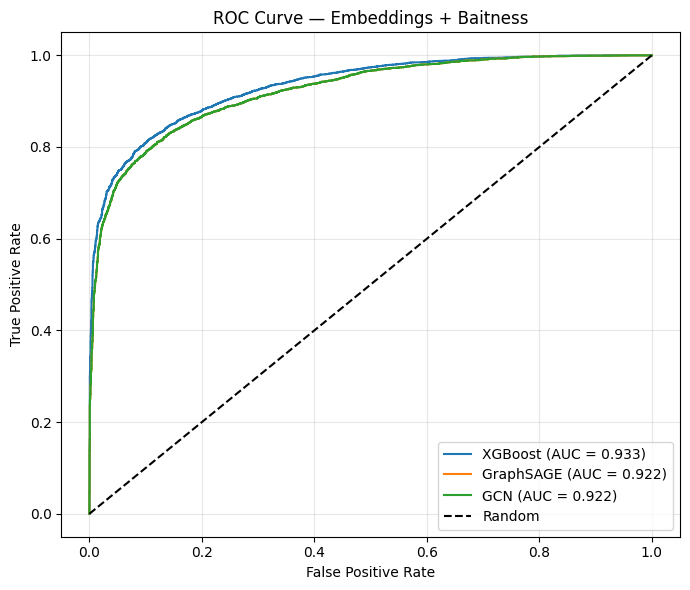
Figure 1: ROC curves for hybrid clickbait detection models using semantic embeddings and baitness features. Graph-based models achieve competitive discrimination performance compared to XGBoost.
Discussion
A key assertion is that the optimal configuration of semantic and heuristic features, minimally constructed, suffices for robust detection; excessive feature engineering and large deep architectures offer diminishing returns relative to implementation and inference costs. The evidence that GraphSAGE matches or surpasses strong tabular baselines with superior efficiency suggests that relational information in headline space, even under minimal kNN graph construction, provides a nontrivial performance boost without significant overhead.
Notably, all models display uniformly high ROC–AUC values, indicating that true clickbait can be effectively isolated with this feature regime. Given that embedding computation time dwarfs all downstream inference costs (reported at over 12,000 seconds for dataset embedding), further research may target embedding distillation or more efficient semantic backbone selection for end-to-end latency reduction.
The hybrid model abstains from multimodal or context-heavy pipelines, aligning with the insights that modern Transformer-based and multimodal approaches, while powerful, incur prohibitive costs in constrained or large-scale environments. This minimalist yet effective approach is therefore highly suited for integration into resource-aware deployments, such as browser extensions or real-time news filtering systems.
Theoretical and Practical Implications
The findings reinforce several points for future system design:
- Feature minimalism: A small set of diagnostic, interpretable features can substantially enhance deep representations, particularly for tasks where context is minimal.
- Efficiency–accuracy Pareto frontier: Relational classifiers (GNNs) can outperform or match ensemble trees in both F1 and latency in highly structured settings.
- Deployment viability: The proposed model is directly usable in production settings where immediate classification of streaming headlines is required, such as in-browser content moderation or mobile device screening.
Future Prospects
Further work may involve:
- Exploration of dynamic graph construction, feature recalibration, or adaptive thresholds for even better trade-offs.
- Investigation of embedding production costs, including pre-caching, quantized representations, or lightweight sentence encoders to mitigate initial bottlenecks.
- User-centric deployment studies, e.g., end-user browser extensions and real-time filtering pipelines, to validate effectiveness in situ.
Conclusion
This paper provides authoritative evidence that efficient clickbait detection in headline-only environments does not require complex architectures or extensive feature sets. Strategic fusion of compact, interpretable heuristics with reduced semantic embeddings—supported by GNN classifiers—enables competitive discrimination and fast inference, meeting core requirements for scalability and real-time deployment. These results should inform future deployments where rapid, transparent, and robust clickbait detection is mandatory.

