TinyDEVO: Deep Event-based Visual Odometry on Ultra-low-power Multi-core Microcontrollers
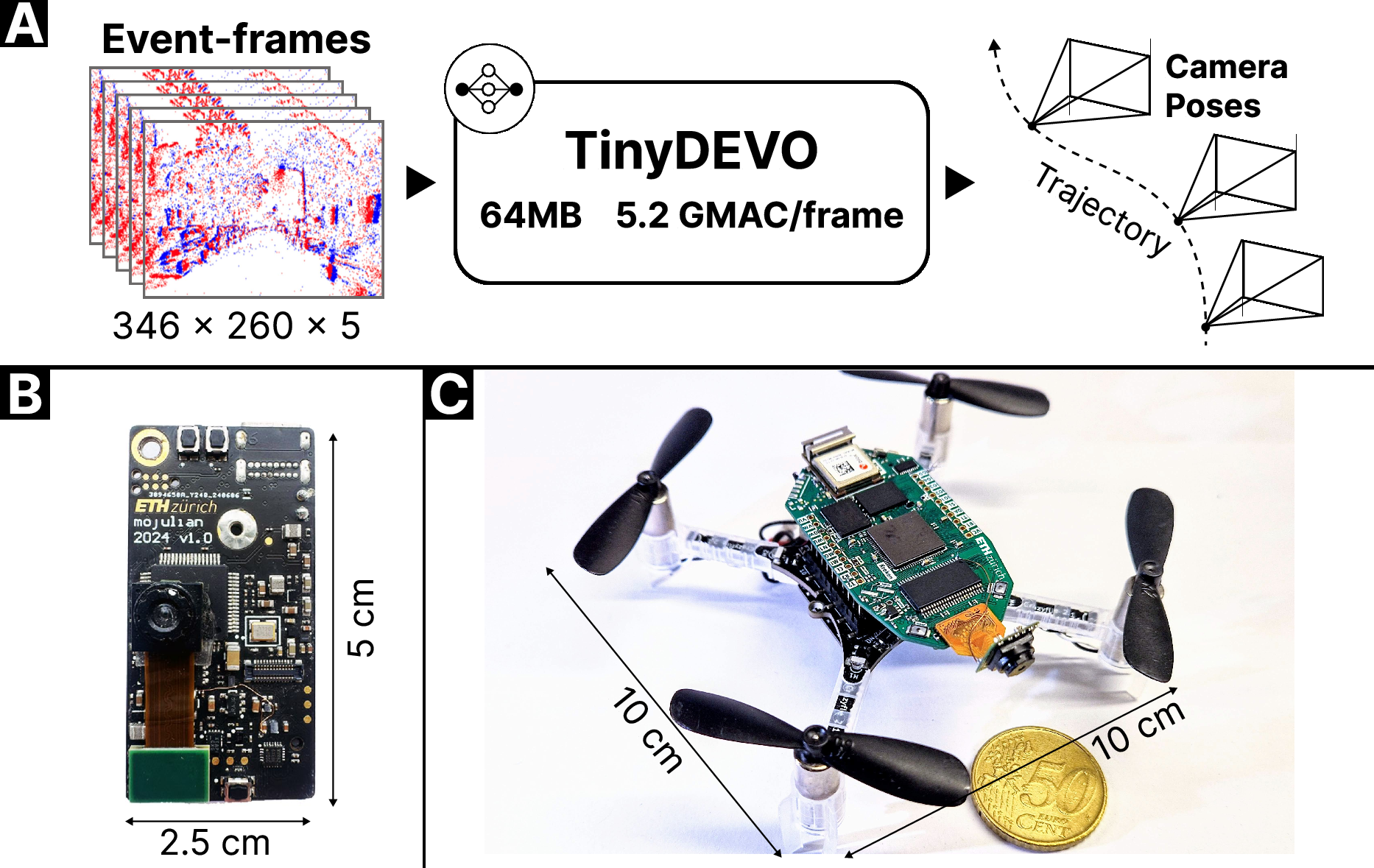
Abstract: A key task in embedded vision is visual odometry (VO), which estimates camera motion from visual sensors, and it is a core component in many embedded power-constrained systems, from autonomous robots to augmented and virtual reality wearable devices. The newest class of VO systems combines deep learning models with bio-inspired event-based cameras, which are robust to motion blur and lighting conditions. However, state-of-the-art (SoA) event-based VO algorithms require significant memory and computation. For example, the leading approach DEVO requires 733 MB of memory and 155 billion multiply-accumulate (MAC) operations per frame. We present TinyDEVO, an event-based VO deep learning model designed for resource-constrained microcontroller units (MCUs). We deploy TinyDEVO on an ultra-low-power (ULP) 9-core RISC-V-based MCU, achieving a throughput of approximately 1.2 frames per second with an average power consumption of only 86 mW. Thanks to our neural network architectural optimizations and hyperparameter tuning, TinyDEVO reduces the memory footprint by 11.5x (to 63.8 MB) and the number of operations per frame by 29.7x (to 5.2 billion MACs per frame) compared to DEVO, while maintaining an average trajectory error of 27 cm, i.e., only 19 cm higher than DEVO, on three state-of-the-art datasets. Our work demonstrates, for the first time, the feasibility of an event-based VO pipeline on ultra-low-power devices.
Paper Prompts
Sign up for free to create and run prompts on this paper using GPT-5.
Top Community Prompts
Explain it Like I'm 14
Overview
This paper is about teaching tiny, low-power computers to understand how they’re moving just by looking at what a special camera sees. That skill is called visual odometry (VO): figuring out the camera’s path and direction over time. The authors built a new system called TinyDEVO that uses “event cameras” (cameras that report only changes, not full pictures) and deep learning to do VO on very small, battery-friendly chips.
What questions were the researchers asking?
- Can we make a deep-learning VO system that’s small and efficient enough to run on ultra-low-power microcontrollers (tiny computers) instead of big, power-hungry graphics cards?
- If we shrink and simplify a top VO model (called DEVO), how much memory and computation can we save without losing too much accuracy?
- Is it possible to run this on real hardware at practical speeds and power levels?
How did they approach the problem? (Explained simply)
Think of the original DEVO system as a very smart, but heavy backpack full of tools. It works great, but it’s too large and power-hungry for tiny devices like smart glasses or miniature drones. The authors made that backpack lighter by:
- Using an event camera: Instead of taking full pictures, event cameras report only pixel changes (like saying “this spot got brighter” or “this spot got darker”). That’s faster, uses less data, and works well in tricky lighting.
- Shrinking the “brain”: They reduced the size of the neural network (fewer channels and simpler blocks), so it uses less memory and does fewer math steps.
- Cutting out parts that matter less: They removed some extra connections and certain processing steps that had little impact on accuracy but cost a lot of computation.
- Tuning how much the model looks at: They carefully chose how many small image “patches” to compare and how far back in time to look, to balance speed and accuracy.
Analogy:
- Patchifier: Imagine slicing the camera’s view into small tiles and turning them into compact features (like quick summaries).
- Correlation: Compare these tiles over time to see how they shift, which suggests motion.
- Update and bundle adjustment: A clean-up step that refines the motion estimate so the overall path makes sense.
They then ran TinyDEVO on a 9-core RISC-V microcontroller (a tiny, efficient chip) to see how fast it goes and how much power it uses.
What did they find, and why is it important?
TinyDEVO keeps VO accurate enough for many uses while being drastically smaller and more efficient:
- Memory: About 11.5 times less memory than DEVO (from about 733 MB down to 63.8 MB).
- Computation: About 30 times fewer math operations per frame (from about 155 billion down to 5.2 billion multiply–accumulate operations).
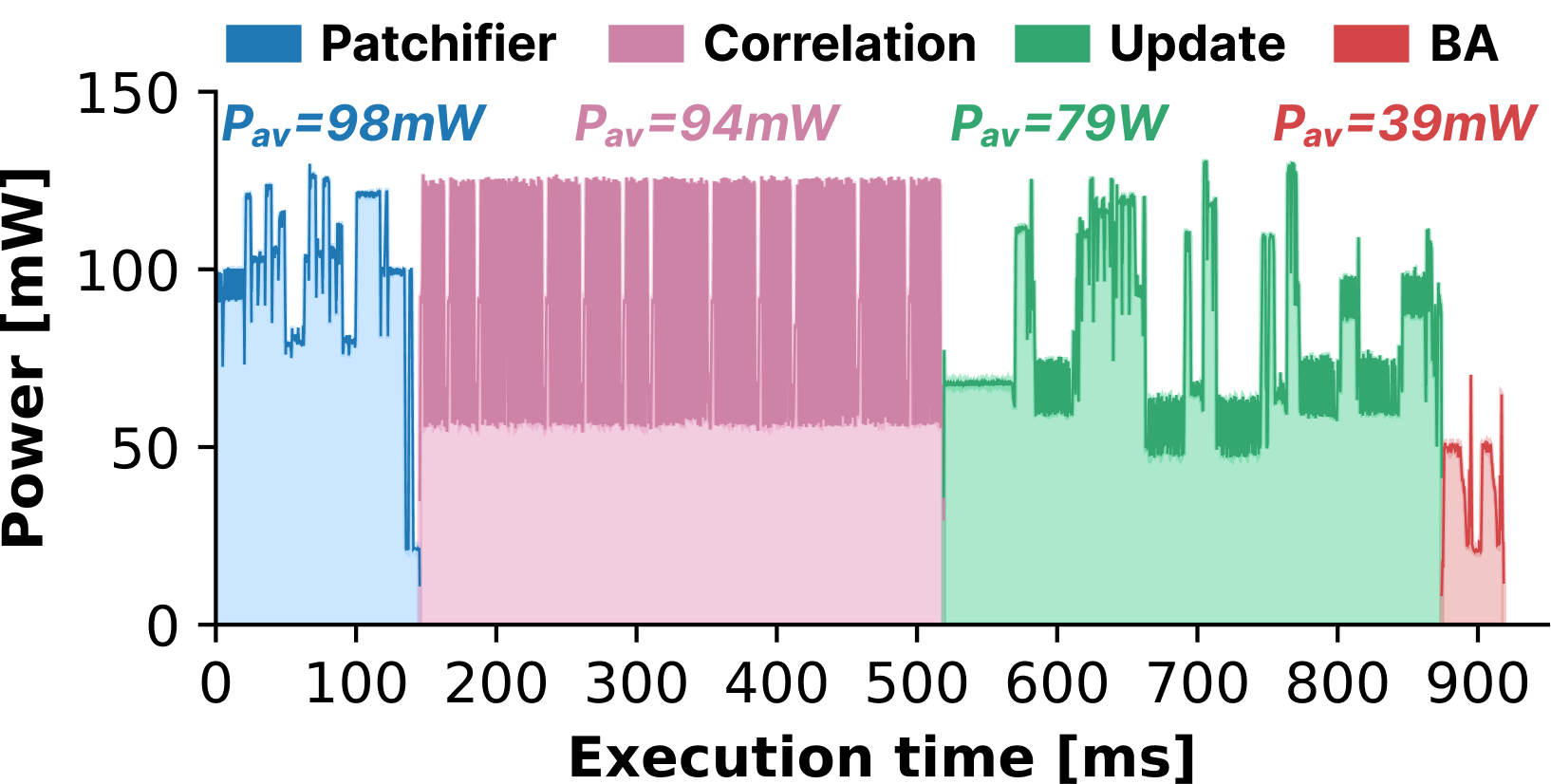
- Speed and power on tiny hardware: Runs at around 1.2 frames per second while using only 86 milliwatts on a small 9-core microcontroller.
- Accuracy: The path error (how far off the guessed path is from the true path) is only a bit worse than the big model. Across three datasets:
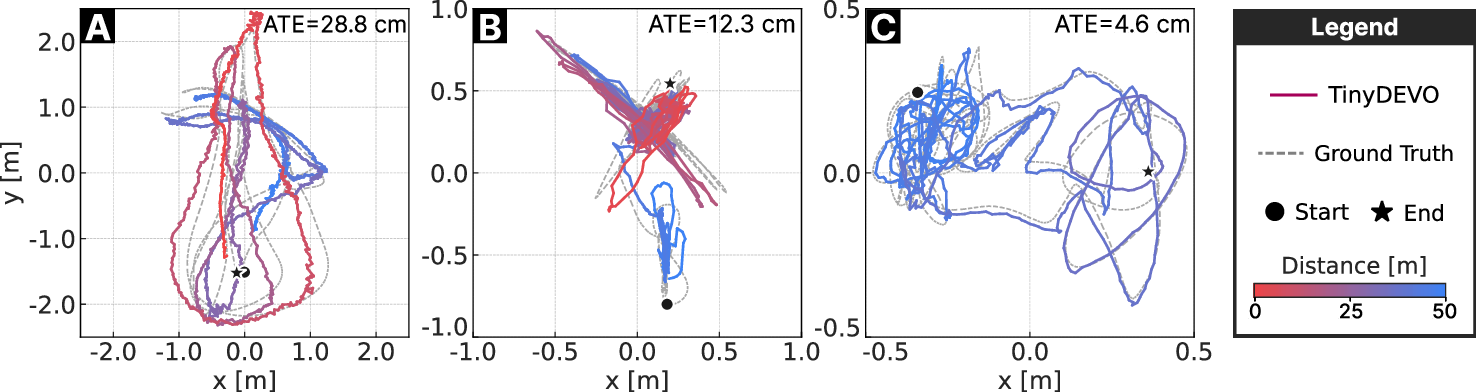
- MVSEC: 27 cm average error (DEVO was about 8 cm)
- HKU: 45.3 cm (DEVO ~26 cm)
- RPG: 4.9 cm (DEVO ~0.9 cm)
- Overall, TinyDEVO is roughly 19 cm worse on average, but that trade-off enables ultra-low-power operation.
Why it matters:
- This is the first time a state-of-the-art event-based VO pipeline has been shown to work on ultra-low-power microcontrollers. That means smaller, cheaper, and more energy-efficient devices can now understand their motion without needing big batteries or powerful computers.
What could this mean for the future?
- Smart glasses: Better head tracking with tiny batteries, even in dim or bright environments.
- Mini robots and drones: More autonomy and navigation on very small platforms that can’t carry heavy hardware.
- Wearables and IoT devices: More accurate movement tracking without draining power.
- Broader access: High-performance vision techniques can run on simple chips, making advanced features possible in everyday gadgets.
In short, TinyDEVO shows that you can get very capable motion understanding from event cameras using deep learning, all on tiny, low-power devices. This opens the door to smarter, more efficient wearables and robots that can operate longer and in more places.
Knowledge Gaps
Knowledge gaps, limitations, and open questions
The paper makes a strong case for event-only VO on ultra-low-power MCUs, but it also leaves several concrete questions and limitations for future work:
- End-to-end throughput remains low (≈1.1–1.2 FPS at ≈86 mW), which is insufficient for many AR/VR and robotics use cases; how to reach ≥10–30 FPS within a sub-100 mW envelope without sacrificing accuracy?
- The deployed system relies on large off-chip memory (HyperRAM); how can the model and pipeline be redesigned to fit entirely within on-chip L2/SRAM (≤1–2 MB) while preserving accuracy?
- The final model still reports substantial peak memory (63.8 MB in algorithm-level analysis, 26.1 MB in the mixed-precision MCU deployment); reconcile and standardize memory reporting across settings and reduce external memory energy overheads.
- The softmax-based scatter aggregations (SA) remain a major bottleneck; can approximate/accelerated softmax (e.g., polynomial/logit approximations, lookup tables, fused kernels) or alternative aggregation mechanisms offer similar accuracy with much lower compute and memory?
- The impact of quantization on accuracy is not quantified; what is the ATE delta from FP32 to FP16/BF16/int8, and can more aggressive schemes (int4, mixed per-layer precision, post-training vs. QAT) further shrink memory/compute without unacceptable error?
- EVG (event voxel grid) construction latency/energy on the MCU is not measured; what is the full end-to-end cost (event readout → voxelization → inference → pose) and how can the pre-processing be optimized (e.g., streaming, DMA-friendly binning, hardware assist)?
- Sensitivity to stationary periods is acknowledged (ATE degrades unless trimming is applied); how to robustly handle low-motion/no-motion regimes (e.g., background-activity filters, refractory-time denoising, adaptive thresholds, IMU gating) without trimming?
- Hyperparameters for edge reduction are tuned on MVSEC only; do these choices generalize to HKU/RPG and other datasets, or is adaptive per-sequence tuning (or learned hyperparameters) needed on-device?
- The method remains monocular and uses Umeyama alignment (unknown scale); what is the feasibility and cost of adding minimal IMU fusion for metric scale and robustness on the same MCU?
- Real-time behavior is evaluated in FPS of EVG frames, not in terms of event-to-pose latency; what is the end-to-end latency distribution under varying event rates, and how does it affect closed-loop control stability?
- Robustness to event-rate spikes (e.g., fast motion, flickering lights) is not characterized; how do compute, memory, and accuracy scale with event rate, and can the algorithm dynamically adapt window sizes or patch counts to stay within power/latency budgets?
- Bundle adjustment is executed in BF16/FP16 without reporting numerical stability effects; how do reduced precision and solver parameter choices impact convergence and drift over long trajectories?
- There is an internal inconsistency in reported RPG ATE (4.9 cm earlier vs. 2.2 cm in the comparison section); clarify evaluation protocols and provide a unified, reproducible reporting pipeline.
- Runtime edge pruning is mentioned but edge-reduction choices are evaluated assuming worst-case (no pruning); what are the actual savings/accuracy impacts of pruning on-device across diverse scenes?
- Patch sampling is fixed and uniform; can learned or saliency/entropy-guided patch selection achieve the same or better accuracy with fewer patches/edges?
- Training is on TartanAir and uses custom losses; assess domain gaps to real event data, and explore techniques (knowledge distillation from DEVO, strong event-specific augmentations, domain adaptation, or self-supervised on-device fine-tuning) to recover the accuracy lost by model shrinking.
- The EVG choice (five voxel grids) is not revisited for MCU efficiency; evaluate alternative representations (time surfaces, leaky integrators, sparse splats, adaptive bin counts) that may reduce memory and improve latency.
- Evaluation excludes outdoor/high dynamic range and high-speed scenarios; how does TinyDEVO perform across illumination extremes, dynamic scenes, and long-range outdoor trajectories that event cameras are known to benefit from?
- The deployed sensor (Prophesee GENX320) differs from evaluation datasets (DAVIS240/346); quantify domain shift due to sensor differences (resolution, biasing, noise) and validate on GENX320-specific datasets.
- Power measurements exclude the event camera and inertial sensors; report full system energy (SoC + memory + sensor suite) and explore duty-cycling/DVFS strategies to meet platform-level budgets.
- No closed-loop tests are reported (e.g., on a nano-drone or wearable); assess trajectory drift, failure modes, and control performance in real-time embodied scenarios over long durations without loop closure.
- Only ATE is reported; provide translational/rotational error breakdowns, drift per meter, and robustness under texture-poor or dynamic objects to identify failure modes and guide targeted improvements.
- Hardware mapping is partial: convs use NE16, but correlation/BA run on cores and SA on FPUs; can these be restructured to exploit accelerators (e.g., NE16 for 1×1/3×3 substitutions, specialized kernels for correlation/softmax) or fused to reduce L3 traffic?
- Explore architectural alternatives that better exploit event sparsity (e.g., sparse convolutions, event-driven spiking networks, lightweight attention) to reduce compute without sacrificing temporal reasoning.
- Investigate adaptive windowing (R_w, P_LT) and early-exit mechanisms that react to scene dynamics to trade off latency and accuracy on the fly.
- Assess sensitivity to calibration (intrinsics, distortion) and event sensor bias settings; provide procedures for calibration-robust operation on resource-constrained platforms.
- Provide code/models and a standardized evaluation harness (datasets, trimming policy, alignment, seeds) to ensure reproducibility and facilitate fair comparisons across embedded VO methods.
Practical Applications
Below are practical applications that flow from TinyDEVO’s findings and optimization methodology—focusing on what can be deployed now versus what likely needs further research, scaling, or integration.
Immediate Applications
These can be built and piloted with current TinyDEVO performance (~1.1–1.2 “frames”/s at ~86 mW on a 9-core RISC‑V MCU, peak memory ~26 MB post-quantization at 346×260; lower at 240×180), event cameras (e.g., 3–9 mW), and off-the-shelf components.
- AR/VR wearables: always-on, low-power pose “keeper”
- Sector: consumer electronics, XR
- Use case: Keep coarse head-pose tracking active while the main SoC sleeps; wake the XR stack when movement exceeds a threshold or lighting is extreme (HDR, motion blur).
- Tools/products/workflows:
- A TinyDEVO-based “coarse odometry coprocessor” module on a ULP MCU + event sensor (e.g., GENX320).
- IMU fusion (e.g., EKF/UKF) to upsample pose to control rates and stabilize scale.
- Power/thermal policy: switch between low-power TinyDEVO and high-performance tracker.
- Assumptions/dependencies:
- ~1 Hz VO is adequate for standby/guard states, not for high-quality rendering.
- Requires accurate camera-IMU calibration and scale handling (monocular scale ambiguity).
- Headsets need external RAM/bus bandwidth similar to GAP9 + HyperRAM; vendor-specific accelerators (NE16-like) help.
- Nano-robots and micro-drones: slow/autonomy phases in HDR or low light
- Sector: robotics (UAV/UGV)
- Use case: Odometry for slow or stop-and-go navigation, landing/perching, homing, or energy-saving cruise; fallback odometry when GPS is unavailable.
- Tools/products/workflows:
- A “ULP VO shield” (MCU + event camera) fused with an IMU in an onboard state estimator.
- Mission manager that throttles vehicle speed to match ~1 Hz VO updates; triggers high-rate compute only when needed.
- Assumptions/dependencies:
- Platform must cap speed and/or use IMU/high-rate controller to bridge between VO updates.
- Requires robust camera-IMU extrinsic calibration and synchronization.
- Stationary periods may degrade event quality; add motion “dithering” or logic to skip/noise-filter stationary frames.
- Industrial inspection crawlers and pipe robots
- Sector: energy, manufacturing, infrastructure
- Use case: Low-speed odometry for inspection in dark/high-contrast environments (pipes, tunnels, substation conduits).
- Tools/products/workflows:
- Ruggedized module with event camera + TinyDEVO + IMU; ROS 2/micro-ROS node for odometry publishing.
- HDR-capable visual sensing complements inertial and wheel odometry (if any).
- Assumptions/dependencies:
- Slow traversal means ~1 Hz VO usable for mapping/layered SLAM backends.
- Requires temperature/EMI-robust packaging and periodic calibration.
- Warehousing/indoor asset localization tags (coarse drift-bounded odometry)
- Sector: logistics
- Use case: Battery-driven localization tags on slow-moving carts/trolleys where GPS is unavailable; coarse VO fused with BLE/UWB anchors for intermittent absolute fixes.
- Tools/products/workflows:
- TinyDEVO + IMU front-end; periodic anchor updates in a factor graph to bound drift.
- Event camera mounting that sees some texture/edges on ceilings/walls.
- Assumptions/dependencies:
- Motion must be slow and intermittent; anchor availability for drift reset.
- Memory/power budget accepting ~100 mW peak.
- Energy-aware “graceful degradation” mode in mobile robots
- Sector: robotics
- Use case: When battery is low, robots switch from a GPU VO stack to TinyDEVO, reducing power draw while maintaining basic motion estimation for retreat/return-to-base.
- Tools/products/workflows:
- Runtime policy manager; health monitor; thresholds for switching VO backends.
- Assumptions/dependencies:
- Accept reduced throughput and accuracy during egress; path planning adjusts speed/trajectory.
- Embedded-vision research/education testbed
- Sector: academia, semiconductor
- Use case: Teaching and benchmarking event-based DL VO on RISC‑V MCUs; ablation/quantization studies; methodology transfer to other tasks.
- Tools/products/workflows:
- GAPflow quantization pipeline; TinyDEVO reference implementation.
- Labs on patch-graph hyperparameter “knee selection” and mixed-precision deployment.
- Assumptions/dependencies:
- Availability of GAP9-like boards with external RAM; event cameras/datasets.
- Privacy-forward indoor localization
- Sector: policy, facilities, consumer IoT
- Use case: Event cameras for localization reduce capture of detailed textures/faces compared to RGB, supporting privacy-by-design deployments in workplaces, hospitals, and homes.
- Tools/products/workflows:
- Privacy impact assessment templates emphasizing event data characteristics and retention limits.
- On-device processing to avoid raw data egress.
- Assumptions/dependencies:
- Policy must recognize the (relative) privacy advantages of events; communicate residual risks (events can be transformed to frames under some conditions).
Long-Term Applications
These require higher throughput, broader integration (e.g., IMU/VIO/SLAM), additional hardware acceleration, or further validation in diverse environments.
- Hard real-time ULP VIO/SLAM at 10–30 Hz on MCUs
- Sector: robotics, XR, wearables
- Use case: Replace or augment GPU-based pipelines with MCU-grade event VIO/SLAM (loop closure, mapping) for fully autonomous navigation and high-quality head tracking.
- Tools/products/workflows:
- Enhanced accelerators for softmax/reduction ops and sparse graph updates; deeper quantization (int4/int8) with accuracy-preserving training.
- Co-design of VO + feature-based loop closure using event descriptors.
- Assumptions/dependencies:
- Next-gen MCUs/NPUs and memory bandwidth; algorithmic improvements to update-rate and scale estimation.
- Battery-free or energy-harvested localization
- Sector: IoT, smart buildings, agriculture
- Use case: Deploy VO nodes powered by light/vibration harvesters for sporadic self-motion tracking (e.g., movable fixtures, tools, carts).
- Tools/products/workflows:
- Adaptive duty-cycling; ultra-low-power event sensors; compressive compute (event sparsification, wake-on-motion).
- Assumptions/dependencies:
- Order-of-magnitude power reduction and event-driven execution scheduling.
- Automotive-grade fallback odometry (GNSS-denied emergencies)
- Sector: automotive, infrastructure
- Use case: Event-based VO as a fail-operational backup in tunnels/nighttime glare or for localization when main sensors fail.
- Tools/products/workflows:
- Sensor fusion with wheel encoders, IMU, lidar/radar; formal safety cases (ISO 26262).
- Assumptions/dependencies:
- Throughput >10 Hz and extensive validation; ASIL-level certification and rigorous ODD coverage.
- Assistive navigation for visually impaired users
- Sector: healthcare, assistive tech
- Use case: Wearable ULP VO (event + IMU) to provide relative motion cues indoors with high dynamic range robustness; fused with beacons/maps for guidance.
- Tools/products/workflows:
- Haptic/audio feedback; smartphone/edge gateway for periodic absolute localization; safety UX.
- Assumptions/dependencies:
- Higher-rate pose estimates and robust scale; human-centered trials and regulatory approvals.
- Swarm micro-drones with on-device event VO
- Sector: robotics, defense, public safety
- Use case: Coordinated exploration in GPS-denied, low-light environments with each agent running ULP VO + cooperative mapping.
- Tools/products/workflows:
- Lightweight communication protocols for pose sharing; distributed SLAM backends adapted to event data.
- Assumptions/dependencies:
- Increased VO rate and communication-efficient SLAM; robust cross-calibration in the field.
- Self-supervised on-device adaptation
- Sector: academia, software tools
- Use case: Combine TinyDEVO with on-device self-supervised learning (e.g., domain adaptation on nano-drones) to maintain accuracy across new environments.
- Tools/products/workflows:
- Low-power training loops (BF16/INT8), confidence-driven updates; curriculum for event-domain shifts.
- Assumptions/dependencies:
- Stabilized training under power/thermal constraints; memory for replay buffers.
- Standardization and policy frameworks for low-power, privacy-friendly localization
- Sector: policy, standards bodies
- Use case: Procurement and compliance guidelines that favor event-based, on-device VO for energy efficiency and reduced data liability in public/enterprise spaces.
- Tools/products/workflows:
- Energy-per-frame and privacy metrics; reference conformance tests using public datasets.
- Assumptions/dependencies:
- Broad stakeholder acceptance; clarity on privacy guarantees and data governance.
- Developer SDKs and ROS ecosystems for event-VO-on-MCU
- Sector: software, semiconductor
- Use case: Turn the paper’s methodology into toolchains (training → quantization → codegen → deployment) across MCU families, with ROS 2 nodes and micro-ROS bridges.
- Tools/products/workflows:
- Auto-tuning of patch-graph hyperparameters (knee-point search), mixed-precision libraries, accelerated softmax/reduce kernels.
- Assumptions/dependencies:
- Vendor support and cross-hardware portability; reproducible accuracy across compilers and quantization schemes.
Cross-cutting assumptions and dependencies (impacting both categories)
- Throughput vs. platform speed: Current ~1 Hz VO requires either slow platform motion or IMU fusion to bridge control rates; many target products will need higher VO rates.
- Scale ambiguity: Monocular VO needs scale from auxiliary sensors (IMU, barometer, altimeter) or scene priors.
- Memory and accelerators: Best performance assumes external RAM (tens of MB at higher resolutions) and NE16-like INT8 conv accelerators; pure CPU-only MCUs will see lower performance.
- Scene texture and motion: Event cameras need motion and edges; stationary periods and low-texture scenes reduce signal—workflows must handle these cases gracefully.
- Generalization and calibration: Robust deployment depends on careful extrinsic/intrinsic calibration, dataset diversity, and possibly on-device adaptation.
Glossary
- Application-Specific Integrated Circuit (ASIC): A custom-designed chip optimized for a specific application, offering high efficiency but limited flexibility. "Energy-efficient monocular VO systems have so far been limited to RGB pipelines, often relying on application-specific integrated circuits (ASICs)."
- Average Trajectory Error (ATE): A metric measuring the average positional deviation between the estimated and ground-truth trajectory. "Among them, Deep Event Visual Odometry (DEVO)~\cite{klenk_deep_2023} is the leading monocular event-based pipeline, outperforming frame-based counterparts~\cite{teed_deep_2023} with an average trajectory error (ATE) of \SI{8}{\centi\meter} on 10-\SI{50}{\meter} long trajectories from SoA datasets."
- BF16 (bfloat16): A 16-bit floating-point format with a wider dynamic range than FP16, useful for efficient DL computation. "We quantize the DL-based blocks, i.e., patchifier (PATCH) and update (UPD), to int8, and the geometric blocks, i.e., correlation (CORR) and bundle adjustment (BA), to FP16 and BF16, respectively"
- Bundle Adjustment: A nonlinear optimization that refines camera poses and scene structure jointly to ensure global trajectory consistency. "Lastly, the update block's outputs are fed to a differentiable bundle adjustment that jointly optimizes camera poses and patch depths over a temporal optimization window ()."
- DMA (Direct Memory Access): A hardware mechanism enabling high-throughput memory transfers without CPU intervention. "Two DMAs manage L3-L2 and L2-L1 transfers, achieving, respectively \SI{370}{\mega\byte/\second} and \SI{13.3}{\giga\byte/\second} throughput."
- Event Voxel Grid (EVG): A spatiotemporal representation where asynchronous events are accumulated into timestamped 2D frames over a temporal volume. "DEVO~\cite{klenk_deep_2023} takes as input a sequence of five event voxel grids (EVGs)~\cite{klenk_deep_2023, zhu_unsupervised_2018}, where raw events are accumulated into timestamped 2D event-frames."
- Event-based Camera: A neuromorphic sensor that outputs asynchronous events upon brightness changes, with microsecond latency and high dynamic range. "Event-based cameras~\cite{event_cameras_survey} have recently emerged as a promising bio-inspired sensing technology for enhancing the robustness and accuracy of embedded vision pipelines, including VO ones."
- Event-based Stereo Vision: A stereo setup using event cameras to estimate depth by leveraging asynchronous event streams. "Several approaches enhance motion estimation by leveraging additional sensing modalities, such as event-based stereo vision~\cite{Zhou_2021} or fusion with depth sensors~\cite{depth_event_odometry}."
- Fabric Controller (FCtrl): The low-power control core domain on GAP9 responsible for coordination and peripheral management. "GAP9 features two frequency domains: the Fabric Controller (FCtrl) with a single RISC-V core, and the Cluster (CL) with nine general-purpose RISC-V cores, four mixed-precision floating-point units (FPUs) (FP16/BF16/FP32), and the NE16 accelerator for int8 and convolutions."
- FP16 (float16): A 16-bit floating-point format used to reduce memory and computation while maintaining acceptable numerical precision. "We quantize the DL-based blocks, i.e., patchifier (PATCH) and update (UPD), to int8, and the geometric blocks, i.e., correlation (CORR) and bundle adjustment (BA), to FP16 and BF16, respectively"
- GAP9 System-on-Chip (SoC): A parallel ultra-low-power RISC-V SoC featuring multi-core compute, FPUs, and specialized accelerators for embedded AI. "Finally, we deploy TinyDEVO on GAP9~\cite{ceredaTrainingFlyOnDevice2024}, a RISC-V parallel ULP System-on-Chip (SoC), where it achieves an energy consumption of \SI{79}{\milli\joule} per inference"
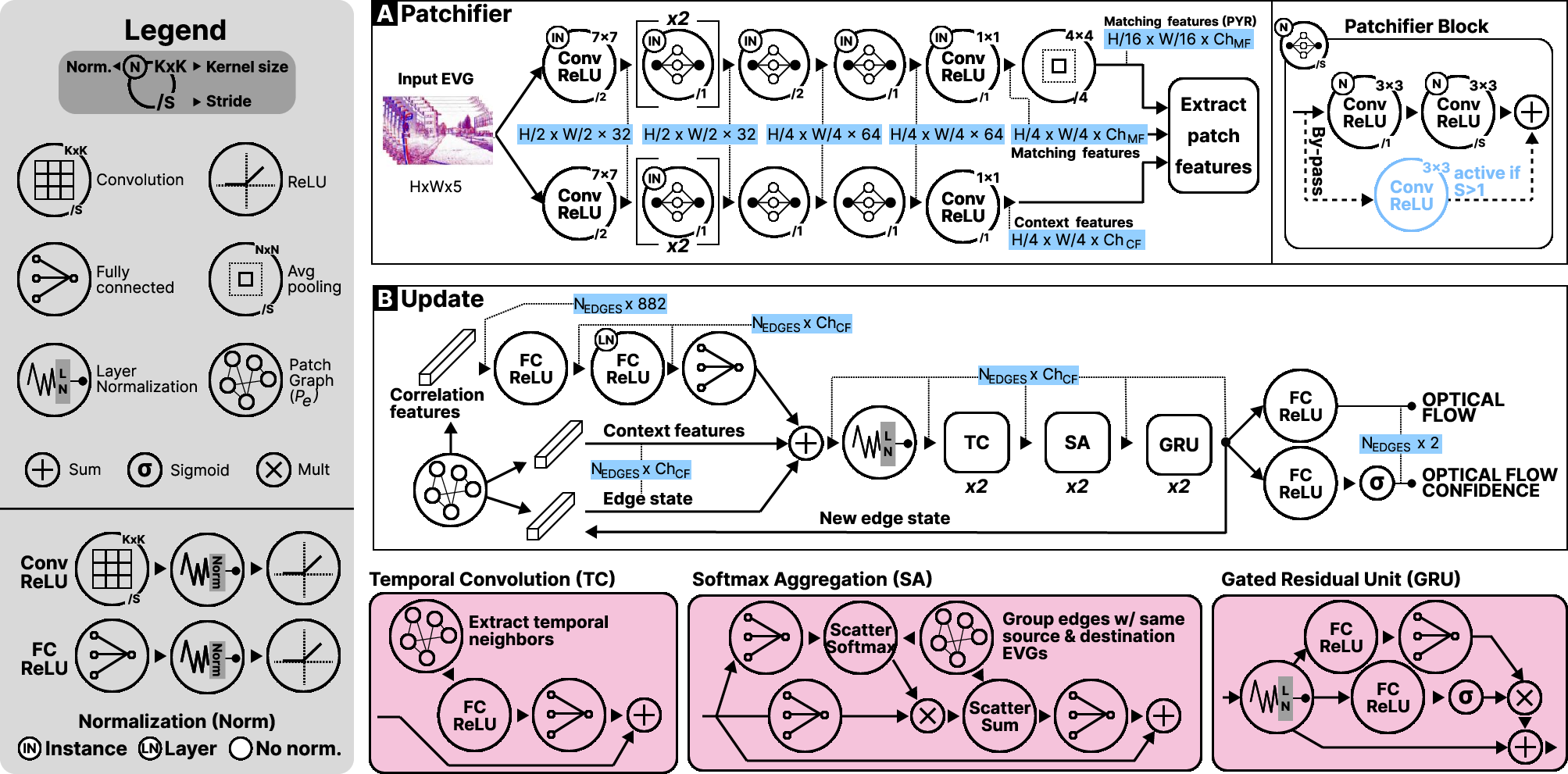
- Gated Residual Unit (GRU): A gated neural block used here in place of recurrent units to process features while mitigating vanishing gradients. "iii) two gated residual units (GRUs) that process the input tensors with FC layers, ReLUs, a sigmoid, and a by-pass connection"
- Hyperparameter Tuning: The process of selecting non-learned configuration parameters to balance accuracy and efficiency. "Thanks to our neural network architectural optimizations and hyperparameter tuning, TinyDEVO reduces the memory footprint by 11.5 (to \SI{63.8}{\mega\byte}) and the number of operations per frame by 29.7 (to \SI{5.2}{\giga MAC/frame})"
- HyperRAM: An external high-bandwidth DRAM used as L3 memory for embedded systems. "The GAP9 evaluation board provides \SI{8}{\mega\byte} of external L3 HyperRAM."
- int8 Quantization: Representing neural network weights/activations as 8-bit integers to reduce memory and accelerate inference. "We quantize the DL-based blocks, i.e., patchifier (PATCH) and update (UPD), to int8"
- Mixed-Precision Quantization: Using different numeric precisions across pipeline components to optimize accuracy-performance trade-offs. "With this mixed-precision quantization scheme, the peak memory footprint using an input size of \SI{}{\pixel} is \SI{252}{\mega\byte} for DEVO and \SI{26.1}{\mega\byte} for TinyDEVO."
- Monocular Visual Odometry (VO): Estimating camera motion (6-DoF pose) from a single visual input. "Monocular VO estimates the six degrees of freedom of a camera pose from a single visual input (\Cref{fig:intro}-A)."
- Multiply-Accumulate (MAC) Operation: A fundamental arithmetic operation in ML workloads combining multiplication and addition. "To achieve this result, DEVO requires at least \SI{733}{\mega\byte} of memory and \SI{155}{\giga \nothing} multiply-accumulate (MAC) operations per frame"
- NE16 Accelerator: A hardware accelerator on GAP9 optimized for fast int8 convolution operations. "and the NE16 accelerator for int8 and convolutions."
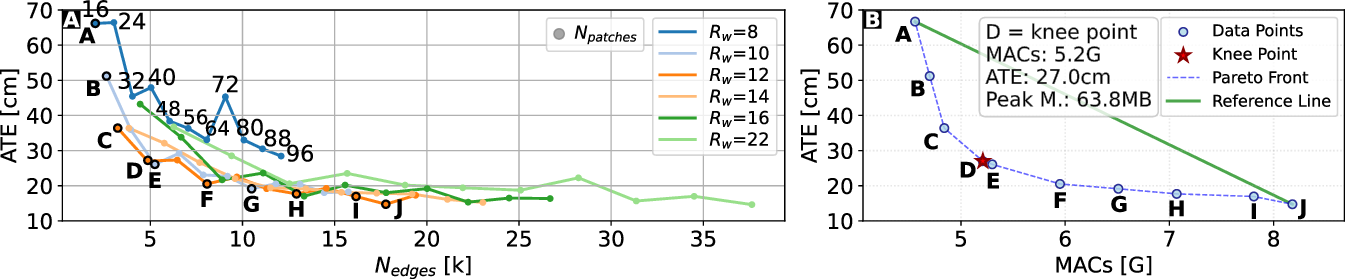
- Pareto-Optimal Points: Solutions along a trade-off curve where improving one metric worsens another, used to select balanced configurations. "the Pareto-optimal points along the ATE and $N_{\text{edges}$ trade-off curve are annotated with labels A-J."
- Patch Graph: A graph whose nodes are sampled feature patches and whose edges encode temporal correlations. "Each sampled patch becomes a node in the patch graph (), where edges correspond to pairwise dot-products between patches"
- Patch Lifetime (): The temporal span during which patches are correlated and kept for processing. "timestamps lie within a fixed temporal span called patch lifetime ()."
- Patchifier: A CNN module that extracts multi-scale matching and context features from event representations. "The patchifier, detailed in \Cref{fig:devo_block_scheme}-A, is a CNN with two branches composed of convolutional layers and by-pass connections."
- Removal Window (): The temporal window determining how many past frames are used for correlation before pruning. "to produce compact correlation features that encode camera motion over a temporal window, i.e., the removal window ()."
- RISC-V: An open instruction set architecture enabling customizable, energy-efficient CPUs in embedded systems. "We deploy TinyDEVO on an ultra-low-power (ULP) 9-cores RISC-V-based MCU"
- Scatter-Softmax: A softmax operation applied over scattered groups (e.g., edges sharing a node) to aggregate features. "ii) two softmax aggregations (SAs), which use scatter-softmax operations to combine features across edges connected either to the same patch or MF"
- SIMD (Single Instruction, Multiple Data): A parallel execution model processing multiple data elements per instruction. "All CL cores support single instruction, multiple data (SIMD) execution: a 4-lane 8-bit integer SIMD on the cores and a 2-lane 16-bit SIMD on the FPUs."
- Softmax Aggregation (SA): Aggregating features using softmax weights across edges associated with shared structures. "ii) two softmax aggregations (SAs), which use scatter-softmax operations to combine features across edges connected either to the same patch or MF"
- Temporal Convolution (TC): Operations that combine features across adjacent timestamps to model temporal dependencies. "i) two temporal convolutions (TCs), using fully connected (FC) layers to combine features from edges with adjacent timestamps"
- Temporal Optimization Window (): The time span over which bundle adjustment jointly optimizes poses and depths. "over a temporal optimization window ()."
- Umeyama Alignment: A method for estimating a similarity transform (including scale) between trajectories to resolve monocular scale ambiguity. "As monocular VO produces trajectories with an unknown scale, we applied Umeyama alignment to the ground truth before evaluation as in~\cite{klenk_deep_2023}."
- Ultra-Low-Power (ULP): Refers to systems operating under very low power budgets, suitable for wearables and micro-robots. "We deploy TinyDEVO on an ultra-low-power (ULP) 9-cores RISC-V-based MCU"
- Visual-Inertial Odometry (VIO): Motion estimation by fusing visual data with inertial measurements for robustness and accuracy. "K\"uhne~et al.~\cite{kuhne_low_2025} presented an embedded visual-inertial odometry (VIO) system, exploiting an ASIC for optical-flow computation and an ARM Cortex-A72 for VIO processing."
Collections
Sign up for free to add this paper to one or more collections.