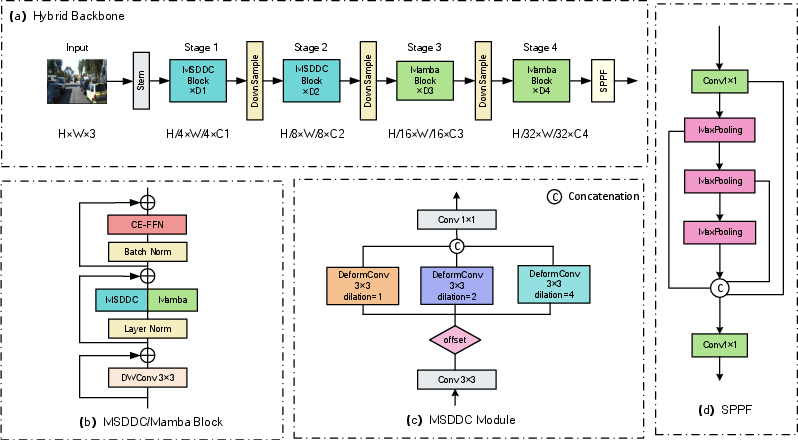
- The paper introduces MDDCNet, a hybrid framework that combines deformable dilated convolutions with state-space models to enhance multi-scale traffic object detection.
- It employs hierarchical MSDDC blocks for local detail extraction and Mamba blocks for global context modeling, achieving higher mAP and faster inference on real-world datasets.
- The architecture’s integrated attention modules and channel-enhanced feed-forward network significantly improve detection of small and occluded objects.
Introduction
The task of object detection in real-world traffic scenes, characterized by extreme scale variance, occlusions, and dense object distributions, remains highly challenging. Classic CNN-based detectors, notably the diverse YOLO variants, articulate efficiency and impressive accuracy but are fundamentally limited by the locality of convolutional receptive fields, resulting in poor global semantic modeling and unreliable detection of small or overlapping targets. Vision Transformer (ViT)–style models resolve global context with self-attention but incur prohibitive computational costs, especially for high-resolution multi-scale detection. State space models (SSMs), and specifically the recently introduced Mamba architecture, offer a scalable paradigm via linear-complexity sequence modeling, yet their flat sequential nature and limited spatial bias result in deficiencies for fine-grained local feature extraction, further weakening their performance in scenarios requiring hierarchical representations and cross-scale fusion.
This work proposes Mamba with Deformable Dilated Convolutions Network (MDDCNet), a hybrid state-space–convolutional framework designed explicitly for high-precision multi-scale traffic object detection. The model interleaves hierarchical Multi-Scale Deformable Dilated Conv (MSDDC) blocks and Mamba blocks, employs a Channel-Enhanced Feed-Forward Network (CE-FFN) for channel adaptation, and introduces an Attention-Aggregating Feature Pyramid Network (A2FPN) to drive comprehensive multi-scale fusion using contextual, spatial, and channel attention. Extensive benchmarking on KITTI and a newly collected Real-world Traffic Object Detection (RTOD) dataset provides significant empirical justification for the architecture, evidencing robust improvements over state-of-the-art detectors in both accuracy and computational efficiency.
Architecture
MDDCNet follows a hierarchical hybrid backbone–neck–head structure, synthesizing the complementary inductive biases and capacities of CNNs and SSMs. The overall architecture is shown below.
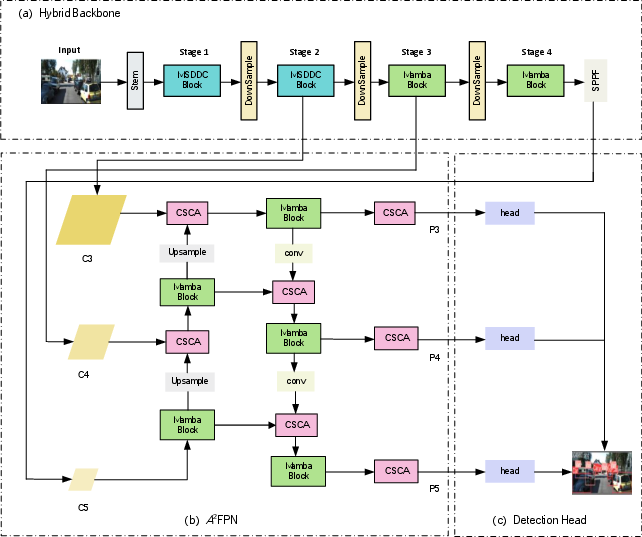
Figure 1: MDDCNet architecture integrating a hierarchical hybrid backbone, attention-aggregating feature pyramid neck, and detection head.
Hierarchical Hybrid Backbone
The network backbone is structured with four stages, employing MSDDC blocks in the shallow, high-resolution stages (1, 2) and Mamba blocks in the deeper, semantically rich, lower-resolution stages (3, 4).
Model variants (MDDCNet-N, MDDCNet-T, MDDCNet-B) adjust embedding dimensionality and depth, enabling tunable parameter/FLOP scaling for deployment tradeoffs.
Channel-Enhanced Feed-Forward Network (CE-FFN)
To mitigate the limitations of classical FFN layers (as in ViT/Mamba or even channel attention–augmented versions), CE-FFN integrates both a local branch (enhanced with CA block and residual modulation) for local feature refinement and a global branch using global average pooling and channel-wise reweighting for explicit contextual calibration.
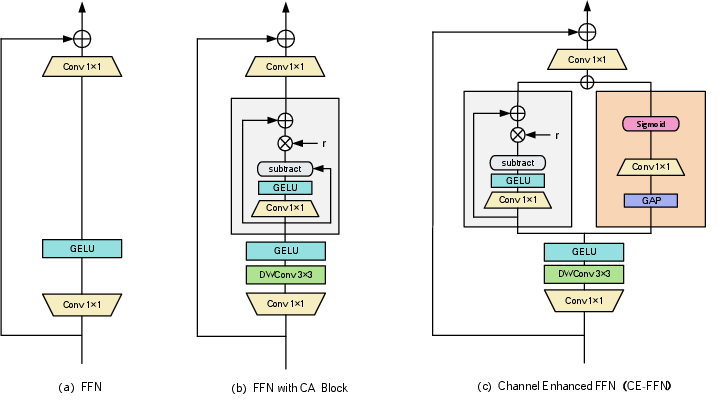
Figure 3: Schematic comparison of vanilla FFN, CA-block–augmented FFN, and CE-FFN; CE-FFN provides local-global feature synergy and dynamic channel recalibration.
Attention-Aggregating Feature Pyramid Network (A2FPN) and CSCA Module
The FPN-like neck incorporates Mamba blocks for global information propagation and the bespoke Contextual-Spatial-Channel Attention (CSCA) module for coordinated enhancement of feature maps:
- SA Branch: Localizes spatially discriminative regions, heightening response at key object locations.
- MLCA Branch: Fuses local and global channel dependency statistics, superior for retaining fine feature granularity during up/downsampling.
- SC Branch: Facilitates dynamic, scale-aware self-calibration during cross-scale interactions.
The synergistic aggregation of these forms the composite contextually-aware and cross-scale feature tensor.
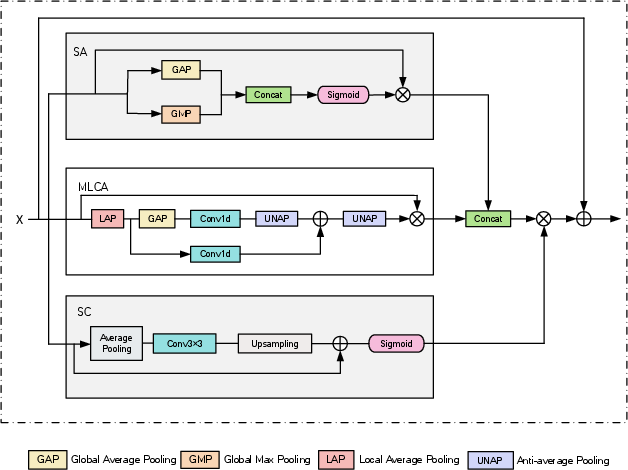
Figure 4: The CSCA synergy module, which fuses spatial, channel, and scale self-calibration attention branches for enhanced feature fusion.
Datasets
Evaluation leverages both KITTI, a canonical traffic vision benchmark with large-scale category and scale variance, and the novel Real-world Traffic Object Detection (RTOD) dataset. RTOD is constructed from urban surveillance imagery, exhibits elevated object diversity and significant annotation complexity, and includes classes such as car, van, bus, truck, person, cycle, plate, traffic light, traffic sign, etc.

Figure 5: Sample images from the RTOD dataset highlighting diverse scale and clutter typical of real-world scenarios.
Quantitative Results
MDDCNet demonstrates superior accuracy–efficiency trade-offs across all measured detectors on both datasets.
On KITTI:
- MDDCNet-T: 93.3% mAP@50; 72.3% mAP@50–95; 6.6M params; 12.9G FLOPs.
- Outperforms YOLOv8s (93.3% mAP@50) with half the computational cost, and MambaYOLO-T (91.6% mAP@50) with reduced model size and improved mAP.
- Significant gains for small-object categories (pedestrian, cyclist: up to 3% mAP improvement).
Detection performance across threshold variations is reflected in PR curve comparisons, revealing stable high-precision at high recall—a hallmark of reduced false positives and missed detections.
On RTOD:
- MDDCNet-T: 85.3% mAP@50; 61.6% mAP@50–95; 45 FPS, outperforming YOLOv8n (84.3%), YOLOv11n, and MambaYOLO-T (82.5%) with faster inference.
- Notable improvements on challenging low-resolution and small-scale categories.
- Class-wise, MDDCNet robustness is evident across extreme illumination, occlusion, and weather conditions.
PR curve analyses confirm the robustness of MDDCNet decision margins, with less collapse at higher recall rates compared to both YOLO and SSM-based baselines.
Qualitative Analysis
Qualitative comparisons, particularly against strong YOLOv13n baselines, reveal that MDDCNet consistently detects occluded, small, or distant targets under adverse visibility and scene complexity, while reducing both false negatives and false positives.
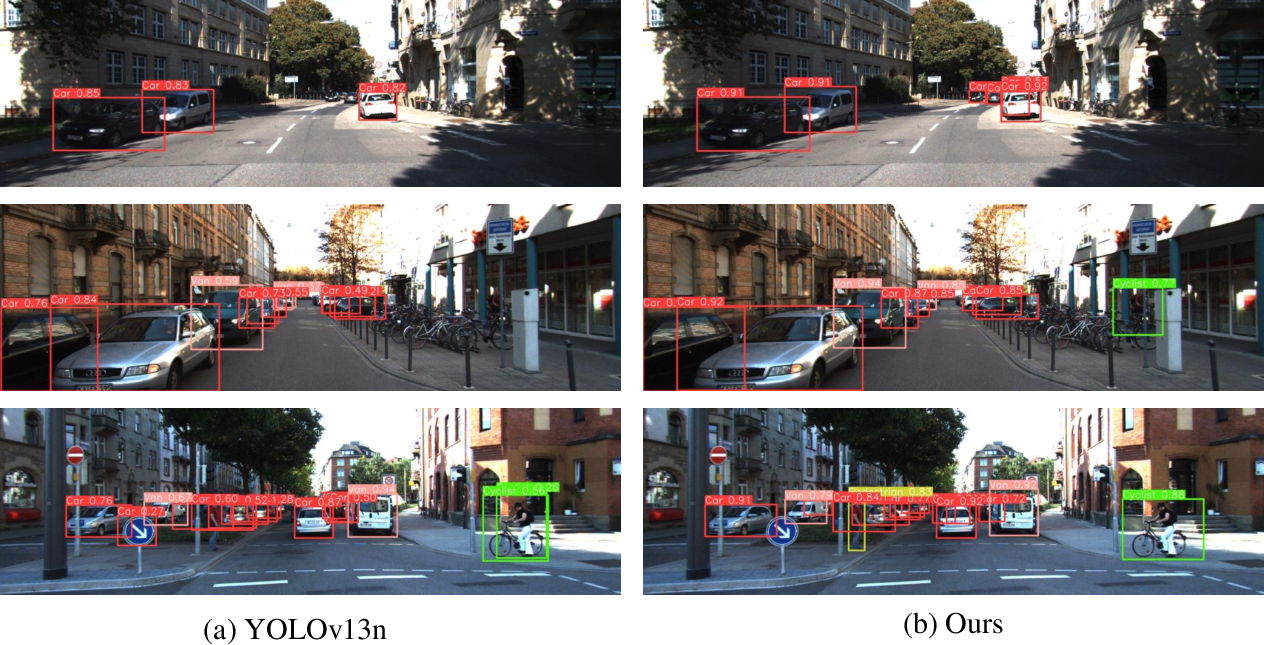
Figure 6: Qualitative comparison of YOLOv13n and MDDCNet on KITTI—MDDCNet detects distant and occluded targets more reliably with fewer misses.
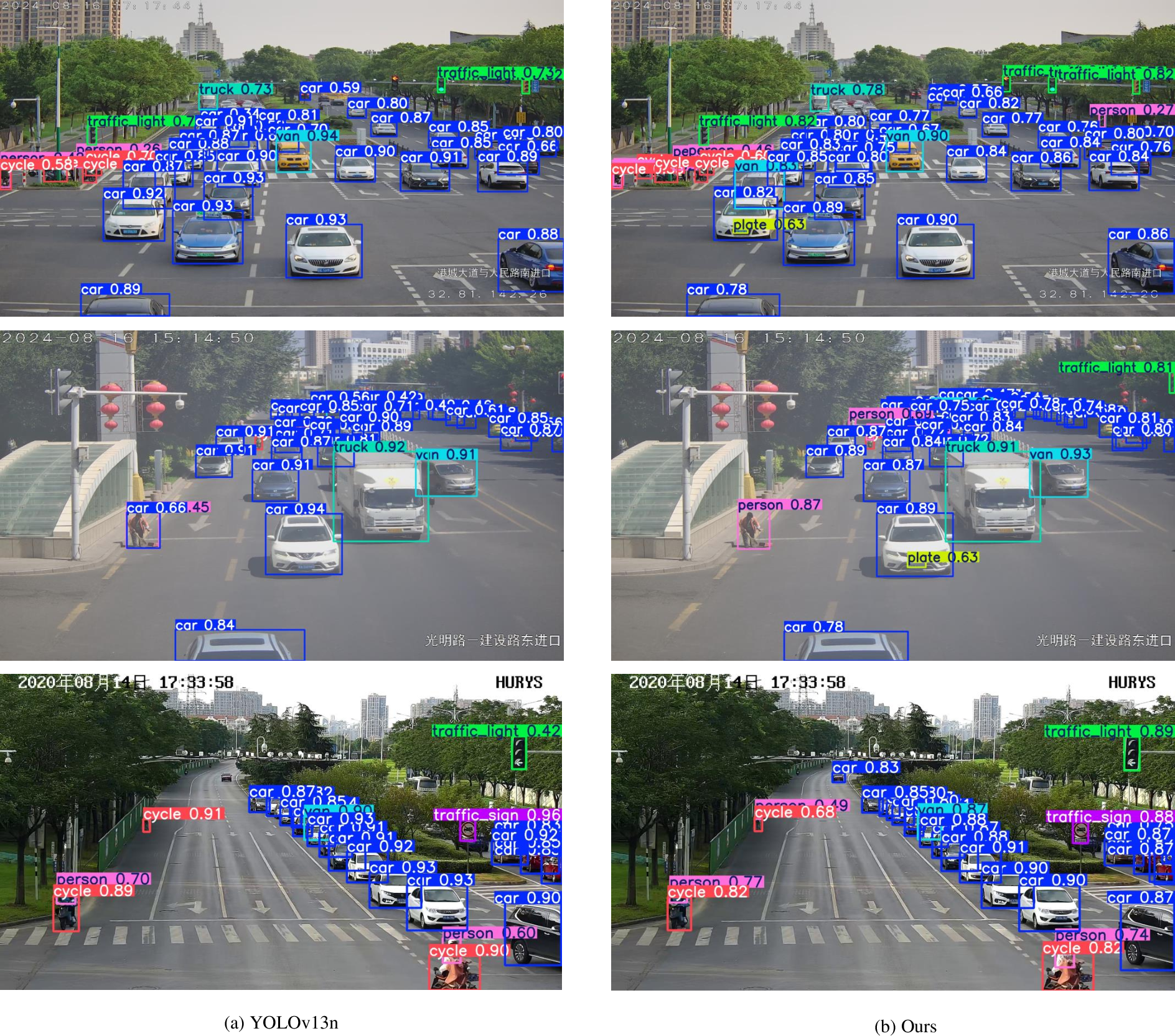
Figure 7: Qualitative comparison on RTOD—MDDCNet achieves marked gains on small objects and reduces misclassification, especially under challenging real-world conditions.
Ablation Study
Systematic ablation validates the architectural hypotheses:
- Hybridizing MSDDC with Mamba block ordering: Essential for optimizing both local detail extraction and global semantic modeling; [MSDDC, MSDDC, Mamba, Mamba] > reversed variants.
- Deformable Dilation Settings: Dilation rates of {1,2,4} in MSDDC yield optimal accuracy, balancing scale coverage.
- CSCA vs competing attentions: Aggregated context, spatial, and channel attention is necessary for cross-scale performance.
- CE-FFN superiority: Outperforms vanilla, CA, and residual/gated FFN architectures by 1%–2% mAP@50.
Comprehensive incrementality of each module is established.
Theoretical and Practical Implications
MDDCNet empirically validates the synthesis of hierarchical spatial priors (CNN), deformable geometric adaptation, and efficient state-space sequence modeling (SSM) as an optimal paradigm for traffic object detection. The demonstrated gains on small objects and occluded categories are theoretically attributable to adaptive receptive field expansion and enhanced multi-scale context flow. Practically, MDDCNet offers a blueprint for deploying highly accurate and fast object detectors in real-time scenario settings, such as urban traffic monitoring, smart infrastructure, and autonomous driving, where both scale diversity and scene clutter are the norm.
The explicit architectural choices—especially the MSDDC–Mamba–CSCA combination—set a new direction for next-generation detectors focused not merely on global–local modeling but on adaptive and interpretable cross-scale feature routing. The methodology is highly extensible to other dense prediction and visual understanding tasks, including instance segmentation, panoptic analysis, and multi-object tracking.
Conclusion
MDDCNet introduces a rigorous, scalable hybrid framework for multi-scale traffic object detection, integrating deformable dilated convolutions, selective state-space modeling, and comprehensive attention-based feature fusion. Exhaustive benchmarks reveal consistent and substantial gains in detection accuracy, particularly for small and occluded objects, with favorable efficiency profiles. The results clearly indicate that such hybridized designs, which meticulously balance global context, spatial adaptation, and hierarchical multi-scale fusion, will likely define the trajectory of future high-performance, real-world vision models.
(2604.08038)