Three-dimensional transport-induced chemistry on temperate sub-Neptune K2-18b, Part II: the combined effects of atmospheric dynamics and chemical reactions
Abstract: The upper atmospheres of temperate sub-Neptunes are strongly influenced by atmospheric dynamics due to their cool equilibrium temperature and thereby longer chemical timescales than the atmospheric dynamical timescales. In this study, we used a three-dimensional (3D) general circulation model to investigate the transport-induced disequilibrium chemistry and vertical mixing on temperate gas-rich mini-Neptunes, using K2-18b as an example. We model K2-18b assuming 180 times solar metallicity and consider it as either a synchronous or an asynchronous rotator, exploring spin-orbit resonances of 2:1, 6:1, and 10:1. We find that the vertical transport affects the chemical structure significantly, making CO$2$ and CO more abundant ($\sim$10${-3}$) in the upper atmosphere compared to the chemical equilibrium abundance (<10${-15}$), and horizontal winds further homogenize the chemical composition zonally in this region. Molecular abundances in the photosphere generally agree across different rotation periods. We employ a passive tracer in the model to estimate the one-dimensional (1D) equivalent eddy-diffusion coefficient ($K{zz}$) of K2-18b, providing a parameter useful for future 1D atmospheric models. Additionally, synthetic transmission spectra generated from our model are compared with the JWST observations, and we find that our model can provide a comparable fit to the observations. This work offers a 3D perspective on transport-induced chemistry on a temperate sub-Neptune and derives vertical mixing parameters to support 1D modelling.
Paper Prompts
Sign up for free to create and run prompts on this paper using GPT-5.
Top Community Prompts
Explain it Like I'm 14
What is this paper about?
This paper studies the “weather and chemistry” of a distant planet called K2‑18b. It asks how fast winds and up‑and‑down mixing in the air change the amounts of gases we can see with telescopes like JWST, and how those changes differ from what you’d expect if the gases were just quietly reacting without being moved around.
What are the main questions?
The authors focus on a few simple ideas:
- How does stirring by winds (both upward/downward and around the globe) change the amounts of key molecules like CO2, CO, CH4 (methane), NH3 (ammonia), and H2O (water)?
- Does the planet’s day length (how fast it spins) matter for those amounts?
- Can we estimate a single “mixing strength” number, called Kzz, that simpler 1D models can use?
- Do computer‑made “fingerprints” of the atmosphere (transmission spectra) match what JWST sees?
How did they study it? (In everyday terms)
Think of K2‑18b’s atmosphere like a giant pot of soup:
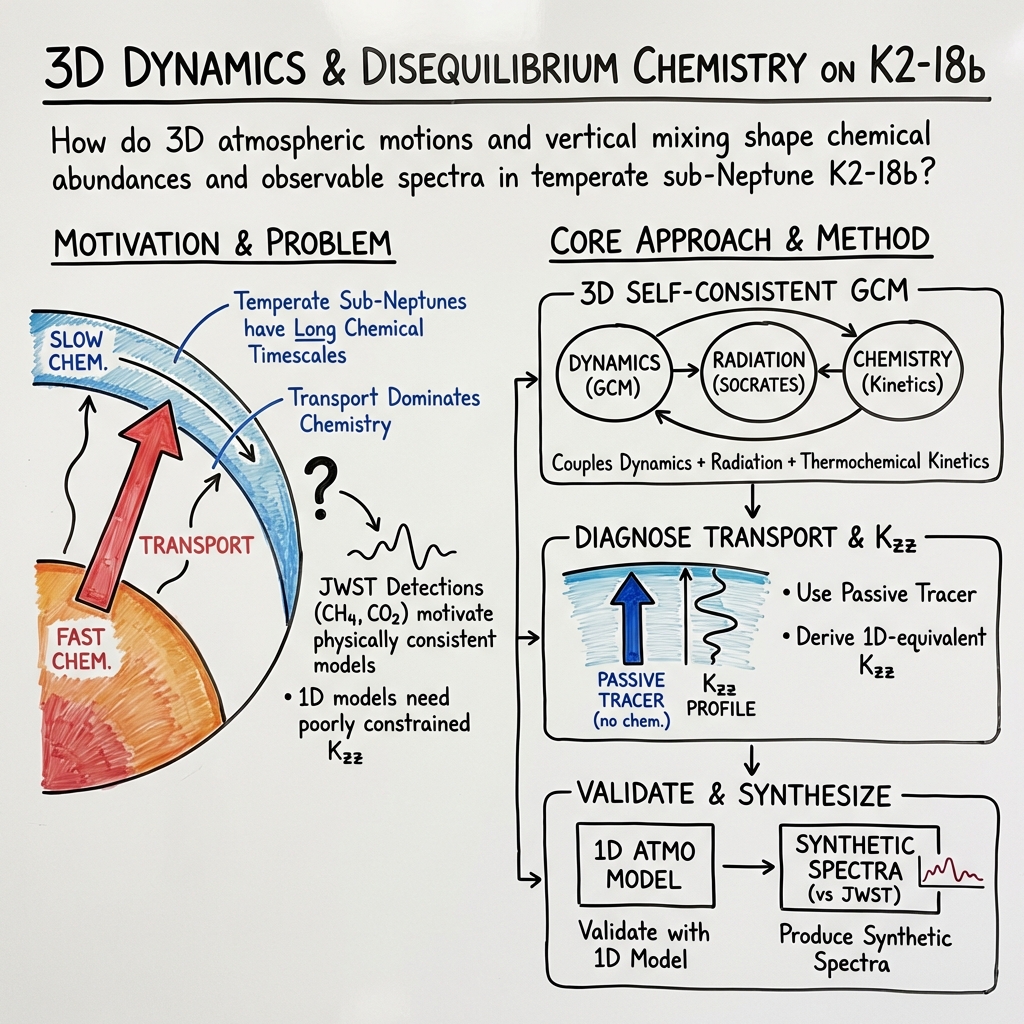
- The team used a 3D “planet weather simulator” (a general circulation model, or GCM) that calculates winds, temperatures, and how gases react.
- They “cooked” the atmosphere in two steps: first they let the winds and temperatures settle, then they turned on the chemistry so gases could react while being carried around by the winds.
- They tried different spin rates: one where the same side always faces the star (like the Moon with Earth), and others where it spins faster (2:1, 6:1, 10:1 spin‑orbit resonances). This checks if day length changes the outcome.
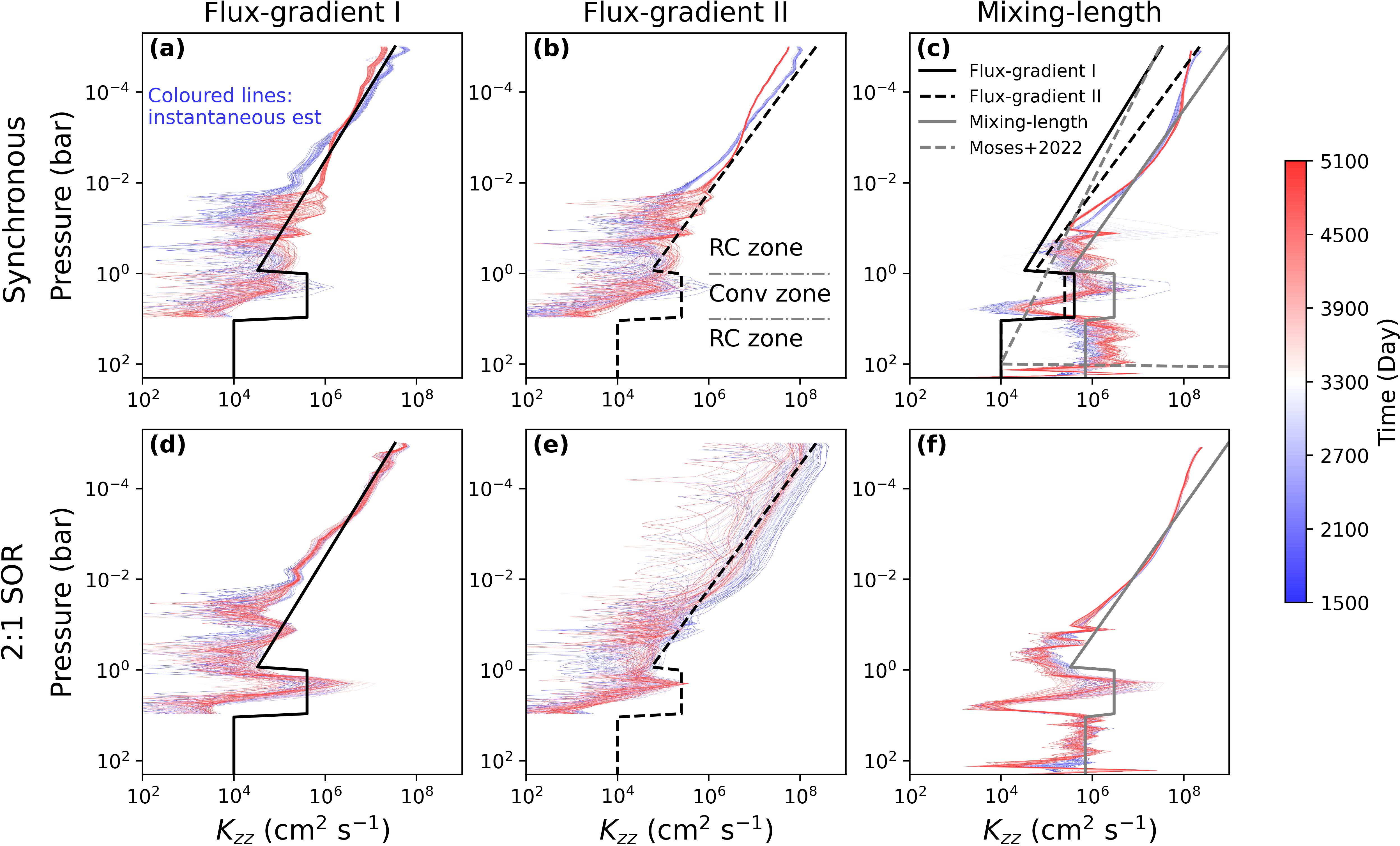
- They added a passive tracer—like dropping invisible dye into the soup—that doesn’t react, only moves with the flow. Watching where the “dye” goes tells you how strongly the air mixes. From this they estimated Kzz, which is basically “how hard the atmosphere is stirring” at different heights.
- They did not include sunlight‑driven breakup of molecules (photochemistry), so the focus is on mixing and heat‑driven reactions.
- Finally, they created synthetic transmission spectra—the rainbow‑like patterns of light filtered through the planet’s air—and compared them to JWST measurements.
A key idea they use is “quenching.” Imagine you move a ladle of warm soup up to a colder layer faster than the flavors can change. The mixture you brought up gets “stuck” as it was—its composition is “quenched.” In the atmosphere, above the quench level, reactions are too slow to keep up with the mixing, so whatever amounts were set deeper down are carried upward and “freeze in.”
What did they find, and why is it important?
Here are the big takeaways:
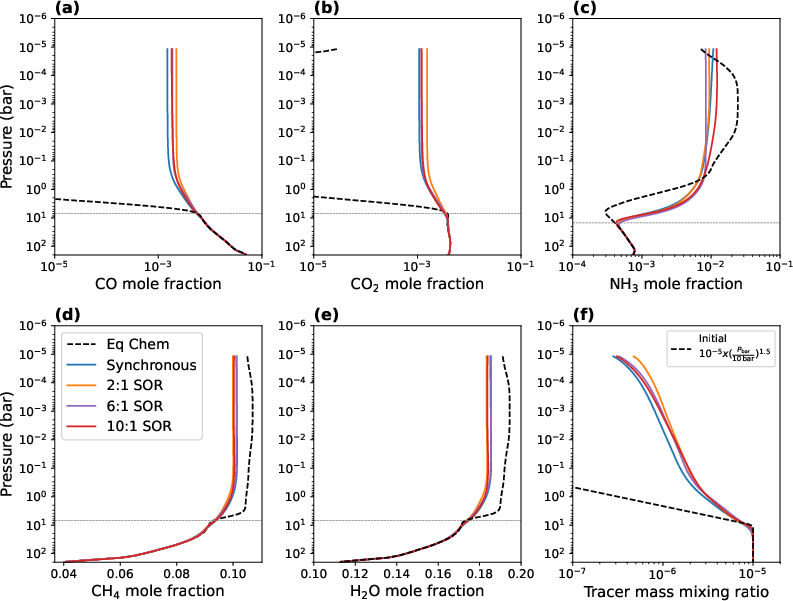
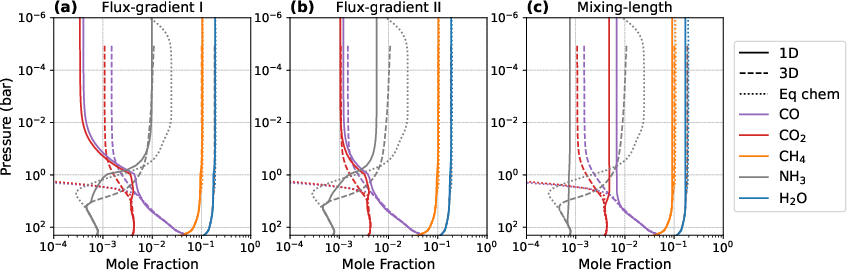
- Strong vertical mixing makes CO2 and CO much more common high up than “quiet” chemistry would predict. In chemical equilibrium, these gases would be practically absent up there (tiny, tiny amounts), but mixing lifts them from deeper layers so they reach about 0.1% by volume (~10⁻³). That’s a huge boost and it matters for what telescopes see.
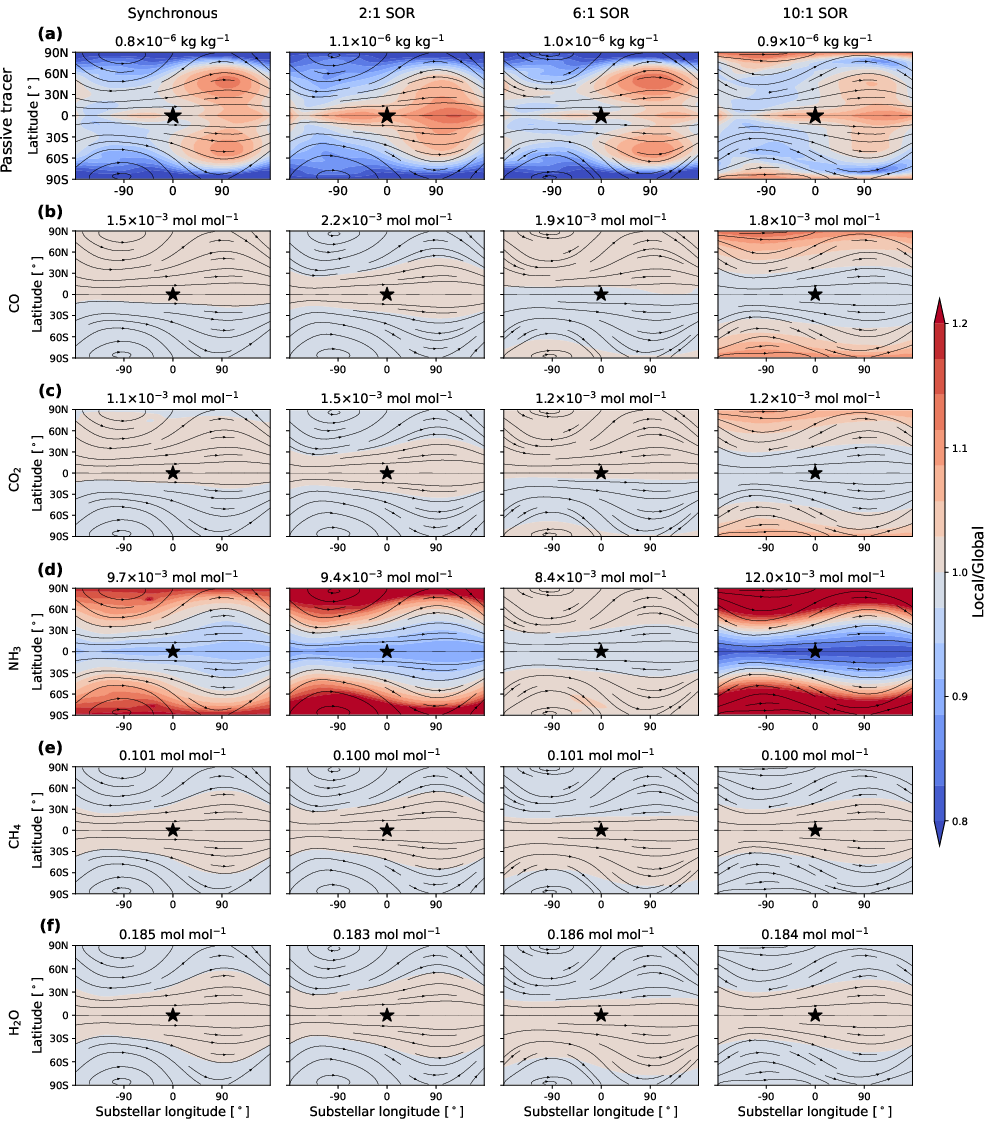
- Winds around the planet smooth out differences from place to place. In the upper atmosphere, gas amounts are fairly even along longitudes (east–west), although there can still be some north–south differences.
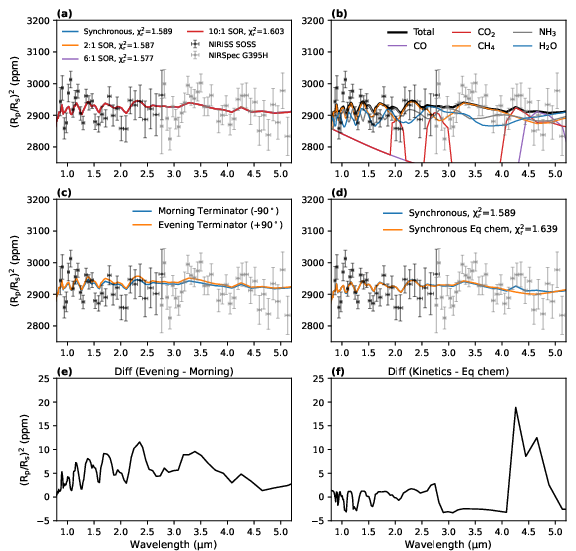
- The “photosphere” (the region most relevant for transmission spectra) looks similar across different spin rates. In other words, whether the planet is tidally locked or spins faster didn’t change the observable gas amounts very much in their runs.
- Quench levels:
- CO, CO2, CH4, and H2O “freeze in” around ~7 bar (a pressure deeper than the visible edge).
- NH3 quenches deeper, around ~15 bar.
- Compared to equilibrium:
- NH3 tends to be lower in the upper layers because mixing moves it downward from where it would otherwise build up.
- CH4 and H2O are only slightly reduced.
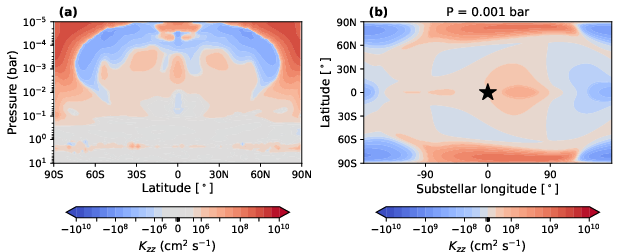
- They provide an estimated Kzz profile (how strongly the air stirs at different heights). This is very useful for 1D models that can’t simulate full 3D winds but still need realistic mixing.
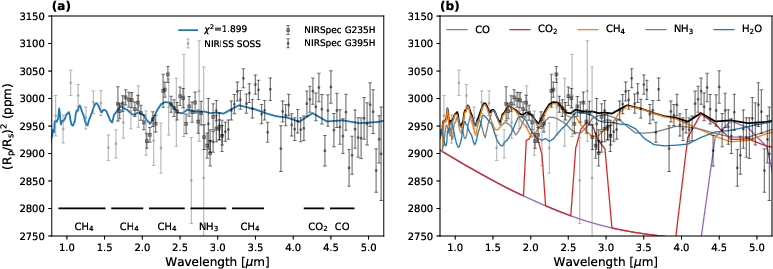
- Their synthetic spectra can match JWST observations reasonably well, showing that including 3D mixing and “quenched” chemistry can explain the detected gases.
Why this matters:
- It shows that on a temperate mini‑Neptune like K2‑18b, transport (stirring by winds) controls much of what we see, especially high up where reactions are slow.
- It helps explain why JWST can detect gases like methane and carbon dioxide together—and why ammonia might be hard to see—without needing to assume exotic scenarios.
- It gives the community better Kzz values, making simpler 1D models more trustworthy when exploring many possible planets.
What are the broader implications?
- Interpreting exoplanet atmospheres needs 3D thinking. Winds can carry gases faster than they can react, reshaping the “chemical fingerprint” that telescopes observe.
- Uncertainty in the planet’s precise rotation state may not drastically change what we can see, at least for the main gases in the photosphere.
- This work supports using transport‑induced chemistry to make sense of JWST data on temperate sub‑Neptunes and to narrow down what these worlds are like inside.
- Next steps include adding photochemistry (sunlight‑driven reactions) and clouds/hazes, which could further change the uppermost layers. But even without those, the study shows that mixing alone can have a big impact on observations.
Knowledge Gaps
Knowledge gaps, limitations, and open questions
The study advances 3D transport-induced chemistry for K2-18b, but several aspects remain missing or uncertain. Addressing the points below would make the results more robust and broadly applicable:
- Photochemistry excluded: UV-driven pathways (e.g., CH4, NH3, HCN, CO/CO2 cycling) and photochemical haze formation are not modeled, despite M-dwarf UV activity likely dominating upper-atmosphere chemistry and affecting the claimed ~10-3 CO/CO2 at low pressures and the transmission spectrum.
- Stellar spectrum uncertainty: Irradiation uses the MUSCLES GJ 176 SED rather than K2-18’s measured spectrum (including UV and flare statistics), leaving the sensitivity of thermal inversions, quench levels, and disequilibrium abundances to the true stellar SED unquantified.
- No condensation, clouds, or hazes: Neglect of condensation and cloud/haze microphysics omits potential radiative, dynamical, and chemical feedbacks (e.g., H2O/NH3 removal, latent heating, altered shortwave heating), which may reshape circulation and the inferred and spectra.
- Reduced chemical network constraints: The 30-species Venot-reduced scheme excludes larger C–N–O complexity and all S/P chemistry; its accuracy at 180× solar metallicity and in the cool, transport-dominated regime (without photolysis) for NH3/HCN/CO2/CO remains to be validated against the full network.
- Species-independent : The “equivalent” is diagnosed with a passive, long-lived tracer and applied as a single scalar field, but real species experience species- and pressure-dependent effective mixing due to finite chemical timescales; how to translate 3D transport into species-specific 1D profiles is unresolved.
- Terminator-specific mixing: The derived is global-mean; terminator-region —most relevant to transmission spectra—and day/night or morning/evening limb differences (noted ~20% tracer contrast) are not provided.
- Horizontal mixing parameters: No terminator-appropriate horizontal mixing coefficients (e.g., ) are supplied for 1D/2D models, despite demonstrated zonal/meridional transport that can homogenize species at low pressures.
- Convergence and timescales: Integration length (~5,100 days) may not exceed the longest advective or mixing times at the lowest pressures; quantitative convergence tests for tracer/chemistry (especially above the photosphere) are not reported.
- Resolution near quench levels: The 5–10 bar region, where quenching occurs, has coarse vertical resolution (~1 bar spacing). The paper flags that meridional temperature contrasts (and thus CO/CO2 quenched gradients) may be artifacts—convergence with higher vertical resolution is needed.
- Bottom and top boundary conditions: The 200 bar lower boundary may exclude deeper quench levels under other parameter choices; the ~1 Pa upper boundary precludes thermospheric/ion chemistry and escape processes that could interact with photolysis and alter upper-atmosphere abundances.
- Rotation/orbital parameter space: Only 1:1, 2:1, 6:1, and 10:1 spin–orbit resonances with zero obliquity/eccentricity are explored; the effects of non-zero obliquity, eccentricity, or other plausible resonances (e.g., 3:2) on transport and quenching remain open.
- Internal heat flux sensitivity: A fixed internal temperature (60 K; 3.7 W m-2) is assumed; the impact of uncertain internal heat on deep convection, quench levels, and is not assessed.
- Composition parameter space: Simulations fix solar C/O (0.55) and 180× solar metallicity tuned to earlier data; the sensitivity of transport, quenching pressures, and spectra to C/O and metallicity variations (including those favored by newer JWST analyses) is not explored.
- CO non-detection tension: The model predicts CO/CO2 enhancements to ~10-3 at low pressures, yet recent JWST results report a non-detection of CO; potential resolutions (photochemistry, different C/O, metallicity, clouds/hazes) are not investigated within this 3D framework.
- Radiative transfer and opacities: Only H2O, CH4, NH3, CO2, and CO opacities (plus CIA and Rayleigh) are included; missing absorbers/continuum (e.g., HCN, C2Hx, S-bearing species, haze optical properties) may bias heating rates and inferred inversions.
- Spectral comparison methodology: “Comparable fit” to JWST is reported without a formal statistical framework (e.g., instrument-forward modeling, Bayesian evidence, parameter posteriors); the discriminating power of the 3D model versus alternative scenarios remains unquantified.
- Time variability: Potential temporal variability (e.g., due to waves, transient eddies, or stellar activity) in terminator composition/temperature is not characterized, though such variability could imprint on time-averaged transmission spectra.
- Dynamical parameterization sensitivity: The UM convection and mixing parameterizations, calibrated for H2 atmospheres but not necessarily for 180× solar metallicity, are not stress-tested; sensitivity of circulation and to convection scheme choices is unassessed.
- Coupling between chemistry and dynamics: While mean-flow dominates vertical tracer fluxes here, the roles of waves/transient eddies might grow with different parameters (e.g., clouds, photochemistry); a mechanistic decomposition across cases is not provided.
- Model-to-retrieval interface: Guidance on how to ingest the provided into 1D kinetics–transport retrievals (e.g., pressure range, limb weighting, species-specific corrections) is limited; best practices for consistent 3D-to-1D translation are not established.
Glossary
- Arakawa C grid: A specific staggered grid arrangement for numerical fluid dynamics used to discretize atmospheric equations. "on an Arakawa C grid"
- Asynchronous rotator: A planet whose rotation period does not match its orbital period (i.e., not tidally locked). "consider it as either a synchronous or an asynchronous rotator"
- Atmospheric scale height: The characteristic height over which atmospheric pressure decreases by a factor of e; often denoted by H. "(H2/K_{zz}H$</sup> is the atmospheric scale height)"</li> <li><strong>Chemical equilibrium</strong>: A state where chemical reaction rates balance and species abundances no longer change with time. "chemical equilibrium abundance"</li> <li><strong>Chemical kinetics–transport model</strong>: A model that couples time-dependent chemical reactions with atmospheric transport processes in one or more dimensions. "1D chemical kineticsâtransport model"</li> <li><strong>Collision-induced absorption</strong>: Absorption of radiation arising from transient dipoles during molecular collisions (e.g., H2–H2, H2–He) in dense gases. "H$_2_2$ collision-induced absorption"</li> <li><strong>Correlated-k radiative transfer</strong>: A numerical technique that accelerates radiative transfer by sorting opacities into cumulative distributions within spectral bands. "two-stream correlated-k radiative transfer model SOCRATES"</li> <li><strong>Detached convective zone</strong>: A convective layer separated from deeper convection by a radiative layer, often caused by strong absorption higher in the atmosphere. "a detached convective zone between 1 and 5~bar"</li> <li><strong>DLSODES solver</strong>: A stiff ordinary differential equation solver commonly used for large chemical kinetics systems. "using the DLSODES solver"</li> <li><strong>Eddy diffusion coefficient (Kzz)</strong>: A parameter representing the effective vertical mixing by turbulent and wave-driven processes in a 1D framework. "eddy diffusion coefficient ($K_{zz}$)"</li> <li><strong>Equatorial superrotating jets</strong>: Fast eastward winds at the equator resulting in net angular momentum transport and strong longitudinal advection. "equatorial superrotating jets"</li> <li><strong>Equilibrium temperature</strong>: The temperature a planet would have if it were in radiative balance with its stellar irradiation, ignoring internal heat and greenhouse effects. "cool equilibrium temperature"</li> <li><strong>General circulation model (GCM)</strong>: A 3D numerical model that solves the atmospheric equations of motion and energy to simulate climate and circulation. "three-dimensional (3D) general circulation model"</li> <li><strong>Gibbs energy minimisation</strong>: A method to compute chemical equilibrium compositions by minimizing the system’s Gibbs free energy. "using the Gibbs energy minimisation"</li> <li><strong>Heliocentric frame</strong>: A coordinate frame fixed relative to the star (substellar point fixed), useful for interpreting day–night patterns on tidally influenced planets. "In the heliocentric frame (with the substellar point fixed at 0$^\circ^\circ$ longitude)"</li> <li><strong>Hycean world</strong>: A hypothesized class of exoplanets with H2-rich atmospheres and potential global liquid water oceans. "classifying them as `Hycean worlds'"</li> <li><strong>Meridional wind</strong>: North–south (latitudinal) component of atmospheric flow; drives poleward heat and tracer transport. "meridional wind is characterised by an equator-to-pole circulation"</li> <li><strong>Non-hydrostatic equations</strong>: Full atmospheric equations of motion that do not assume vertical hydrostatic balance, allowing vertically accelerated motions. "solves the non-hydrostatic equations of motion"</li> <li><strong>Passive tracer</strong>: An advected scalar that does not affect dynamics or radiation and is used to diagnose transport. "We employ a passive tracer"</li> <li><strong>Photochemistry</strong>: Chemical reactions initiated by photon absorption, significant in upper atmospheres exposed to UV. "photochemistry alters the abundances of chemical species."</li> <li><strong>Photosphere</strong>: The pressure level(s) from which most observed photons emerge in transmission or emission spectra. "Molecular abundances in the photosphere"</li> <li><strong>Pseudo-equilibrium</strong>: A state where a subset of reactions or species maintains an approximate equilibrium with another under given conditions. "is in pseudo-equilibrium with CO"</li> <li><strong>Quench level</strong>: The pressure level where chemical and mixing timescales are equal; above it, abundances are “frozen” by transport. "The level where $\tau_\mathrm{chem} = \tau_\mathrm{mix}$ is generally referred to as the quench level"</li> <li><strong>Quenching approximation models</strong>: Models that assume species abundances become constant above the quench level due to fast transport. "quenching approximation models"</li> <li><strong>Radiative-convective-equilibrium model</strong>: A 1D atmospheric model balancing radiative and convective energy transport to produce steady-state temperature profiles. "1D radiative-convective-equilibrium model ATMO"</li> <li><strong>Rayleigh scattering</strong>: Elastic scattering of light by particles much smaller than the wavelength, producing strong blue-wavelength scattering. "the Rayleigh scattering due to H$_2$ and He"</li> <li><strong>Runaway greenhouse</strong>: A climate feedback where increased greenhouse warming leads to rapid heating, potentially boiling oceans or producing supercritical conditions. "runaway greenhouse state"</li> <li><strong>Semi-implicit semi-Lagrangian scheme</strong>: A numerically stable and efficient time-integration and advection scheme widely used in weather/climate models. "semi-implicit semi-Lagrangian scheme"</li> <li><strong>SOCRATES</strong>: A radiative transfer code implementing correlated-k methods for atmospheric modeling. "the two-stream correlated-k radiative transfer model SOCRATES"</li> <li><strong>Spin–orbit resonance</strong>: A rotational state where the spin period is a rational ratio of the orbital period (e.g., 2:1). "spin-orbit resonances of 2:1, 6:1, and 10:1"</li> <li><strong>Sub-Neptune</strong>: An exoplanet class smaller than Neptune, typically with radii between ~1.7–3.5 Earth radii. "Sub-Neptunes, defined as planets with radii between 1.7 and 3.5 R$_\oplus$"</li> <li><strong>Substellar point</strong>: The point on a planet directly beneath the star (local noon), often used to define day–night geometry. "the substellar point fixed at 0$^\circ^\circ$ latitude"</li> <li><strong>Supercritical phase</strong>: A fluid state above the critical point where distinct liquid and gas phases do not exist. "resulting in a supercritical phase"</li> <li><strong>Synchronous rotator</strong>: A tidally locked body whose rotation period equals its orbital period, keeping the same face toward the star. "assuming K2-18b is a synchronous rotator"</li> <li><strong>Terminator</strong>: The dividing line/region between day and night sides on a planet, important for transmission spectroscopy. "evening (90$^\circ$ substellar longitude) and morning terminators"</li> <li><strong>Thermal inversion</strong>: A layer where temperature increases with altitude, often due to strong absorption of stellar radiation aloft. "a thermal inversion above 5%%%%12$^\circ$13%%%%~bar"
- Transport-induced disequilibrium chemistry: Departures from equilibrium abundances caused by atmospheric mixing being faster than chemical relaxation. "transport-induced disequilibrium chemistry"
- Transmission spectra: Wavelength-dependent transit depths probing atmospheric composition along the planet’s limb during transit. "synthetic transmission spectra"
- Tidal synchronisation timescales: Timescales over which tidal torques adjust a planet’s spin state toward synchronous rotation. "their tidal synchronisation timescales may be long"
- Vertical mixing: Upward and downward transport of heat and tracers by convection, waves, and turbulence. "vertical mixing"
- Vertical transient eddies: Time-varying eddies that transport momentum, heat, or tracers vertically. "strong vertical transient eddies"
Practical Applications
Immediate Applications
The study’s 3D transport–chemistry modeling of K2-18b yields actionable outputs and workflows that can be deployed now across research, observation planning, and software development.
- Improve retrieval accuracy with 3D-informed priors and parameterizations
- Use case: Constrain 1D retrievals by importing the paper’s equivalent eddy diffusion coefficient (Kzz) profile and quench levels (∼7 bar for CO/CO2/CH4/H2O; ∼15 bar for NH3), and by adopting disequilibrium-informed expectations (e.g., CO/CO2 ≈ 10⁻³ above ∼0.1 bar; NH3 depleted relative to equilibrium).
- Sectors: Academia (exoplanet atmosphere retrievals), software (retrieval/modeling packages).
- Tools/products/workflows: Add Kzz(P) and quench-level constraints as priors in CHIMERA, TauREx, NEMESIS, petitRADTRANS, ATMO, PLATON; incorporate simple quenching modules for CO/CO2/CH4/NH3/H2O; provide “3D-to-1D priors” option in retrieval GUIs.
- Assumptions/dependencies: Results assume 180× solar metallicity, solar C/O, no photochemistry or condensation/clouds, a reduced chemical network, and an M-dwarf spectrum (GJ 176 proxy). Kzz and quench pressures may shift with metallicity, UV flux, and aerosols.
- Streamline observation planning and instrument mode selection
- Use case: Prioritize wavelength regions for expected strong detections (e.g., CH4 and CO2; CO2 at 4.3 μm) and de-emphasize NH3 bands for K2-18b-like targets where transport depletes NH3 in the photosphere; account for weak sensitivity of limb-averaged abundances to rotation state.
- Sectors: Space agencies and observatories (JWST, ARIEL, ground-based NIR), observation PIs.
- Tools/products/workflows: Exposure time calculators with feature-strength inputs from the 3D model; pre-defined observing templates focused on CH4/CO2 features; decision trees that down-weight NH3 detection for temperate sub-Neptunes with strong vertical mixing.
- Assumptions/dependencies: Clouds/hazes and photochemistry not included; real UV environments may alter CH4/CO2; instrument noise floors and systematics may dominate.
- Re-interpret existing K2-18b spectra with reduced degeneracy
- Use case: Refit JWST transmission spectra using 3D-informed priors for Kzz and quenched abundances to test mini-Neptune vs. Hycean interpretations; leverage the model’s finding that zonal winds homogenize limb composition, supporting limb-averaged retrievals.
- Sectors: Academia (data analysis teams), journals (methods reporting standards).
- Tools/products/workflows: Re-run Bayesian retrievals with priors anchored to the 3D-derived Kzz and quench levels; quantify how disequilibrium shifts posteriors for CO2/CH4/NH3.
- Assumptions/dependencies: Spectral fits depend on the adopted stellar spectrum, cloud opacity, and network completeness.
- Adopt a best-practice workflow for 3D chemistry–dynamics runs
- Use case: Replicate the two-stage spin-up (fixed-opacity → kinetics-on) to reduce HPC cost and improve numerical stability for temperate sub-Neptunes.
- Sectors: HPC centers, academic modelers (global circulation model communities).
- Tools/products/workflows: Shared configuration templates for UM/SOCRATES (or analogs in Exo-FMS, THOR, MITgcm) including DLSODES settings, output sampling, and convergence criteria; checklists for long-spinup exoplanet GCM runs.
- Assumptions/dependencies: Model-dependent stability; solver performance (DLSODES) and timestep controls; portability to other GCMs.
- Exportable method: Passive-tracer-based Kzz estimation
- Use case: Apply the “deep-source passive tracer” technique to derive 1D-equivalent Kzz in other 3D models and for other planets, creating consistency between 3D and 1D frameworks.
- Sectors: Academia (atmospheric modeling), software (model coupling).
- Tools/products/workflows: A modular “Kzz-from-3D” utility that ingests 3D wind/tracer fields and outputs Kzz(P) and uncertainty; integration hooks for retrieval codes.
- Assumptions/dependencies: Requires well-resolved dynamics and long integrations; Kzz is regime-dependent and will vary with photochemistry/clouds.
- Reduce systematic error models in limb spectroscopy
- Use case: Because horizontal winds homogenize composition zonally in the upper atmosphere, simplify limb-contrast corrections in transmission analyses for K2-18b-like worlds.
- Sectors: Data reduction pipelines, instrument calibration teams.
- Tools/products/workflows: Pipeline flags that allow a “zonal homogenization” approximation; sensitivity tests that quantify the impact of residual longitudinal gradients.
- Assumptions/dependencies: May not hold for planets with strong terminator clouds/hazes or extreme photochemistry.
- Teaching and training applications
- Use case: Case-study modules on disequilibrium chemistry, quenching, and 3D–1D coupling for graduate courses in planetary atmospheres.
- Sectors: Education (universities, summer schools).
- Tools/products/workflows: Reproducible notebooks demonstrating quench-level diagnostics and Kzz estimation; schematic comparisons of 1D vs. 3D results.
- Assumptions/dependencies: Access to model outputs or simplified surrogate datasets.
Long-Term Applications
The paper’s methods and insights can be expanded with additional physics and scaled to broader target sets, informing instrument design, science policy, and cross-planet parameterizations.
- Comprehensive 3D photochemistry–cloud–dynamics frameworks for temperate sub-Neptunes
- Use case: Extend the current chemistry to include photolysis and aerosol microphysics to predict spectra and Kzz under realistic UV and cloud conditions; publish “Kzz atlases” across metallicity, C/O, gravity, and rotation grids.
- Sectors: Academia, space agencies (JWST, ARIEL, future missions).
- Tools/products/workflows: Coupled UM/SOCRATES (or equivalents) with VULCAN-like photochemistry and cloud microphysics; public grids of Kzz(P) and quenched abundances; mission planning libraries.
- Assumptions/dependencies: Requires stellar UV measurements, cloud models, and validation against multi-epoch spectra.
- Strengthened biosignature/habitability assessment protocols
- Use case: Embed transport-induced disequilibrium effects into frameworks evaluating NH3 depletion and carbon species as potential biosignatures, reducing false positives/negatives for Hycean claims.
- Sectors: Academia, science-policy bodies, mission science teams.
- Tools/products/workflows: Checklists and software that enforce 3D disequilibrium/transport checks before biosignature claims; standardized reporting of Kzz and quench-level priors in retrievals.
- Assumptions/dependencies: Interior/surface interactions (e.g., ocean or magma solubility) and cloud/UV effects must be co-modeled.
- Inform the design of next-generation instruments and missions
- Use case: Use predicted line strengths and weak rotation sensitivity of transmission spectra to optimize wavelength coverage, spectral resolution, and detector performance for temperate sub-Neptunes.
- Sectors: Industry (instrument manufacturers), space agencies.
- Tools/products/workflows: Requirements studies using 3D-informed spectra; trade-off analyses for bandpass selections (e.g., robust CH4/CO2 bands).
- Assumptions/dependencies: Generality across target class; evolving knowledge of cloud incidence and UV environments.
- Machine-learning emulators trained on 3D models
- Use case: Train surrogate models to map system parameters (e.g., g, metallicity, C/O, stellar type) to Kzz(P) and quenched abundances, accelerating retrievals by orders of magnitude.
- Sectors: Software/data science, academia.
- Tools/products/workflows: Emulator APIs that retrieval codes can call for rapid disequilibrium predictions; uncertainty-aware ML frameworks.
- Assumptions/dependencies: Needs comprehensive training datasets spanning parameter space; careful validation to avoid extrapolation errors.
- Cross-planet comparative laws for vertical mixing
- Use case: Derive scaling relationships linking circulation regimes to Kzz and quench pressures across sub-Neptunes and warm Neptunes; integrate with interior and formation models to reduce structural degeneracies.
- Sectors: Academia (planet formation and evolution).
- Tools/products/workflows: Meta-analyses of multi-planet 3D runs; empirical formulas packaged for retrievals and population studies.
- Assumptions/dependencies: Requires ensemble modeling and consistent physics across targets.
- Tech transfer to Solar System/terrestrial modeling
- Use case: Apply the passive-tracer Kzz estimation approach to improve vertical mixing parameterizations in giant-planet stratospheric models and, more speculatively, to other chemical–transport domains.
- Sectors: Planetary science (Jupiter/Saturn modeling), environmental modeling/energy (stiff chemistry solvers).
- Tools/products/workflows: Shared libraries for Kzz inference from GCMs; solver optimizations for stiff ODEs (DLSODES alternatives).
- Assumptions/dependencies: Adaptation to different chemistries and dynamical regimes; validation with in situ/remote data.
- Data standards and repositories for 3D→1D mapping
- Use case: Establish community repositories for planet-specific Kzz(P), quench levels, and disequilibrium priors consumable by retrieval codes and observation planning tools.
- Sectors: Academia, data infrastructure (archives), policy (open-data mandates).
- Tools/products/workflows: FAIR-compliant datasets; standard metadata for 3D-derived priors; integration hooks in popular retrieval packages.
- Assumptions/dependencies: Ongoing maintenance, versioning with new physics (photochemistry/clouds), community governance.
Notes on Key Dependencies Across Applications
- Physics assumptions in this study: 180× solar metallicity, solar C/O, no photochemistry or condensation/clouds, reduced reaction network, zero obliquity/eccentricity, and an M-dwarf proxy spectrum (GJ 176). Deviations from these assumptions can shift Kzz and quench levels.
- Numerical/resolution limits: Coarser vertical resolution at 5–10 bar may affect the precision of quench-level gradients; long integrations are required for convergence.
- Generality: While findings such as zonal homogenization and modest rotation sensitivity at the photosphere are robust within the tested regimes, they should be revalidated for other targets, especially under strong UV irradiation or heavy cloudiness.
Collections
Sign up for free to add this paper to one or more collections.