- The paper reports the discovery of SN 2025mkn, a Type II supernova with magnification over 100× provided by gravitational lensing from a z=0.42 elliptical galaxy.
- The study uses multi-wavelength imaging and spectroscopy, including JWST/NIRCam and NIRSpec, to resolve multiple images and confirm redshifts.
- The analysis underscores the potential for time-delay cosmography and probing SN evolution over ~9 Gyr by comparing with the local SN 2023ixf.
Discovery of the Strongly Lensed Type II SN 2025mkn at z=1.37: An Ultra-Magnified Supernova as a Natural ≳100× Telescope
Introduction
The paper presents the discovery and comprehensive analysis of SN 2025mkn, a gravitationally lensed Type II supernova at redshift z=1.371, multiply imaged by a foreground elliptical galaxy at z=0.42. This system represents the most highly magnified resolved supernova yet identified, with observed magnifications ≳100 and estimates as high as ∼250, using SN 2023ixf as an intrinsic luminosity analog. The fortuitous lensing geometry functions as a natural telescope, enabling the study of exploded massive stars at cosmologically significant lookback times. The system's configuration, with tightly split multiple images and large time delays, offers new opportunities for extragalactic SN spectroscopy and time-delay cosmography.
Observational Campaign and Detection
SN 2025mkn was discovered in the Zwicky Transient Facility (ZTF) survey as an anomalously luminous blue transient closely projected near an early-type galaxy. Follow-up classification spectroscopic observations immediately identified absorption systems at two redshifts, z=1.256 and z=1.371, greatly exceeding that of the nearby galaxy, thereby indicating foreground lensing. These redshifts were subsequently secured with ground-based spectra and confirmed with resolved spectroscopy from JWST/NIRSpec.
Subsequent JWST/NIRCam imaging resolved at least three distinct images of the supernova: the brightest image (A) near the lens, further resolved as a 2-PSF structure, and a significantly fainter counterimage (B) further out. Additionally, imaging and residual analysis revealed an extended arc from the host galaxy and a possible fourth image (C), as expected from gravitational lensing by an elliptical galaxy.
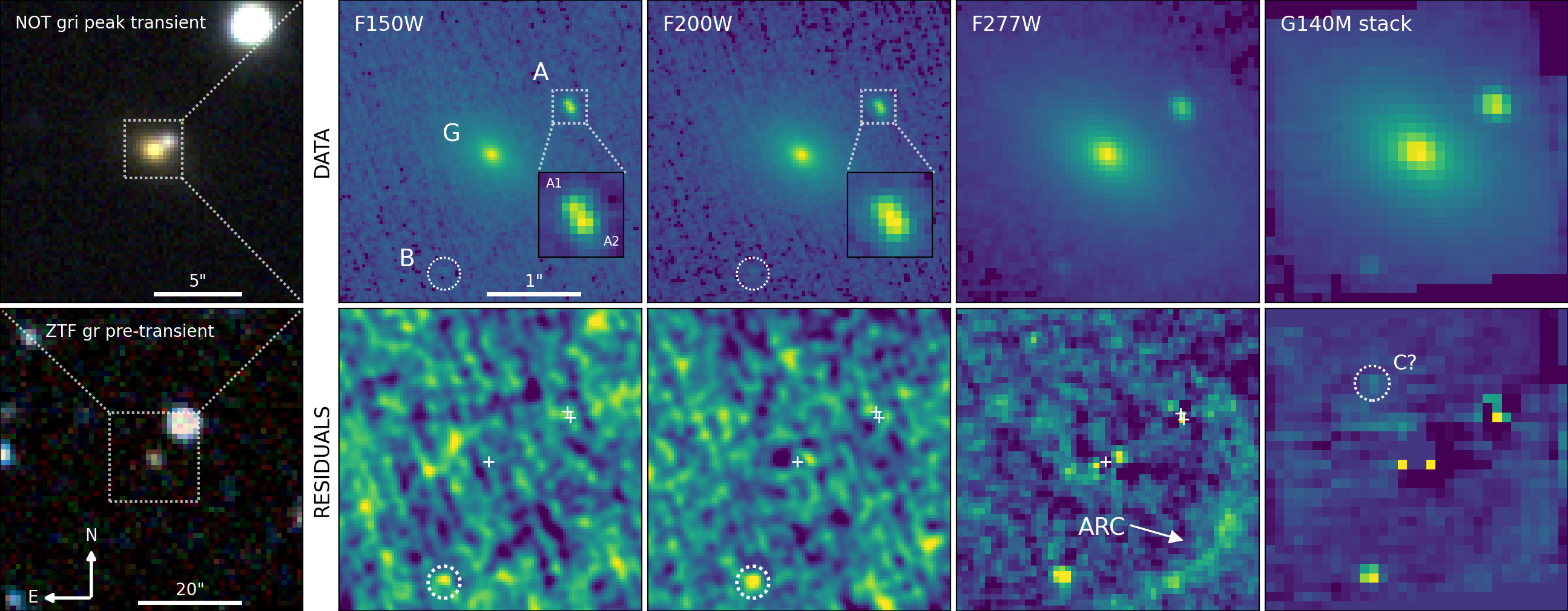
Figure 1: ZTF and NOT imaging demonstrating the appearance and location of SN 2025mkn; JWST/NIRCam and NIRSpec imaging resolves multiple lensed images and arc features associated with the SN and its host.
Photometric and Spectroscopic Properties
The photometric evolution of the primary image is consistent with a Type II plateau (or intermediate IIP/IIL) SN, matching the luminosity evolution of SN 2023ixf when redshift and time dilation are accounted for. Matching the peak observed flux for image A to the well-sampled light curve of SN 2023ixf at similar rest-frame epochs requires a lensing magnification of μA∼250, corresponding to ΔmA∼6 mag. The counterimage B is ≳100×030 times fainter, in line with lens model predictions for highly asymmetric quadruple configurations near caustic crossings.
Spectroscopy with JWST/NIRSpec reveals broad emission features (H≳100×1, H≳100×2, H≳100×3) at ≳100×4 and clear evidence for another distinct image at the predicted counterimage location with the same redshift and spectral phase characteristics, but at lower luminosity.
Lens Model and Mass Estimate
The lensing galaxy's stellar mass is estimated as ≳100×5 via SED modeling, with dynamical constraints from DESI spectroscopy yielding ≳100×6. These parameters imply an Einstein radius ≳100×7–≳100×8, in excellent agreement with the measured image separations.
Parametric modeling (singular isothermal ellipsoid plus external shear) using the resolved image positions reproduces (A1, A2, B) and predicts a fourth image (C). The source position is tightly constrained near the caustic, with images A1 and A2 straddling the critical curve, leading to the large observed magnifications.
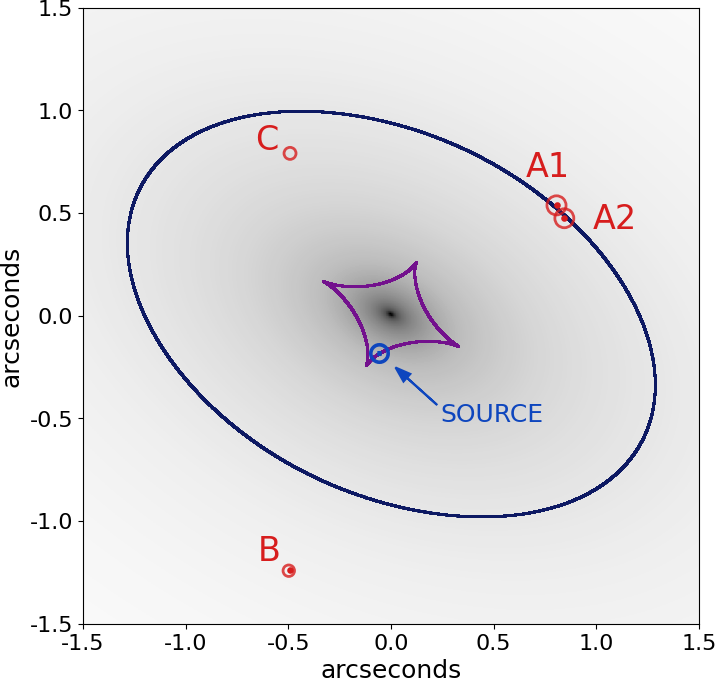
Figure 3: The gravitational lens model for SN 2025mkn, with observed and predicted image positions, caustic structure, and critical curve.
Flux Ratio Anomalies and Microlensing
The flux ratio between the primary (A1+A2) and secondary (B) images (≳100×925–30) is somewhat lower than predicted (z=1.371065) from the mass/light-aligned lens model. Additionally, the predicted fourth image (C) is not detected at the predicted brightness in the imaging. The paper demonstrates that microlensing by stars in the lensing galaxy can plausibly demagnify image C and boost B's flux via stochastic macro+micro magnification close to caustics, as expected for images formed near saddle points, consistent with theoretical work on microlensed lensed SNe and quasars. Such microlensing scenarios are found to be sufficiently probable given the best-fit macro model parameters.
Implications for Cosmography and SN Physics
Owing to the extreme magnification and resolved multiple images with sizable time delays, SN 2025mkn represents a textbook system for time-delay cosmography. While recognizing that the leading (first arriving but faintest) image was not captured photometrically, the spectroscopically resolved phases of the bright and faint images enable phase-based delay measurements, sidestepping the absence of early-time light curves. This is particularly valuable since SNe, due to their well-characterized light curves and spectral evolution, offer lower systematic uncertainties than quasar-based time delays.
Detailed comparison of the SN's spectral energy distribution—UV through NIR—at z=1.3711 with nearby analogs places constraints on the possible evolution of massive star explosions and progenitor channels over z=1.3712 Gyr. The observed consistency between SN 2025mkn and the local SN 2023ixf in both photometry and spectroscopy is notable at this redshift and addresses questions of SN population evolution.
Prospects and Future Directions
The system exemplifies the capabilities of wide-area time-domain surveys (e.g., ZTF) and rapid spectroscopic follow-up (ground-based, JWST) in discovering rare, highly-magnified transient events. Similar events will allow (i) large samples of time-delay-lensed SNe for z=1.3713 inference, (ii) ultraviolet spectroscopy of high-redshift SNe at signal-to-noise unreachable without lensing, and (iii) improved understanding of microlensing and macro model degeneracies via resolved multi-epoch photometry and spectra.
Future work will refine the lens mass model using extended arcs and lens galaxy kinematics, extract precise time delays via spectral phase retrieval, and assess the systematic uncertainties arising from microlensing, source size, and potential substructure in the lens.
Conclusion
SN 2025mkn provides an unprecedented example of a highly-magnified (z=1.3714) resolved Type II supernova, facilitating the study of SN physics, lensing mass distributions, and cosmology at high redshift. The observational approach, ground- and space-based follow-up, and combined macro-micro lens modeling described in this paper set the framework for exploiting similar systems in forthcoming time-domain surveys and for novel cosmological measurements based on lensed SNe (2604.07983).

