- The paper introduces a Karma-based mechanism that uses history-dependent credits to balance replanning costs among agents.
- It demonstrates improved task throughput and reduced service time variance on simulated warehouse grids compared to baseline protocols.
- The study reveals that tuning the Karma weight parameter τ balances immediate cost efficiency with long-term fairness in multi-agent systems.
Karma-Based Mechanisms for Decentralised Cooperative Multi-Agent Path Finding
Introduction and Problem Context
The paper "Karma Mechanisms for Decentralised, Cooperative Multi Agent Path Finding" (2604.07970) addresses the scalability and fairness challenges inherent to Multi-Agent Path Finding (MAPF) in decentralised robotic and cyber-physical systems. MAPF is foundational in scenarios such as warehouse automation, where agents must compute conflict-free paths under resource and communication constraints. Classic centralised solvers (e.g., CBS, ICTS, flow-based methods) guarantee optimality but are computationally prohibitive for large-scale deployments. Decentralised heuristics enhance scalability but exacerbate cost disparities and may compromise task throughput due to local information myopia.
MAPF under decentralisation is further complicated when considering lifelong task assignment, agent heterogeneity, kinematic constraints, and dynamic re-planning. The studied environment instantiates these complexities in a lifelong multi-agent pickup-and-delivery (MAPD) warehouse scenario (Figure 1), embedding kinematic constraints that reflect realistic robotic motion.
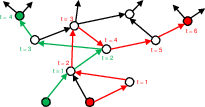
Figure 1: Schematic of the canonical MAPF problem, involving multiple agents tasked with computing conflict-free trajectories on a discrete graph.
Decentralised MAPF: Limitations of Existing Approaches
Token-passing protocols impose sequential planning which, while simplifying coordination, induces pronounced asymmetries: agents scheduled later must account for all prior trajectories, often yielding suboptimal global routes and higher costs. Negotiation-based heuristics permit dynamic, localised negotiation (egoistic or altruistic). Under the egoistic regime, an agent concedes only when its own incremental cost is non-positive, while in the altruistic case, responsibility is assigned to the agent with the smaller cost increment. While the latter policy can reduce average cost somewhat, neither guarantees balanced distribution of replanning effort nor system-wide fairness, especially over extended time horizons or under high task densities.
Karma-Based Negotiation Mechanism
This work introduces a Karma-based negotiation mechanism—a decentralised, endogenous feedback protocol augmenting conflict resolution. Each agent maintains a Karma balance ki, incremented or decremented based on conflict outcomes and replanning cost. In each bilateral negotiation, the decision to replan is governed by a composite cost function, Δi+τki, where Δi is the immediate cost for agent i and τ a system-level parameter weighting Karma's influence.
Formally,
Nkarma(Δi,Δj,ki,kj)={j,if Δj+τkj<Δi+τki i,if Δj+τkj>Δi+τki U({i,j}),otherwise
Karma is thus accrued by agents who replan, inexorably raising their effective cost in subsequent disputes, and driving balanced distribution both in the instantaneous and integrative sense. The protocol does not rely on explicit global priorities or centralized oversight and operates under minimal communication overheads.
Empirical Evaluation in MAPD Warehouse
Simulations are performed on warehouse-like grids featuring orientation-aware agents with kinematic constraints (Figure 2). The evaluation includes three grid sizes (5×5, 10×10, 15×15), variable agent densities, stochastic task generation, and lifelong operation over 100 time steps per run.
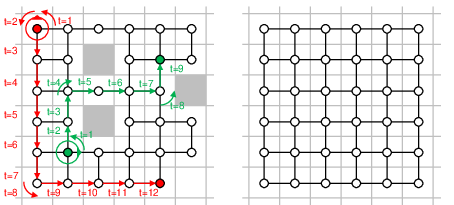
Figure 2: Lifelong MAPD warehouse scenario incorporating agent kinematics and randomised pickup-delivery assignments.
The Karma-based mechanism is benchmarked against token-passing, egoistic, and altruistic negotiations. Key metrics include the aggregate number of completed tasks, average task and service time, variance in agent costs, and cumulative computational effort (A* search calls).
Numerical Results and Analysis
The Karma-based method yields strong aggregate performance: average task and service times are on par with, or superior to, negotiation-based baselines, and markedly higher task throughput compared to token-passing across all grid sizes and agent densities. Importantly, the variance of service times—quantifying fairness—is substantially reduced under Karma, highlighting its capacity to mitigate cost disparities among agents. This is observable in the distributional statistics of task and service times (Figure 3).
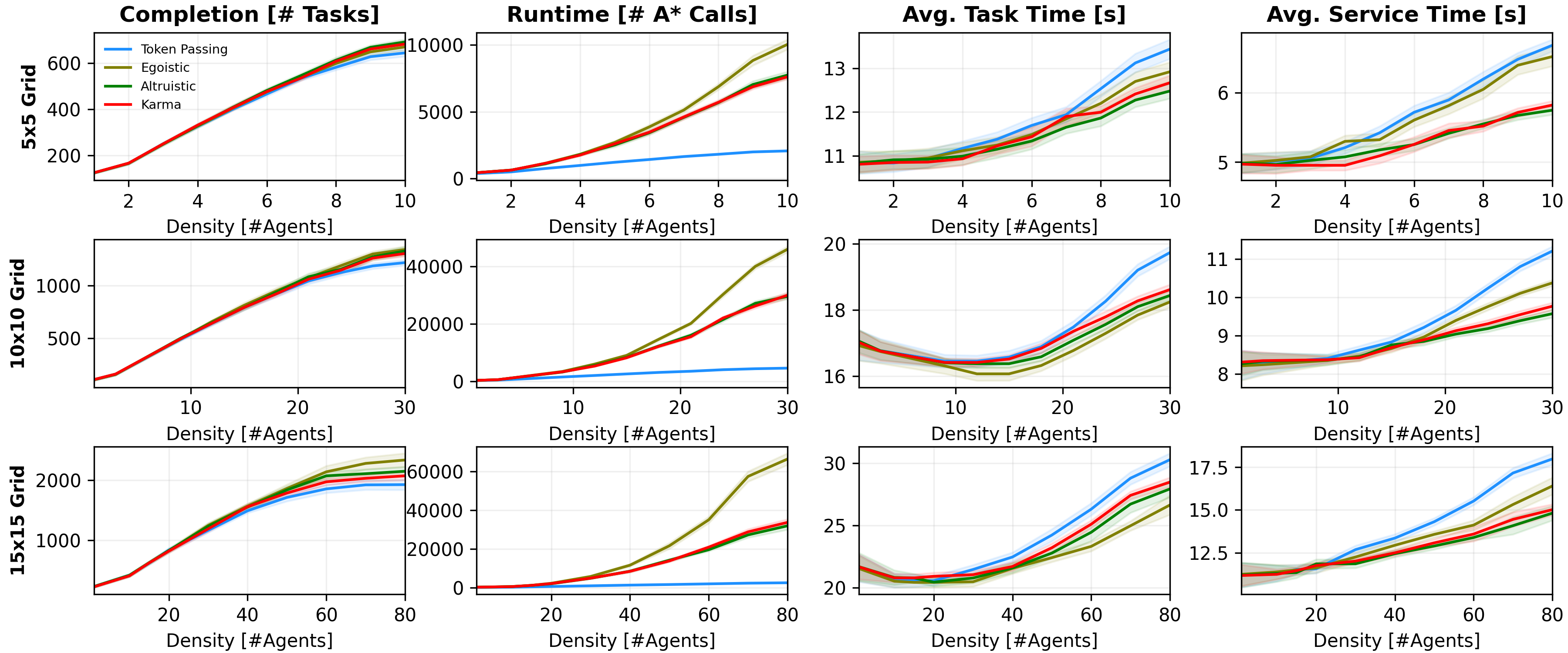
Figure 4: Comparative efficiency benchmarks for token-passing, egoistic, altruistic, and Karma-based strategies across grid sizes.
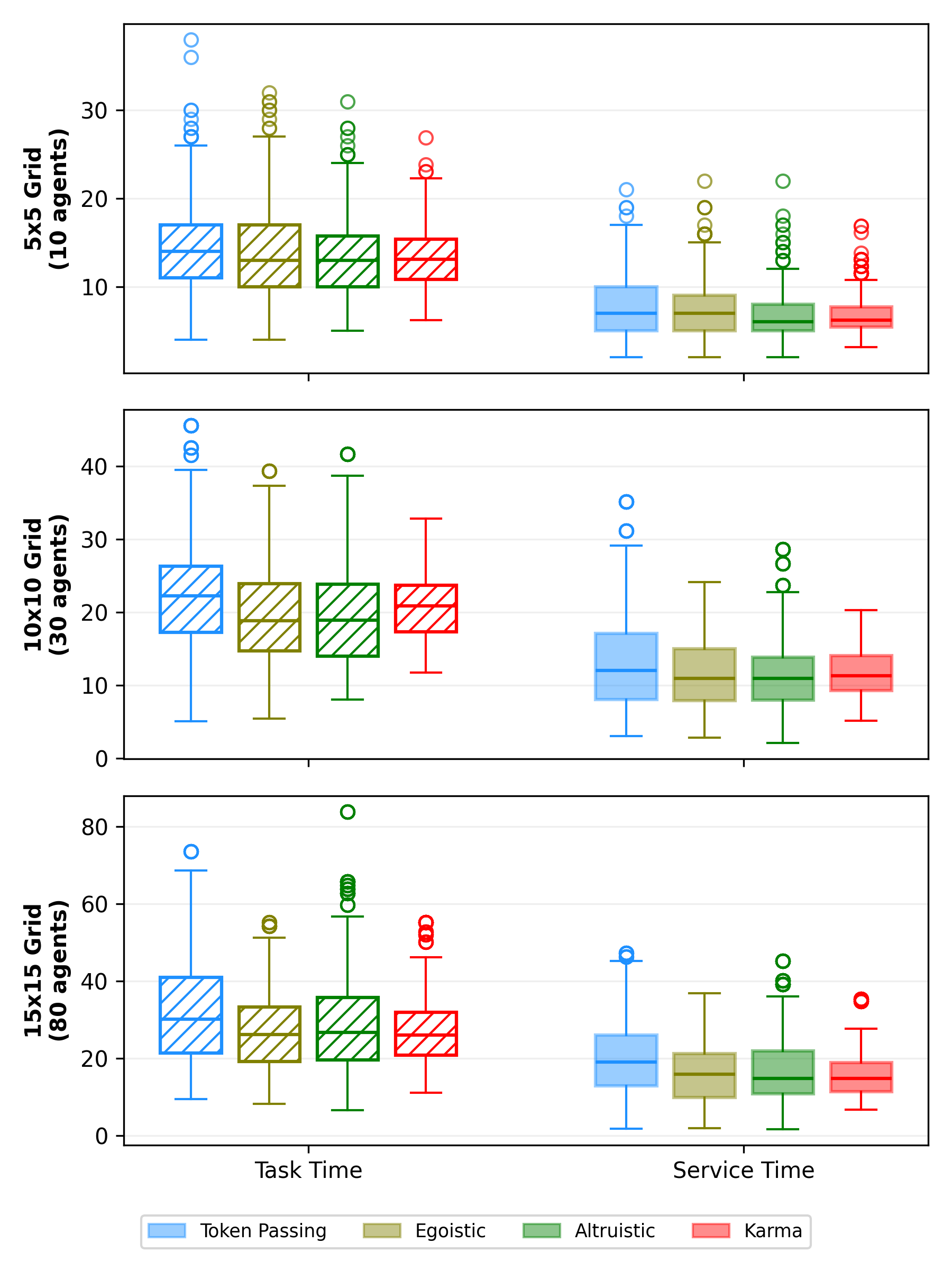
Figure 3: Task and service time distributions. Karma-based negotiation yields reduced dispersion, signifying improved fairness in load balancing.
The trade-off between average cost and cost spread is tunable via the Karma influence parameter τ (Figure 5). As Δi+τki0 increases, immediate cost optimality is softened in favor of uniformity, but excessive increase degrades aggregate performance. Empirically, Δi+τki1 offers a robust balance between mean efficiency and fairness.
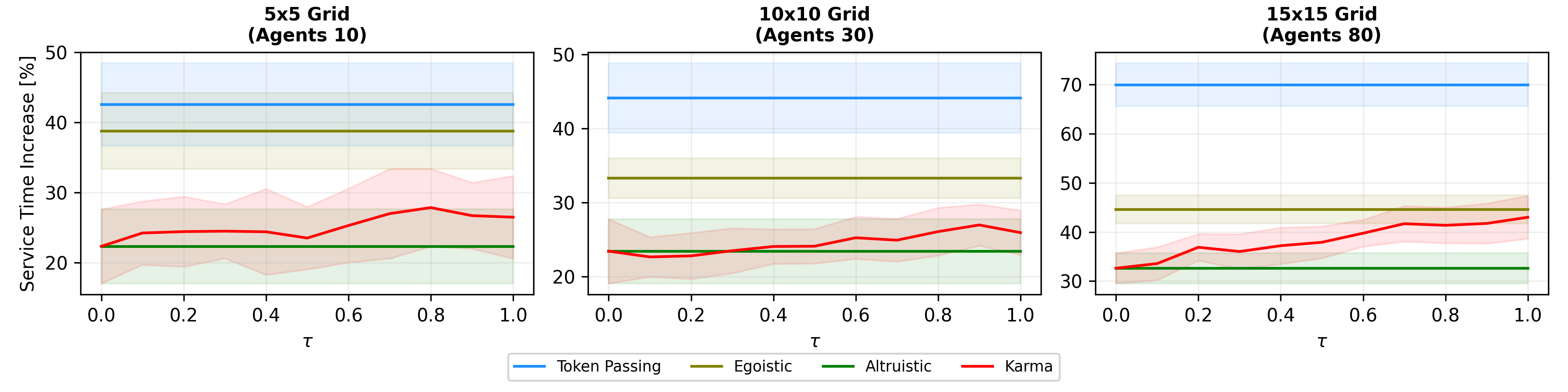
Figure 5: Impact of the Karma weight Δi+τki2 on mean service times, illustrating the tradeoff between cost efficiency and fairness.
Theoretical and Practical Implications
The Karma mechanism provides an instantiation of a distributed integral feedback controller in cooperative multi-agent systems, enabling long-term indirect reciprocity without explicit trade or global resource exchange. This architecture is inherently scalable, robust to task churn, and adaptable to varying agent heterogeneity, communication topologies, and extended task horizons.
Theoretically, these results underscore the efficacy of embedding economic incentive analogs (e.g., artificial non-tradeable credits) in large-scale decentralised control. The Karma update rule emerges as a generalizable template for enforcing fairness and balancing computational effort without the need for external regulation or omniscient supervision.
Practically, the framework is immediately applicable to multi-robot warehouse operation, multi-UAV coordination, and automated logistics, where decentralisation is a necessity due to communication, reliability, and privacy constraints.
Future Directions
Further research is warranted to analytically characterise stability and convergence of the Karma dynamics, including robustness under adversarial conditions, non-stationary environments, or partial observability. There is also scope to explore alternative Karma update rules (e.g., peer/society payments, bounded Karma, stochastic resets), and to generalise the feedback architecture for other distributed resource allocation subproblems (task assignment, dynamic prioritisation, heterogeneous agent capabilities).
Integration with auction-theoretic protocols and further analysis on communication requirements, robustness, and convergence guarantees represent promising lines for theoretical expansion.
Conclusion
The Karma-based decentralised negotiation mechanism demonstrably advances the fair scalable coordination of multi-agent systems in MAPF scenarios. By embedding history-dependent artificial credits into local conflict resolution, the approach yields equitable distributions of service times and computational effort, without compromising aggregate system performance or scalability. This aligns with broader trends toward economic mechanism design in decentralised AI, underscoring the potential of incentive-driven, history-aware protocols for robust and adaptive multi-agent planning (2604.07970).